ABOUT PROJECT
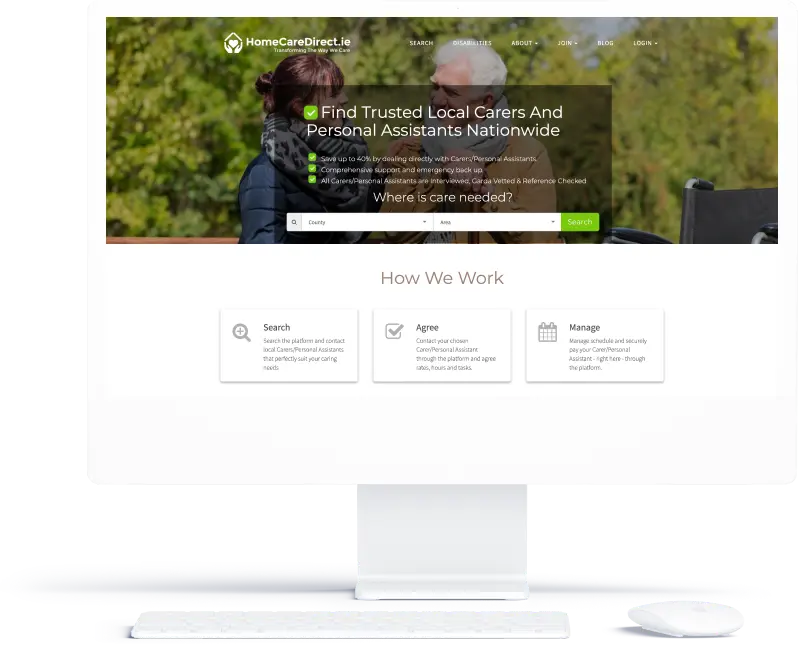
When Michael Harty and John McQuillan looked at the traditional care industry, they saw a system that was failing the very people it was meant to serve. Families were struggling to find trustworthy help for their loved ones, often left with limited options and high agency fees. Meanwhile, professional Carers and Personal Assistants – the backbone of the industry – were frequently undervalued, earning low wages while agencies took a significant cut of the funding. This disconnect inspired the founders of HomeCareDirect to build a better way: a digital marketplace built on transparency, respect, and direct connection.
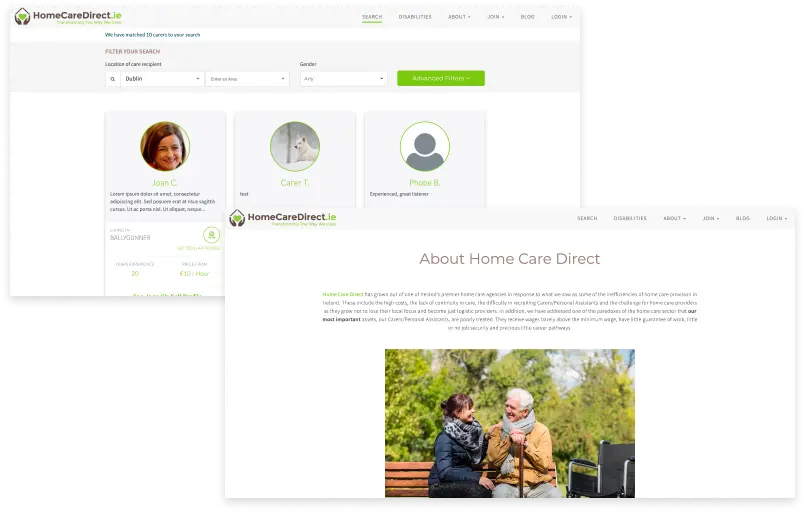
The result is a platform that feels less like a job board and more like a community. By removing the bureaucratic layers of traditional agencies, HomeCareDirect empowers families to browse detailed Carer profiles, and build relationships based on genuine compatibility. For Carers, it offers the freedom to manage their own schedules, set their rates, and receive the full financial value of their vital work. By creating a safe, secure, and direct line of communication, Roobykon Software helped HomeCareDirect facilitate meaningful partnerships – restoring the human element to an industry that had lost its way.
Key Challenges
The most significant hurdle in bringing the HomeCareDirect vision to life lay in the platform’s very core: the contract logic. In a direct-care marketplace, the relationship between a family and a Carer involves dynamic terms, changing schedules, and evolving rates. The Roobykon team was tasked with building a system where this logic could shift fluidly over time, allowing contracts to be updated or renewed without creating legal grey areas or confusing paperwork for either party.
Compounding this technical complexity was the challenge of working with an existing codebase originally built by another team. Rather than building from scratch, the Roobykon engineers had to first decode the previous developers’ logic and structure before we could even begin to enhance it.
TECHNOLOGY STACK


Solution Highlights
To build a platform as relationship-driven as HomeCareDirect, the Roobykon team needed a stack that was both robust and responsive. We built the backend with Ruby on Rails to handle complex contract logic efficiently, while the frontend combined Vanilla JavaScript with Turbo Rails for smooth, fast interactions without unnecessary complexity. Gems like Cocoon simplified dynamic forms for profile building, and PostgreSQL provided reliable data management. The entire system was hosted on AWS, ensuring enterprise-grade security and the ability to scale seamlessly as the platform grew.
Beyond the core architecture, Roobykon focused on real-time engagement and stability. We implemented ActionCable to power instant notifications, keeping Carers and families immediately connected when contracts updated or profiles were viewed.
THE PROCESS
01
Business Analysis Phase: In May 2025, we kicked off the HomeCareDirect project by immersing ourselves in the founders’ vision. During this phase, we audited the existing codebase built by another team, identifying areas needing refactoring while documenting what worked well.
02
Architecture & Planning: With requirements gathered, our team architected a solution balancing innovation with stability. We chose Ruby on Rails for the backend with PostgreSQL for data management, and planned how to transform the fragmented codebase into a scalable system. We broke the massive undertaking into manageable sprints, from simple CRM notes to complex Stripe Connect migration.
03
Development Phase Launch: Development kicked off in September 2025 with immediate attention to pressing issues. Our engineers dove into the codebase to fix broken integrations and stabilize core functionality while establishing clean coding patterns for the work ahead. We set up our development pipelines and began the methodical process of refactoring legacy code.
04
Building Core Functionality: Our team focused on strengthening the platform’s foundation. We worked through the technical debt inherited from the previous development team, ensuring new features would have a stable base to rest upon. Regular communication with Michael kept us aligned on priorities as we progressed.
05
Refinement and Testing: As the year closed, we focused on polishing the admin experience and ensuring all systems worked together smoothly. Our QA team tested every workflow while developers addressed edge cases and performance bottlenecks.
06
Final Development Sprint: January was our final push on new development. The team worked through the remaining items with efficiency born of deep familiarity with the codebase. We ensured the mobile-responsive design worked across devices and that all data flowed correctly between systems.
07
Client Testing and Launch Preparation: In February 2026, we handed the platform to Michael’s team for rigorous testing on their side. As February progressed, we prepared for the full relaunch, confident that HomeCareDirect was finally the platform its founders had envisioned.
Main Features
Document Upload and Tracking
We built a comprehensive document upload system for carers during registration. Carers can now upload mandatory CVs and qualification documents directly through the sign-up form, with files displayed in a clean, organized format. Admins have full control to update, download, and preview these files after registration, while carers can only view and download their own uploaded documents.
Contract Model Simplification
We completely restructured the contract system by removing fixed weekly advance payments and migrating additional payment functionality from mobile to web. New payment pages were designed for both carers and account holders, featuring clean interfaces for viewing visit history and managing expense requests. The sidebar navigation was updated across all user roles with renamed “Payments” sections and streamlined access to essential financial information.
Reverse Marketplace (Jobs Board)
We created a complete job board system where account holders can post available work opportunities. The platform now limits account holders to one active job post at a time, with admin approval required for all posts and edits. Carers receive targeted email notifications for geographically relevant jobs or live-in opportunities, and can express interest directly through the platform, initiating the contract creation flow.
Enhanced Admin Reporting
We transformed the admin reporting capabilities with granular filtering options for exports. Admins can now generate detailed reports on extra hours requests, total invoices, and bespoke payments with filters by user role, contract type, and specific individuals. We added new HSE invoicing exports matching required templates, updated payroll exports to reflect new payment logic, and refined all entity exports to include newly implemented registration fields.
RESULTS
Our collaboration with HomeCareDirect began with a dedicated Business Analysis phase in May 2025, taking time to truly understand the founders’ vision and audit the existing codebase built by another team. This foundational step proved crucial, allowing us to identify what to keep, what to rebuild, and how to prioritize an extensive wishlist before writing a single line of new code.
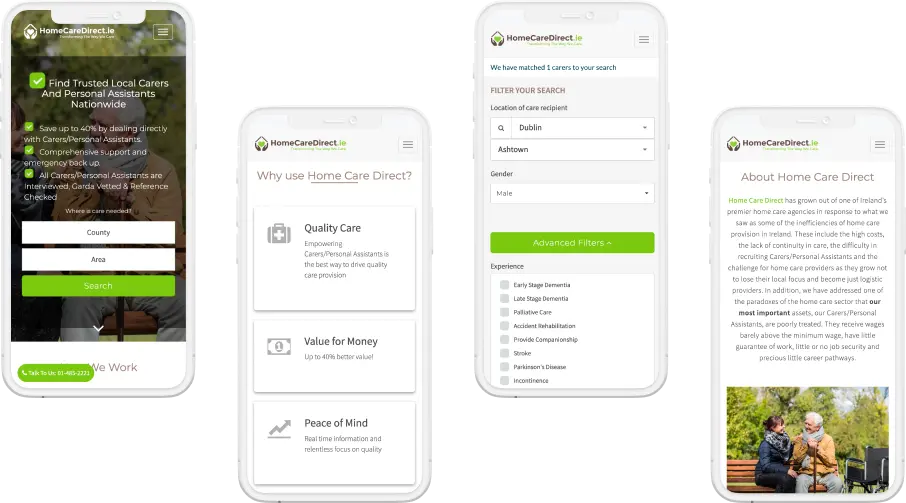
When development began in September, our team moved with precision. Over the following months, we stabilized the shaky codebase, built a comprehensive document management system, and launched an intelligent job board. By February 2026, as Michael’s team tested the fully mobile-responsive platform, the results spoke clearly: a secure, feature-rich ecosystem where families find trusted care, carers earn fairly, and administrators manage complex reporting with a few clicks instead of hours of manual work.
Lessons from HomeCareDirect
Working on HomeCareDirect taught us that sometimes the most important code we write is the time we spend listening before we start building. When we insisted on a dedicated Business Analysis phase before touching the existing codebase, we discovered just how fragmented the platform had become under previous development. That upfront investment saved us months of rework later, because we truly understood the contract logic, the user journeys, and the founders’ vision before we wrote a single new feature.
The project also pushed us to grow in unexpected ways. Building the document management system showed us how to balance powerful functionality with intuitive simplicity. Every challenge made us more professional, but the real lesson was that the best technology fades into the background, letting human connections take center stage.
WHAT OUR CLIENTS SAY

Pat Drinan
Founder & CEO, Homehak

Richard Rucevics
Co-Founder, Eventify

Kalyn McDonald
Co-Founder & Managing Partner, Rabel
MORE PROJECTS