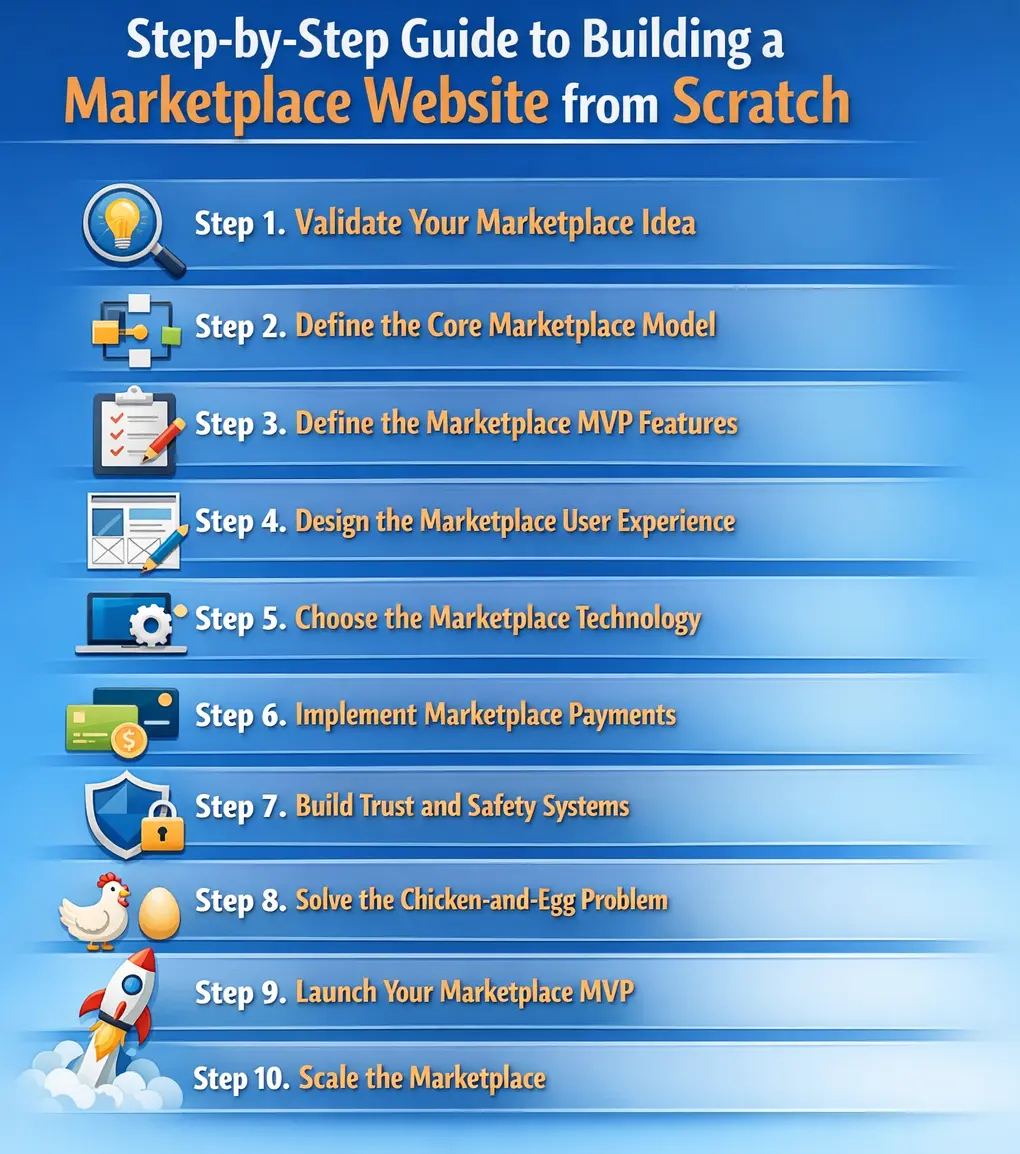
Step-by-Step Guide to Building a Marketplace Website from Scratch
Step 1. Validate Your Marketplace Idea
Step 2. Define the Core Marketplace Model
Step 3. Define the Marketplace MVP Features
Step 4. Design the Marketplace User Experience
Step 5. Choose the Marketplace Technology
Step 6. Implement Marketplace Payments
Step 7. Build Trust and Safety Systems
Step 8. Solve the Chicken-and-Egg Problem
Step 9. Launch Your Marketplace MVP
Step 10. Scale the Marketplace
How Much Does It Cost to Build an Online Marketplace
Subscribe and you will promptly receive new published articles from the blog by mail
The lines between a simple website and a digital empire have never been blurrier. Every year, billions of dollars flow through platforms that didn’t exist a decade ago – from hyper-local service exchanges to global B2B juggernauts. If you have a vision to connect buyers and sellers, there has never been a better time to build a marketplace website.
However, the landscape of 2026 requires a strategic blueprint, not just a good idea. With the on-demand market projected to surpass $630 billion, knowing how to build a marketplace website from scratch is the ultimate competitive advantage.
In this thorough guide, we strip away the fluff and give you the exact steps and strategies you need to create your own marketplace website that survives its first contact with real users.
Step-by-Step Guide to Building a Marketplace Website from Scratch
Step 1. Validate Your Marketplace Idea
Before writing a single line of code, you must answer one question with brutal honesty: Is this a problem people will pay to solve? Many founders fall in love with their solution without validating the problem. In fact, 42% of startups fail because “there’s no market need” for their product, making validation the single most critical step in your building a marketplace startup journey.
Start by defining your target audience and your Unique Selling Proposition (USP). What specific pain point are you addressing that existing solutions ignore? To determine the best way to create an online marketplace, conduct in-depth competitor analysis – not to copy, but to find the gaps they’ve left open. Look at review sites like G2, Capterra, or Trustpilot to see what users love and hate about existing platforms. Talk to at least 20-30 potential users on both sides of the market (supply and demand). Customer interviews or surveys early can validate product-market fit before you invest heavily in development.
A great framework is to look for “niche pain points.” For example, our client Book Holistic didn’t try to compete with general wellness directories. They focused on the unique needs of holistic practitioners – like global scheduling synchronization – and seekers looking for specific, niche therapies. They validated that practitioners needed a management tool. In 2026, this validation phase must also consider how AI agents will discover your sellers – consistent, high-quality product data is now the biggest driver of conversion and trust.
Practical validation methods for 2026:
- Landing page tests: Create a simple page describing your marketplace concept with a “notify me” or “pre-register” button. Drive traffic with small ad spend and measure conversion rates above 5-10% as a positive signal.
- Concierge MVP: Manually facilitate transactions between buyers and sellers using spreadsheets and email. This proves demand exists before you write a single line of code.
- Crowdfunding campaigns: Platforms like Kickstarter or Indiegogo can validate demand while also providing initial capital.
- Letter of Intent (LOI): For B2B marketplaces, get potential enterprise buyers to sign non-binding LOIs indicating their purchase intent.
Step 2. Define the Core Marketplace Model
Your model dictates your architecture, features, and revenue. When creating a marketplace website, this foundational decision shapes everything that follows. In 2026, successful platforms rarely rely on a single revenue stream. They build diversified models that create stability while maximizing growth potential.
Identify Your Type:
- B2B (Business-to-Business): These marketplaces handle complex sales cycles, often require integration with ERP systems, and feature negotiated pricing. 80% of B2B buyers now expect B2C-style digital experiences, meaning your platform must balance complexity with consumer-grade usability.
- B2C (Business-to-Consumer): High volume, transaction-focused, with emphasis on slick UX, mobile optimization, and rapid checkout. Think of platforms like Amazon or Warby Parker.
- C2C/P2P (Consumer-to-Consumer/Peer-to-Peer): Trust and verification are paramount here. Platforms like eBay, Airbnb, or Etsy succeed based on their ability to facilitate safe transactions between strangers.
- Hybrid models: Many successful platforms blend elements – Etsy is primarily C2C but offers B2C features like Etsy Ads and Pattern for professional sellers.
Choose Your Monetization Strategy:
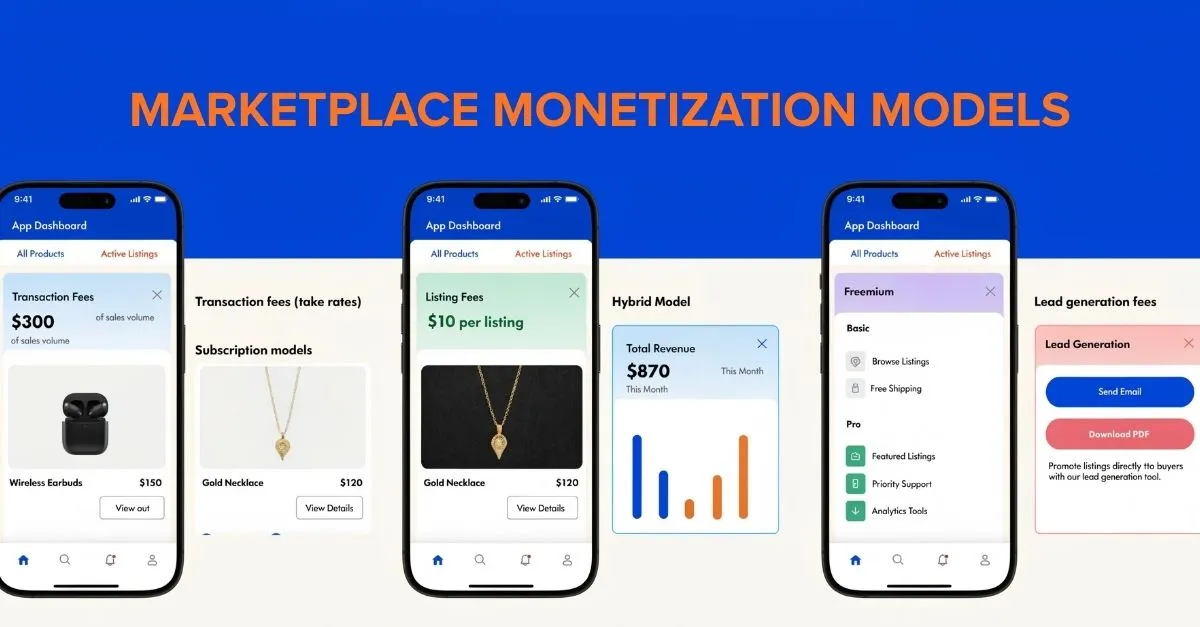
- Transaction fees (take rates): The platform takes a percentage of each sale, usually 10-30% based on industry standards. Revenue grows naturally with platform activity. This works best when your platform provides clear value in facilitating the transaction.
- Subscription models: Regular access fees create steady, predictable income. B2B marketplaces and specialty services often use this approach. It aligns incentives – sellers only pay when they’re actively using your platform.
- Listing fees: Sellers pay to post items, whether they sell or not. This keeps money flowing even during slow sales periods, but can discourage sellers if fees are too high.
- Hybrid model: It is also a common practice to combine the models we described above.
- Freemium with premium features: Offer basic listings for free, charge for enhanced visibility, analytics, or promotional tools.
- Lead generation fees: Charge buyers to submit leads or charge sellers for access to qualified buyer inquiries.
ALSO READ: TOP 5 Marketplace Business Models to Build
The 2026 Twist: Retail Media
As you learn how to create an online marketplace that scales, one of the most powerful levers you can pull is retail media. Amazon’s advertising business generated nearly $47 billion in 2023, representing 26% year-over-year growth and now accounting for approximately 8% of the company’s total revenue.
The global retail media networks market is projected to reach $26.23 billion in 2026 and grow to $37.76 billion by 2030, with industry forecasts predicting approximately $74 billion in retail media ad spend for 2026. The lack of unified ad-tech infrastructure remains a common scaling challenge – address this proactively by investing in integrated advertising technologies that unify data, ad buying, targeting, and measurement across channels.
Platforms like Amazon (34.2% global GMV share), Shopify (14.3%), and TikTok Shop (9.1%) each have unique strengths, and leading performers deploy a “Triad Stack” approach – using each for different roles in the customer journey. Amazon captures high-intent buyers actively searching for solutions; TikTok Shop surfaces products to users in exploratory mode through authentic creator content and live commerce; while your owned Shopify store becomes the retention hub for loyalty programs and personalized upsells.
Step 3. Define the Marketplace MVP Features
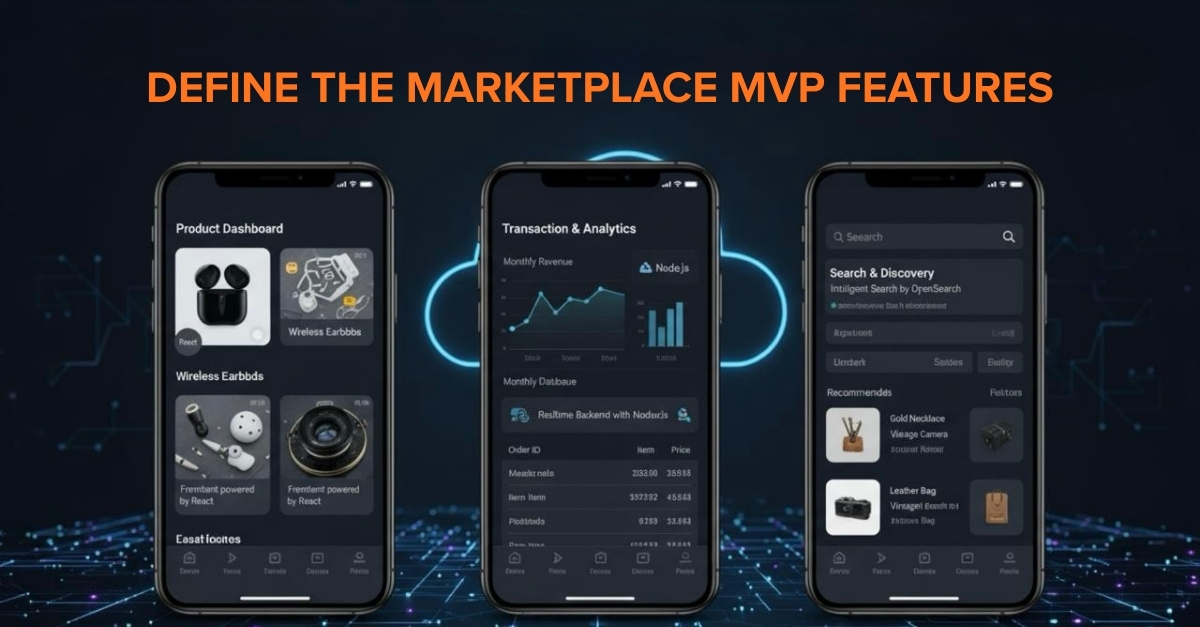
When you build an online marketplace from scratch, the urge to build every feature you can imagine is strong. Resist it. Focus on the core transaction loop. A strong MVP validates your concept with real users, not just features. Every feature you add beyond the core transaction loop increases development time and complexity – only include what’s essential for a successful first transaction.
Based on our work at Roobykon and industry best practices, your MVP should include:
User Registration & Profiles:
Implement Role-Based Access Control (RBAC) for buyers, sellers, and admins. Key marketplace roles include:
- Administrator: Full platform control, user management, dispute resolution, analytics access
- Seller/Vendor: Inventory management, order fulfillment, sales analytics, payout management
- Buyer: Browsing, purchasing, order history, wishlists, reviews
- Moderator: Content moderation, quality control, policy enforcement
- Not Authorized User: Can search, look at the listings, needs to register to buy/post listings
- Email Confirmations: Email confirmations for both buyer and seller
Listing Management:
Build an intuitive dashboard for sellers to upload products or services. When you create own custom marketplace, you have the freedom to design a database schema tailored to your specific vertical – including fields for name, price, SKU, description, variants, categories, tags, and high-resolution images.
Powerful Search & Filters:
Users must find what they’re looking for instantly. Implement:
- Keyword search with autocomplete to reduce friction in product discovery
- Faceted filters (price range, category, location, ratings, availability)
- Sorting options (relevance, price low-to-high, newest, highest rated)
- Geolocation search for service-based marketplaces
ALSO READ: Discover How Advanced Search Algorithms Improve Collaborative Marketplaces
Core Transaction Flow:
Build a secure, reliable path from “add to cart” to “order confirmed.” Include:
- Clear pricing breakdown (subtotal, fees, taxes, total)
- Multiple payment method support
- Order confirmation page with clear next steps
ALSO READ: Learn How to Build a Transaction Workflow for a Service Marketplace
Reviews & Ratings:
Non-negotiable. 3 in 5 shoppers hesitate to buy if a product has no reviews, and nearly 90% say ratings and customer reviews are the most influential factor in their purchase decisions. Around 93% of consumers read online reviews before buying, which makes reviews critical even for an MVP listing, where you are just starting to test the market. Implement:
- Post-purchase review invitations
- Verified purchase badges
- Star ratings with written reviews
- Seller response capability
Admin Dashboard:
A basic admin panel to monitor transactions, manage users, resolve disputes, and view platform analytics. This gives you visibility into platform health from day one.
ALSO READ: Top 10 Features for B2B Marketplace
Step 4. Design the Marketplace User Experience
Design is the bridge between your code and your user’s heart. In the first moments, potential customers form an opinion about your site based on design alone. 68% of shoppers abandon carts due to poor user experience. Focus on simplicity, speed, and intuitive navigation.
Key Design Principles for Marketplaces
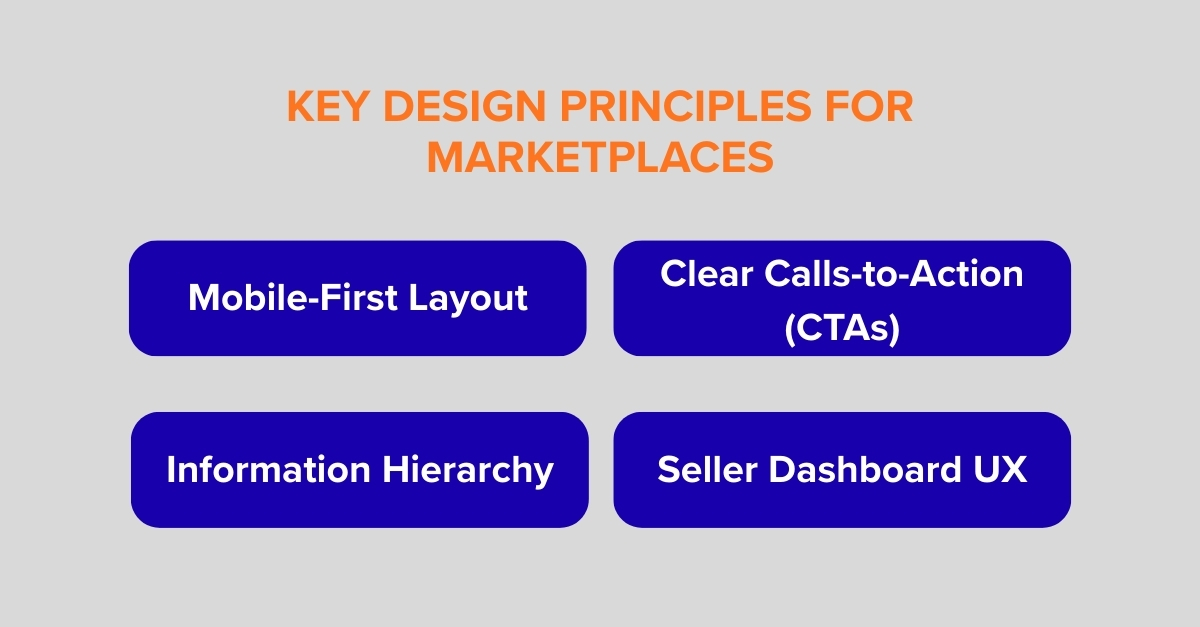
Mobile-First Layout:
Over 60% of online shopping occurs on smartphones. Ensure all elements are touch-friendly with:
- Thumb-zone navigation (primary actions within easy reach)
- Responsive images that load appropriately for screen size
- Simplified menus that collapse gracefully
Clear Calls-to-Action (CTAs):
Use contrasting colors for primary actions like “Add to Cart” and “Checkout” to guide user flow. Each page should have one primary action – don’t compete with yourself. Secondary actions should be visually subdued.
Information Hierarchy:
Present information in order of user priority:
- Product image (visual confirmation)
- Title and price (quick identification)
- Key specifications (size, color, availability)
- Add to cart/Buy/Send request button (conversion)
- Detailed description and reviews (supporting information)
Seller Dashboard UX:
For a marketplace, you’re not designing one experience; you’re designing two (or three, including the admin). The buyer journey must be frictionless, while the seller dashboard must be empowering.
- Clear analytics (views, sales, conversion rates)
- Simple listing management with bulk editing
- Financial overview (earnings, payouts, fees)
- Customer communication tools
- Mobile responsiveness for on-the-go management
Step 5. Choose the Marketplace Technology
This is where the rubber meets the road. Your tech stack must be robust enough to handle growth but flexible enough to allow for pivots. In 2026, the trend is toward composable, API-first architectures and headless commerce – decoupling the frontend from the backend to enable flexibility across web, mobile, and emerging channels like voice assistants, smart displays.
Frontend Frameworks:
- React: The leader. Perfect for dynamic, complex interfaces and marketplaces that want rich user interactions. React’s virtual DOM ensures fast rendering, while its component architecture promotes reusability. The ecosystem includes Next.js for server-side rendering, improving SEO, and initial load times.
- Angular: Brings a complete toolkit with routing, forms, and HTTP services that work great for enterprise-level applications. TypeScript-native with dependency injection out of the box, Angular enforces consistency across large development teams.
Backend Technologies:
- Node.js: Excellent for high-concurrency, real-time applications (like chat or live tracking). If you’re researching how to build a marketplace with Node js, you’ll find its non-blocking, event-driven architecture handles concurrent requests efficiently. Perfect for marketplaces expecting spikes in traffic. The npm ecosystem provides thousands of pre-built modules to accelerate development.
- Ruby on Rails: Allows for rapid development, making it a favorite for creating a marketplace Ruby on Rails MVP. Rails conventions mean less configuration and faster feature delivery. The gem ecosystem includes battle-tested solutions for payments (Stripe), authentication (Devise), and admin interfaces (ActiveAdmin).
- Python (Django/FastAPI): Django offers built-in security and admin tools—perfect for rapid development with strong conventions. FastAPI provides modern Python with automatic API documentation and async support, excellent for high-performance API-driven marketplaces.
Database Decisions:
- PostgreSQL: Excellent for complex queries and JSON support. Sticks to traditional rows and columns, giving you tight schema control. ACID compliance ensures transaction integrity – critical for payment processing. Advanced features like full-text search and geospatial queries (via PostGIS) can eliminate the need for additional services.
- MySQL: A reliable, battle-tested relational database powering many large-scale marketplaces. Excels in read-heavy applications with strong replication support for scaling. Provides ACID compliance via InnoDB for transaction safety. Recent versions add JSON support and improved NoSQL capabilities. Offers an excellent balance of performance and simplicity for straightforward data relationships.
- MongoDB: Keeps data in JSON-like documents, adapting easily to changing data structures – perfect for marketplaces with many product types. Helps growing marketplaces by spreading data across multiple servers through sharding. Schema flexibility means you can iterate quickly without migrations.
- Redis: In-memory data store perfect for caching, session management, and real-time features like leaderboards or rate limiting.
- OpenSearch: A specialized search engine that powers fast, relevant product discovery with typo tolerance, synonyms, and advanced filtering.
Cloud Infrastructure:
- AWS: Holds approximately 30% of the cloud market share, offering 240+ cloud products and 114 Availability Zones for consistent performance worldwide. Services like RDS (managed databases), S3 (storage), and CloudFront (CDN) reduce operational overhead.
- Google Cloud Platform (GCP): Holds 11% market share, potentially offering 25-50% lower prices for certain instance types. BigQuery provides powerful analytics for marketplace data, while Kubernetes on GKE is industry-leading.
- Microsoft Azure: The second-largest provider. Offers seamless integration with Microsoft products – ideal for B2B marketplaces serving enterprise clients. Strong hybrid capabilities and enterprise-grade compliance.
- DigitalOcean: Dominates the startup segment. Simplifies cloud with predictable pricing and intuitive interfaces. Perfect for MVPs and bootstrapped marketplaces needing simplicity and value over advanced features.
By 2026, 83% of enterprise workloads will be cloud-based, making scalability a key factor in marketplace architecture. Multi-cloud or hybrid approaches are becoming common for redundancy and vendor negotiation leverage.
Step 6. Implement Marketplace Payments
Payments are the most sensitive part of your platform. A single hiccup can shatter user confidence. You need a “bulletproof, flexible transaction system.” Payment processing involves multiple layers: authorization, settlement, disputes, and payouts – each must work flawlessly.
The Payment Facilitator Model:
For most marketplaces, a payment facilitator like Stripe Connect or Adyen is the gold standard. It handles the complex compliance (KYC, money transmitter laws, PCI DSS) and allows you to split payments between the platform, the seller, and any taxes or fees automatically. These platforms provide:
- Onboarding flows with identity verification
- Automated compliance checks
- Multi-party payment splitting
- International currency support
- Dispute management
Payment Trends in 2026:
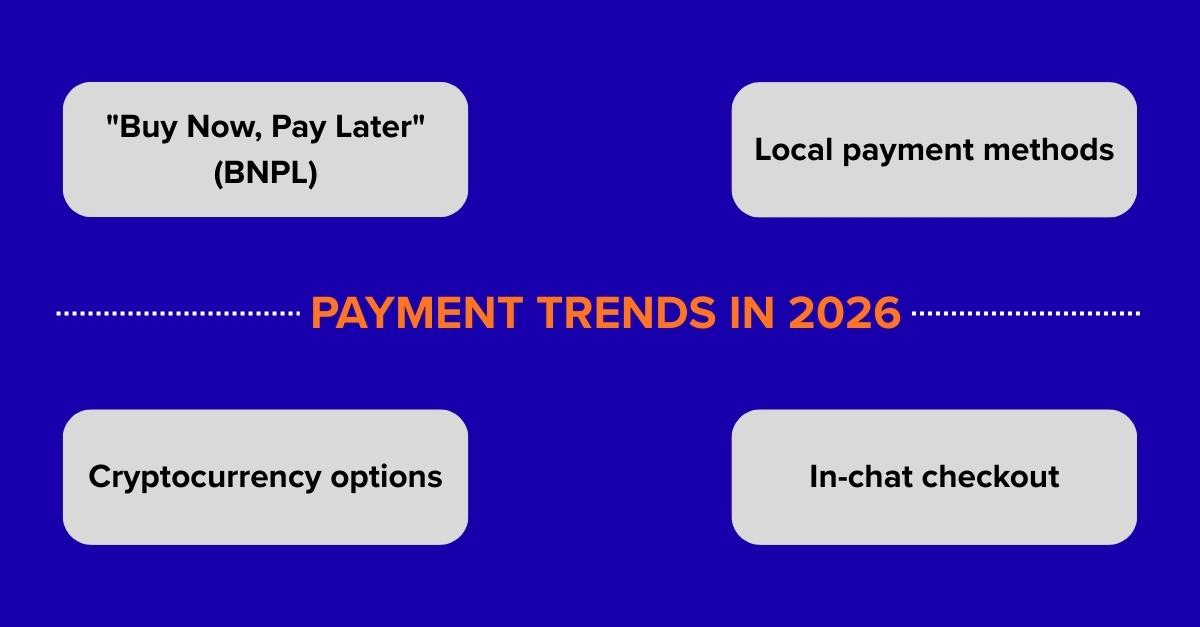
- “Buy Now, Pay Later” (BNPL): Digital wallets and flexible payment options are becoming standard features, ensuring convenience and increasing conversion rates. Platforms like Klarna, Afterpay, and Affirm report that merchants see AOV increases of 30-50% when offering BNPL.
- Local payment methods: For global marketplaces, supporting region-specific methods (iDEAL in the Netherlands, Boleto in Brazil, WeChat Pay in China) is essential for conversion.
- Cryptocurrency options: Some marketplaces are experimenting with crypto payments for cross-border transactions, though volatility and regulatory uncertainty remain challenges.
- In-chat checkout: OpenAI now adds a 4% transaction fee per in-chat sale for Shopify merchants, while Walmart keeps checkout inside its own environment when working with Gemini – showing how conversational commerce is reshaping payment flows.
ALSO READ: A Complete Overview of Payments for Sharetribe Marketplaces
Step 7. Build Trust and Safety Systems
In a multi-vendor world, buyers trust the platform to guarantee the quality of the sellers. In 2026, winning sellers invest equally in trust infrastructure: signals that reduce perceived risk and accelerate purchase decisions.
Marketplace Security:
Trust begins the moment a user lands on your site. If they don’t feel secure, they won’t transact – no matter how many reviews or verification badges you display. Building a secure technical foundation is non-negotiable for any serious marketplace:
- HTTPS encryption: Every page of your marketplace must be served over HTTPS with a valid SSL certificate. This encrypts all data transmitted between users and your platform, protecting login credentials, payment information, and personal details from interception.
- Cloudflare security layer: Implementing Cloudflare or similar CDN and security services provides multiple benefits. It protects against DDoS attacks that could take your marketplace offline, offers a Web Application Firewall (WAF) to block common exploits like SQL injection and cross-site scripting, and masks your origin server IP addresses.
- Secured database architecture: Your database houses the most valuable asset of your marketplace – user and transaction data. Implement encryption at rest for all stored data, use parameterized queries to prevent SQL injection attacks, enforce strict access controls with the principle of least privilege, and regularly audit database logs for suspicious activity.
- Secured file storage: Marketplaces typically handle user-uploaded content – profile photos, listing images, identity documents, and dispute evidence. All file storage must be secured with proper access controls, malware scanning before files are made public, and encryption both in transit and at rest.
Verification Systems:
- Identity verification: Implement automated vendor vetting using services like Stripe Identity or Jumio. For Athlens, trust was paramount as it connected high school athletes with recruiters – every user underwent identity verification.
- Business verification: For B2B marketplaces, verify business licenses, tax IDs, and professional credentials.
- Address verification: Confirm physical locations for service-based marketplaces.
Secure Communication:
Keep buyer-seller communication on the platform to provide evidence in case of disputes. Implement:
- Encrypted messaging
- File sharing for dispute evidence
- Read receipts and timestamps
- Automated moderation for prohibited content
Escrow and Milestone Payments:
For high-value or service-based transactions, hold funds until delivery is confirmed. This protects both parties and reduces disputes. Implementation options include:
- Full escrow: Funds held until both parties confirm completion
- Milestone releases: Funds released incrementally as project phases complete
- 80/20 holds: Platform holds the portion of the payment for a review period after delivery
Clear Policies:
Have transparent, enforceable rules for refunds, disputes, and conduct. Ensure returns policies explicitly state processing time, not just policy duration. Key policies include:
- Terms of Service
- Privacy Policy
- Seller Agreement
- Refund and Returns Policy
- Dispute Resolution Process
- Prohibited Items List
Step 8. Solve the Chicken-and-Egg Problem
This is the classic marketplace paradox: you need buyers to attract sellers, and sellers to attract buyers. How do you build a successful marketplace without one? Every marketplace faces this bootstrap challenge – the key is strategic sequencing, especially in the critical first six months after launch.
Seed the Supply Side:
Manually onboard a core group of high-quality sellers. This approach ensures:
- Quality control during the early days
- Deep understanding of seller needs
- Testimonials and case studies for recruiting more sellers
- Guaranteed supply for early buyers
Create a “Sideways” Strategy:
Attract one side with a tool that doesn’t require the other. For example:
- Offer a valuable inventory management tool to sellers even before you have buyers.
- Provide a price comparison tool for buyers before you have many sellers.
- Build a community or content hub around your vertical.
- Create a directory or database that’s valuable independent of transactions.
Lead Fees:
For service marketplaces, consider charging buyers a fee to submit a lead, guaranteeing the seller pays only for potential business. This approach not only creates immediate value for sellers while generating early revenue, but also represents one of the most sustainable ways to create marketplace business models that align incentives between both sides from day one.
Incentivize Early Adopters:
- Offer commission holidays for the first 50 sellers
- Provide free professional photography for listings
- Give early buyers credits or discounts
- Feature early sellers prominently in search results
The Triad Stack Approach:
Leading 2026 performers deploy a three-tier architecture:
- Core owned channel (Shopify or headless WooCommerce): Your brand home with full data ownership
- High-intent marketplace (Amazon): Where buyers come ready to purchase
- Discovery-first social engine (TikTok Shop): Where serendipitous discovery happens
Each serves a distinct role, not redundancy. New sellers who launch simultaneously on Amazon and Shopify achieve 2.8x higher 12-month retention than those launching on Amazon alone.
Liquidity Metrics:
Track these key indicators:
- Liquidity ratio: Transactions per buyer per seller
- Time to first transaction for new users
- Fill rate: Percentage of searches that yield results
- Concentration: Percentage of transactions from top sellers
Step 9. Launch Your Marketplace MVP
Think of your launch as a learning experiment, not a race. A gradual, phased rollout gives you room to gather insights while minimizing risk. Launching to everyone at once without preparation is a dangerous gamble. The numbers prove it: 63% of shoppers will abandon their cart after just two failed purchase attempts, and only 18% will give you a third chance. That means you have, at most, two opportunities to prove your transaction flow works – or lose a customer forever.
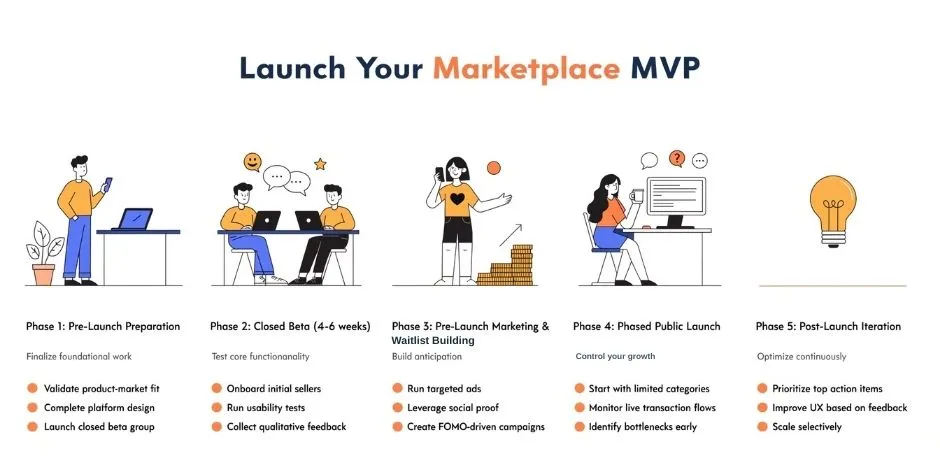
Phase 1: Pre-Launch Preparation
Before any users see your platform, rigorous preparation is essential. The foundation of a successful launch starts with a solid pre-launch checklist :
Core Value Proposition & Readiness
- Clearly define the problem you’re solving and what makes your marketplace different
- Ensure your supply side is ready – onboard enough vendors or service providers to make the marketplace feel alive from day one
- Create demo listings if necessary, so users never land on an empty page
Technical & Trust Foundation
- Test every step of the user journey – sign-up, search, booking, checkout, messaging, and notifications
- Verify your payments are working properly in live mode, not just sandbox
- Establish customer support basics: visible contact options, FAQ, and clear refund/dispute policies
- Build trust infrastructure from the start: understand your data flows, document security controls, and have privacy policies ready
- Prepare for privacy questions and data subject requests under regulations like GDPR
The stakes are clear: If a user encounters a bug at any point during shopping, 26% will abandon the purchase immediately. Even more critically, checkout is the most fragile moment – 28% of consumers are more likely to abandon a purchase at checkout than any other point in the journey.
Phase 2: Closed Beta (4-6 weeks)
Launch to a small, controlled group first. This phase focuses on identifying bugs, measuring stability, and gathering feedback without risking public reputation.
What to test during Closed Beta:
- App stability and crash-free sessions
- UI responsiveness across devices and screen sizes
- Performance under load
- Device-specific issues
- In-app conversion tracking and notifications
Key advantage: Beta users typically cannot leave public reviews, protecting your platform’s rating while still providing valuable feedback. Success metrics aren’t revenue, but rather:
- Retention: Do users return within 7 days?
- Completion rate: Percentage of started transactions completed
- Feedback: Qualitative insights on friction points
Phase 3: Pre-Launch Marketing & Waitlist Building
Before general availability, build anticipation. This phase allows you to generate early interest, test messaging, and create a pipeline of early adopters.
Pre-launch activities:
- Create a waitlist or pre-registration page to capture early user interest
- Run small paid campaigns to test messaging and conversion
- Use organic social and community announcements to build awareness
- A/B test creative assets (icons, screenshots, copy) to optimize for conversion before full launch
This approach creates a wishlist of early adopters ready to engage immediately upon launch.
Phase 4: Phased Public Launch
Open sign-ups, but consider a staged rollout. Launching to 100% of users simultaneously magnifies any undetected issues. Instead, release to a small percentage first (e.g., 10%), monitor performance, then gradually increase as stability is confirmed.
Critical success factors for public launch:
1. Timing matters
Releasing on Mondays or Thursdays often works well to catch algorithm cycles and user traffic patterns.
2. Checkout optimization is non-negotiable
The average cart abandonment rate across e-commerce hovers around 70%. Understanding why is essential:
- Unexpected costs are the #1 culprit – 39% of customers abandon when surprised by shipping, taxes, or fees
- Account creation requirements drive away 19% of users who don’t want to register
- Security concerns cause 19% to abandon
- Complex checkout processes lose 18% of customers
- Limited payment methods cost 10% of sales
Mobile makes the problem worse – around 80% of carts are abandoned on mobile devices, largely due to poor optimization, slow load times, and difficult form entry.
3. Transaction reliability is make-or-break
Globally, 5%-10% of online payment attempts fail for various reasons. When payment problems occur, 62% of customers abandon their cart entirely. Failed payments erode trust and lifetime value.
4. Post-launch monitoring
Monitor relentlessly with:
- Crash and error tracking: Use tools to identify stability issues across devices
- Analytics: Traffic sources, user behavior, conversion funnels
- Session recording: Understand where users encounter friction
- Payment monitoring: Track success rates and failure reasons
Phase 5: Post-Launch Iteration
Going live is just the beginning. What happens next shapes your growth.
Have a plan for:
- Gathering user feedback systematically
- Iterating based on early behavior patterns
- Tracking key metrics: supply growth, bookings, GMV
- Staying in touch with early users to build loyalty
Make learning a core part of your post-launch rhythm. Each user interaction provides data to refine the experience.
The Launch Reality Check
The statistics paint a clear picture: 48% of consumers report they would leave a brand entirely due to poor omnichannel experiences. When you’re building an online marketplace website, your launch is about proving you can deliver a seamless, trustworthy experience from day one.
Most critically: If a customer encounters a failed payment, 32% will stop shopping at that brand completely. This means the cost of launch-day failures extends far beyond lost transactions – it destroys customer acquisition investment and long-term loyalty.
Want to understand exactly why users abandon your site before they even reach checkout? We’ve analyzed the top 10 reasons users leave websites – from performance issues and security concerns to complicated registration and intrusive design. Read the full breakdown here to identify and fix the friction points killing your conversions.
With the right preparation, phased approach, and relentless focus on checkout optimization and payment reliability, you can launch with confidence. The brands that win are those that remove friction, build trust, and meet customers exactly where they are, right up to the final click.
Ready to dive deeper? Before you build, you need to know what actually matters. Discover which features deserve a spot in your launch and which can wait – read our guide: How to Build an Online Marketplace MVP
Step 10. Scale the Marketplace
Once you have product-market fit, it’s time to scale. This is when your architecture choices pay off. Scaling is about handling more complexity, more categories, more geographies, and more transactions without breaking.
Evolve Your Architecture:
Start with a monolith for speed (simpler deployment and debugging, faster initial development). As you grow, consider moving to microservices so different parts of your platform can scale independently. Most successful marketplaces start with a monolith and switch to microservices as they grow.
Typical service boundaries include:
- User service (profiles, authentication)
- Catalog service (listings, categories, search)
- Order service (transactions, fulfillment)
- Payment service (processing, payouts)
- Communication service (messaging, notifications)
- Analytics service (reporting, insights)
Add Advanced Features:
- Seller tools: Bulk listing uploads, promotional campaigns, inventory forecasting, competitive pricing suggestions
- Buyer features: Wishlists, saved searches, price drop alerts, subscription purchasing
- Analytics dashboards: Traffic reports, conversion funnels, seller performance benchmarks
Embrace AI and Prepare for Agentic Commerce:
In 2026, AI is a competitive necessity. Use it for:
- Predictive search: Anticipating user intent before they finish typing
- Fraud detection: Identifying suspicious patterns in real-time
- Chatbots: 24/7 customer support for common issues
- Dynamic pricing: Adjusting prices based on demand, inventory, and competitor activity
More importantly, prepare for AI-powered discovery – consumers are now chatting with AI advisors like Perplexity, Gemini, and Amazon Rufus. Product data must be:
- Complete (no missing fields)
- Rich in use case explanations (not just features)
- Structured for conversational search (natural language queries)
- Consistent across all endpoints
- Updated frequently (stale data undermines trust)
Expand Strategically:
- New categories: Analyze search data to identify natural expansion opportunities
- New geographies: Research local payment methods, shipping logistics, and regulations
- New channels: Integrate with social commerce (TikTok Shop’s live shopping monetization averages $22.40 AOV during streams)
- New business models: Consider B2B wholesale, subscription boxes, or enterprise solutions
Implement Automation:
Automation supports lean teams, reduces human error, speeds up listing workflows, and ensures pricing, availability, and stock levels are updated in real time. Key automation areas:
- Onboarding: Automated verification and account setup
- Moderation: AI-powered content screening
- Customer service: Automated responses to common queries
- Marketing: Triggered emails based on user behavior
How Much Does It Cost to Build an Online Marketplace
This is the million-dollar question (sometimes literally). The cost to build a marketplace website varies wildly based on complexity, location of your development team, and feature set. Understanding the cost drivers helps you make informed tradeoffs.
Cost Breakdown by Complexity:
Basic Marketplace MVP: A simple multi-vendor marketplace with core features like product listings, seller profile pages, and basic payments can start around $10,000 – $30,000. This assumes:
- 2-3 month development timeline
- Pre-built frontend components
- Standard payment integration
- Limited custom design
- Offshore or nearshore development team
Advanced Marketplace: A platform with a highly customized UI/UX design, complex seller dashboards, AI-driven personalization, and multiple third-party integrations will likely range from $30,000 to $100,000+. This includes:
- 4-9 month development timeline
- Custom design system
- Mobile responsive web + native apps
- Advanced search (Elasticsearch)
- Multiple payment methods
- Analytics dashboard
Enterprise Solution: A full-scale platform with custom logistics, complex B2B workflows (like Net-30 terms, procurement integration), and a fully composable architecture can easily exceed $500,000. Features include:
- 12-18 month development timeline
- Microservices architecture
- Multiple integrations (ERP, CRM, WMS)
- Custom algorithms and AI
- High-scale infrastructure
- Enterprise security and compliance
Cost Factors:
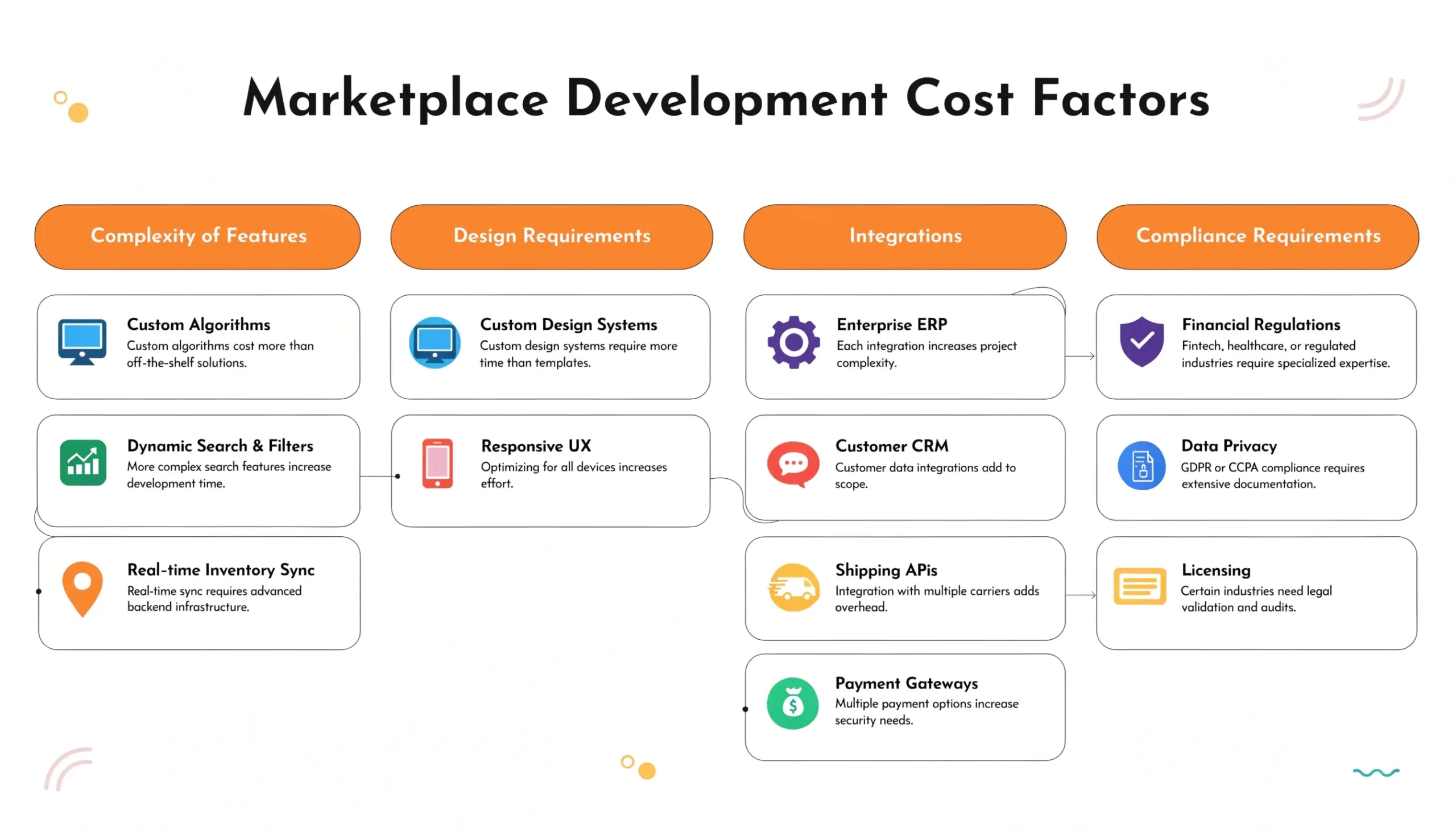
- Complexity of features: Custom algorithms cost more than off-the-shelf solutions.
- Design requirements: Custom design systems require more time than template-based designs.
- Integrations: Each third-party integration (ERP, CRM, shipping, payments) adds complexity.
- Compliance requirements: Fintech, healthcare, or regulated industries require specialized expertise.
How Long Does It Take to Build a Marketplace
Speed matters. The market won’t wait. But rushing leads to technical debt that slows future development. Balance is key.
MVP Timeline (2-3 months):
A focused, core-feature marketplace can be ready for a closed beta in x months with a dedicated team. This includes:
Phase | Timeline | Key Activities |
|---|---|---|
Discovery | Week 1 | Discovery, requirements gathering, user stories |
Design | Weeks 2-3 | Wireframing, prototyping, design concepts |
Development Sprint 1-2 | Weeks 4-6 | User authentication, listings, search functionality |
Development Sprint 3-4 | Weeks 7-8 | Checkout, payments integration, reviews system |
Quality Assurance | Weeks 9-10 | Testing, QA, bug fixes, beta preparation |
Launch | Week 11+ | Closed beta launch |
Mature Platform Timeline (4-9 months):
To create online marketplace platform with a full feature set, mobile apps, scalable microservices architecture, and robust integrations, you should plan for a year or more of continuous development and iteration:
- Months 1-4: MVP development and launch
- Months 5-6: Post-launch iteration based on feedback
- Months 7–8: Advanced features (AI, analytics)
- Months 9+: Scaling infrastructure, international expansion
Our Marketplace Case Studies
Athlens (Athlete Recruitment Marketplace)
The Challenge: Athlens needed to build a marketplace platform connecting high school athletes with creative professionals (photographers, videographers, recruiters) for recruitment content. The core challenge was trust and flexibility – they needed a system handling multiple service types, pricing models, disputes, and cancellations with absolute fairness.
Our Approach: We architected a solution on Sharetribe (for rapid development) while custom-building critical trust features:
- Mapped out 14 distinct transaction scenarios from booking to completion
- Integrated Stripe Connect with custom logic for each scenario
- Built a dispute resolution workflow supporting partial refunds, full refunds, and mediation
- Implemented identity verification for all users
- Created a portfolio system for professionals showcasing their work
The Result: Athlens launched with confidence, knowing every transaction edge case was covered. The platform built trust in a high-stakes market where reputation is everything. User feedback highlighted the fairness and transparency of the transaction system as a key differentiator.
Upisle: P2P Watercraft Rental Platform
The Challenge: Upisle aimed to become the world’s most trusted community for peer-to-peer watercraft rentals, connecting owners of boats, jet skis, and yachts with adventurers. The challenge was building an online marketplace website to handle complex rental logistics – hourly/daily bookings, location-based search, secure payments, and robust trust measures.
Our Approach: We architected Upisle on Sharetribe, custom-building critical features:
- Flexible listings supporting multiple watercraft types with varying price models
- Hourly/daily booking with instant booking capabilities
- ID verification (Twilio) and transparent cancellation policies (Flexible, Moderate, Strict)
- Mapbox integration for location-based search and map visualization
- Stripe Connect as the financial backbone for complex payment splits and payouts
- Multi-watercraft functionality for owners managing fleets
- Sentry integration for real-time issues monitoring
The Result: Upisle launched as a feature-rich platform ready to scale. Hundreds of 5-star reviews praise the “smooth and easy booking process” and “friendly, helpful” hosts. From Miami to the Bahamas, Upisle is successfully connecting people with unforgettable memories on the water.
HomeHak: Tenant-First Rental Marketplace
The Challenge: The traditional rental market frustrates tenants. HomeHak set out to disrupt this space with a tenant-first platform empowering renters with tools to showcase reliability and streamline landlord communication.
Our Approach: We built a custom, high-performance platform extending Sharetribe with a modern JavaScript stack and cutting-edge technologies:
- “Tenant CV” feature showcasing rental history, references, and financial stability
- Tenant–agent communication module keeping conversations organized on-platform
- Employer’s module for corporate rentals and HomeHak for students portal
- Stripe ID for secure identity verification and co-applicants module for group rentals
- AWS Bedrock powering AI search and suggestions matching renters to properties
- Property imports from third-party services for rapid inventory scaling
- HubSpot, HotJar, Zendesk, and Amazon QuickSight for CRM, UX analytics, support, and BI
The Result: HomeHak is a complete ecosystem empowering tenants and streamlining the rental journey – differentiated by AI-powered matching and a tenant-first philosophy.
Let’s Discuss Your Software Needs
Ready to move beyond generalizations? Contact Roobykon Software for a complimentary technical consultation. We will listen first. Evaluate second. Build third. The only sequence that works.
Book Your Call NowFAQ

Recommended articles
 Top Exclusive Online Marketplace Ideas for Startups: The Ultimate Guide for 2026
Stop competing with giants. Learn how to build a specialized, trusted marketplace that transforms an industry. From niche rental ideas to B2B hubs, this guide provides the ideas, examples, and actionable steps for founders.
 Custom Commission in Marketplaces: How to Set Different Fees for Hosts and Customers
Ditch the one-size-fits-all approach. This data-backed guide reveals the strategic framework for designing a dynamic fee structure that grows with your platform, maximizes revenue, and keeps both sides of your marketplace happy.
 Sharetribe vs Medusa.js: Choosing Between a Launchpad and an Engine
Confused between Sharetribe and Medusa.js for your marketplace? Our definitive guide breaks down the critical choice: launch fast with a ready-made SaaS or build a custom, scalable empire with open-source power.
 The Ultimate Guide on How To Build a Multi-Vendor Marketplace in 2026
Unlock the secrets of successful marketplaces. This guide explains how a multi-vendor website works and provides a clear plan to build your own, from validating your idea to launching and driving growth.