Why Fixed Commission Stops Working in Growing Marketplaces: The Data Tells the Story
What Is Custom Commission in a Marketplace?
Popular Custom Commission Models & Their Statistical Benchmarks
Common Pitfalls in Setting Custom Commission Rates and How to Avoid Them
When Your Marketplace Needs Custom Commission Logic: Key Triggers
How Roobykon Helps Marketplace Owners Configure Custom Commission
Subscribe and you will promptly receive new published articles from the blog by mail
The marketplace world is undergoing a quiet revolution powered by data. While the one-size-fits-all commission rate was once standard for fledgling platforms, today’s growth is driven by dynamic, strategic fee structures. The stakes are higher than ever: 63.5% of all B2C online retail sales now occur through marketplaces, and the total global digital marketplace market is projected to nearly double, reaching $1.06 trillion by 2030.
In this high-stakes environment, where platforms like Amazon facilitate a Gross Merchandise Value (GMV) of nearly $800 billion, a static commission is a strategic bottleneck that caps growth and alienates partners.
At Roobykon Software, we empower founders to build adaptable, high-growth marketplaces. The cornerstone of this adaptability is a sophisticated, data-informed commission engine. This enhanced guide dives deep into the statistics, models, and strategic imperatives behind custom commission logic, showing you how to set up different commission for host and customers to optimize revenue, incentivize behavior, and build a dominant platform.
Why Fixed Commission Stops Working in Growing Marketplaces: The Data Tells the Story
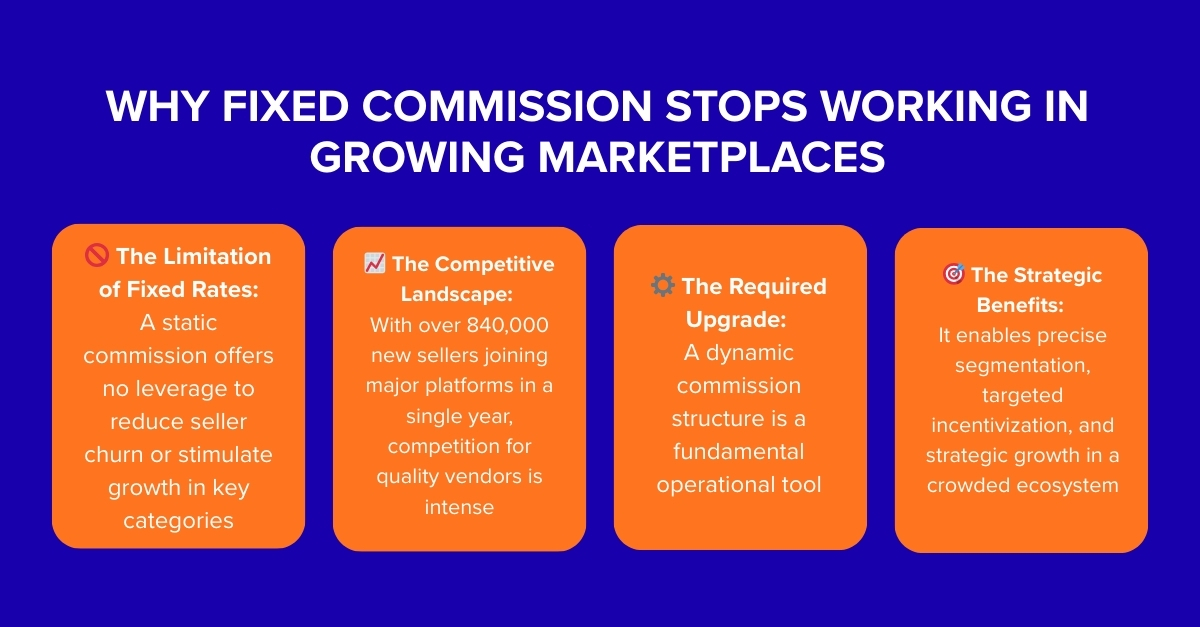
Launching often begins with a simple, fixed percentage. However, as your platform scales and you attract a diverse seller base – from 9.7 million total sellers on Amazon to niche artisans – this model fractures. Industry data reveals that typical marketplace commission rates span a wide range of 10% to 30%, influenced by category, value, and services provided. A single rate cannot equitably cover a high-margin digital service and a low-margin physical good, which is precisely why learning how to set up commissions strategically becomes a critical growth skill.
Furthermore, a fixed mulit vendor marketplace commission offers no leverage to combat critical business challenges like seller churn or to strategically stimulate growth in key categories. With more than 840,000 new sellers joining Amazon in 2024 alone, the competition for quality vendors is intense. A dynamic commission structure is a fundamental requirement for segmentation, incentivization, and strategic growth in a crowded ecosystem.
What Is Custom Commission in a Marketplace?
Custom commission is the strategic application of different fee structures to transactions, users, or categories. It’s the operational layer that allows your financial model to reflect your business strategy actively.
Successfully learning to set up a commission online marketplace that is custom means moving beyond a single, global percentage to a flexible system that can be tailored to the unique economics of your platform and its participants.
Custom Commission for Hosts (Providers/Sellers)
This involves tailoring the fee a host pays. Instead of a flat rate, you can implement models where:
- A new artisan pays a promotional 15% for onboarding, then graduates to a standard 10%.
- A power seller exceeding a monthly sales tier pays a reduced 8%.
- A host in a high-value category like electronics pays a different rate than one in apparel, mirroring industry norms where fees vary significantly by product type.
Custom Commission for Customers (Buyers/Guests)
Charging a fee to the customer is a powerful tool for balancing marketplace economics. A customer commission or service fee is added on top of the listing price. This model enables dual commissions, reducing friction for hosts while funding platform operations from the demand side.
For example, to set up a commission online marketplace model like this, you would configure your system to apply different rules to each side of the transaction. Airbnb employs this masterfully, charging guests up to 14.2% while hosts typically pay about 3%.
Popular Custom Commission Models & Their Statistical Benchmarks
Implementing custom logic is built on proven models. The table below outlines these models with real-world statistical benchmarks.
Model | How It Works & Statistical Benchmark | Best For | Example Platforms & Their Rates |
Commission by Category | Different commission rates are set per product/service category. Rates vary widely based on margin and competitiveness. | Marketplaces with diverse inventory (e.g., electronics vs. fashion). | Amazon: Varies by category. Etsy: Flat 6.5% transaction fee. |
Tier-Based Commission | Rates decrease as a vendor’s sales volume or performance increases. Incentivizes growth and loyalty. | Encouraging vendor growth, rewarding high-volume sellers. | Upwork: 20% on the first $500, 10% up to $10,000, then 5% beyond. |
Commission by Order Value | The fee percentage adjusts (often decreases) based on the total transaction value. | High-value goods/services where a flat percentage on large amounts is prohibitive. | Common in B2B and luxury marketplaces. |
Promotions & Onboarding | Temporary, reduced rates to attract new vendors or stimulate activity. | Driving initial growth, filling inventory gaps. | Often used tactically; can be combined with other models. |
Dual-Sided/ Split Commission | Fees are levied on both the host and the customer. Balances attractiveness to supply with platform revenue. | Service-based, rental, and booking marketplaces. | Airbnb: ~3% from hosts, up to 14.2% from guests. |
To ground this in current platform data, here is a snapshot of 2025 fee structures from major players:
Platform | Host/ Seller Fee (Example) | Customer/ Guest Fee | Key Model & Notes |
Airbnb | ~3% of booking subtotal | Up to 14.2% service fee | Dual Commission. Also offers a host-only fee option (~15%). |
Etsy | 6.5% transaction fee + $0.20 listing fee | None | Category-Flat + Listing Fee. Simple structure for its niche. |
Amazon | 8-15%+ (varies by category) + possible $0.99/item (Individual) or $39.99/mo (Professional) | None | Category-Based + Subscription. The archetype of complex, layered fees. |
eBay | 13.25% + $0.30/order (most categories) | None | Category-Based + Fixed Fee. Offers seller subscription tiers. |
Fiverr | 20% from seller (on orders by providers) | 5.5% from buyer (on orders above $50) | Tiered Dual Commission. Showcases a service-based tiered model. |
Common Pitfalls in Setting Custom Commission Rates and How to Avoid Them
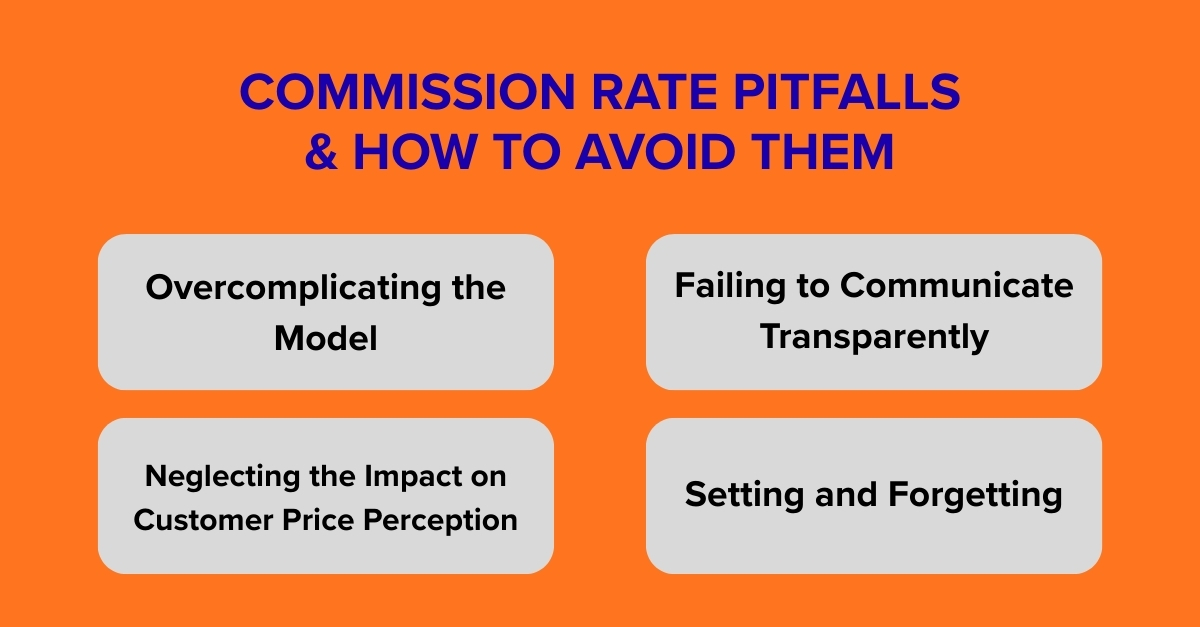
While custom commissions are powerful, their implementation is fraught with potential missteps that can alienate your community and complicate operations. Awareness of these common pitfalls is your first line of defense.
1. Overcomplicating the Model
The desire to cater to every edge case can lead to a labyrinth of rules that are impossible for hosts to understand and difficult for your team to manage. A structure with dozens of overlapping tiers, categories, and promotional exceptions creates a poor user experience and increases the risk of calculation errors. This often defeats the purpose of clear online marketplace commission rates.
- How to Avoid: Start simple. Implement one or two clear differentiation rules first, such as defining straightforward types of commission by category or seller tier. Use analytics to see how they perform before adding more complexity. The goal is strategic flexibility, not intricate complexity.
2. Failing to Communicate Transparently
Springing new, complex fee structures on your hosts without a clear explanation is a sure way to erode trust. Hosts need to easily predict what they will earn from a sale. If they cannot understand the fee breakdown, they will perceive it as the platform taking an unfair, opaque cut.
- How to Avoid: Provide hosts with a clear, accessible fee calculator or preview within their dashboard. Before launching any change, communicate the why, how, and when well in advance through multiple channels (email, blog, community forums). Transparent communication about marketplace commission rates fee is non-negotiable for maintaining a healthy marketplace ecosystem.
3. Neglecting the Impact on Customer Price Perception
When you implement a customer-facing service fee, you directly affect the final price the buyer sees. A sudden or high fee can increase cart abandonment, which is a critical factor to consider as part of your broader strategy for how to set up commission structure.
- How to Avoid: If adding customer fees, consider a phased rollout or test different percentages. Always ensure the total price (item price + fees) is displayed clearly early in the checkout process to avoid “price shock” at the final step.
4. Setting and Forgetting
Your initial custom commission model is a hypothesis, not a set-and-forget solution. Market conditions, competitor actions, and your own strategic goals will change.
- How to Avoid: Establish a regular review cycle (e.g., quarterly) to analyze the performance of your commission rules. Are they driving the desired behavior? Are certain categories underperforming? Use data to iterate and optimize.
When Your Marketplace Needs Custom Commission Logic: Key Triggers
Moving beyond a fixed marketplace commission rates fee is a strategic evolution. Key data-driven signals include:
- Vendor Feedback & Churn: Sellers request lower rates for higher volume, or you notice churn in high-fee categories. When planning how to build a multi-vendor marketplace in 2026, consider that platforms with flexible onboarding and adaptive commission structures see 20% higher seller retention.
- Competitive Pressure: Rivals offer tailored fees to poach your best hosts. With typical customer acquisition costs (CAC) for marketplaces between $30–$100, retaining sellers is crucial.
- Strategic Goals: Launching a new vertical (e.g., “premium services”) requires a different economic model.
- Data Insights: Analytics show a wide dispersion in Average Order Value (AOV) – which can range from $60–$100 for fashion to $150–$300 for electronics, indicating a one-rate model is inequitable.
The Technical & Strategic Implementation of Custom Commissions
A robust technical implementation integrates mulit vendor marketplace commission seamlessly into the transaction flow, from configuration to payout. This requires a powerful rules engine and seamless payment gateway integration.
Critical Consideration: The “Hybrid Marketplace” Dynamic
An advanced strategic consideration is the rise of the hybrid model, where platforms like Amazon and Walmart act as both the marketplace referee and a competing player by selling their own products. Research indicates this can create an incentive for platforms to set higher third-party commissions to subtly steer demand toward their more profitable own-brand products – a practice known as “insidious steering”.
When designing your custom commissions logic, it’s vital to ensure fairness and transparency to build long-term trust with your third-party sellers, who are the lifeblood of your ecosystem.
How Roobykon Helps Marketplace Owners Configure Custom Commission
At Roobykon Software, we translate complex commission strategies into reliable, scalable platform features.
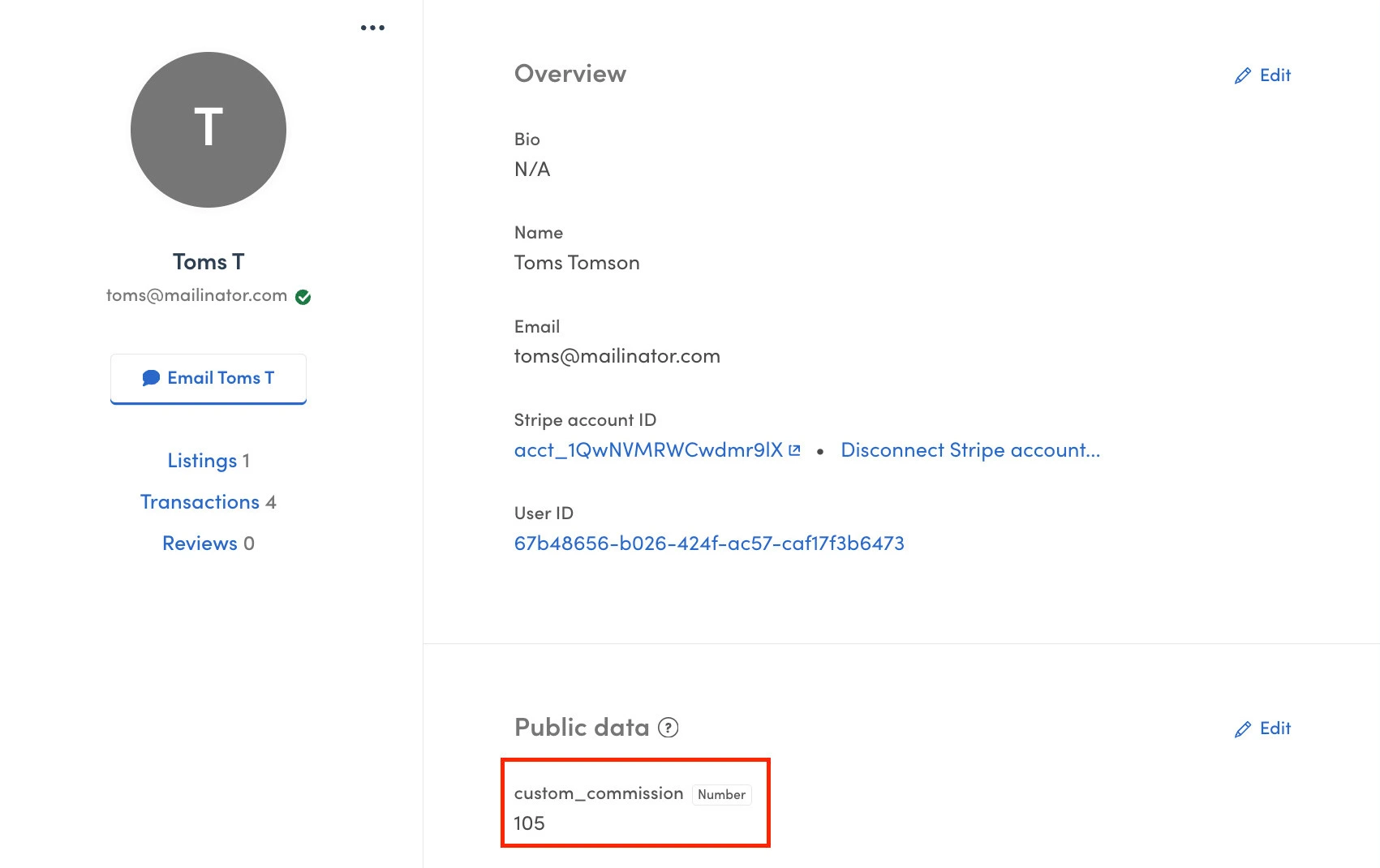
- Technical Implementation & Integration: Our experts build and integrate a robust rules engine into your platform, ensuring accurate real-time calculation, clear financial reporting, and seamless integration of payment options in Sharetribe. We bring the strategic model of how to set commission rate rules into a fully operational, dependable system.
- Ongoing Optimization: We provide analytics to test, measure, and refine your commission structure, helping you adapt to market changes and maximize platform health.
Ready to build a dynamic commission engine that drives growth? Contact Roobykon Software today for a consultation on designing your data-powered custom commission strategy.
Let’s Discuss Your Software Needs
Ready to take the next step in transforming your business with innovative software solutions? Schedule a call with our experts today. During the call, we’ll discuss your challenges and explore tailored solutions that can help you succeed. Quick, convenient, and focused on your goals.
Book Your Call NowFAQ

Recommended articles
 The Ultimate Guide on How To Build a Multi-Vendor Marketplace in 2026
Unlock the secrets of successful marketplaces. This guide explains how a multi-vendor website works and provides a clear plan to build your own, from validating your idea to launching and driving growth.
 Communication & Support: Integrated Chat for Renters & Owners
Your marketplace thrives when communication flows effortlessly. This article dives into how integrated chat builds transparency, speeds up decisions, and keeps renters and owners engaged. See how AI chatbots, real-time messaging, and Sharetribe’s communication tools transform the rental experience.
 Why Your Business Can Benefit From Having a Mobile App
As more and more people become mobile users, marketers strive to reach them via their devices. This is where mobile applications come in handy. Let's find out why you need a mobile app and how to make the most of it.
 User Registration and Identity Verification for a Car Sharing Platform
From stolen identities to fake profiles, fraud is one of the biggest threats to the car-sharing industry. But with today’s tools (document checks, biometric scans, criminal database cross-references, and deep learning verification), you can protect both your business and your community. Find out how.