Subscribe and you will promptly receive new published articles from the blog by mail
A lot of the internet may feel broken for finding specific, trustworthy services or unique goods. Need to hire a freelance engineer who knows a niche programming language? Looking to rent a high-quality camera lens for a weekend trip without paying retail prices? The current options are often fragmented, frustrating, and lack the trust we crave in transactions. This widespread friction is your invitation to build something better.
In 2026, the global e-commerce landscape is projected to exceed $7 trillion in payment transactions, with marketplaces commanding an estimated 67% share of all online retail activity. For startups, this presents a golden opportunity to build the next disruptive platform by connecting underserved communities, unlocking idle assets, and solving tangible problems for both buyers and sellers.
Unlike traditional e-commerce, marketplaces create ecosystems. This asset-light model offers superior scalability, multiple revenue streams, and the powerful network effects that occur as more users join the platform. The most transformative companies of the last decade – Airbnb, Uber, Etsy – were all built on this model. For agile startups, the key to success lies not in competing with giants like Amazon on breadth, but in dominating a specific, high-value niche with a superior, trusted experience.
This guide is designed for founders and entrepreneurs ready to launch their marketplace venture. We will explore high-potential online marketplace business ideas for 2026, deconstruct the essential key marketplace models, and provide a practical, step-by-step framework for moving from concept to launch.
Marketplace Fundamentals: Models, Advantages, and Core Concepts
What Defines a Marketplace?
An online marketplace is a platform that facilitates transactions between independent buyers and sellers. The core distinction from a traditional e-commerce store is the multi-vendor model; the platform operator does not own the inventory but provides the technology, trust, and community for exchange to happen. Marketplaces can be categorized by their participant types, which form the basis of all marketplace business ideas:
- Business-to-Consumer (B2C): Businesses sell to individual consumers (e.g., Amazon, Walmart Marketplace) .
- Business-to-Business (B2B): Transactions occur between businesses, often for bulk goods or specialized services (e.g., Alibaba). The B2B e-commerce market is massive, valued at over $17.9 trillion.
- Peer-to-Peer (P2P)/Consumer-to-Consumer (C2C): Individuals trade goods, services, or assets directly with each other (e.g., Airbnb, eBay). These peer to peer marketplace ideas unlock value from idle assets and personal skills.
The Compelling Advantages for Startups
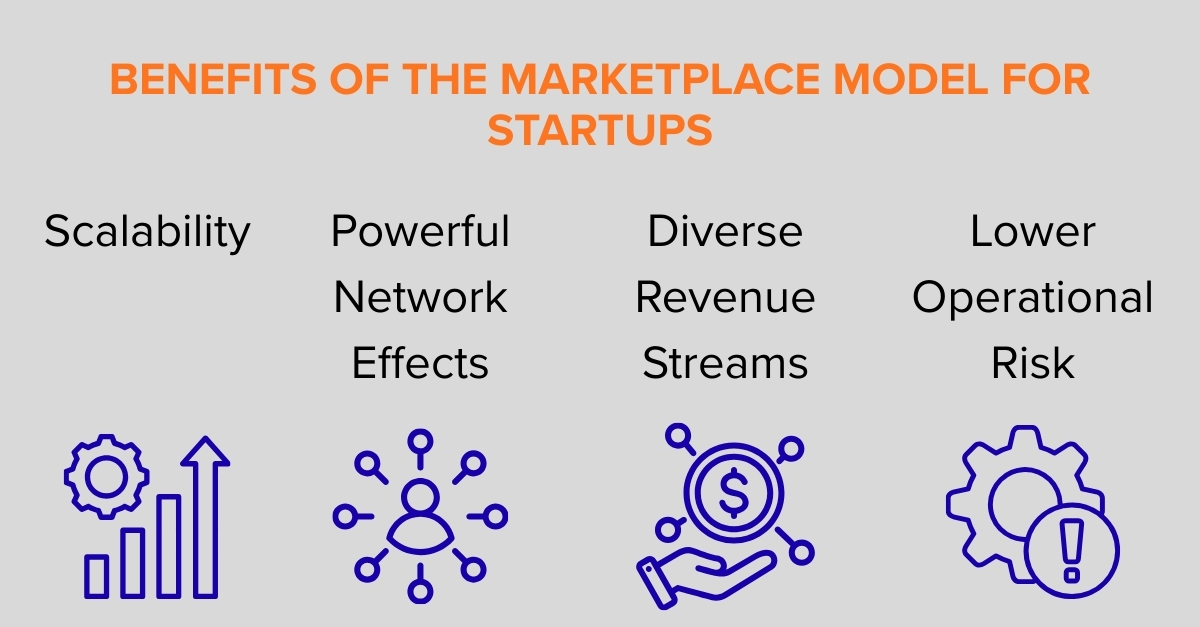
The marketplace model is uniquely suited for startups due to several inherent benefits:
- Scalability: Without the burden of inventory management or physical storefronts, marketplaces can grow rapidly by onboarding new sellers, which in turn attracts more buyers.
- Powerful Network Effects: The platform becomes more valuable as more people use it. More sellers attract more buyers, which attracts even more sellers, creating a virtuous growth cycle that is central to successful two sided marketplace ideas.
- Diverse Revenue Streams: Startups can generate income through various methods, such as transaction commissions, seller subscription fees, featured listings, and advertising, building a more resilient business.
- Lower Operational Risk: The marketplace does not bear the risks of unsold inventory, product obsolescence, or major supply chain disruptions, as these are managed by the sellers.
The Critical Mindset: Solving a Real, “Two-Sided” Problem
A common pitfall for marketplace founders is building a “solution in search of a problem.” The most successful platforms address a pressing, tangible need for both sides of the market.
- For Buyers: The value often comes in the form of lower cost, greater convenience, better access, or higher quality than existing alternatives.
- For Sellers: The value lies in access to a new customer base, easier client acquisition, and monetization of underutilized assets (like a spare room or an idle power tool).
The Core Value Propositions of Successful Marketplaces
Marketplace | Buyer’s Problem Solved | Seller’s Problem Solved |
|---|---|---|
Airbnb | Finding affordable, unique accommodation when hotels are full/expensive. | Monetizing spare rooms or vacant properties. |
Upwork/Fiverr | Finding vetted freelance talent quickly for specific projects. | Finding clients and projects without costly self-promotion. |
Etsy | Discovering unique, handmade, or vintage items not found in big-box stores. | Reaching a global audience of buyers specifically seeking handmade goods. |
Want to build a platform like Airbnb? We’ve written a separate guide on Airbnb-style marketplace development that walks through the features, costs, and technical decisions.
6 High-Potential Online Marketplace Ideas for Startups (2026)
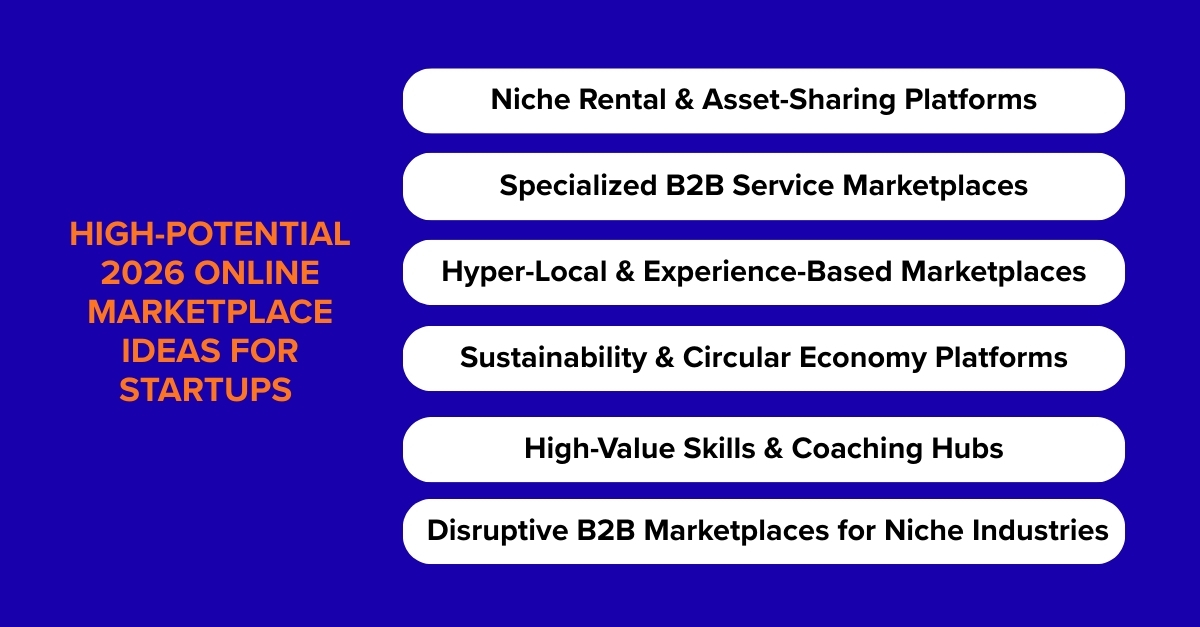
The future belongs to focused, vertical platforms. Here are exclusive, high-growth marketplace startup ideas with proven potential.
1. Niche Rental & Asset-Sharing Platforms
The shift from ownership to access continues to accelerate, with 70% of Millennials preferring to rent certain items over buying them. Look beyond general accommodations to specific asset classes – a prime area for peer to peer marketplace ideas. If you’re inspired by the Airbnb model, you can create a vacation rental platform like Airbnb with a focused approach on a specific niche or region.
A great example of a specialized platform is a healthcare and wellness services marketplace. The demand for such platforms is rising fast, and founders can discover valuable online healthcare marketplace promotion tips on building and launching a platform in this lucrative niche.
Idea Space:
- high-end outdoor/event equipment (e.g., professional camping gear, photography drones, party supplies),
- specialist tools (e.g., woodworking, automotive repair),
- recreational vehicles (e.g., boats, campervans),
- fashion/accessory rentals for special occasions
Real-World Example: Roobykon Software built Upisle, a successful peer-to-peer platform for renting watercraft like jet skis and yachts. We integrated Stripe Identity for user verification and built a custom booking engine with flexible hourly/daily rates and multi-unit rentals on a Sharetribe foundation, directly addressing the trust and logistics challenges of high-value rentals.
Revenue Model: Primarily commission-based on each transaction. Can be supplemented with seller subscription tiers for premium features.
Key Success Factor: A robust insurance, verification, and quality-inspection system to build trust for high-value items.
2. Specialized B2B Service & Procurement Marketplaces
The B2B service sector remains highly fragmented and ripe for digitization. Platforms that streamline hiring, project management, and procurement for specific industries offer immense value. These B2B marketplace ideas solve critical efficiency problems.
Idea Space:
- creative & marketing services for SMBs
- specialized engineering or IT freelancing
- sustainable sourcing for manufacturers
- RFQ (Request for Quote) platforms for custom industrial parts
Real-World Example: Roobykon developed MaterialsNow, a B2B reverse marketplace for specialty materials. The platform centers on an RFQ tool where buyers post needs and vetted suppliers bid, automating notifications and quote management. To streamline workflow, it integrates ACH payments and Avalara for tax compliance, showcasing how deep industry-specific features drive adoption.
Revenue Model: Commission on project value, SaaS subscription for businesses to post unlimited RFQs, or a premium membership for suppliers to access leads.
Key Success Factor: Developing deep workflow integrations (e.g., with project management or accounting software) and tools for vetting provider credentials.
3. Hyper-Local & Experience-Based Marketplaces
While global platforms dominate goods, opportunities abound in connecting people within their own communities for services and experiences – territory rich with website marketplace ideas.
Idea Space:
- local artisan food and farm produce delivery
- “skill-sharing” platforms (e.g., cooking lessons, DIY workshops from locals)
- hyper-local home services with community-vetted providers
- community-based childcare/pet care networks
Real-World Example: For the Canadian platform TaskYourNeighbor, Roobykon created a crowdsourced local services marketplace. Our team focused on building community trust through a simple sign-up process with clear user roles (“Offering Help”/”Looking for Help”) and integrated local payment methods like E-Transfer. Post-launch features like SMS alerts drove a 79% increase in user growth, proving the power of hyper-local engagement.
Revenue Model: Transaction fee or a flat commission. Subscription model for frequent providers or “pro” memberships for buyers.
Key Success Factor: Leveraging local community trust as a growth engine through referrals and a focus on quality and safety.
4. Sustainability & Circular Economy Platforms
Consumers and businesses are increasingly prioritizing sustainability. Marketplaces that facilitate reuse, repair, and responsible consumption are gaining traction.
Idea Space:
- marketplace for refurbished electronics with certified quality grades
- platform for upcycled or pre-loved designer fashion
- tool/library for shared community resources
- B2B marketplace for industrial surplus and by-products
Real-World Example: Roobykon’s portfolio includes Rosella Street, an environmental and community sharing (C2C) platform. Its categorization shows direct experience in building for the circular economy, focusing on platforms that enable reuse and community resource sharing.
Revenue Model: Sales commission, listing fees, or a subscription for businesses to list unlimited surplus inventory.
Key Success Factor: Establishing clear quality standards, certification processes, and a compelling narrative around environmental impact.
5. High-Value Skills & Coaching Hubs
The digital transformation of expertise sharing is creating new business ideas for online marketplace focused on knowledge. This moves beyond generic freelancing to niche, high-trust coaching and consultation.
Idea Space:
- marketplace for executive and career coaching
- platform connecting startups with fractional C-level advisors (CFO, CMO)
- specialized fitness and wellness coaching
- tutoring hub for advanced academic and professional certifications
Real-World Example: Roobykon has built AllCourse, an educational service platform. This project demonstrates our capability in structuring marketplaces for knowledge exchange, which requires features for expert vetting, session scheduling, and structured content delivery – key components for any coaching hub.
Revenue Model: Commission on session packages, subscription fee for coaches to maintain a premium profile, or a SaaS fee for businesses accessing a curated talent pool.
Key Success Factor: Implementing a rigorous vetting process for experts, featuring detailed profiles with verified credentials and client outcomes, and providing structured session tools (scheduling, payment, goal tracking) within the platform.
6. Disruptive B2B Marketplaces for Niche Industries
Beyond services, there is massive potential in digitizing the supply chain for specific industrial verticals. These B2B marketplace ideas target high-value transactions in fragmented industries.
Idea Space:
- marketplace for restaurant-quality specialty ingredients
- platform for sourcing sustainable packaging materials
- marketplace for construction materials and equipment rental
- overstock and liquidation platform for retail brands
Real-World Example: The aforementioned MaterialsNow perfectly fits this category. By digitizing the procurement of specialty industrial materials, it disrupts a traditional, fragmented supply chain. Its success hinges on deep industry knowledge to build features for bulk ordering, compliance documentation, and supplier management.
Revenue Model: Percentage-based commission on high-volume orders, tiered membership fees for buyers/suppliers with premium features, or charged access to detailed analytics and trend reports.
Key Success Factor: Deep industry knowledge to build features that address specific procurement pain points (e.g., bulk ordering, sample requests, compliance documentation) and a dedicated team to onboard and manage key industrial suppliers.
Comparative Analysis of High-Potential Marketplace Ideas
Idea Category | Target Audience | Core Value Proposition | Primary Revenue Model | Example Inspiration |
|---|---|---|---|---|
Niche Rentals | Millennials/Gen Z, Hobbyists | Access over ownership, affordability for high-cost items | Transaction Commission | Airbnb, Rotaro (fashion rental) |
B2B Services | Small & Medium Businesses | Efficient talent/supplier discovery, streamlined procurement | Commission, SaaS Subscription | Upwork, Thomasnet |
Hyper-Local Experiences | Community Residents | Trusted local connections, unique experiences, supporting local economy | Transaction Fee, Subscription | TaskRabbit, EatWith |
Circular Economy | Eco-conscious Consumers/Businesses | Sustainable consumption, cost savings, reducing waste | Commission, Listing Fee | StockX, Reverb |
Skills & Coaching | Professionals, Lifelong Learners | Direct access to niche expertise, personalized development | Commission, Subscription | Coach.me, Clarity.fm |
Niche B2B Procurement | Specific Industries (e.g., Hospitality, Construction) | Supply chain efficiency, discovery of specialized suppliers | Commission, Tiered Membership | Faire, Chefs’ Warehouse |
The Startup Launch Framework: From Idea to Liquidity
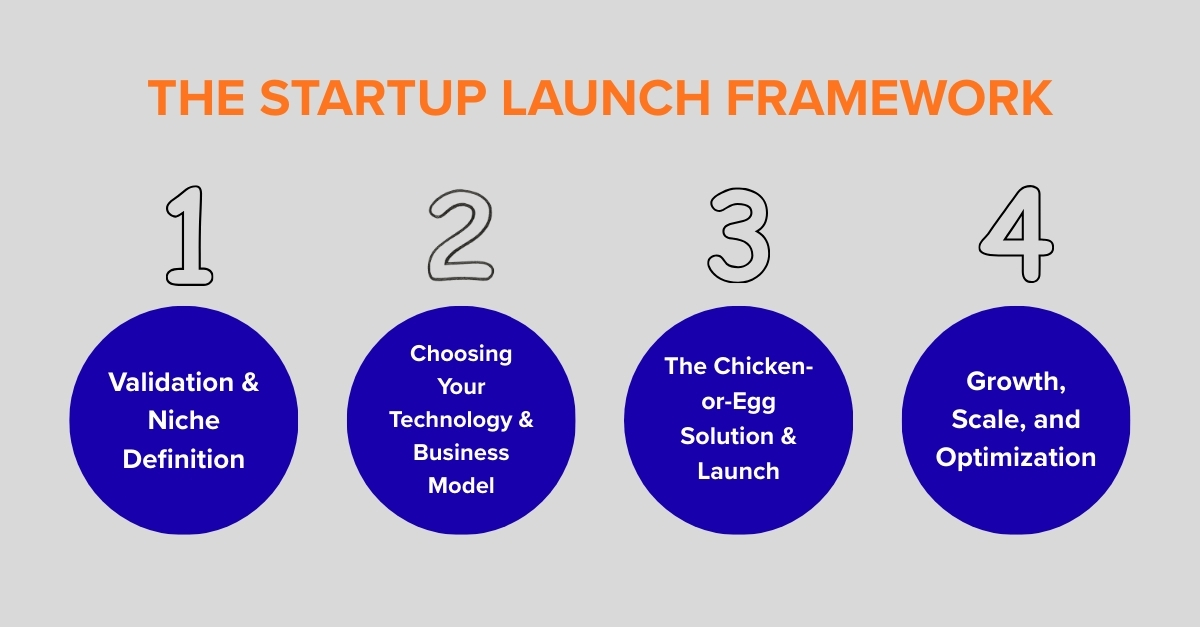
Phase 1: Validation & Niche Definition
Validate the core problem and your proposed solution. This is the first step for all promising ideas for marketplace startups.
- Find Your Niche: Study platforms like Craigslist to identify categories with high volume but poor user experience – these are often ripe for disruption with a trust-based model. Ask: Is the market fragmented? Are existing solutions frustrating?
- “Pre-Sell” Your Concept: Talk to at least 20 potential buyers and sellers. Would they pay for your solution? Use tools like a simple landing page to gauge interest and collect emails.
- Define Your MVP (Minimum Viable Platform): Identify the one core transaction your marketplace must facilitate perfectly. For a rental platform, this might be “search, book, and pay.” Everything else is secondary for launch.
Phase 2: Choosing Your Technology & Business Model
Technology Path: You have three main choices:
- Full Custom Build: Maximum control and uniqueness, but high cost and slow time-to-market. Best if you have significant funding and highly complex, unique needs. This typically requires partnering with a specialized web development company.
- Marketplace SaaS (e.g., Sharetribe): Fastest and most cost-effective launch. Platforms like Sharetribe can save up to 90% of development time by providing pre-built, customizable core marketplace functionality. This is an excellent choice for validating website marketplace ideas quickly.
- Hybrid (SaaS + Custom): Start with a SaaS for speed, then use its API to add custom features as you scale.
Monetization Strategy: Decide early on your primary revenue model. A commission on transactions (5-20%) is most common and aligns your success with your sellers’ success. Consider hybrid models (commission + subscription) as you grow.
Leveraging No-Code/Low-Code Platforms: Platforms like Sharetribe have empowered numerous successful marketplace startup ideas. Reviewing a list of Sharetribe sites examples can provide inspiration and prove the model’s viability. Successful ventures built on such platforms often focus on tight niches, such as:
- Landtrust.com: A niche C2C platform for finding private land to hunt on.
- Thepickleballswap.com: A dedicated North American marketplace for buying and selling used pickleball gear.
- Coachlync.com: A global platform where coaches can buy and sell drills, playbooks, and templates.
- Bookpoets.com: A unique service marketplace for booking poets to perform at events.
- Instagrooms.com: A North American service platform connecting horse owners with professional equestrian grooms.
These examples demonstrate that with a strong idea and execution, the technology platform does not limit success.
Phase 3: The Chicken-or-Egg Solution & Launch
Attracting both buyers and sellers simultaneously is the classic attracting both buyers and sellers simultaneously challenge.
- Supply-First Strategy: Often the best approach. Manually recruit your first 10-50 high-quality sellers. Offer them exceptional support, waived fees, and co-market their listings. A small supply of great options is better than a large supply of poor ones.
- Focus on a Micro-Market: Launch in a single city, university, or professional network. This makes liquidity (having enough buyers and sellers) easier to achieve and provides a controlled environment to refine your product.
- Build Trust from Day One: Implement a verified identity system, secure payments (via providers like Stripe), and a transparent review/rating system. This is your primary advantage over classifieds sites.
Phase 4: Growth, Scale, and Optimization
- Leverage Data: Use analytics to identify friction points in the user journey. Which step has the highest drop-off? A/B test solutions.
- Cultivate Community: Engage with your users. Feature top sellers, share success stories, and create forums or social channels for interaction. A marketplace is a network, not just software.
- Scale Thoughtfully: After dominating your initial niche, expand to adjacent categories or geographies. Use the playbook that worked in your launch micro-market.
Your Platform for the Future
The era of the “everything-for-everyone” online marketplace is fading. Today’s most exciting opportunities are about being the only platform for a specific community. Think of it as building a vibrant, trusted town square for a passionate group, not a massive, impersonal megamall.
This shift is a startup’s dream. Your job is to find a real, frustrating problem – one that has both buyers and sellers struggling to connect – and solve it with elegance and focus.
So, how do you start? It’s not with a massive tech build. It’s by identifying an underserved niche, becoming obsessed with solving that two-sided problem, and then choosing the right technology path to bring it to life. That might be a quick-start tool like Sharetribe to test your idea or a custom build with a web development company to create something truly unique.
That’s the core of what we do at Roobykon Software. We specialize in making online marketplace visions a reality. We’ve been in your shoes and have helped founders like you cross the finish line. Our team can help you navigate the tough tech choices, build the essential trust and safety features, and craft the engaging experiences that turn a concept into a sustainable business.
Let’s discuss your vision. Contact Roobykon Software for a free consultation and take the first step toward turning your marketplace idea into a reality.
Let’s Discuss Your Software Needs
Ready to take the next step in transforming your startup ideas with innovative software solutions? Schedule a call with our experts today. During the call, we’ll discuss your challenges and explore tailored solutions that can help you succeed. Quick, convenient, and focused on your goals.
Book Your Call Now
Recommended articles
 TOP 5 Marketplace Business Models to Build in 2026
Unlock high-growth opportunities in the digital economy. Our deep-dive article identifies the top 5 marketplace business models primed for success in 2026. We break down the data, consumer trends, and operational advantages of each model.
 How to Build an Online Marketplace MVP in 2026
Turning a marketplace idea into reality is fraught with risk. This guide cuts through the complexity, showing you how a focused MVP is the antidote.
 The Ultimate Guide on How To Build a Multi-Vendor Marketplace in 2026
Unlock the secrets of successful marketplaces. This guide explains how a multi-vendor website works and provides a clear plan to build your own, from validating your idea to launching and driving growth.
 Best Rental Business Ideas to Start in 2026
The global sharing economy is projected to hit $335 billion. Discover the high-growth rental sectors that are dominating the new access economy. We break down the initial investment, profit margins, and digital tools you need to launch a scalable and future-proof rental venture.