Understanding the multi-vendor marketplace ecosystem
How to create a successful multi-vendor marketplace in 2026
1. Laying the unshakeable strategic foundation
2. Technical development: building your digital engine
3. Launch strategy and the growth framework
How to Build a Multi-Vendor Marketplace in 5 Steps with Sharetribe
Subscribe and you will promptly receive new published articles from the blog by mail
The digital agora is the pulsating heart of the modern global economy. From the behemoth Amazon marketplace, which connects millions of sellers to billions of customers, to niche platforms for handmade crafts like Etsy, multi-vendor marketplaces have fundamentally reshaped modern commerce. These platforms, including service-based hubs like Upwork, have completely transformed how we buy, sell, and trade in the digital age. Projections indicate that marketplaces will account for a staggering 59% of all global e-commerce by 2027. This is a tectonic shift in commercial infrastructure.
If you’re reading this, you likely have an idea, a vision for a space where multiple vendors and eager customers can converge, but you may be unsure of how to start a multi-vendor website. The journey from that spark of an idea to a thriving, liquid marketplace is complex, but imminently achievable with the right roadmap.
This definitive guide will demystify the entire process, providing you with a step-by-step framework for building a multi-vendor marketplace that is built to last. We will navigate the strategic foundations, technical execution, launch strategies, and future trends, transforming you from a curious entrepreneur into an informed founder ready to build your digital empire.
Understanding the multi-vendor marketplace ecosystem
So, what is a multi-vendor marketplace in its essence? It is a digital platform, a central hub, where multiple independent third-party sellers can list, showcase, and sell their products or services directly to customers. The platform owner does not own the inventory; instead, they provide the digital real estate, the rules of engagement, and the transaction infrastructure, earning revenue through commissions, subscriptions, or other fees.
This is the core differentiator from a traditional e-commerce store. A standard online shop is a single-vendor model: one brand selling its products directly to consumers. A marketplace, however, is a multi-sided platform. Your primary customers are not one, but two distinct groups: the buyers who seek value and selection, and the sellers who seek customers and sales. Whether you want to build a niche artisanal hub or create a website like Amazon, your success hinges on your ability to serve both simultaneously and effectively.
Types and models of multi-vendor marketplaces
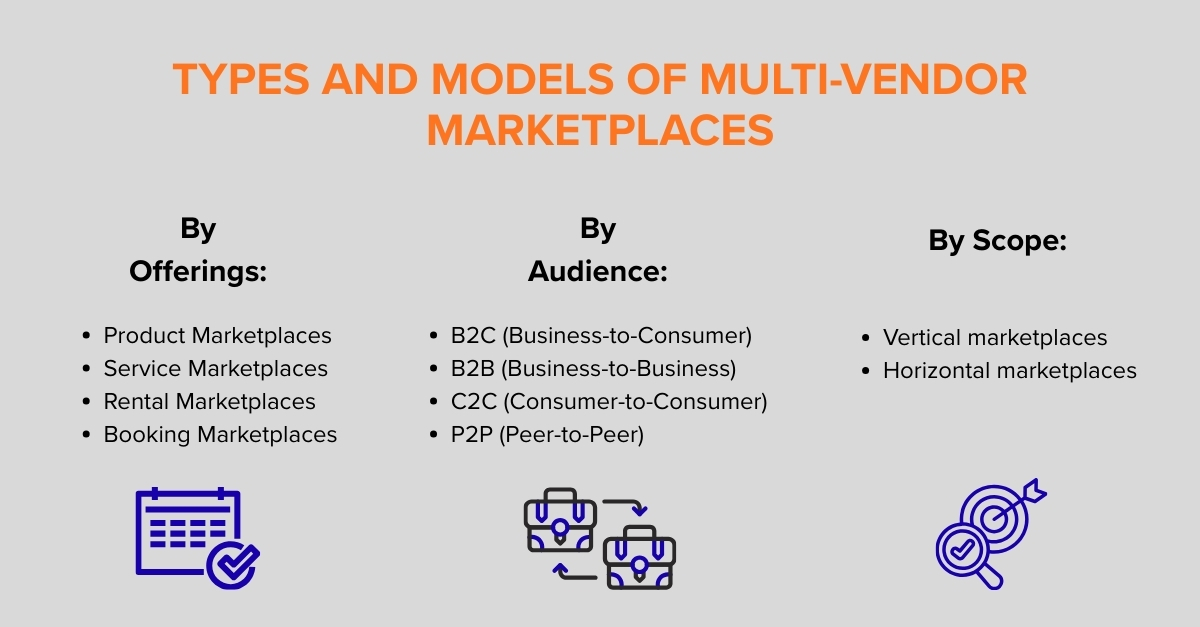
The landscape of marketplaces is wonderfully diverse. Understanding the different marketplace types is your first step in defining your own. They can be classified in several ways:
- By Offerings:
- Product Marketplaces: Physical goods (e.g., Amazon, Etsy).
- Service Marketplaces: Professional services (e.g., Upwork, Thumbtack).
- Rental Marketplaces: Temporary access to assets (e.g., Airbnb, Turo).
- Booking Marketplaces: Appointment-focused services (e.g., multi-vendor booking marketplace for beauty salons or fitness classes).
- Food Delivery Marketplaces: Platforms that connect restaurants, grocery stores, and delivery partners with hungry customers (learn how to build a food delivery marketplace).
- By Audience:
- B2C (Business-to-Consumer): Businesses selling to individuals. (Learn more about the B2C model.)
- B2B (Business-to-Business): Businesses selling to other businesses; often involves complex transactions, bulk orders, and custom pricing.
- C2C (Consumer-to-Consumer): Individuals selling to individuals (e.g., eBay, Facebook Marketplace).
- P2P (Peer-to-Peer): Similar to C2C, but emphasizes shared access (e.g., a multi-vendor rental marketplace like Peerby).
- By Scope:
- Vertical marketplaces: Deep focus on a specific niche or category (e.g., Farfetch for luxury fashion).
- Horizontal marketplaces: Broad focus across multiple unrelated categories (e.g., Amazon, eBay).
Grasping these models is essential because the choices you make here will cascade through every subsequent decision, from your business model to your technical feature set.
How to create a successful multi-vendor marketplace in 2026
1. Laying the unshakeable strategic foundation
The most common reason marketplaces fail is not technical failure, but a failure of strategy. Rushing to build a multi-vendor website without a solid foundation is like building a castle on sand. This phase is about validation, planning, and building your business case.
1.2. Idea Validation and Market Research
Your idea might be brilliant, but is it viable? Validation is the process of answering this question with data, not just intuition.
- Identify a Real Problem: Are you solving a genuine pain point for a specific group of buyers or sellers? For a multi-vendor service marketplace, is there a fragmented industry where customers struggle to find reliable providers? For a multi-vendor rental marketplace, are there underutilized assets in a community?
- Analyze the Competition: Who else is operating in this space? What are they doing well? Where are their gaps? Your competitive advantage could be a better user experience, a specific niche, or superior vendor tools.
- Talk to Your Potential Users: Conduct interviews with potential buyers and sellers. Would they use your platform? What would convince them to switch from existing solutions? This feedback is invaluable and can help you build a waitlist even before a single line of code is written.
1.3. Defining your multi-vendor marketplace business model
How will your platform generate revenue? The multi-vendor marketplace business model is not one-size-fits-all. Here are the most common and effective revenue streams:
- Commission model: You take a percentage of each successful transaction. This is the most common model as it aligns your success with the success of your vendors. The key is to set a commission rate that is sustainable for your business and acceptable to your sellers.
- Subscription/membership fees: Vendors pay a recurring fee (monthly/annually) to access your platform and list their products or services. This provides predictable revenue and can be combined with a lower commission rate.
- Listing fees: Charge vendors a small fee for each product or service they list. This can deter low-quality listings but may also discourage new vendors from joining.
- Featured placements and advertising: Offer premium visibility options within search results and category pages for an additional fee. This is a powerful upsell for vendors eager to increase their exposure.
- Value-added services: Offer services like premium storefront customization, promotional marketing, logistics and shipping support, or business analytics reports for a fee.
Often, the most robust approach is a hybrid model, such as a low subscription fee plus a transaction commission.
1.4. Trust and safety: the bedrock of your marketplace
Trust is the currency of any marketplace. No one will transact on your platform if they don’t feel safe. From day one, you must implement systems to build and maintain trust.
- Robust verification: Implement a process to verify vendor identities. This could be through business registration checks, phone verification, or social profile linking.
- Clear rating and review systems: This is the community’s self-policing mechanism. A transparent system holds both buyers and sellers accountable for their behavior.
- Secure payment gateway: Use a reputable, PCI-compliant payment processor. Assure users that their financial data is safe.
- Explicit policies: Draft clear, fair, and easily accessible terms of service, return/refund policies, and dispute resolution procedures.
2. Technical development: building your digital engine
This is the phase where your vision starts to take tangible form: building a multi-vendor marketplace platform. The technical decisions you make here will impact your scalability, flexibility, and total cost of ownership.
2.1. Platform selection: your first major crossroad
How you choose to build multi-vendor website infrastructure is a pivotal decision. Here’s a breakdown of the main paths:
Approach | Key Advantages | Potential Drawbacks | Ideal Use Case |
|---|---|---|---|
Custom Development | Complete control, unlimited customization, and a scalable, future-proof architecture. | Very high initial cost, lengthy development timeline, and requires a dedicated technical team. | Large enterprises or funded startups with complex, unique requirements and ample resources. |
SaaS Platforms + Extensions (e.g., Shopify + Shipturtle) | Fast deployment, lower upfront cost, and managed infrastructure & security. | Less customization flexibility, ongoing subscription fees, and potential for extension conflicts. | Most startups and SMBs seeking a balance of speed, functionality, and cost-effectiveness. |
Open-Source Solutions (e.g., Magento, WooCommerce) | A high degree of control, a large global developer community, and no direct software licensing costs. | Requires significant in-house technical expertise for hosting, security, and maintenance. | Technically-equipped teams wanting more control without the full cost of custom development. |
Flexible Low-Code Platforms (e.g., Sharetribe) | Fastest launch with minimal technical knowledge, perfect for validating an idea. | Can feel “cookie-cutter” initially; some platforms may have limitations on core architecture. | Non-technical founders validating a core idea with an MVP. |
Scalable Low-Code Foundation | A clear growth path: Once your idea is validated, the same platform allows for deeper code customizations to meet evolving requirements without a complete rebuild. | Advanced customizations require developer resources, similar to other approaches. | Founders who want to start fast with an MVP but need assurance they can scale and customize later without switching platforms. |
For many, the most pragmatic path to create multi-vendor website is to start with a robust SaaS solution or to hire a multivendor marketplace developer who can build a custom solution on a solid framework. A skilled team can help you navigate these choices and build a platform tailored to your specific multi-vendor marketplace business model.
2.2. Essential features framework
A successful multi-vendor ecommerce platform requires three distinct yet interconnected interfaces: one for the customer, one for the vendor, and one for you, the admin.
Customer-facing features:
- Intuitive search & navigation: Advanced filters, categories, and a powerful search bar are non-negotiable.
- Unified shopping cart: The ability to add products from multiple vendors and checkout in a single, seamless transaction.
- Secure and flexible checkout: Support for multiple payment gateways (Stripe, PayPal, etc.) and a guest checkout option.
- Product/service listings: High-quality images, detailed descriptions, vendor information, and availability calendars (for a multi-vendor booking marketplace).
- Review and rating system: The cornerstone of building trust within the community.
Vendor-facing features (the vendor dashboard):
- Dashboard analytics: An overview of sales, orders, visits, and earnings.
- Inventory/service management: Easy tools to add, edit, and manage listings. For a multi-vendor service marketplace, this would include managing service types, durations, and schedules.
- Order management: View, process, and update order statuses.
- Payment tracking: A clear record of transactions, commissions deducted, and payout schedules.
- Profile management: Ability to customize their storefront and branding.
Admin-facing features (the control panel):
- Vendor onboarding & management: Tools to approve, manage, and communicate with vendors.
- Commission management: Set and adjust commission rates globally or per vendor/category.
- Dispute resolution: A system to mediate issues between buyers and sellers.
- Content moderation: Monitor and remove inappropriate listings or content.
- Advanced analytics: Track key platform health metrics like GMV, number of transactions, and user growth.
2.3. The mobile imperative
A mobile-responsive website is the baseline. However, to truly engage users and stay competitive, developing a dedicated mobile app offers significant advantages. The benefits of a mobile app for business include push notifications for order updates and promotions, faster loading times, and a more immersive brand experience. For a multi-vendor booking marketplace or any on-demand service, a mobile app is almost essential.
2.4. Technical architecture and security
When you decide it’s time for starting a multi-vendor marketplace from scratch, several technical pillars are critical:
- API-First architecture: This approach ensures that your core platform logic is decoupled from the front-end. It allows for easier development of mobile apps and future integrations with third-party services (e.g., shipping calculators, ERP systems).
- Scalable cloud infrastructure: Start with a cloud provider like AWS, Google Cloud, or Azure. This allows you to scale your server resources up or down based on traffic, preventing your site from crashing during a sales spike and controlling costs during quieter periods.
- Payment processing & splitting: The heart of a multi-vendor e-commerce site is its ability to automatically split payments. When a customer pays $100, the system must instantly calculate the commission (e.g., 10% = $10), hold it for the admin, and route the remainder ($90) to the vendor’s account. This requires a payment gateway that supports this functionality natively or through custom development.
3. Launch strategy and the growth framework
Your platform is built, tested, and ready. Now comes the most critical challenge: achieving liquidity. This is the “chicken-and-egg” problem: buyers won’t come without sellers, and sellers won’t join without buyers.
3.1. Building and launching an MVP
Do not fall into the trap of building the “perfect” platform with every possible feature. Instead, focus on a Minimum Viable Product (MVP). Your MVP should have the absolute core features needed to facilitate a basic transaction. The goal is to get a live platform in front of real users as quickly as possible to gather feedback and validate your assumptions. This is the most efficient way to set up a multi-vendor marketplace.
3.2. Solving the chicken-and-egg problem
Your initial focus should be on supply. It is easier to attract buyers to a platform with a good selection than to attract sellers to an empty marketplace.
- Seed your supply: Manually recruit your first 20-50 high-quality vendors. Use your personal network, attend industry events, or offer heavily incentivized launch terms (e.g., zero commission for the first 3 months).
- Artificial stimulation: If necessary, create the initial transactions yourself. You or your team can act as the first buyers to generate sales and reviews for your early vendors, creating social proof.
- Leverage existing communities: Partner with influencers or established communities in your niche who can bring both buyers and sellers to your platform en masse.
3.3. Growth and marketing strategies
With liquidity starting to flow, shift your focus to scalable growth.
- Vendor acquisition: Develop a sales playbook, create a compelling vendor portal explaining the benefits, and launch a referral program.
- Customer acquisition: Implement Content Marketing and SEO to attract organic traffic. Use performance advertising (Google Ads, Social Media) to target your ideal buyers. Building an email list from your waitlist is a powerful tool for your launch campaign.
- Build a community: Engage with your users on social media, create valuable content, and make them feel like part of something. A community is a powerful defensive moat.
3.4. Key metrics and performance monitoring
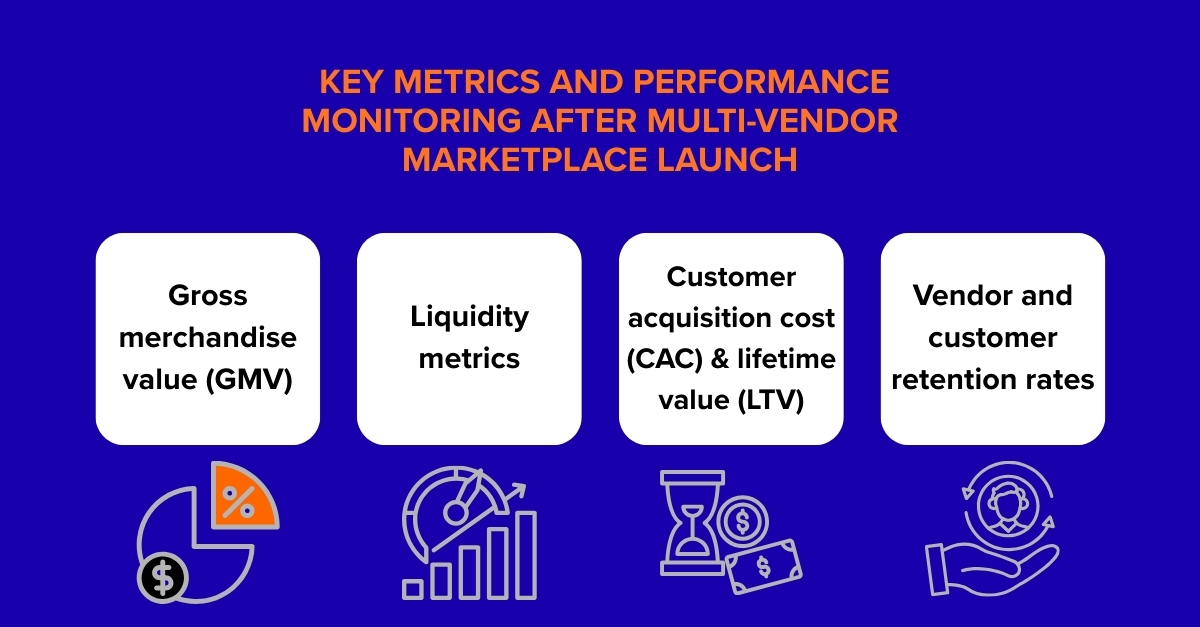
You cannot manage what you cannot measure. To steer your marketplace towards success, you must track the right KPIs.
- Gross merchandise value (GMV): The total sales volume processed through your platform. This is your top-line health metric.
- Liquidity metrics: What percentage of searches result in a transaction? How long does it take for a new listing to sell? These metrics tell you how well your marketplace is matching supply and demand.
- Customer acquisition cost (CAC) & lifetime value (LTV): Ensure that the cost to acquire a user is significantly less than the revenue they will generate over their lifetime.
- Vendor and customer retention rates: It’s far cheaper to keep a user than to acquire a new one. High churn rates are a major red flag.
How to Build a Multi-Vendor Marketplace in 5 Steps with Sharetribe
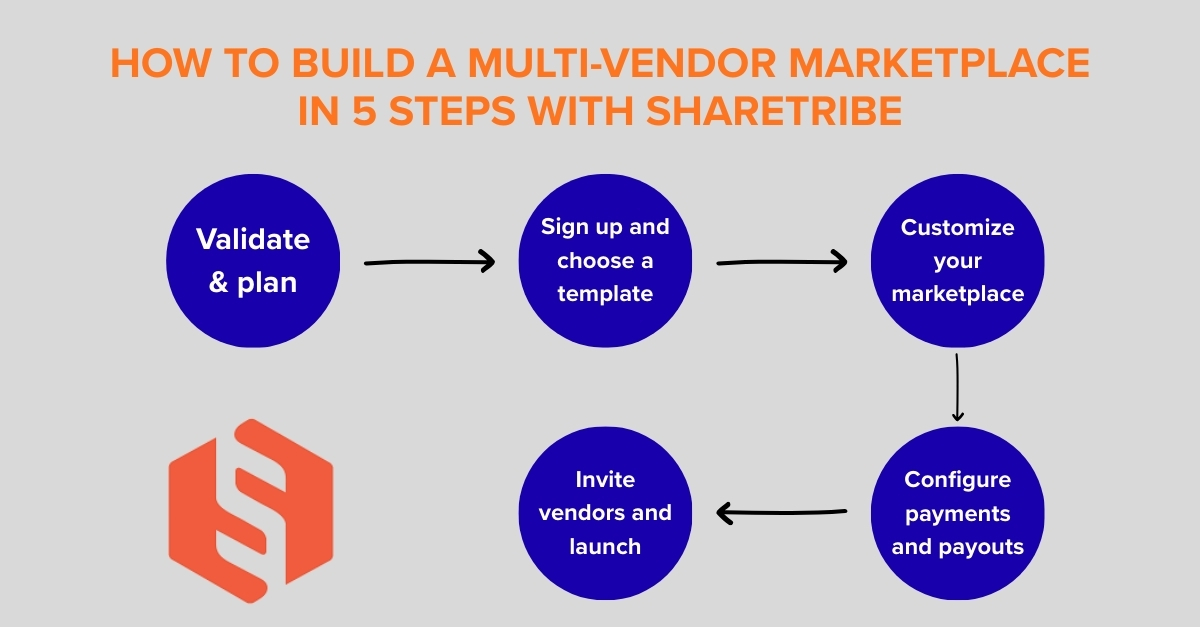
For entrepreneurs wondering how to create a multi-vendor website from scratch without a massive technical team, no-code platforms like Sharetribe offer a streamlined path. Here’s a simplified 5-step process to make a multi-vendor website using this approach:
- Validate & plan: Clearly define your niche, target audience, and revenue model before you start building.
- Sign up and choose a template: Create an account on Sharetribe and select a template that fits your marketplace type (product, service, rental).
- Customize your marketplace: Use the intuitive editor to configure your branding, set up commission rates, and define the categories for your listings.
- Configure payments and payouts: Connect a payment processor like Stripe to handle secure transactions and automate split payouts to your vendors.
- Invite vendors and launch: Onboard your initial vendors and open your digital doors to the public to start facilitating transactions.
This method dramatically reduces the time and cost to launch, allowing you to validate your concept and understand how a multi-vendor website works in a real-world environment before investing in heavy custom development.
Future trends and innovations in marketplaces
The marketplace space is not static. To future-proof your investment, keep an eye on these latest marketplace trends:
- Creator-led marketplaces: A new model where creators or influencers curate and sell products from partnered vendors, leveraging their audience’s trust to drive sales.
- Advanced, seamless checkouts: The future is in reducing friction. This includes one-click buying, saved payment methods, and the ability to start a purchase on one device (e.g., a social media app) and complete it on another.
- The rise of B2B marketplaces: The digitization of B2B trade is a massive opportunity. A b2b multi-vendor marketplace for micro-manufacturers or industrial parts is a growing frontier.
- Zero-UI and ambient commerce: The integration of voice-enabled transactions through smart devices and voice assistants (e.g., “Alexa, order more coffee beans from my favorite marketplace”) is on the horizon.
Conclusion: your journey begins now
Creating a multi-vendor website is one of the most exciting and rewarding entrepreneurial journeys in the digital age. It requires a blend of strategic vision, technical understanding, and relentless execution. The path from asking “how to create a multi-vendor marketplace website?” to launching a thriving platform is paved with challenges, but each one is surmountable with the right plan.
Remember to start with a validated idea, choose your technology stack wisely, focus relentlessly on solving the chicken-and-egg problem, and never stop iterating based on user feedback. Whether your goal is to create a website like Amazon or to build a niche multi-vendor rental marketplace for a specific community, the principles remain the same.
The digital agora awaits its next great space. It’s time to build yours, and with Roobykon Software as your technical partner, you have a dedicated team to engineer the platform that will power your community.
FAQ

Recommended articles
 Boost Your Sharetribe Marketplace with Zapier Integrations
Move past simple notifications. This in-depth guide teaches you how to build advanced, custom Zapier integrations for your Sharetribe marketplace. Create a truly intelligent, self-operating platform that grows with you.
 Sharetribe vs Bubble: Which No-Code Titan Wins for Your Marketplace Vision?
Stuck debating Sharetribe vs Bubble? The choice becomes simple once you define your primary goal. Learn whether you need a ready-made marketplace or a custom-built app to achieve your vision.
 Sharetribe vs WordPress: Which Platform Is Better for Building a Marketplace?
You have a visionary marketplace idea. But do you build on the specialized, speed-to-market engine of Sharetribe or the limitless, modular workshop of WordPress? The choice will define your launch, your budget, and your growth.
 Custom Car Rental Platform Development on Ruby on Rails or Quick Start with Sharetribe
Every car rental marketplace founder faces the same question: build a custom platform or start with a ready-made solution? Ruby on Rails offers flexibility, scalability, and advanced functionality, while Sharetribe provides speed and affordability. We compare both options, so you can make an informed choice that supports your long-term growth.