Medusa.js vs Sharetribe: Core Philosophies and Target Users
Medusa.js vs Sharetribe: Architectural and Technical Deep Dive
Key Feature Comparison and Use Cases in the Medusa.js vs Sharetribe Debate
When to Choose Which Platform? A Decision Framework
The Path Less Traveled: Migrating a Marketplace from Medusa.js to Sharetribe
Subscribe and you will promptly receive new published articles from the blog by mail
Building a multi-vendor marketplace is more possible than ever, but your very first decision – picking a platform – will shape everything. Do you choose the fast track or the fully-custom road? Understanding the difference between Medusa.js and Sharetribe is critical from the start.
The choice is stark. On one hand, there’s Sharetribe, a tool for entrepreneurs. Its goal is to get you from an idea to a live site in days. Statistics show its appeal: it powers over 500 active marketplaces, with its user base exploding by almost 600% in a single year, mostly driven by lean startups and solo founders.
On the other hand is Medusa.js, a developer’s toolkit. It doesn’t give you a finished site; it hands you the keys to an open-source engine. It’s built for scale and complexity, chosen by brands like Eight Sleep that grew to over $500 million in sales and needed to rebuild their entire fulfillment system from the ground up.
So, which is it for you? Are you testing a simple service idea and need validation fast, or are you building a complex, unique platform and need full control? This is the core of the Medusa.js vs Sharetribe decision.
Medusa.js vs Sharetribe: Core Philosophies and Target Users
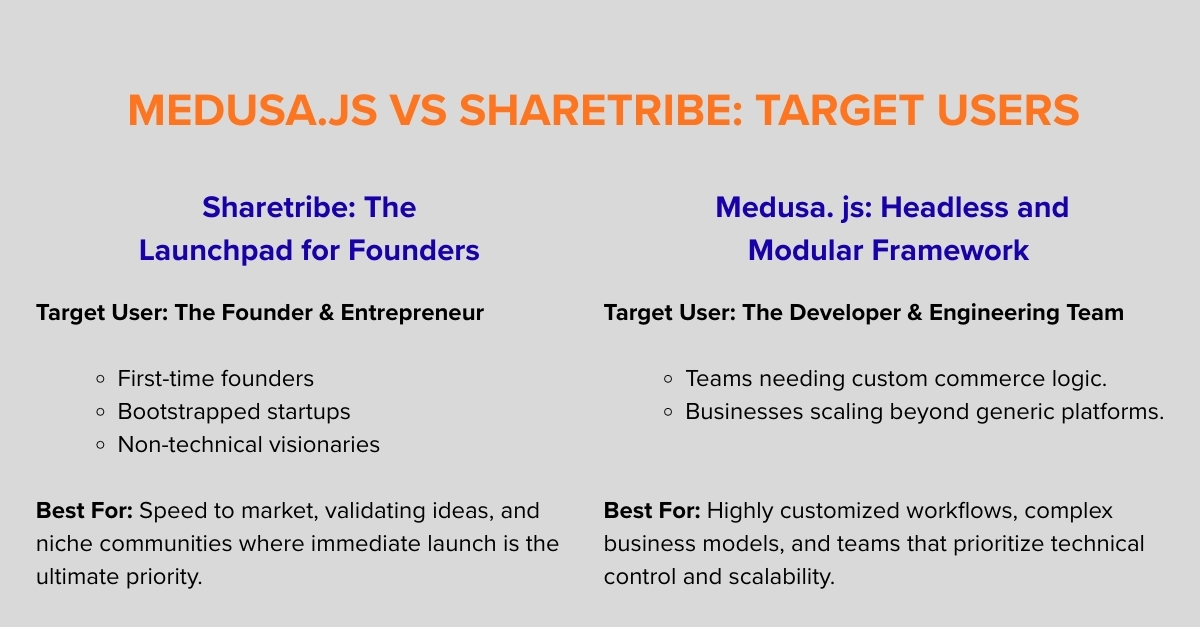
Sharetribe: The Launchpad for Founders
Sharetribe operates on a simple, powerful promise: get your marketplace business live, fast. It’s designed for founders and entrepreneurs, particularly those without a dedicated technical team. The platform emphasizes a “launch in a day” capability, providing a complete, hosted solution where the core marketplace functionalities – user management, listings, transactions, and payments – are ready out of the box. This allows you to focus on validating your business model, acquiring users, and growing your community from day one.
The journey usually starts right in their intuitive web console, letting you define your core marketplace logic, payment flows, and branding without touching code. You can go from a blank slate to a live, testable marketplace in a remarkably short time. When you’re ready to stand out, you can bring in a developer to customize the visual theme and connect advanced features through Sharetribe’s API. This “launch-first, customize-later” approach makes it a go-to for first-time founders, bootstrapped startups, and niche platforms where getting to market fast is the ultimate priority.
Medusa js: The Engine for Developers
Medusa js represents the other end of the spectrum. It brands itself as “the world’s most flexible commerce platform,” but at its heart, it’s a modular, open-source framework. Unlike a turnkey SaaS, Medusa provides the foundational commerce “primitives” – like carts, orders, and products – as building blocks. It’s designed for developers and engineering teams who need to construct a highly customized digital commerce experience, be it a B2C store, a complex B2B portal, or, with additional layers like Mercur, a sophisticated multi-vendor marketplace.
The philosophy here is freedom and ownership. As a true Medusa open source platform, it gives you full access to the code, eliminating vendor lock-in and granting complete control over your data, infrastructure, and feature roadmap. This makes it a compelling Medusa js alternative for scaling businesses that have outgrown generic solutions or have specific, complex workflows that off-the-shelf platforms cannot accommodate.
Core Philosophy & Best Fit
Aspect | Sharetribe | Medusa.js |
|---|---|---|
Primary Philosophy | Complete, hosted SaaS solution | Modular, open-source framework |
Ideal User | Non-technical founders, fast-moving startups | Development teams, businesses with complex needs |
Core Value Proposition | Speed to market & ease of use | Unlimited customization & control |
Initial Development Speed | Very Fast (days/weeks) | Fast with starters, but custom builds take longer |
Long-term Flexibility | Customizable within platform constraints | Essentially unlimited |
Medusa.js vs Sharetribe: Architectural and Technical Deep Dive
Sharetribe’s Integrated SaaS Architecture
Sharetribe offers a managed, cloud-based environment. You get a unified system where the database, application logic, and front-end templates are provided and maintained by Sharetribe. The platform handles hosting, security updates, and core server maintenance.
Customization is achieved through two main paths:
- No-code console: For configuring listing types, fees, and basic page content.
- Code-based customization: Developers can download the front-end React template and connect it to Sharetribe’s backend using Sharetribe’s API, allowing for deep customizations to design, user workflows, and transaction processes. However, the core backend logic and data model are proprietary and not open for modification. This structure provides stability and reduces initial complexity, but can become a constraint when business logic needs to diverge significantly from Sharetribe’s standard models.
Medusa js: Headless and Modular Framework
Medusa Node js is architected for the modern, composable tech stack. It is a headless backend, meaning it delivers commerce functionality via APIs, completely decoupled from the frontend. You can build your storefront with Next.js, React, or any other technology.
Its most powerful feature is its modularity. Every commerce function (cart, product, inventory) is a separate module. You can disable, extend, or completely replace these modules with your own custom code. This “Lego brick” approach means you can integrate a proprietary ERP for inventory, a custom PIM for products, or build a unique checkout flow without fighting the platform’s assumptions.
As an open source platform, the entire codebase is transparent and modifiable. You host it on your own infrastructure (e.g., DigitalOcean, AWS), giving you full control over performance, scalability, and cost. This architecture is inherently more complex to set up but offers unparalleled long-term adaptability.
Key Feature Comparison and Use Cases in the Medusa.js vs Sharetribe Debate
Marketplace Models and Customization
- Sharetribe excels at peer-to-peer (P2P) and service-based marketplaces. Its templates and default workflows are intuitively built for models like equipment rentals (an “Airbnb for X”), local services, or classifieds. Customization is strong on the front-end user experience and specific transaction flows. However, a case study revealed limitations for product-based marketplaces, such as lacking native support for product variants (e.g., sizes, colors).
- Medusa.js, especially when combined with its marketplace module Mercur, is agnostic to the business model. It provides the tools to build any model you can architect. It handles complex product variants, multi-warehouse inventory, and sophisticated B2B logic (like custom pricing catalogs) natively. The customization level is high, limited only by development resources. For instance, a football club used Medusa to unify ticket sales and merchandise in a single cart – a feat difficult for monolithic platforms.
Scalability, Performance, and Costs
- Sharetribe manages scalability on its end, promoting a “scale to any size” model. Costs follow a SaaS model: a monthly platform fee plus a transaction fee on sales. This is predictable initially, but can become a significant operational cost (OPEX) at high volume, as seen in the Natuja case, where the “pay as you grow” transaction fees became a burden.
- Medusa.js hands scalability to your team. Performance depends on your infrastructure choices, allowing for aggressive optimization. The cost model is fundamentally different: there are no licensing or transaction fees. Costs are primarily capital expenditure (CAPEX) for development and operational expenditure for your own cloud hosting. This can be more cost-effective at scale, though it requires in-house or agency technical management.
When to Choose Which Platform? A Decision Framework
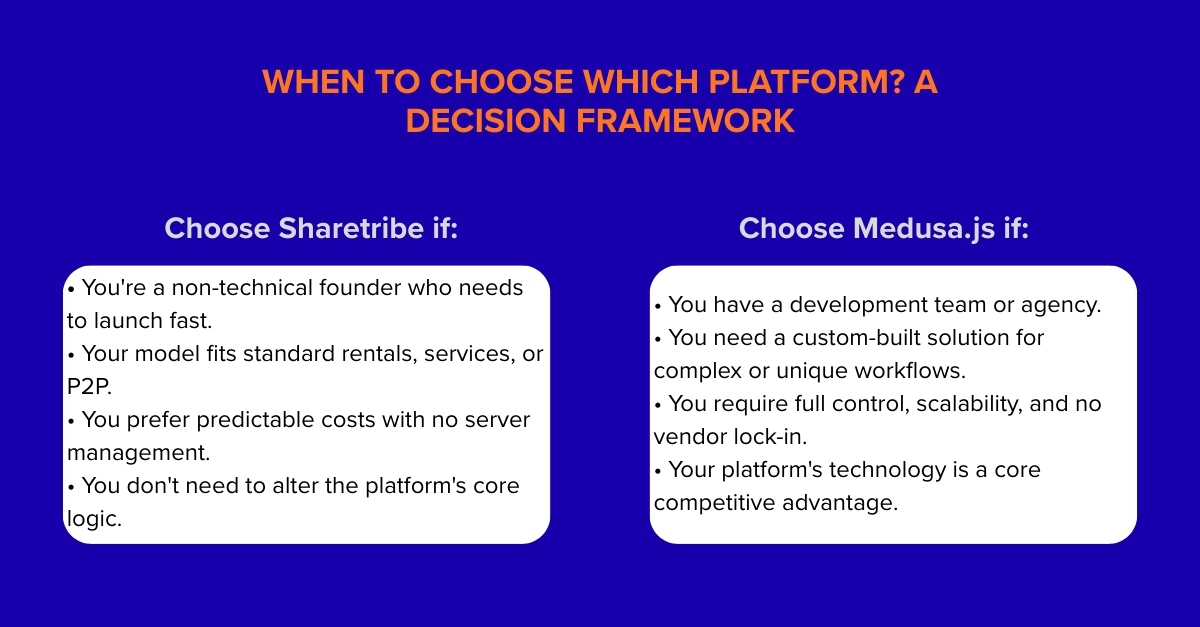
Choose Sharetribe if:
- You are a non-technical founder or a small team wanting to validate a marketplace idea quickly.
- Your business model aligns well with standard rental, service, or P2P models.
- You prefer a predictable, all-inclusive cost and do not want to manage servers or deep technical debt.
- You are comfortable with a “customize within bounds” approach and don’t foresee needing to alter fundamental platform logic.
Your choice of a foundational platform has long-term implications. While other tools like WordPress or Bubble can be adapted for commerce, building a dedicated marketplace on them often requires significant customization and plugin ecosystems to handle core features like multi-vendor transactions and trust systems. This is a key distinction we explore when we compare Sharetribe to WordPress and other generalised platforms – specialised tools are built for the job from the ground up.
Similarly, in a Sharetribe vs Shopify scenario for multi-vendor models, Sharetribe’s transaction-focused architecture is more native than trying to force Shopify into a true marketplace mold.
Choose Medusa js if:
- You have access to development resources (in-house team or a trusted agency like Roobykon).
- Your marketplace has complex, unique requirements – be it B2B workflows, digital products, intricate shipping rules, or deep integrations with existing systems.
- You are building a product-based marketplace with many variants and inventory complexity.
- Long-term control, cost efficiency at scale, and avoiding vendor lock-in are top priorities.
- You view your marketplace technology as a core competitive advantage that must be uniquely tailored.
Ultimately, selecting the right tool is about finding the one that supports your long-term vision. Suppose your primary goal is to launch and validate a multi-vendor concept without deep technical investment. In that case, the Sharetribe marketplace platform provides a powerful, all-in-one foundation to get started quickly. Successfully building on any platform, however, often hinges on expert execution.
For founders who want to customize Sharetribe beyond its out-of-the-box capabilities, hiring a developer with experience in the Sharetribe ecosystem can be the key to unlocking its full potential and tailoring it precisely to your business needs.
The Path Less Traveled: Migrating a Marketplace from Medusa.js to Sharetribe
An Uncommon Strategic Choice
While most technical migrations move from less flexible to more flexible platforms, the reverse scenario – migrating a marketplace from Medusa.js to Sharetribe – is a distinct and considered choice. This path is typically not about scaling up, but rather about simplifying down.
When Does This Migration Make Sense?
It may become relevant if a business with a custom-built Medusa open source platform undergoes a fundamental pivot to a much simpler, service-based, or P2P model that aligns perfectly with Sharetribe’s native strengths. The primary drivers are often a strategic decision to eliminate the overhead of maintaining a custom codebase, reduce long-term developer dependency, and transition to a predictable SaaS cost model.
The Challenges of Moving to a Standardized Framework
However, such a migration is a significant undertaking, as it involves mapping complex, custom data structures and workflows to Sharetribe’s more standardized framework. This often requires substantial data transformation, feature compromise, and a complete redesign of the user experience to fit within Sharetribe’s templated ecosystem.
A Trade-Off for Operational Focus
Ultimately, migrating a marketplace from Medusa.js to Sharetribe is a move made for operational convenience and focus, not for increased technical capability. It represents a deliberate shift from maximum customization to streamlined management, trading long-term flexibility for immediate operational simplicity.
Conclusion: Building Your Foundation for the Future
The difference between Medusa.js and Sharetribe is not merely about features; it’s a fundamental choice between speed and convenience versus control and ultimate flexibility.
- Sharetribe is your powerful launchpad. It democratises marketplace creation, turning an idea into a live platform in record time. It remains an excellent choice for many businesses whose needs align with its strengths.
- Medusa.js is your scalable engine. It is the Medusa open source platform of choice for those who see their technology as a strategic, evolving asset. It demands more technical investment but pays dividends in customization, ownership, and long-term total cost of ownership.
Before deciding, explore Sharetribe’s free trial to feel the user journeys. Simultaneously, review Medusa’s documentation and starter kits to gauge the development scope. As you Medusa.js compare Sharetribe, consider not just the starting point but the long-term path. For a broader perspective, you can see how we’ve compared Sharetribe to other platforms like Arcadier to help founders weigh all their options.
Ultimately, this decision comes down to your vision for the business. Are you in a sprint to launch and test your idea, or are you planning a marathon to build a uniquely complex platform? There’s no single right answer – only the right answer for you. Choosing Sharetribe could get you from “what if?” to your first paid booking in a matter of weeks. Choosing Medusa.js might mean a longer setup, but it builds a house you can redesign room-by-room years from now without ever needing to move. The goal is the same: a foundation sturdy enough to grow from your very first “Sold!” to your ten-thousandth and beyond.

Recommended articles
 Sharetribe vs WordPress: Which Platform Is Better for Building a Marketplace?
You have a visionary marketplace idea. But do you build on the specialized, speed-to-market engine of Sharetribe or the limitless, modular workshop of WordPress? The choice will define your launch, your budget, and your growth.
 Sharetribe vs Bubble: Which No-Code Titan Wins for Your Marketplace Vision?
Stuck debating Sharetribe vs Bubble? The choice becomes simple once you define your primary goal. Learn whether you need a ready-made marketplace or a custom-built app to achieve your vision.
 Sharetribe vs Shopify in 2026: What Fits Your Business Best?
The e-commerce landscape is full of options, but two platforms often stand out for very different reasons: Sharetribe and Shopify. But which one should you choose for your business model? This article takes you through a detailed comparison, and gives you the clarity you need to align your platform with your vision, budget, and technical resources.
 Custom Car Rental Platform Development on Ruby on Rails or Quick Start with Sharetribe
Every car rental marketplace founder faces the same question: build a custom platform or start with a ready-made solution? Ruby on Rails offers flexibility, scalability, and advanced functionality, while Sharetribe provides speed and affordability. We compare both options, so you can make an informed choice that supports your long-term growth.