Managed or true peer-to-peer: which model should you build?
What are the non-negotiable features of a P2P marketplace?
How should you set up payment infrastructure for a P2P marketplace platform?
Custom P2P development, Sharetribe, or a hybrid: which should you choose?
How do you build trust and safety into a P2P platform?
What should you ask your team about scalability and tech stack?
What are realistic timeline and budget benchmarks for a P2P marketplace?
How do you evaluate a P2P development partner?
What mistakes do founders make when scoping a P2P site build?
Subscribe and you will promptly receive new published articles from the blog by mail
Learning how to start a peer-to-peer marketplace really comes down to 3 early calls: who holds the money (a managed model or true peer-to-peer), what one transaction looks like from request to payout, and which build path you take: Sharetribe, a hybrid, or a fully custom build. Get those right, and most of what follows on your peer-to-peer marketplace platform – payments, trust, budget, and timeline – falls into place.
This article is written for founders, not developers. For each topic, we cover what you need to decide, what to bring to your team, and what it means for budget and timeline – with real Roobykon case studies and honest cost ranges for a peer-to-peer site.
You’ve already cleared the “should I even do this?” hurdle. It’s not about what to build anymore. It’s about how to build it right, and who to build it with.
So we skip the basics here. No niche selection, no business plans. If you still need that groundwork, start with what to know before launching a marketplace business, and see the marketplace model advantages for startups.
- Choose your model first. The managed vs. true P2P decision shapes roughly 80% of your payments, operations, and support load – write it down before development starts.
- 7 features are non-negotiable. Structured listings, search and filters, a clear booking or deal flow, messaging, identity verification, two-sided reviews, and an admin panel.
- Decide your money rules early. When the buyer is charged, when the seller gets paid, and what happens on cancellation or dispute. A marketplace-ready provider like Stripe Connect then handles splits, payouts, and refunds.
- AI can fix thin listings, but people approve them. AI can draft listings for sellers, but the seller (or an admin) approves each one before it goes live on your peer-to-peer online marketplace.
- Open source saves time, not responsibility. A P2P marketplace open-source base can save months, but you still pay for payments, trust features, and maintenance.
Managed or true peer-to-peer: which model should you build?
Decide this first, because it shapes roughly 80% of everything that follows. In a true peer-to-peer marketplace model, participants deal with each other directly and the platform supplies discovery and trust tools. In a managed model, the platform steps into the transaction: it holds the money, vets providers, and answers for quality.
The difference comes down to three questions. Who holds the money: an escrow-style hold or a direct payment? Who is responsible for quality: the platform or the participants? And how is trust built: through platform guarantees, or through reviews and verification?
Question | True peer-to-peer | Managed marketplace |
|---|---|---|
Who holds the money? | Participants pay each other directly, or the platform only passes payments through | The platform holds funds through a payments provider and releases them after fulfilment |
Who owns quality? | Participants, with reviews as the check | The platform, through vetting and standards |
How is trust built? | Verification, reviews, and cancellation rules | Guarantees, curation, and active dispute handling |
What breaks first? | Off-platform payments and thin listings | Operations and support load |
Where do most successful P2P platforms land?
In the middle. On Upisle and Drive lah, payments run through Stripe Connect and providers are verified, while providers and owners still set their own pricing. The platform protects the transaction; the participants own the product.
A peer-to-peer online marketplace that keeps money off-platform is cheaper to build and harder to protect. A peer-to-peer site that holds funds needs real payment and dispute handling, and people to run it. Neither is wrong, but each commits you to a different setup, budget, and support load, so choose deliberately and write the decision down before development starts.
What does each model mean for your budget?
A true P2P model keeps the first build lighter: fewer admin tools, simpler payouts, and a smaller support team. A managed model adds scope in three places: rules for holding and releasing money, admin tools for vetting and disputes, and the people who use those tools every day. If you’re unsure how to start a peer-to-peer marketplace without overspending, a middle-ground setup – payments on-platform, quality owned by participants – is usually the safest starting point, because it’s easier to add guarantees later than to take them away.
For the wider field, see these types of marketplace business models.
What are the non-negotiable features of a P2P marketplace?
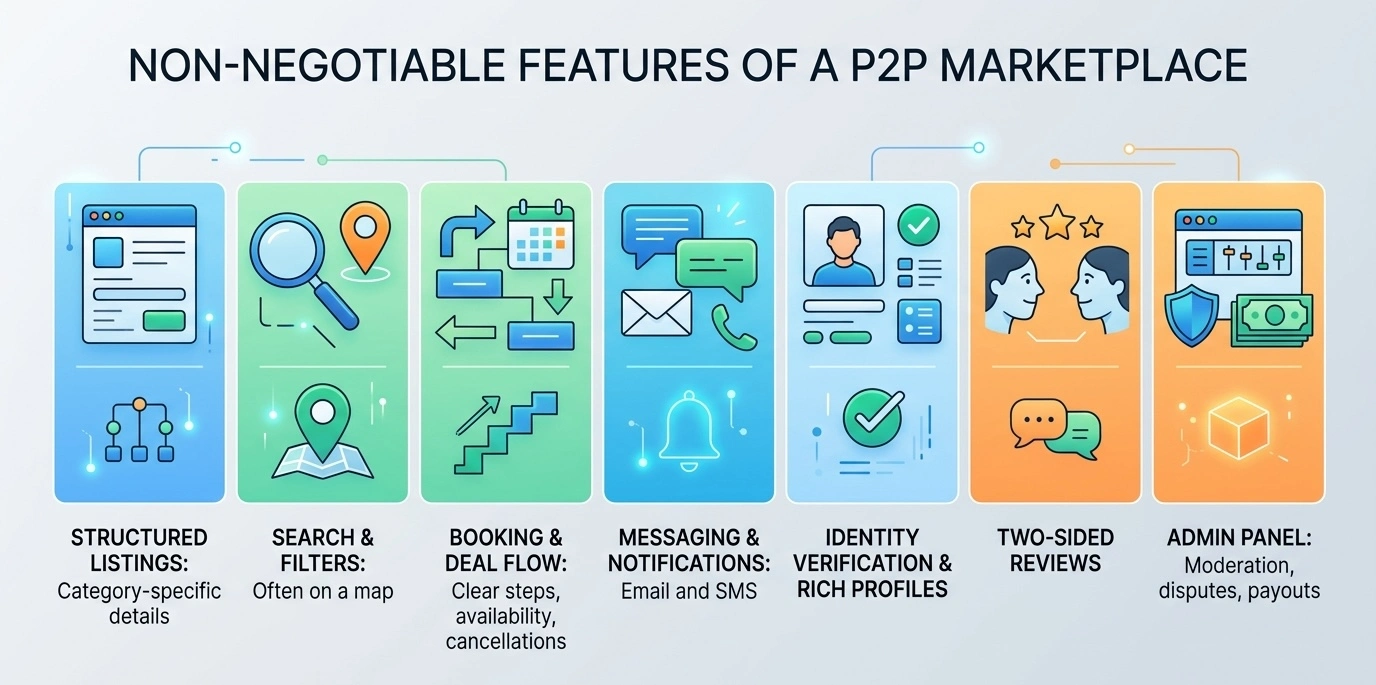
Any peer-to-peer marketplace platform needs 7 features, and skipping any of them usually shows up later as a support problem:
- Structured listings with the details each category needs
- Search and filters, often on a map
- A booking or deal flow with clear steps, availability, and cancellations
- Messaging and notifications by email and SMS
- Identity verification and rich profiles
- Two-sided reviews
- An admin panel for moderation, disputes, and payouts
On Sharetribe, most of these come ready-made, which is why creating a peer-to-peer marketplace on Sharetribe can ship an MVP in weeks. On a fully custom build, each one is scope you pay for.
What should you bring to your development team?
You don’t need to design the database – that’s your team’s job. What only you can supply is how your business actually works. Bring two documents to your first workshop, and you’ll save weeks of back-and-forth as you build a peer-to-peer marketplace.
1. A category sheet. List every category you plan to launch with, and for each one, the details a buyer needs before they commit. On Upisle, Jet Skis, Boats, Yachts, and watersport equipment each have their own fields. Mark which fields are required, which should work as search filters, and which categories you expect to add in the next year – that tells your team how flexible the setup needs to be. A simple version looks like this:
Category (example) | Details a buyer needs | Used as a filter |
|---|---|---|
Boat | Length, passenger capacity, captain included, licence required | Capacity, captain |
Jet Ski | Engine power, number of riders, minimum age | Number of riders |
Equipment | Type, size, quantity available | Type |
2. A deal map. Walk through one deal step by step, from request to payout. For each step, note who acts, what happens to the money, and what each side is told:
Step | Who acts | What happens to the money |
|---|---|---|
Buyer sends a request or books instantly | Buyer | Card is held or charged – your call |
Seller accepts or declines | Seller | On decline, the buyer is refunded automatically |
The rental or service happens | Both | Funds stay with the payment provider |
Deal is marked complete | Platform | Seller is paid out, minus your commission |
Both sides leave reviews | Both | – |
Then map the moments things go wrong. What if the buyer cancels? The seller cancels? Someone doesn’t show up? The item comes back damaged? Each answer becomes a rule your team builds in.
What it means for budget: every extra step or exception in the deal map adds design, development, and testing time. One clear main path with a handful of defined exceptions keeps an MVP at the lower end of the ranges below. If prices are negotiated rather than fixed, see how a quote-based marketplace transaction flow works in production.
Can AI help sellers create better listings?
Yes, and it targets the real cause of thin listings. Most sellers on a P2P site are locals, not merchants, and a long form is where good listings die. If you’re wondering how to make a peer-to-peer website people actually fill with good listings, start with the listing form, not the homepage.
On an outdoor gear marketplace we worked on, the seller starts with a product name or link, AI drafts the listing, and the seller reviews and edits it. The AI never publishes on its own. That review matters: a product page describes the catalogue model, not the scuffed item in someone’s garage. And if the AI is ever unavailable, the regular form still works, so sellers are never stuck.
Before you add it, settle three things with your team:
- Who approves AI drafts: the seller, an admin, or both?
- Which details must the seller always confirm, such as price, condition, and availability?
- What will AI usage cost each month at your expected listing volume?
It’s a practical way to create a P2P website whose listings mostly fill themselves in.
How should you set up payment infrastructure for a P2P marketplace platform?
Use a payments provider built for marketplaces, such as Stripe Connect, so splits, payouts, and refunds run through it instead of through your own bank account. Upisle and Drive lah both run on Stripe Connect. Regulation varies by country, so check the specifics with a lawyer and your provider.
Capability | Why a P2P marketplace needs it | Example from our builds |
|---|---|---|
Split payments and commission | The platform takes a fee, and the seller receives the rest | Stripe Connect on Upisle and Drive lah |
Provider onboarding and ID checks | You only pay out to verified sellers | Stripe Identity for provider IDs on Upisle |
Cancellation and refund rules | Deposits and partial refunds need defined policies | Upisle: Flexible, Moderate, and Strict policies, from free cancellation until 24 hours before start to 30 days before |
Owner approval and refunds | Declined requests must refund the renter automatically | Drive lah: owner cancellation notifies the renter and starts a refund |
Payout scheduling | Sellers manage their own cash flow | Drive lah: owners can reschedule payouts |
Which money rules do you need to decide?
Your team builds the payment logic, but the rules behind it are business decisions, and only you can make them. Write them down as a one-page money policy:
- When is the buyer charged? At request, on acceptance, or just before the start date.
- When does the seller get paid? Right after completion, or after a short holding period for complaints.
- What happens on cancellation? By each side, at each point in time – and whether your commission is refunded too.
- What happens on a decline, no-show, or dispute? And who decides the outcome.
- Who pays processing fees, and do you take deposits?
Creating a peer-to-peer marketplace on Sharetribe gives you standard payment flows out of the box, but it doesn’t make these decisions for you, so it’s worth understanding how Sharetribe marketplace payments work before you settle payouts. Clear rules also give support and finance a straight answer when a user asks, “where’s my money?”
What it means for budget: standard flows through Stripe Connect are among the cheapest parts of a Sharetribe build. Deposits, partial refunds, custom split rules, and multiple currencies each add scope, and they’re built into every booking, so changing them after launch costs more than deciding now.
Custom P2P development, Sharetribe, or a hybrid: which should you choose?
Pick Sharetribe when speed matters and your transaction fits its model, custom development when your logic is unusual, and a hybrid when you need both. Dozens of solutions we built landed on the hybrid: Sharetribe at the core, with custom work where the product differs.
Option | Best for | Trade-off |
|---|---|---|
Sharetribe, configured | Fast validation and standard rental or booking flows | Bound by Sharetribe’s standard transaction model |
Custom build | Unusual transaction logic, full control, long-term scale | Highest cost and longest timeline |
Hybrid | Speed plus a differentiated product | Needs a team fluent in both sides |
How do you know which path fits?
To decide how to make a peer-to-peer website that fits your niche, take your deal map and compare it with what Sharetribe does out of the box:
- Your deal follows a standard booking, rental, or purchase flow. Configured Sharetribe is likely enough to launch and validate.
- Most of it fits, but a few steps differ – trip extensions, special pricing, an extra approval. A hybrid keeps the standard core and adds custom work only where it’s needed.
- The deal itself is unusual – several parties per transaction, auctions, or rules a standard flow can’t express. A custom build is usually the honest answer.
What does Sharetribe cost?
Sharetribe changed its pricing in October 2026 and now offers two plans: Build at $39 a month for building and testing, and Live at $199 a month billed yearly ($259 billed monthly) for running with real users and payments. Live includes full code and API access, so custom features on a live Sharetribe marketplace no longer require a separate top-tier plan, and Sharetribe charges no transaction fees. Both plans include 1M usage credits a month, with heavier usage billed on top.
Sharetribe hosts and secures the backend; any custom code your team adds is hosted separately. Roobykon is a Sharetribe Verified Expert.
What does a hybrid build look like in practice?
Drive lah shows it well. Owners and renters needed to modify and extend trips, but Sharetribe’s standard booking flow doesn’t cover changing a trip midway. Rather than rebuild booking and payments, we added changes as linked bookings inside the original trip – we call them Child Transactions. Renters can extend, owners are paid for the extra time, and the core flow stays untouched.
That’s the practical answer to how to create a peer-to-peer website without rebuilding payments and identity from scratch. When you compare backend web technologies for peer-to-peer site builds, the useful question isn’t which framework – it’s what comes ready-made. Every piece you don’t have to build (payments, identity, search, booking) is budget you can spend on what makes your niche different.
If you want to start a P2P marketplace without overcommitting, begin on the core. In our experience, Sharetribe is the fastest way to test an idea, and many platforms move toward custom P2P marketplace development as they outgrow the template. When you build a peer-to-peer marketplace this way, migration is a planned step, not a rewrite.
How do you build trust and safety into a P2P platform?
Layer identity checks, transaction protections, and reputation, because strangers only transact when the risk feels low. A peer-to-peer online marketplace is really a trust product with a booking engine attached.
Layer | What to decide | Example from our builds |
|---|---|---|
Identity | Which users must verify ID and phone, and when | Stripe Identity for provider IDs and Twilio phone verification on Upisle |
Transaction protection | Approval or instant booking, cancellation rules, refunds | Upisle’s three cancellation policies; owner confirmation on Drive lah |
Reputation | Two-sided reviews and when they become visible | On Drive lah, feedback becomes visible only once both sides have submitted it |
Moderation | Who reviews listings and handles disputes | Outdoor gear owners review every AI-drafted listing before it goes live |
What about insurance and regulation?
Plan for them early. On Drive lah, insurance rules, liability frameworks, and local laws across several jurisdictions were an ongoing challenge, and we worked through them closely with the relevant authorities. Requirements depend on your niche and country, and a car, a boat, and a spare room are regulated very differently. Budget for legal advice before launch, not after.
Then make the safe path the easy one: default cancellation policies, visible verification, and clear dispute steps. Peer-to-peer websites don’t need perfect safety. They need visible rules that both sides accept before money moves.
What should you ask your team about scalability and tech stack?
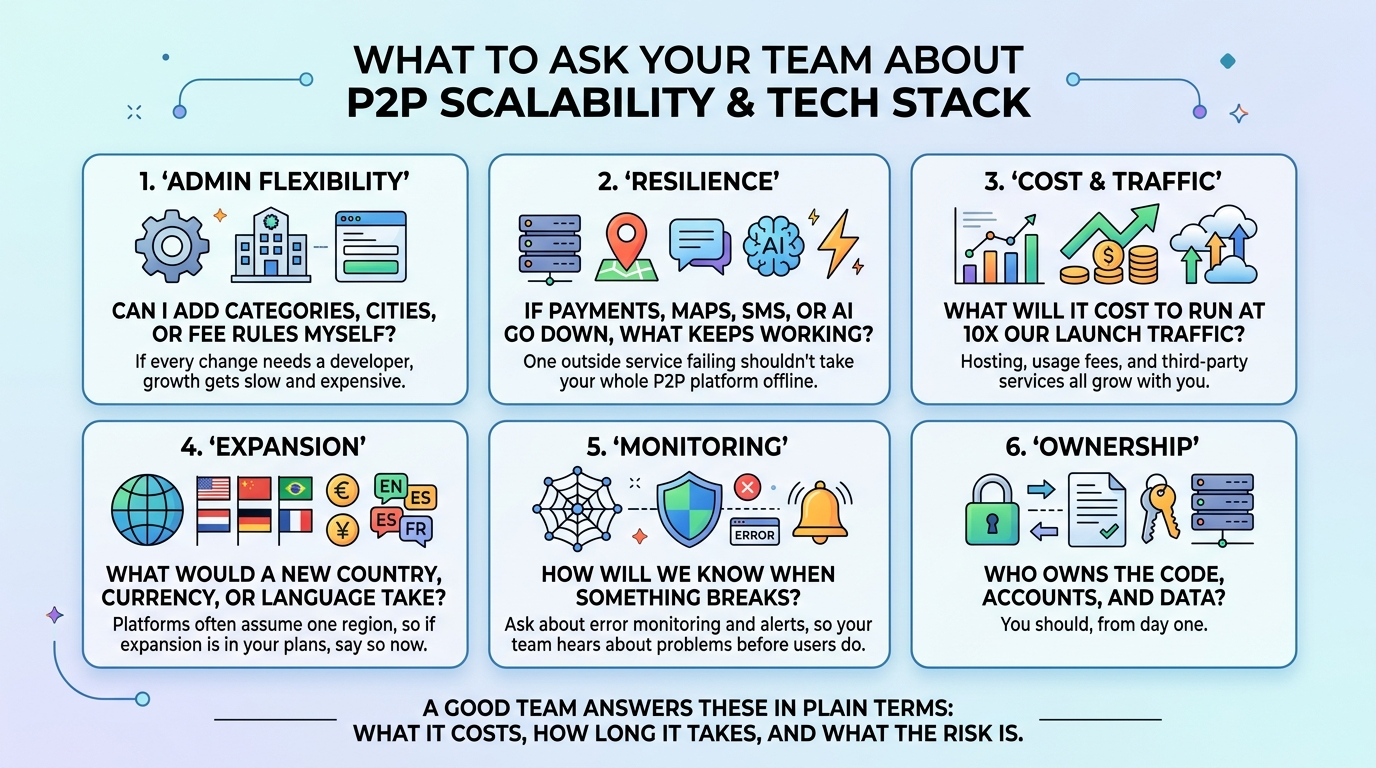
You don’t need to choose the stack yourself, but you do need to know what you’re signing up for. The right questions are about cost, control, and what happens when something breaks:
- “Can I add a category, city, or fee rule myself?” If every change needs a developer, growth gets slow and expensive.
- “If payments, maps, SMS, or AI go down, what keeps working?” One outside service failing shouldn’t take your whole P2P platform offline.
- “What will it cost to run at 10x our launch traffic?” Hosting, usage fees, and third-party services all grow with you.
- “What would a new country, currency, or language take?” Platforms often assume one region, so if expansion is in your plans, say so now.
- “How will we know when something breaks?” Ask about error monitoring and alerts, so your team hears about problems before users do.
- “Who owns the code, accounts, and data?” You should, from day one.
A good team answers these in plain terms: what it costs, how long it takes, and what the risk is.
What do our flagship P2P builds run on?
Project | Build path | Where the custom work went | Payments, sign-in, and trust |
|---|---|---|---|
Upisle | Sharetribe, extended with custom changes | Four listing types, hourly and daily booking, map search | Stripe Connect, Stripe Identity, Twilio |
Drive lah | Sharetribe, extended with custom changes | Trip modification and extension, excess reduction, payout rescheduling | Stripe Connect; Facebook, Google, and Apple login |
Wilder Places | Sharetribe Web Template, extended with custom code on the Core API | Admin-managed translations, seasonal availability, fixed-date tour listings, a 12-month booking window | Sharetribe’s built-in transactions; map search; up to five Google reviews per listing |
None of the three needed a backend built from scratch. The custom work went only where each niche was different.
Should you use open source?
Yes, in parts, and only after checking what you inherit. A peer-to-peer marketplace open-source stack can save months, but it still needs payments, trust features, and someone to maintain it.
Sharetribe’s Web Template is a good example: an open-source front end (Apache-2.0 license) that your team customizes, while the marketplace backend stays hosted by Sharetribe. You skip the cost of building the backbone, but you still pay to customize, host, and update the front end.
Before adopting any P2P marketplace open-source project, ask your team:
- Does the license allow a commercial product?
- Is the code actively maintained, and who will update it after launch?
- What’s missing – transaction rules, ID verification, payouts, notifications – and what will filling those gaps cost?
- What will hosting and upkeep cost each month?
What are realistic timeline and budget benchmarks for a P2P marketplace?
Expect roughly $10,000–$30,000 and 4–8 weeks for a Sharetribe-based MVP, and $50,000–$150,000 and 4–9 months for a mid-complexity custom build. These are Roobykon’s published estimates, not quotes, and your scope will move them. Use them as a starting point if you’re planning how to create a peer-to-peer website from scratch.
Path | Typical budget | Typical timeline |
|---|---|---|
Sharetribe-based MVP | $10,000–$30,000 | 4–8 weeks |
Mid-complexity custom build (multi-vendor, payment splitting, reviews) | $50,000–$150,000 | 4–9 months |
Complex custom build (mobile apps, scale ambitions) | $80,000–$250,000+ | A year or more of continuous development |
What moves your number?
Most of the gap between the low and high end comes from decisions you control:
- The number of categories and listing types, each with its own details
- Exceptions in your deal map: cancellations, deposits, disputes, extensions
- Managed-model tooling for vetting, dispute handling, and payout controls
- Native mobile apps on top of the web platform
- Integrations such as ID checks, SMS, maps, insurance, and accounting
- More than one country, currency, or language at launch
Moving two or three of these to version two is usually the fastest way to bring a quote down without hurting the core product.
What do real timelines look like?
Wilder Places is a useful reference: work started on November 1, 2025, and the marketplace went live on December 4, 2025, because the roadmap was split into launch must-haves, nice-to-haves, and future features. A full redesign followed in 2026 on the same foundation.
AI-assisted development now shortens schedules like this further. On our builds, AI coding tools take on much of the repetitive work – boilerplate, routine form and page changes, test scaffolding, and first drafts of integrations – while our engineers review every change and spend their time on transaction logic, payments, and edge cases. Sharetribe itself now positions its open, API-first setup as built for AI-assisted coding. The savings land mostly in routine scope, so use them to fit more into version one or launch sooner, not as a discount on the hard parts.
Launch one core transaction first, then expand. For the full sequence on how to build a peer-to-peer marketplace website, see these steps to launch a marketplace website, and if you want to start a P2P marketplace lean, this is the order to follow.
What ongoing costs should you plan for?
Running costs are easy to underestimate, so plan them alongside the build. Here’s what to expect at the time of writing (October 2026):
Cost | What to expect |
|---|---|
Sharetribe subscription | Build: $39 a month while you build and test. Live: $199 a month billed yearly, or $259 billed monthly. No Sharetribe transaction fees. |
Sharetribe usage | 1M usage credits a month included. Beyond that, usage is billed per 1,000 credits, from 7¢ down to 0.5¢ as volume grows. Sharetribe’s own customer examples range from $0 a month for small marketplaces to over $1,000 for rental platforms handling around 11,000 transactions a month. |
Payment processing | Stripe’s fees, typically around 1.5–3% of each transaction |
Custom code hosting | Paid separately if you extend Sharetribe with custom features |
Other services | Maps, SMS, ID checks, and AI are usually billed by usage |
Maintenance and new features | 15–25% of the original build cost per year |
If you’re on a legacy Sharetribe plan, the switch happens on December 1, 2026: Pro and Extend subscriptions move to the Live plan automatically (Extend customers see their base price drop to Live’s), while Lite customers can stay on their plan as long as they don’t change it. From that date, usage-based pricing applies to everyone once they exceed the included credits. Pricing changes, so check Sharetribe’s pricing page before you finalize your budget.
How do you evaluate a P2P development partner?
Judge a partner on the marketplaces they’ve shipped, how deeply they handle payments, and how they scope, not on price or a slide deck. Ask them to walk you through a live P2P marketplace product and explain what they would change.
What to check | What to ask | Red flag |
|---|---|---|
Shipped P2P products | Can you show live marketplaces in my model? | Only generic e-commerce work |
Payments depth | How do you handle split payouts, refunds, and payout timing? | Payments treated as a plugin added at the end |
Platform fluency | Do you work on both Sharetribe and custom code? | One approach pushed onto every project |
Scoping process | Who is on the team, and how do you scope? | No discovery phase, or no analyst, designer, QA, and DevOps |
Ability to grow | How would the platform handle 100K, 1M, and 10M users, and what would that cost? | No concrete answer on scaling |
Founder communication | Can you explain each decision in terms of cost, timeline, and risk? | Answers only in technical jargon |
After launch | What support and updates follow delivery? | The team disappears at handover |
Any team can show a portfolio. The useful question is how they would build a peer-to-peer marketplace like yours, and whether the answer shows they know how to make a peer-to-peer website that survives real users. Then check references beyond ratings and talk to a founder whose product is live.
What mistakes do founders make when scoping a P2P site build?
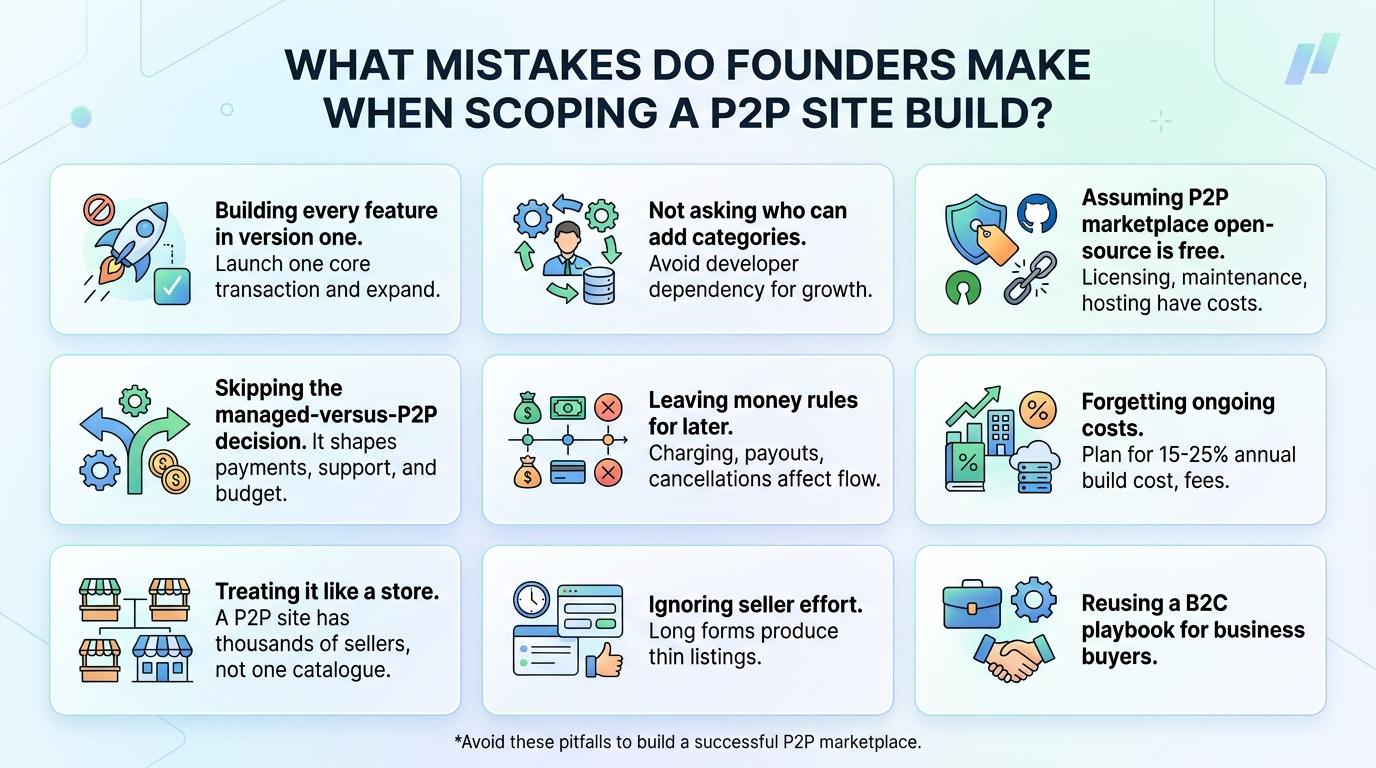
The most common are trying to build everything at once and leaving the hard decisions until after launch. Watch for these:
- Building every feature in version one. Launch one core transaction and expand.
- Skipping the managed-versus-P2P decision. It shapes your payments, support, and budget.
- Treating it like a store. A P2P site has thousands of sellers, not one catalogue.
- Not asking who can add categories. If every new category needs a developer, each one becomes a small project with its own invoice.
- Leaving money rules for later. Charging, payouts, and cancellations shape the whole deal flow.
- Ignoring seller effort. Long forms produce thin listings.
- Assuming peer-to-peer marketplace open-source code is free. Licensing, maintenance, and hosting all cost something.
- Forgetting ongoing costs. Plan for 15–25% of the build cost each year, plus subscription and usage fees.
- Reusing a B2C playbook for business buyers. Read how to create a successful B2B marketplace first.
Most of these are cheap to avoid during scoping and expensive to fix after launch. That’s why peer-to-peer websites benefit from a proper discovery phase before any code is written.
Which P2P marketplaces has Roobykon built?
Among many: Upisle, Drive lah, and WilderPlaces, plus the AI listing assistant on a P2P platform described earlier. Each is a peer-to-peer marketplace platform we built or extended, and each shows the decisions above in production.
Upisle: how did a watercraft marketplace handle four listing types?
Upisle is a peer-to-peer watercraft rental marketplace based in Miami, Florida. We built it on Sharetribe, extended with custom features, and it launched in September 2023. Providers list Jet Skis, Boats, Yachts, and watersport equipment, each with its own fields.
Booking runs hourly or daily, and instant booking skips provider confirmation. Three cancellation policies (Flexible, Moderate, and Strict) are built into every booking. Stripe Connect handles payouts, Stripe Identity checks provider IDs, Twilio covers phone verification and notifications, and Mapbox lets renters search by location on a map.
The big lesson: flexible booking options matter more than you’d think, and payments, design, and the platform behind them have to work as one connected system. If you want to build a peer-to-peer marketplace with multiple listing types, this is what it looks like when it’s actually running.
Drive lah: how do you extend a live car-sharing marketplace?
Drive lah is a peer-to-peer car-sharing marketplace in Singapore, with a sister brand, Drive mate, in Australia. We inherited a live platform and extended it instead of starting over. The hardest part was adding Trip Modification and Extension without breaking Sharetribe’s standard booking flow.
Our answer was Child Transactions: linked bookings inside the original trip, so new features reuse the core flow while staying separate from it. We also added Apple login, excess reduction for renters, and payout rescheduling for owners. Reviews stay hidden until both sides submit theirs, which keeps feedback honest.
This is a good look at what it actually takes to extend a peer-to-peer online marketplace after launch. Sometimes you just need to be smart about where you add things.
Wilder Places: what does a one-month launch look like?
Wilder Places is a nature-based tourism marketplace launched under the umbrella of Rewilding Europe. Travelers book stays, day experiences, and multi-day tours in rewilding landscapes across Europe, and local guides, landowners, and small operators get a dedicated channel to sell them.
The process of developing this peer-to-peer online marketplace was simple and disciplined: the roadmap was split into launch must-haves, nice-to-haves, and future features, and the marketplace went live just over a month after work began, in December 2025. Hosts can set seasonal availability and a minimum booking notice, guided tours use a custom listing type with fixed dates, travelers can book up to 12 months ahead, and admins manage translations section by section without a developer.
What do these projects have in common?
Project | Niche | Timeline | Signature decision |
|---|---|---|---|
Upisle | Watercraft rentals, Miami | Launched September 2023 | Four listing types with their own fields, plus hourly and daily booking |
Drive lah | Car sharing, Singapore and Australia | Feature work from 2019 on an existing platform | Child Transactions for trip extensions |
Wilder Places | Nature-based stays, experiences, and tours across Europe | Live in December 2025, about a month after kickoff; redesigned in 2026 | Seasonal availability and fixed-date tour listings |
Creating a peer-to-peer marketplace on Sharetribe was the common thread, and the custom work went where each niche needed it. When you create a P2P website with features beyond the defaults, keep them separate from the core, so your budget goes into differentiation, not plumbing.
Ready to talk about your build?
If you're still working out how to create a peer-to-peer website that fits your niche, we'll give you an honest assessment of scope, timeline, and cost, and tell you whether Sharetribe, a hybrid, or a fully custom build fits best.
Contact usFAQ

Recommended articles
 How to Create a Nanny & Babysitter Marketplace That Parents Actually Trust
Parents don’t trust nanny marketplaces because of design – they trust verification, background checks, real reviews, and responsive support. This guide compares Sharetribe vs custom builds, explains must-have features, and shows how Roobykon approaches safe childcare platforms.
 How to Build a Marketplace with Sharetribe: A Complete Guide
What can you build with no-code Sharetribe, and when do you need a developer? This article provides a clear roadmap for founders.
 How to Build a Camping Marketplace That Actually Gets Bookings
How much does it cost to build a camping marketplace? Should you use Sharetribe or build custom? What features does your platform actually need? Get all the answers in this complete guide.
 How to Build an Online Marketplace Website (Complete Guide for 2026)
You have a marketplace idea. Now what? This complete guide answers the questions every founder faces: How do I validate my concept? What features actually matter in an MVP? This article provides practical answers to the challenges of building a marketplace startup from scratch.