Understanding the B2B Online Marketplace Market in 2026
Key Stages of B2B Digital Marketplace Development
Functionality That Makes a B2B Platform Successful
Monetization Strategies for the B2B Segment
B2B Startup Challenges and How to Overcome Them
Our Experience in Building B2B Platforms
Ready to Build? Roobykon Turns B2B Digital Marketplace Vision Into Reality
Subscribe and you will promptly receive new published articles from the blog by mail
Let’s start with a number that should grab your attention: $406.3 billion.
That’s the projected value of the global B2B e-commerce platform market by 2035, growing at a compound annual rate of 12.55% from its $12.46 billion base in 2025. But here’s what those numbers don’t tell you: over 68% of B2B buyers now prefer digital self-serve channels, and more than 61% have integrated automated procurement systems.
Yet most companies rushing to create B2B marketplace platforms are getting it wrong.
They build B2C experiences with bigger price tags and call it a day. They slap together a B2B online platform that looks professional but fails at the one thing that matters: making complex business transactions feel effortless.
This isn’t another generic guide. This is a strategic blueprint for 2026 – built on fresh data, real implementation experience, and a clear-eyed understanding of what separates thriving B2B digital marketplaces from expensive digital ghost towns.
Understanding the B2B Online Marketplace Market in 2026
The B2B platform landscape has fundamentally shifted. How a B2B website works today bears almost no resemblance to the digital catalogs of five years ago.
Here’s what the data shows about today’s B2B buyer: over 72% research suppliers online before engaging directly, and more than 70% of enterprises now report consistent cross-platform engagement. The old model of relationship-driven, offline-first procurement is dying. In its place, businesses expect B2B e commerce website functionality that rivals their consumer experiences – but with enterprise-grade depth.
The Three Platform Types Reshaping the Market
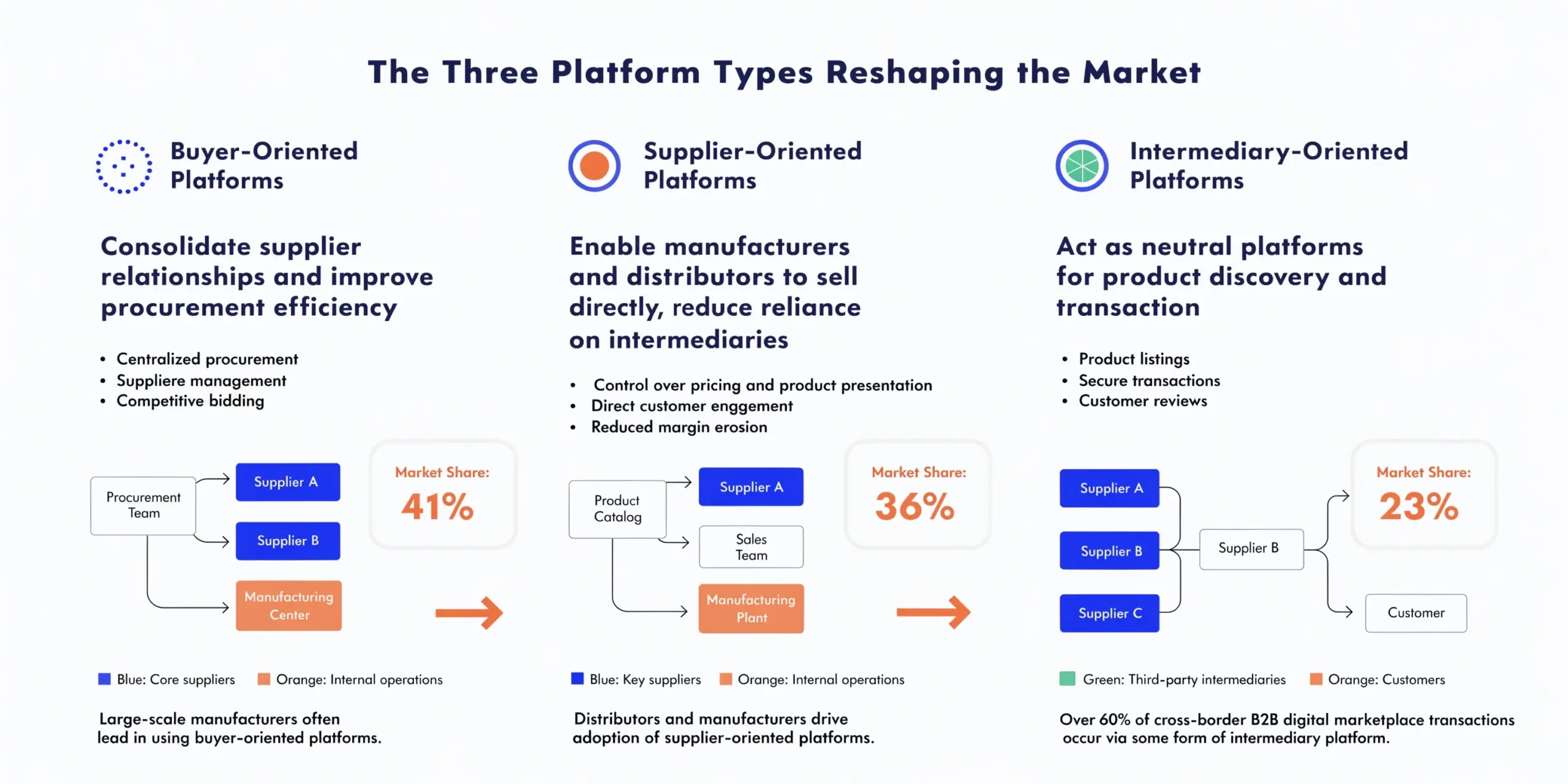
When you decide to build a B2B marketplace, you’re not building one thing. You’re choosing between three distinct models, each with its own economics:
- Buyer-oriented platforms (41% market share) put procurement control first. These are for businesses that want centralized purchasing, supplier management, and competitive bidding. Think: large manufacturers consolidating supplier relationships.
- Supplier-oriented platforms (36% market share) flip the script. Manufacturers and distributors use these to sell directly, bypassing intermediaries and protecting margins. The appeal is complete control over pricing, product presentation, and customer relationships.
- Intermediary-oriented platforms (23% market share) are the pure marketplaces – neutral ground where discovery and transaction happen. Over 60% of cross-border B2B digital marketplace transactions now flow through some form of intermediary platform.
The fastest-growing segment? Vertical-specific platforms serving industries like pharmaceuticals, industrial components, and medical supplies. Generalists are losing to specialists who understand domain-specific workflows, compliance requirements, and procurement cycles.
Key Stages of B2B Digital Marketplace Development
Niche Research and Idea Validation
Before you spend a dollar on development, spend time answering one question: What specific, painful, expensive problem are you solving for both sides of the market?
The most successful B2B online marketplace platforms start narrow. Very narrow.
Consider the numbers: 58% of businesses report integration issues as their primary barrier to adopting new platforms, and 49% cite data interoperability gaps. That’s not a feature gap – it’s a trust gap. Your validation phase must include:
- Deep interviews with at least 20 potential buyers about their current procurement frustrations
- Supply-side economics analysis – what makes sellers willing to pay you a cut of their margin?
- Workflow mapping of existing offline processes. Every step you digitize should save time or reduce errors.
The validation question most founders skip: “If your top supplier joined this platform tomorrow, would you use it?” If the answer isn’t an immediate yes, you haven’t found the right pain point.
Choosing the Right Technology Stack
Here’s where most projects veer off course. How to make B2B website decisions often gets driven by developer preference rather than business reality.
For building B2B marketplace platforms in 2026, you have three paths:
Path one: Custom development ($30,000–$50,000+ initial investment)
Full control, complete customization, no platform limitations. The trade-off? Longer timelines, higher risk, and significant ongoing maintenance costs. Best for B2B enterprises with unique workflows or compliance requirements that off-the-shelf solutions can’t handle.
Path two: Platform-based development with expert partners ($10,000–$29,000+)
This is where the Roobykon development company specializes, leveraging powerful white-label solutions like Sharetribe as a foundation, then building custom functionality on top. You get enterprise capabilities with startup speed. For most B2B marketplaces, this is the sweet spot.
Path three: SaaS marketplace tools (10,000 – $49,999)
Quick to launch, but you’ll hit limitations fast. Custom pricing? Complex approval workflows? ERP integration? Most SaaS tools crumble under real B2B requirements.
The technology decision is about whether your architecture can evolve. Over 53% of businesses report that performance limitations in their initial platform choice created costly migration needs later.
Designing UX/UI for Business Users
Consumer design principles don’t translate to a B2B platform. Your users aren’t browsing, they’re working.
- A procurement professional managing 500+ SKUs across 20 suppliers needs efficiency, not delight. Your design must prioritize:
- Information density without chaos. Business users can handle complex tables and data visualizations – they actually prefer them to image-heavy, scroll-intensive consumer layouts.
- Workflow continuity. Every action should feel like a natural extension of how they already work. Break their mental model, and you’ve lost them.
- Progressive disclosure. New users see simplicity. Power users find depth. The same interface serves both through smart information architecture.
The data backs this up: 94% of first impressions are design-related, but for B2B, “good design” means task completion speed, not visual flair.
Functionality That Makes a B2B Platform Successful
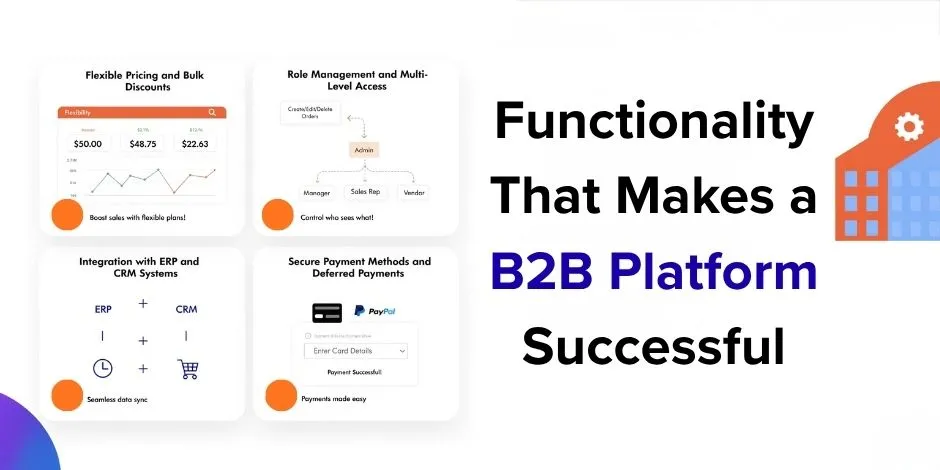
Flexible Pricing and Bulk Discounts
Consumer websites have one price. A B2B platform has dozens, and they change based on who’s asking.
Your marketplace needs tiered pricing structures, volume discounts, contract pricing, and promotional pricing – all co-existing without confusion. More importantly, different buyers should see different prices based on their agreements, purchase history, and negotiated terms.
When you build your own B2B website, this is the feature that separates serious platforms from amateur efforts. A B2B e commerce website without flexible pricing is s a consumer store with a business landing page, not a B2B platform.
Role Management and Multi-Level Access
Here’s what makes B2B platform development uniquely complex: one account often serves multiple humans with different permissions.
Your platform needs:
- Procurement managers who can approve purchases but not change payment terms
- Budget owners who see spending but can’t place orders
- Individual buyers who request purchases and track approvals
- Administrators who manage user roles across departments
Each role needs a different view, different actions, and different data access. Get this wrong, and your B2B online platform becomes unusable for the very businesses you’re trying to serve.
Integration with ERP and CRM Systems
This is where most B2B features discussions miss the point entirely. Your marketplace is a layer on top of existing business systems.
Seamless ERP integration means orders placed on your platform automatically appear in the buyer’s procurement system. Inventory sync means sellers don’t double-manage stock. CRM integration means sales teams see marketplace activity alongside direct sales. Without these integrations, you’re creating more work, not less. And businesses won’t adopt a platform that adds an administrative burden.
Secure Payment Methods and Deferred Payments
B2B online platform payments look nothing like consumer transactions. Net-30 terms, purchase orders, escrow arrangements, multi-currency settlements, complex approvals before payment release…
Your payment infrastructure needs to handle all of it while maintaining security and regulatory compliance. KYC/KYB verification is mandatory – over 65% of organizations now cite digital fraud as a critical concern in e-commerce operations.
The most sophisticated B2B digital marketplace implements escrow-style payment protection, holding funds until transaction milestones are met. This bridges the trust gap – 7 in 10 buyers want to complete more of their journey online, but won’t if checkout feels insecure.
Monetization Strategies for the B2B Segment
The best business models for B2B marketplaces differ fundamentally from consumer platforms. Your revenue strategy must align with transaction values that are often 100x higher than B2C, and with customer relationships measured in years, not minutes.
Transaction fees (typically 5-15%) work well when you’re facilitating high-value deals and providing real matching value. The key insight from 2026 data: platforms that take fees only after successful delivery (not at order placement) see higher completion rates and lower disputes.
Subscription models generate predictable revenue and work best for platforms where ongoing access to data, analytics, or supplier networks creates recurring value. Enterprise subscriptions often range from $500–$5,000 monthly, depending on feature access and transaction volume.
Freemium with paid upgrades attracts suppliers with basic listing access, then charges for premium placement, advanced analytics, or lead generation tools. This model has become dominant for newer platforms – over 67% of businesses now deploy AI-driven analytics for order prediction and decision-making.
Value-added services represent the frontier: financing, logistics coordination, quality inspection, and insurance. These high-margin services differentiate your platform while creating additional revenue streams independent of transaction volume.
The most successful platforms combine multiple models. Base subscription covers platform access; transaction fees align incentives; premium services create expansion revenue from your best customers.
B2B Startup Challenges and How to Overcome Them
Solving the Chicken and Egg Problem
Every marketplace faces this: buyers won’t come without sellers, sellers won’t invest without buyers. For how to create a B2B website that survives this phase, the solution is counterintuitive: serve one side first, even if that means temporarily not being a “marketplace.”
The winning strategy? Build a single-player tool that creates value for suppliers regardless of buyer presence. Inventory management. Order tracking. Analytics. Give suppliers something useful even before the network exists. Then, when you have a critical mass of supply, aggressively recruit buyers.
This approach flips the traditional marketplace playbook. Instead of launching with empty shelves and hoping for traffic, you launch with tools that work for sellers whether buyers show up or not.
Ensuring Data Security and Trust on the Platform
Trust is the entire foundation. Without it, transactions leak offline, and your commission disappears.
Your security architecture needs:
- End-to-end encryption for all transactions and communications
- GDPR/CCPA compliance as baseline, not afterthought
- Regular third-party security audits – over 57% of organizations report encountering vulnerabilities in integrated third-party applications
- Transparent dispute resolution that both buyers and sellers trust
The platforms that win in 2026 treat security as a competitive advantage, not a compliance checkbox. When buyers know their data is protected and sellers know their payments are secured, transactions flow.
Our Experience in Building B2B Platforms
At Roobykon development company, we’ve built marketplaces that span P2P car sharing, B2B traceability platforms, environmental sharing networks, rental marketplaces, and many others. Each taught us something about what works (and what fails) in multi-sided platform development.
Real-World Case Studies
Semoto exemplifies how vertical specialization creates defensible competitive advantages. By focusing exclusively on the crypto and blockchain ecosystem, Semoto created a platform where both supply and demand are naturally concentrated.
HireCompare is a B2B equipment marketplace developed by Roobykon that connects businesses to rent and sell industrial equipment with ease. As homegrown as a field of shamrocks, HireCompare empowers users to reduce downtime, improve project timelines, and contribute to a more sustainable future.
Cordially shows how B2C and B2B marketplace dynamics can coexist. The party and event planning marketplace serves both individual consumers planning personal celebrations and businesses organizing corporate events.
Roobykon’s Approach to B2B Platforms
Our approach combines deep technical expertise with marketplace strategy. We help founders understand what is a B2B platform in practice, helping them think through real-world liquidity challenges, build sustainable network effects, and implement the specific B2B features that will drive adoption in their industry.
For B2B specifically, we’ve learned that successful platforms share three characteristics:
- They start with workflow, not transactions. The platforms that scale fastest are the ones that integrate into how businesses already operate, then add marketplace capabilities.
- They over-invest in the supply side early. Quality inventory attracts buyers. Buyers attract more sellers. This flywheel starts with supply.
- They build for the 10-year relationship, not the 10-minute transaction. B2B customer lifetime value justifies significantly higher acquisition costs – but only if retention justifies the investment.
When clients ask how to build a B2B marketplace that works, our answer always begins with the same question: “What’s the specific problem you’re solving that no one else is solving well?”
Ready to Build? Roobykon Turns B2B Digital Marketplace Vision Into Reality
The window for B2B marketplace leadership is open, but it won’t stay open forever. By 2035, this market will exceed $400 billion. The platforms that capture that value are being built right now – by founders and enterprises willing to move beyond the B2B e commerce website basics and into true marketplace economics.
Whether you’re ready to create B2B marketplace functionality that transforms your industry or simply want to understand what’s possible, the time to start is now. The technology exists. The data is clear. The only question is whether you’ll build – or be built around.
Want to build your B2B marketplace? Roobykon’s team of specialized B2B website developers has helped launch platforms across industries. From initial strategy through launch and beyond, we build B2B platform solutions that work for businesses, not just browsers.
FAQ

Recommended articles
 How to Track and Reduce Your Marketplace’s Carbon Footprint
Over 1,000 companies are pledging net-zero goals, and digital platforms are next. Discover practical ways to measure and lower your marketplace’s carbon footprint from the codebase to the cloud.
 Why Your Business Can Benefit From Having a Mobile App
As more and more people become mobile users, marketers strive to reach them via their devices. This is where mobile applications come in handy. Let's find out why you need a mobile app and how to make the most of it.
 How to build a local online marketplace
Dreaming of launching a local marketplace that serves your community? This article will help you make it happen. We cover everything you need to know—how to research your market, pick the right tech, attract users, and grow your platform.
 How your B2B marketplace can utilize machine learning and AI
Read about how your B2B B2B market can use machine learning and AI: User verification, Product and service recommendations, Logistics management and other in this article