Quick Comparison of the Top Web Development Companies in Europe
Why Eastern Europe Is a Strong Region for Web Development
How We Selected These Best Web Development Companies in Europe
The Best Eastern European Web Development Companies
How to Choose the Right Web Development Company in Eastern Europe
What Services Should a Strong Top Web Development Firm Offer?
How Much Does Web Development Cost in Eastern Europe?
Red Flags When Choosing a Web Development Company
Questions to Ask Before Hiring a Web Development Company
When Roobykon Is the Right Fit for Your Web Development Project
Subscribe and you will promptly receive new published articles from the blog by mail
Choosing the right technical partner is about people, process, and product fit, not just a logo on a list.
Most top web development companies in Europe articles follow the same template: a numbered list, three-word descriptions, and a Clutch rating. The buzzwords are predictable: “innovative solutions,” “cutting-edge technology,” “digital transformation.” They blur together fast.
The real question is more specific. A marketplace that handles payments, disputes, and thousands of product listings. A SaaS platform with subscription tiers, dashboards, and API integrations. A founder’s first product that cannot afford a rewrite six months after launch. Each of these is a different brief, requiring a different type of partner.
This guide is a practical buyer’s reference for identifying which web development companies in Europe are the right fit for a specific project type, with honest analysis, not just names.
A quick breakdown of the best European web development companies covered in this guide:
- Roobykon Software: Best overall for marketplaces, SaaS MVPs & complex web platforms
- Netguru: Best for enterprise digital products
- The Software House: Best for backend-heavy SaaS
- Infinum: Best for product design + mobile ecosystems
- Boldare: Best for agile product discovery
- Wolfpack Digital: Best for startup MVPs
- STX Next: Best for Python/Django development
Quick Comparison of the Top Web Development Companies in Europe
The table below gives a fast overview of the leading players. Use it to shortlist before reading the full company breakdowns.
Company | Country/ Region | Best For | Core Focus | Ideal Client |
|---|---|---|---|---|
Roobykon Software | Ukraine | Custom marketplaces, SaaS, MVPs, complex web platforms | Ruby on Rails, marketplace development, custom web apps | Founders & product teams building transactional platforms |
Netguru | Poland | Enterprise & scale-up digital products | Product design, web apps, digital transformation | Scaleups and enterprises |
The Software House | Poland | Backend-heavy web platforms | Node.js, React, cloud, product teams | SaaS and web app companies |
Infinum | Croatia | Product design + web/mobile ecosystems | UX/UI, web apps, mobile apps | Product-led companies |
Boldare | Poland | Agile product development | Product strategy, software development, UX/UI | Companies needing discovery & delivery |
Wolfpack Digital | Romania | Startup MVPs and scaling | Startup product development | Startups & growth-stage companies |
STX Next | Poland | Python-based web development | Django, Python, JavaScript | Companies needing Python web development |
Not sure which company type fits your project?
Roobykon can map the right delivery model and technical approach before any commitment is made.
Contact usWhy Eastern Europe Is a Strong Region for Web Development
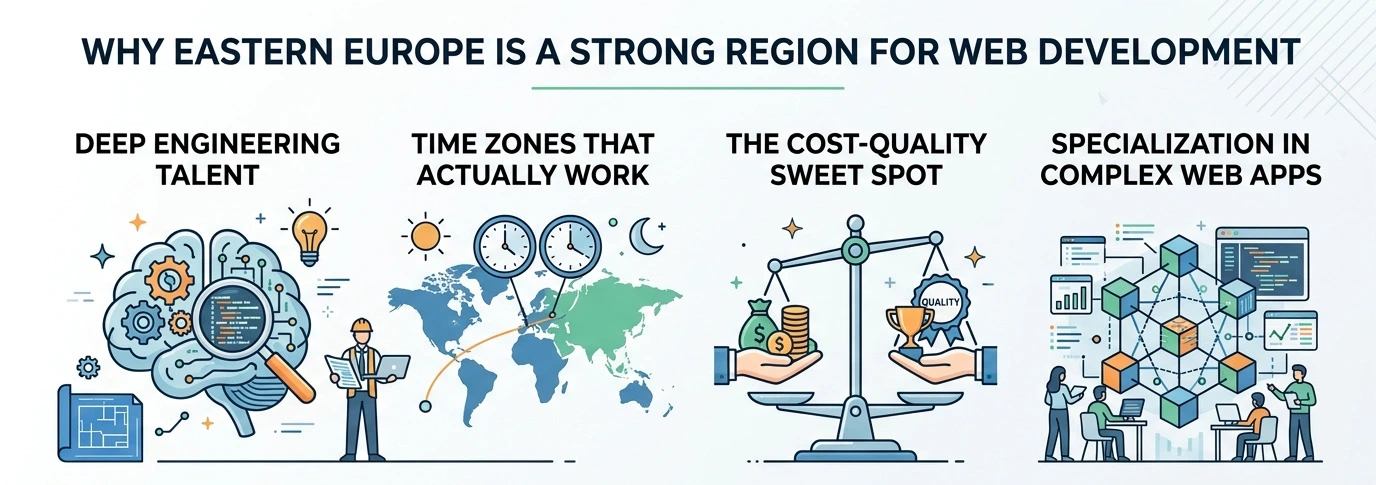
1. Deep engineering talent, not just “coders”
Countries like Ukraine, Poland, Romania, and Estonia produce tens of thousands of STEM graduates every year. But more importantly, the culture here values product thinking. Your average senior developer in Warsaw or Tallinn has likely worked on complex systems – fintech, logistics, marketplaces, not just WordPress themes.
This talent base is reinforced by a thriving ecosystem of structured training programmes, from university computer science departments to intensive front end web development bootcamp Europe providers across Europe, ensuring a strong and continuously refreshed pipeline of engineers at every level.
2. Time zones that actually work
A daily standup at 10 AM CET works with teams in Ukraine or Poland. There is also workable overlap with US East Coast mornings – a practical advantage that a 12-hour gap with Vietnam or India simply cannot offer. Real-time collaboration is possible without destroying anyone’s working day.
3. The cost-quality sweet spot
Eastern European development rates are significantly more competitive than Western European or North American equivalents, while delivering substantially higher quality than most offshore alternatives. For teams building MVPs or product teams developing SaaS platforms, this balance is critical: the right answer is capable engineers, not just affordable ones.
4. Specialization in complex web apps
Here is a secret: many of the best web development agencies from Western Europe actually subcontract work to Eastern Europe. Why? Because the technical expertise for scalable web applications, real-time features, and heavy backend logic is often stronger in this region. Companies that choose to outsource web development to Europe (rather than going fully offshore) consistently get better results when they work directly with the best web development companies European talent pools produce, rather than going through an intermediary.
How We Selected These Best Web Development Companies in Europe
There is no shortage of rankings claiming to be the list of web development companies in Europe. Most follow the same formula: a short description, a logo, and a Clutch rating. That pattern is familiar: “Top X Companies” where half the entries paid for placement.
This list was built differently.
The methodology is straightforward and applied consistently across every entry.
Companies were selected against seven real-world criteria:
- Proven web development expertise: We looked for portfolios filled with web applications, not just marketing brochures. Custom dashboards, payment flows, admin panels, API integrations, that sort of meaty work.
- Public portfolio or case studies: If a company hides its past work, that is a red flag.
- Experience with modern tech stacks: React, Vue, Node.js, Python, Ruby on Rails, Sharetrive.
- Technical stack clarity: A credible company explains exactly what they use for frontend, backend, database, hosting, and DevOps. Vague answers like “we use the best technology” were counted against entries.
- Delivery process maturity: Do they have a discovery phase? Do they write automated tests? Do they have QA engineers, or do developers test their own code?
The Best Eastern European Web Development Companies
Roobykon Software
- Location: Ukraine/CEE delivery context
- Best for: Custom marketplaces, SaaS, MVPs, and complex web platforms
- Core services: Custom web development, marketplace development, Ruby on Rails, Sharetribe, MVP, SaaS.
- Ideal clients: Founders, startups, scaleups, and product owners building transactional platforms
What Roobykon actually builds
We are not a generalist outsource web development Europe region. Where we excel is in platforms that have:
- Multiple user roles (buyers, sellers, admins, moderators)
- Complex payment logic (commissions, escrow, subscriptions)
- Workflows that involve chats, notifications, reviews, disputes, and analytics
- Integrations with CRMs, ERPs, payment gateways, and shipping providers
Projects that feel more like systems than websites are exactly where Roobykon operates. Learn more about the web development company.
Why the delivery model matters
Most development companies build what they are asked for. Roobykon’s model is different: the engagement starts with understanding what should be built, then delivers it with the architecture, quality, and reliability a growing platform demands.
This distinction matters because the most expensive mistakes in web product development are not coding errors. They are architectural decisions made too early, features built before the product logic is validated, and integrations underestimated in a scope that looked clean on paper. Roobykon’s delivery model is designed to catch and resolve these problems before they become sunk costs.
Best fit projects:
- Multi-vendor marketplaces (like Etsy, but for your niche)
- Rental or booking platforms (equipment, spaces, services)
- SaaS products with tiered subscriptions and dashboards
- MVPs scoped for validation speed without sacrificing architectural quality, built to survive a Series A, not collapse under it
What clients consistently report:
- Clear and consistent communication throughout the engagement
- Proactive identification of scope and architecture issues before they become problems
- Technical quality that holds up to internal review and audit
- Reliable delivery against agreed milestones
- Genuine product-thinking input, not just requirement-following
Potential limitation: Roobykon is not the right choice for simple brochure websites, one-off landing pages, or low-complexity marketing sites. Our value (and our process investment) is calibrated to projects where technical decisions matter, and the product is expected to evolve significantly over time.
Planning a marketplace, SaaS platform, or complex web application?
Roobykon Software starts every conversation with product vision and business logic, not a pricing sheet.
Contact us todayNetguru
- Location: Poland
- Best for: Enterprise and scale-up digital products
- Core focus: Product design, web apps, digital transformation
Netguru in practice
Netguru is one of the most recognized best web development agencies in Europe – and for good reason. They have built products for Volkswagen, OLX, and UBS. Their process is polished, their design is excellent, and they can handle large-scale projects with enterprise compliance requirements.
Best fit projects:
- Digital transformation for established companies
- Consumer-facing web apps that need high polish
- Projects where design is a primary differentiator
Potential limitation: They are on the higher end of the cost spectrum for Eastern Europe. Smaller startups or bootstrapped founders might find their pricing challenging.
The Software House (TSH)
- Location: Poland
- Best for: Backend-heavy web platforms
- Core focus: Node.js, React, cloud, product teams
TSH in practice
TSH is the more credible choice when the stack is Node.js rather than Python – their blog, open-source contributions, and conference presence reflect genuine JavaScript ecosystem depth. The focus is on B2B SaaS and complex web apps; their engineering-first culture means technical decisions get proper attention.
Best fit projects:
- B2B SaaS platforms with complex data models
- Real-time applications (collaboration tools, dashboards)
- Projects that need cloud-native architecture (AWS, GCP, Azure)
Potential limitation: They are less focused on marketplace-specific logic (user roles, payments, disputes). If marketplaces are your core, ask TSH for relevant case studies.
Infinum
- Location: Croatia
- Best for: Product design + web/mobile ecosystems
- Core focus: UX/UI, web apps, mobile apps
Infinum in practice
Infinum wins awards for design. If your product lives or dies by its user interface (think consumer apps, fintech dashboards, or brand-heavy web experiences), they are worth a serious look. They also do native mobile, which is rare among pure web agencies.
Best fit projects:
- Web + mobile companion apps (e.g., a service with customer and driver apps)
- Design-led products where UX is the main feature
- Brands that need consistency across web and mobile
Potential limitation: Their engineering is solid, but design is their superpower. If your project is backend-dominant (e.g., complex integrations, data pipelines), other firms on this list may be a better match.
Boldare
- Location: Poland
- Best for: Agile product development
- Core focus: Product strategy, software development, UX/UI
Boldare in practice
Boldare positions itself around the full product loop. And not just building, but figuring out what to build first. Their discovery workshops are well-regarded, and the agile structure suits early-stage companies where scope is still evolving. A good fit when the brief is genuinely unclear and product-market fit validation is part of the brief.
Best fit projects:
- Early-stage startups that need product strategy + execution
- Companies that want to transition from an agency to an in-house team model
- Projects with uncertain scope that require iterative discovery
Potential limitation: Ask specific questions about how they handle scope changes, MVP definition, and post-launch iteration.
Wolfpack Digital
- Location: Romania
- Best for: Startup MVPs and scaling
- Core focus: Startup product development
Wolfpack Digital in practice
Wolfpack Digital has built its practice around startup-stage projects. Their process is lean, the team stays hands-on, and the engagement model is built for founders who need to move quickly from concept to live product. Cluj-Napoca’s growing tech ecosystem gives it access to solid engineering talent at startup-appropriate rates.
Best fit projects:
- Seed-stage startup MVPs
- Founder-led projects that need close collaboration
- Web apps that will scale from 0 to 1000 users quickly
Potential limitation: Their smaller size may be a constraint for very large or complex enterprise projects.
STX Next
- Location: Poland
- Best for: Python-based web development
- Core focus: Django, Python, JavaScript
STX Next in practice
STX Next is Europe’s largest Python software house and the most prominent Python web development company in Europe. If your technical stack is Django, FastAPI, or any Python framework, they are a natural choice. They also do React on the frontend, so full-stack Python shops will feel at home.
Best fit projects:
- Python/Django web applications
- Data-heavy backends (Python excels here)
- Projects that benefit from a large pool of Python developers
Potential limitation: Outside the Python/JavaScript ecosystem, the specialisation advantage disappears. Rails, PHP, or other stacks are better served by differently specialised partners on this list.
How to Choose the Right Web Development Company in Eastern Europe
Having the list is only useful if the selection logic follows. Eastern Europe web development is not a single homogeneous market. The region includes companies with very different specialisations, process maturity levels, and commercial models. The matrix below maps project type to the criteria that actually matter.
Project Type | What to Prioritize | Best Vendor Type |
|---|---|---|
Marketing website (5-15 pages, mostly content) | UX, CMS, SEO, performance | Web design/development agency |
SaaS platform (subscriptions, dashboards, APIs) | Architecture, backend, scalability, security | Product development company |
Marketplace (buyers, sellers, payments, disputes) | User roles, transaction logic, trust & safety | Marketplace development company |
E-commerce (inventory, checkout, shipping) | Checkout flow, product data, integrations, CRO | E-commerce/headless commerce agency |
MVP (first version, fast and lean) | Speed, discovery, scope control | MVP development partner |
Legacy platform (old codebase, migration) | Audit, refactoring, documentation | Modernization-focused team |
Dedicated capacity (ongoing team extension) | Team fit, communication, and long-term availability | Dedicated development team |
What Services Should a Strong Top Web Development Firm Offer?
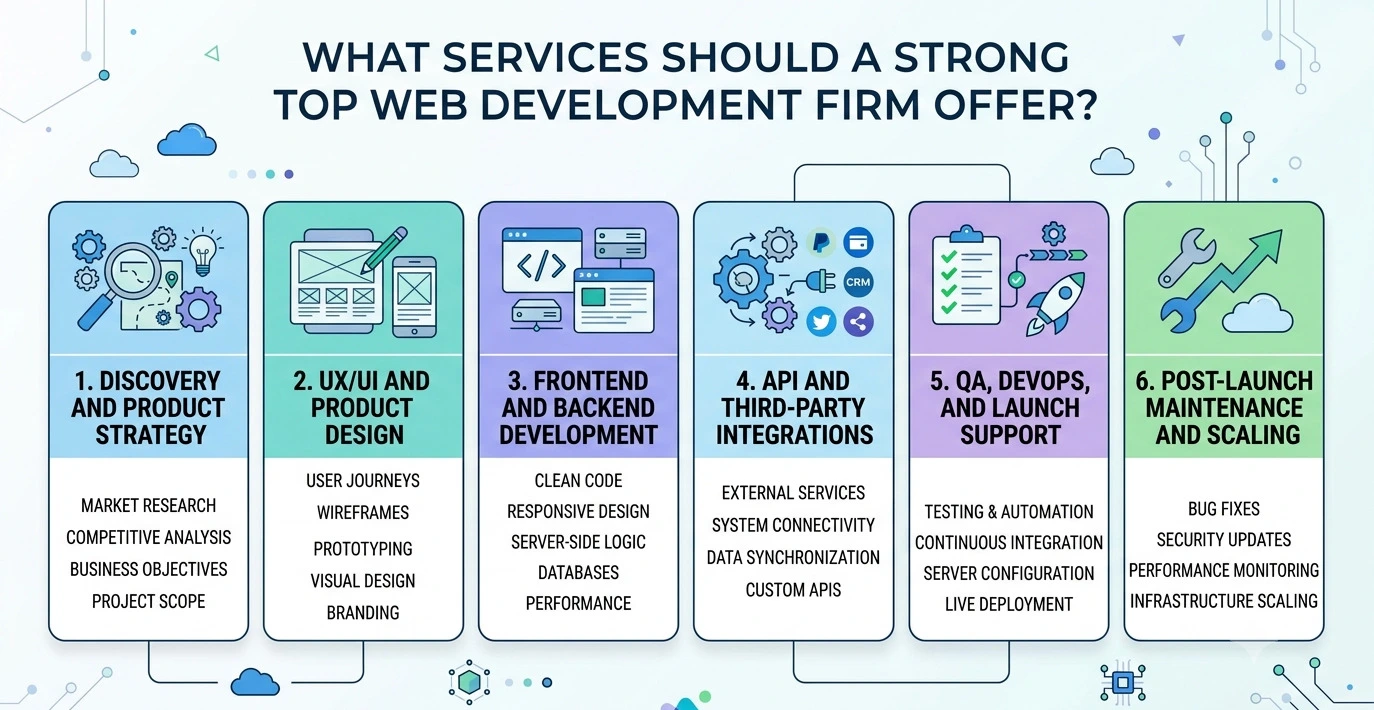
Evaluating the best web development agency or comparing top web development services across Europe comes down to one question: does the company offer a full product lifecycle, or just execution? A team that only codes is a liability for anything beyond a simple build.
Here is what to look for when choosing the best web development companies in Europe:
1. Discovery and product strategy
The best projects do not start with code. They start with whiteboards, user stories, and risk analysis. A good agency will spend 2-4 weeks in discovery before writing a single line. If they skip this, run.
2. UX/UI and product design
Design is not just about looking pretty. It is about user flows, conversion, accessibility, and usability. Does the agency have dedicated designers, or do developers “figure out the design”?
3. Frontend and backend development
Obvious, but dig deeper. Ask: do they separate frontend (React, Vue) and backend (Node, Rails, Python) cleanly? Do they use REST or GraphQL? What is their testing strategy?
4. API and third-party integrations
Most web platforms talk to other systems: payment gateways (Stripe, Braintree), CRMs (Salesforce, HubSpot), email services (SendGrid), analytics (Mixpanel), and more. Integration experience is non-negotiable.
5. QA, DevOps, and launch support
Code is not done when it is written. It is done when it is deployed safely. Look for: automated testing, CI/CD pipelines, staging environments, monitoring, and rollback plans.
6. Post-launch maintenance and scaling
Launch day is not the finish line. Launch day is not the finish line. Bugs surface. Features get added. Traffic grows. A credible partner has a defined support model, not a vague promise to be available.
Roobykon’s Custom Web Development covers all of these.
How Much Does Web Development Cost in Eastern Europe?
Cost is one of the most searched questions when evaluating eastern Europe web development partners, and one of the most misleading if answered with a single number. Project cost is driven by project type, complexity, team seniority, engagement model, and what the partner actually includes in scope.
The table below provides indicative budget logic by project type: not fixed prices, but frameworks for understanding what drives cost and how to interpret proposals.
Project Type | What Drives the Budget |
|---|---|
Simple business website | Design quality, CMS choice, number of pages, SEO baseline setup |
Marketing website with CMS | Content modelling, design system, SEO technical foundation, migration complexity |
MVP web application | Feature scope, user roles, integrations, discovery depth, performance requirements |
SaaS platform | Subscription management, user authentication, dashboards, admin logic, scalability architecture, and multi-tenancy |
Marketplace | Buyer/seller roles, payment flows, commissions, listing logic, trust systems, messaging, moderation, and admin workflows |
Enterprise web platform | Security architecture, enterprise integrations, governance, compliance, multi-team delivery model |
The hidden costs to watch for:
- No discovery phase → requirements change mid-project → budget blows up
- No automated testing → bugs pile up → expensive fixes after launch
- Poor documentation → your next developer cannot understand the code
- No post-launch support → the product is stranded after launch
Pro tip: When comparing proposals, request a breakdown by phase: discovery, design, development, QA, and project management. A suspiciously low category is almost always compensating elsewhere.
Red Flags When Choosing a Web Development Company
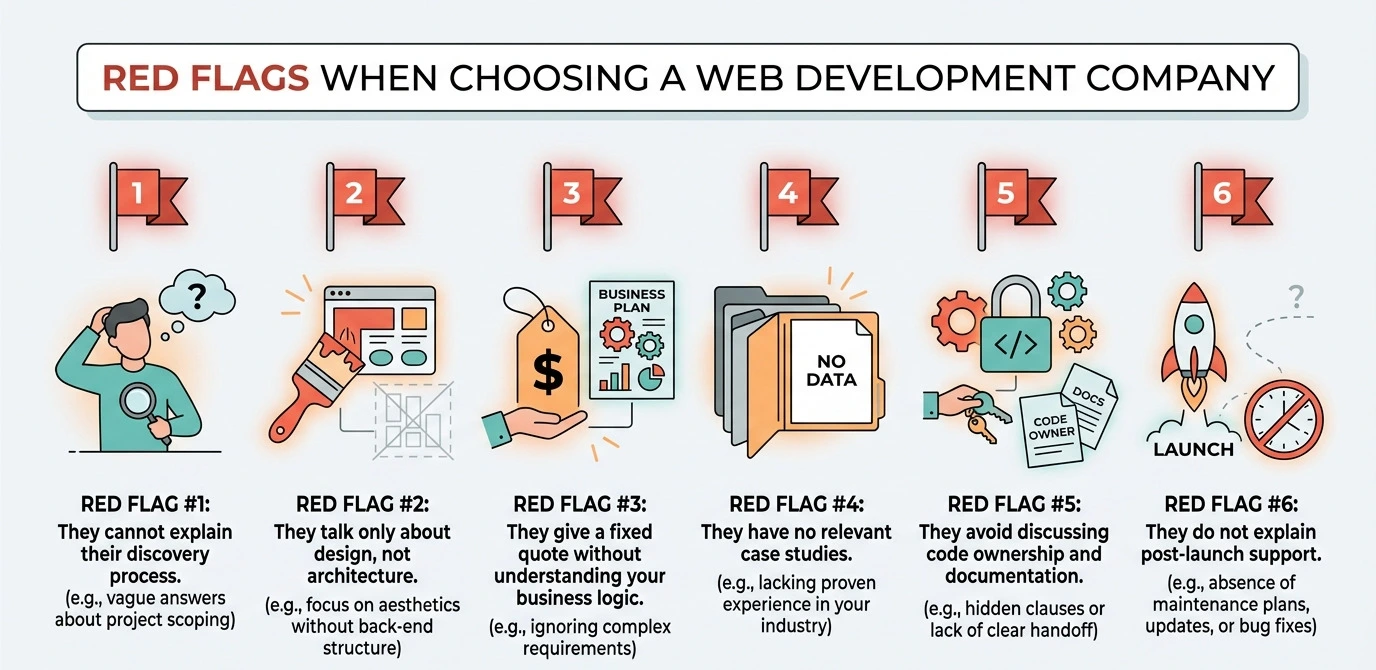
These warning signs consistently precede troubled projects, regardless of agency size or reputation.
Red flag #1: They cannot explain their discovery process.
A fixed price produced after a 30-minute call is a guess. Real discovery takes days or weeks.
Red flag #2: They talk only about design, not architecture.
Beautiful mockups mean nothing if the backend collapses under 100 users. Database schema, API design, and scaling strategy deserve equal attention in early conversations.
Red flag #3: They give a fixed quote without understanding your business logic.
“Sure, we can build that marketplace for $40k” without asking about payment flows, dispute resolution, or seller analytics. That price will double.
Red flag #4: They have no relevant case studies.
A portfolio full of restaurant websites is not evidence of marketplace capability. Ask for directly relevant case studies and apply scepticism when they are not offered.
Red flag #5: They avoid discussing code ownership and documentation.
Source code ownership, architecture diagrams, API docs, and a deployment runbook should be deliverables, not negotiables. Hesitation on any of these is a serious signal.
Red flag #6: They do not explain post-launch support.
Who fixes the first critical bug at 11 PM on a Friday? What is the SLA? Is support included or extra? No clear answer means no real support.
Questions to Ask Before Hiring a Web Development Company
A credible agency welcomes direct questions. The ones below are designed to surface what standard vendor presentations will not volunteer.
Business questions
- “Have you built a product with similar business logic? Walk us through one. What was hard?”
- “What are the two biggest risks in what we have described so far?”
- “If this were your product, what would ship in the first phase and what would wait?”
- “How is ‘done’ defined for a sprint?”
Technical questions
- “What architecture would you recommend for our scale expectations (100, 10k, 1M users)?”
- “How do you handle third-party API integrations? Do you mock them in testing?”
- “What is your approach to automated testing? What percentage of code is tested?”
- “How do you document the code, APIs, and deployment process?”
Process questions
- “Who will be on the team day-to-day? Is it possible to meet them before any contract is signed?”
- “Are your developers in-house employees or contractors?”
- “How often do we get demos? Weekly? Bi-weekly?”
- “How do you manage scope changes? What is the change request process?”
- “What is included in post-launch support, and what triggers an additional charge?”
Commercial questions
- “Is your pricing fixed price, time & materials, or hybrid?”
- “What is not included in your proposal (e.g., hosting, third-party fees, project management)?”
- “How do you handle overages if we exceed estimated hours?”
When Roobykon Is the Right Fit for Your Web Development Project
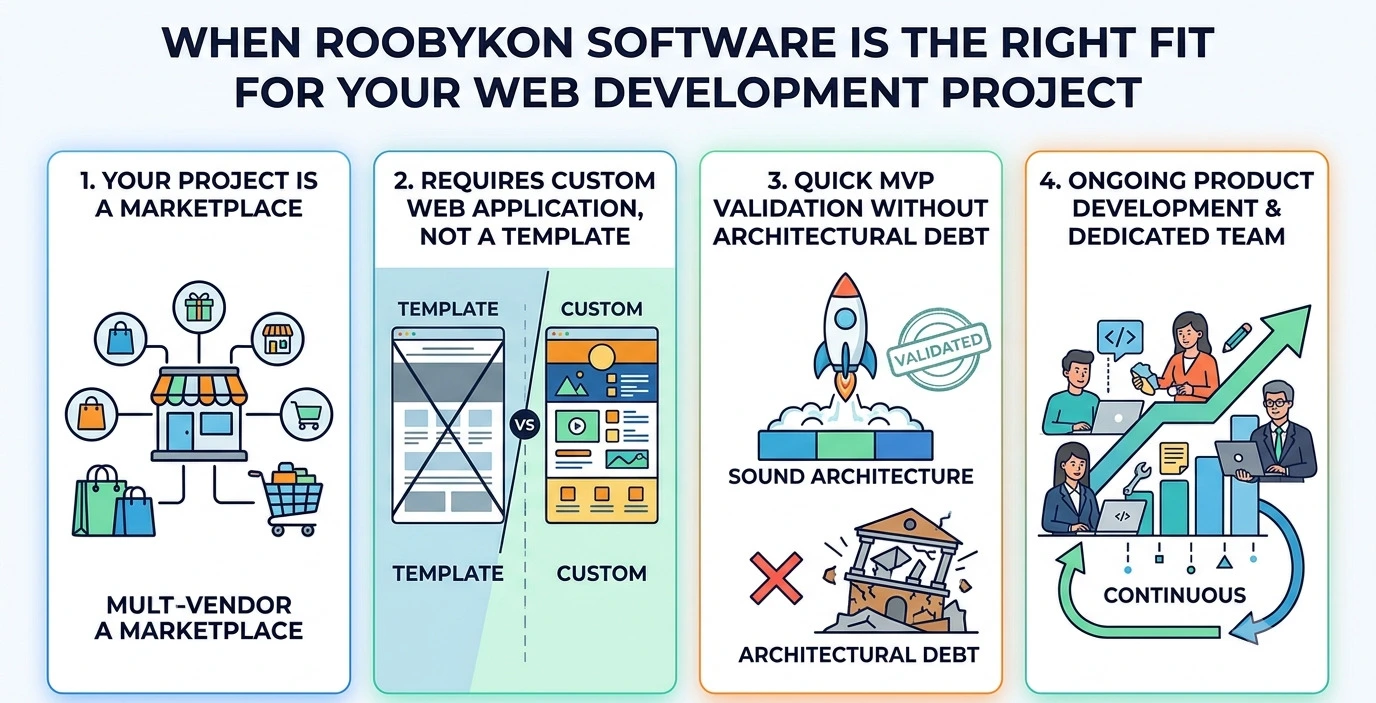
Roobykon is the right fit when:
- The project is a marketplace. User roles, payments, reviews, messaging, moderation, admin workflows – this is the domain Roobykon has delivered across equipment rental, professional services, and physical goods platforms.
- The project requires a custom web application, not a template. When Shopify, WooCommerce, or off-the-shelf SaaS cannot accommodate the business model, custom development is the only path. That is Roobykon’s core work.
- An MVP needs to validate quickly without creating architectural debt. Many agencies build MVPs that collapse after launch. Roobykon’s approach is to scope the right first phase, build it on a foundation that survives a Series A, and avoid the rewrite cycle that burns through post-launch momentum.
- Ongoing product development needs a consistent dedicated team. For multi-year product development, dedicated teams that accumulate deep product knowledge are more valuable than rotating contractors who re-learn context with every sprint.
How to Shortlist the Best Web Development Company
A practical shortlisting checklist to run before any contract is signed:
- Define the project type precisely: website, web app, SaaS, marketplace, or something else.
- Identify must-have integrations: payments, CRM, email, analytics, and any third-party systems.
- Check relevant case studies: not just any case studies.
- Ask about discovery: do they insist on it? (They should.)
- Clarify team structure: in-house or freelancers? Senior or junior?
- Review QA and documentation standards: automated tests? Docs?
- Understand pricing model: fixed, T&M, or hybrid? What is excluded?
- Discuss post-launch support: SLA, response time, included hours.
- Compare by fit, not only price: the cheapest often costs more in the end.
Questions Worth Answering Directly

Recommended articles
 How to Hire Ruby on Rails Developers: A Practical Guide for Founders and CTOs
Hiring Rails developers? Skip the generic checklists. This practical guide helps founders choose the right model, avoid costly mistakes, and know when to hire a team instead of a solo coder.
 How to Build an Online Marketplace Website (Complete Guide for 2026)
You have a marketplace idea. Now what? This complete guide answers the questions every founder faces: How do I validate my concept? What features actually matter in an MVP? This article provides practical answers to the challenges of building a marketplace startup from scratch.
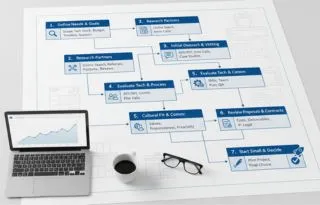 How to find a web development partner for your startup: a step-by-step guide
Choosing the wrong development partner can cost you months. Use this expert guide from Roobykon Software to find a trusted web development partner who treats your startup like their own.
 How to Hire a Sharetribe Developer
Sharetribe gives you the engine, but turning it into a product your users love takes experience. This guide breaks down how to hire Sharetribe developers who understand growth, UX, APIs, and the real-world dynamics of online marketplaces.