What Counts as a Marketplace AI Tool for a Business?
Must-Have Categories of AI Tools for Marketplace Businesses
The AI Tool Stack for Marketplace Businesses
Ready-Made AI Tools vs. AI Plugins vs. Custom AI Development
How to Evaluate AI Tools Before Adding Them to Your Marketplace
AI-Powered Marketplace Tools Implementation Roadmap for Businesses
Subscribe and you will promptly receive new published articles from the blog by mail
Let’s start with the actual problem: you’re running a marketplace (or building one), and everyone keeps telling you AI is the answer. But the answer to what, exactly? Which of the best AI powered tools for marketplaces actually matter for your specific situation? Which ones are vendor hype dressed up in a demo? And when does it make more sense to build something yourself rather than subscribe to yet another SaaS platform?
This guide is the one we wish existed when we started helping marketplace operators implement AI. It covers the best AI-powered tools for marketplaces across every major category – the same tools we’d recommend as the best AI tools for marketplace businesses of any size.
What Counts as a Marketplace AI Tool for a Business?
AI Tools vs. AI Plugins vs. Custom AI Features
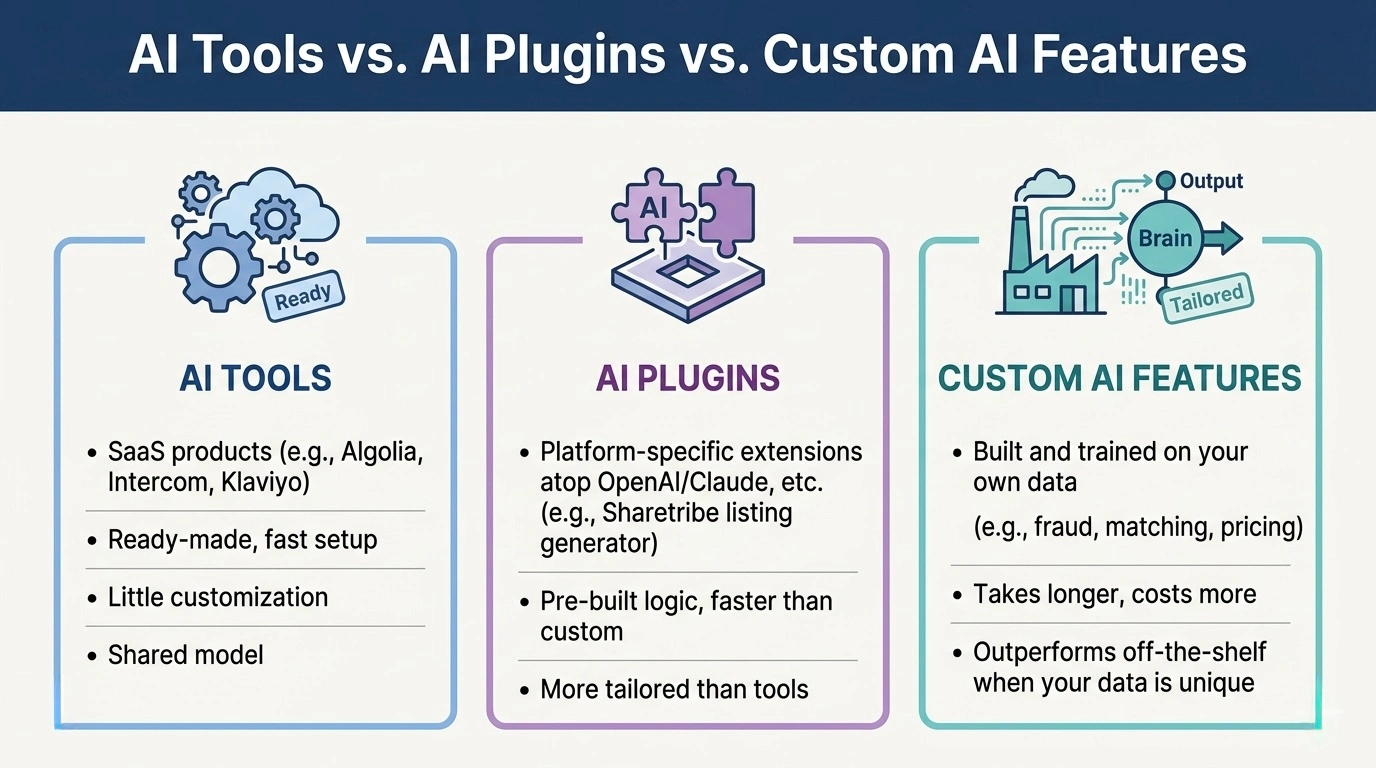
These three categories get lumped together constantly, but they’re very different things:
AI tools are standalone SaaS products you subscribe to and integrate via API or SDK. Algolia, Intercom Fin, Klaviyo AI – you configure them, you don’t train them. They come with their own models, their own training data, and (usually) their own UI. The main trade-off: fast to implement, limited customization, and you’re sharing that model with every other customer on the platform.
AI plugins are purpose-built extensions that sit on top of general AI APIs – OpenAI, Claude, Cohere – and are tailored for a specific platform or use case. A listing description generator built for Sharetribe that takes a photo and spits out polished seller copy is an AI plugin. So is a smart search widget that wraps a vector search model and exposes it as a UI component. These live between ready-made tools and full custom builds – faster than building from scratch, more specific than off-the-shelf.
Custom AI features are capabilities you build entirely, trained on your own data. A fraud model trained on your transaction history. A matching algorithm tuned to your specific category. A pricing engine calibrated to your seller behavior. These take longer and cost mor, but when the underlying data is yours, the resulting model can be genuinely better than anything you could buy.
Knowing which category applies to a given problem determines your AI marketplace integration services build timeline, your cost structure, who owns the data, and what happens when your platform grows. It’s the first decision to make, not the last.
Why AI Tools For Marketplaces are Different From Regular E-commerce Stores
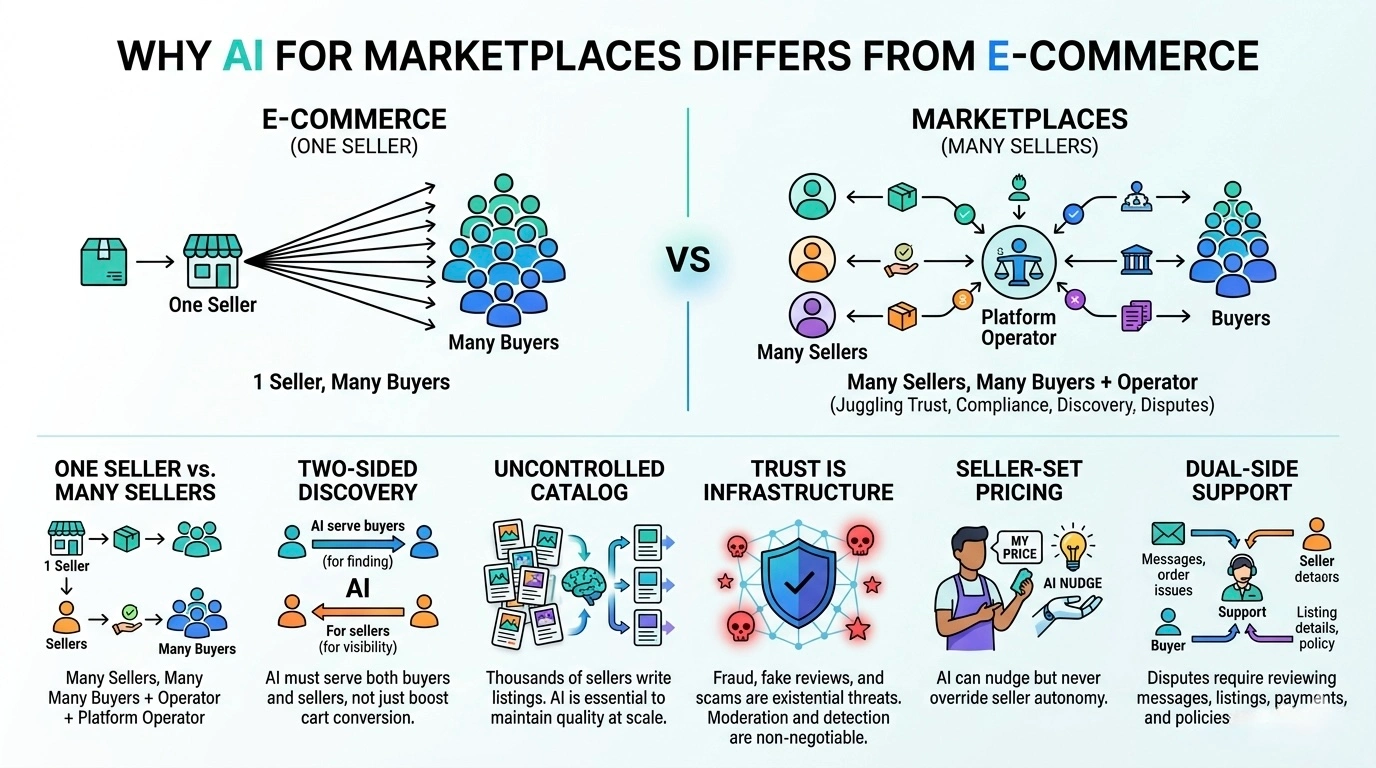
Here’s the structural reality: a traditional ecommerce store has one seller and many buyers. A marketplace has many sellers, many buyers, and a platform operator in the middle who’s responsible for trust, compliance, discovery, and dispute resolution all at once.
That triangle changes everything about how AI tools for marketplaces apply.
Discovery is bidirectional. It’s not enough to help buyers find listings; sellers need to be surfaced to the right buyers too. AI search and recommendations have to satisfy both sides simultaneously, not just optimize cart conversion.
Your catalog is written by strangers. In a normal e-commerce store, a copywriter wrote the product descriptions. In a marketplace, thousands of sellers wrote them – with varying skill, motivation, and language ability. AI content tools aren’t a nice-to-have. They’re the only way to maintain listing quality at any meaningful scale.
Trust is the whole product. An e-commerce store controls its inventory. You don’t. Fraudulent listings, fake reviews, bad actors, and payment scams can kill a marketplace faster than any competitor. Fraud detection and content moderation are infrastructure you need from day one.
Pricing is out of your hands. Sellers set their own prices. Dynamic pricing tools in a marketplace context have to work with that constraint, informing and nudging without overriding seller autonomy.
Support means managing two sides. A buyer-seller dispute requires reviewing messages, listing terms, payment records, and platform policy simultaneously. An AI support tool that only knows how to track orders won’t cut it.
These differences mean the AI tools for marketplace platforms that actually move metrics are rarely the same ones that work for Shopify stores.
Must-Have Categories of AI Tools for Marketplace Businesses
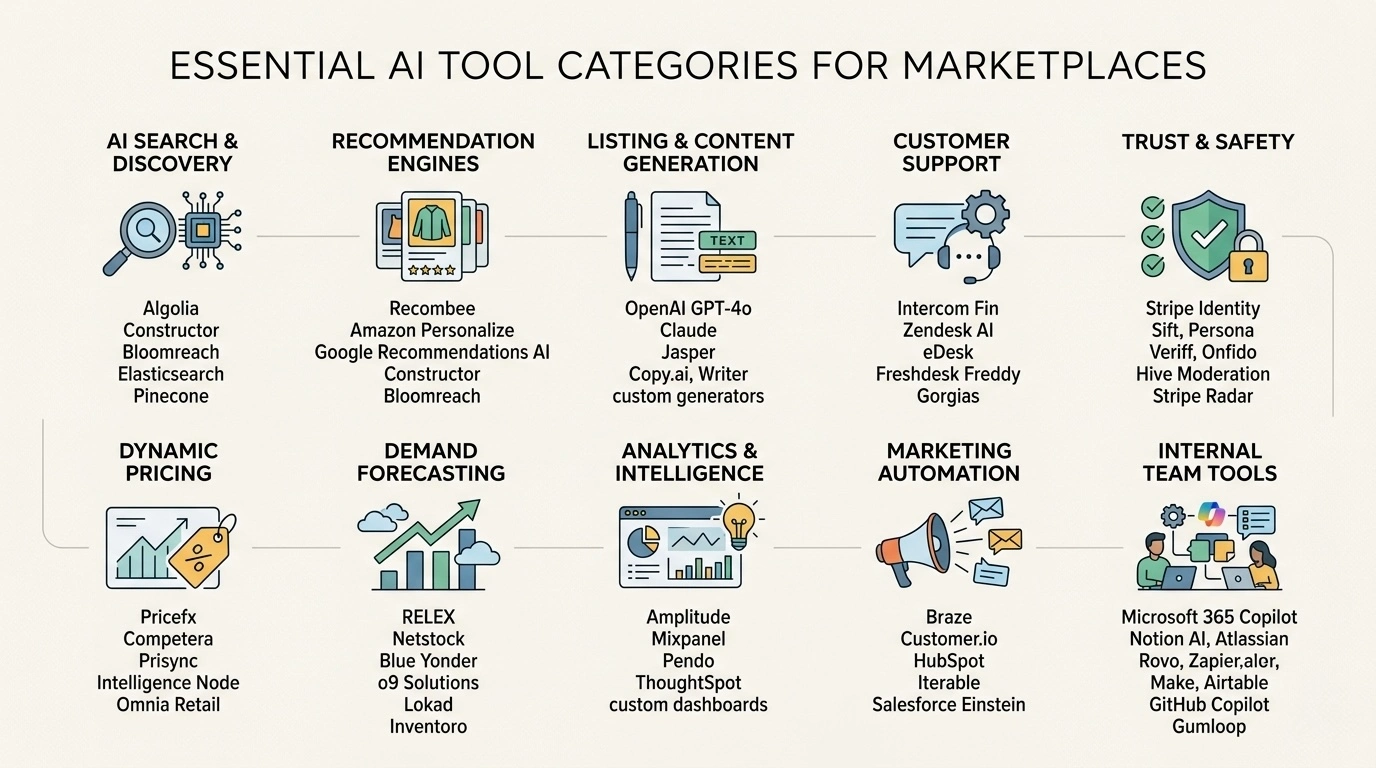
AI Search and Discovery Tools
Search is where marketplace revenue gets made or lost. A buyer who can’t find what they’re looking for doesn’t complain; they just leave. And on a two-sided platform, that departure hurts twice.
Modern AI search understands intent, tolerates typos, and surfaces semantically relevant results. For AI tools for marketplace startups, search is often the highest-ROI first investment.
Algolia AI Search is the most widely deployed AI search solution for marketplaces, and for good reason. Its NeuralSearch feature blends keyword and vector search in a developer-friendly API, reducing zero-result rates meaningfully. It plays well with marketplaces built on the Sharetribe platform and headless marketplace architectures. Start here if you want proven performance without months of configuration.
Constructor is built specifically for commerce conversion optimization, not just search relevance. Its ranking algorithms learn from your marketplace’s actual transaction data (clicks, purchases, returns) and adjust results accordingly. Strong fit for product marketplaces with large catalogs. Among the best AI powered tools for marketplaces, Constructor consistently ranks high for conversion-focused search.
Bloomreach Discovery combines search, product recommendations, and SEO-driven content personalization in one platform. Its edge is the connection between search relevance and on-page SEO performance, which matters a lot for marketplaces that rely heavily on organic traffic.
Elasticsearch/Elastic AI Search is the open-source foundation under many large marketplace search implementations. It requires more engineering investment than the SaaS alternatives, but it gives you complete ownership of relevance tuning, language support, and deployment.
Pinecone is a vector database for marketplaces building semantic search on their own embedding models. Proper integration requires specialized AI marketplace integration services to ensure optimal performance.
Recommendation and Matching Engines
Personalized recommendations are among the highest-ROI AI tools for marketplaces. Done well, they keep buyers on the platform longer, increase average order value, and surface the long tail of your catalog that search alone never reaches.
Recombee is a flexible recommendation-as-a-service platform with a clean API design and solid support for item-to-item, user-to-item, and contextual recommendation types. It’s the right call for growth-stage marketplaces that want strong personalization without a dedicated ML team.
Amazon Personalize is AWS’s managed recommendation service, built on the same tech powering Amazon’s own product suggestions. It handles high request volumes at low latency and plugs naturally into AWS data pipelines. The trade-off versus Recombee is more configuration upfront, but for teams already on AWS, it’s the path of least resistance.
Google Recommendations AI/Vertex AI Search is Google’s equivalent, with natural integration into GCP infrastructure and BigQuery-based data warehouses. Makes obvious sense for marketplaces already living in Google Cloud.
Constructor Recommendations extends the Constructor search engine into personalized recommendation placements across the home page, product pages, cart, and email. The advantage here is cohesion – the same behavioral data driving search rankings also drives recommendations, keeping both systems calibrated to the same signals.
Bloomreach Personalization goes further than item recommendations, adapting landing pages, categories, and promotional content to individual users. It’s the right tool when you have sophisticated content operations and need personalization to extend across the full site experience.
AI Listing and Content Generation Tools
OpenAI API (GPT-4o) is the most versatile option for listing generation. Among the best AI powered tools for marketplaces, the OpenAI API remains the gold standard for flexible content generation.
Claude API (Anthropic) is a strong alternative, particularly strong instruction-following, lower rates of fabrication on structured tasks, and competitive pricing. Claude handles complex, nuanced descriptions especially well: rental properties, service offerings, B2B equipment. Worth testing head-to-head with GPT-4o on your specific category.
Jasper is a purpose-built AI copywriting platform with pre-built templates and brand voice controls. It’s the right call for marketplace operators who want a non-developer interface, a content team that needs to generate and review listing copy without touching an API directly.
Copy.ai and Writer sit in similar territory. Writer distinguishes itself on brand governance and enterprise compliance, which makes it worth considering for larger marketplace businesses with strict guidelines around tone, claims, and legal language.
Custom listing generators are worth building when your marketplace has domain-specific vocabulary, unusual listing formats, or category requirements that general-purpose tools handle poorly. At Roobykon, we build listing generation plugins for Sharetribe marketplaces that pull listing photos, structured attributes, and category context, and output complete, polished listing content.
One trend worth watching in 2026: agentic listing workflows. Traffic from AI sources to retail sites grew 393% year-over-year in Q1 2026, and that traffic converts 42% better than average. What this means for marketplaces is that AI agents are beginning to shop on behalf of humans, and they interact with listing data very differently than human buyers do. Getting listing quality right now is also preparation for that shift.
AI Customer Support and Dispute Assistance
Intercom Fin is the most widely adopted AI support agent for mid-market marketplace and SaaS companies. It reads your help center content, resolves common queries autonomously, and has well-calibrated handoff logic, escalating to human agents when it’s not confident. Integration is a JavaScript snippet. Start here if you’re evaluating AI-powered marketplace tools for support and don’t have a strong incumbent.
Zendesk AI Agents (significantly upgraded from the old Answer Bot) bring similar capabilities inside the Zendesk ecosystem. If your team is already on Zendesk, this is the obvious first step rather than introducing a new vendor.
eDesk is purpose-built for multi-channel marketplace sellers – unified inbox across Amazon, eBay, Shopify, and custom platforms, with AI features covering smart replies, sentiment detection, and auto-tagging. Strong fit for B2C product marketplaces managing volume across channels.
Freshdesk Freddy AI covers comparable ground with stronger no-code automation. Worth considering for operations teams that want AI-assisted support without deep engineering involvement.
Gorgias AI is optimized for e-commerce and marketplace support, with strong native integrations to order management systems. Its auto-close feature, automatically resolving clear-cut queries without human review, meaningfully reduces per-ticket cost.
Trust, Safety, Fraud Detection, and Moderation Tools
Every marketplace will eventually encounter fraud. The question is whether you’re ready for it when it shows up, or whether you’re scrambling after it’s already cost you real money and user trust.
The challenge is volume. At any meaningful scale, you cannot review transactions manually. The fraud patterns are subtle, the bad actors adapt quickly, and the cost of false positives (blocking legitimate users) is almost as bad as false negatives (missing the fraudulent ones). Marketplace AI tools are the only practical answer.
Stripe Identity is the most popular tool we use at Roobykon for identity verification in marketplace projects. Built directly into the Stripe ecosystem, it allows you to verify user identities with document capture and biometric matching, all while staying within Stripe’s compliance framework. For marketplaces already using Stripe Connect for payment processing (which is the majority of our clients), Stripe Identity is the path of least resistance. For AI tools for marketplace startups, starting with Stripe Identity makes perfect sense – it leverages infrastructure you likely already have.
Sift is a machine learning fraud platform built specifically for marketplace signals: account takeover, payment fraud, listing fraud, and review manipulation. Its Decision Engine lets non-technical teams build custom rules on top of ML models, so you’re not completely dependent on a data science team to tune it. Strong track record in peer-to-peer and rental contexts. AI tools for marketplace owners who need granular control over fraud rules will appreciate Sift’s flexibility.
Persona handles identity verification and compliance workflows – KYC, KYB, regulatory screening – with a customizable orchestration layer. For B2B marketplaces or any platform operating in regulated categories (healthcare, legal, financial services), Persona is how you handle onboarding compliance without building it all yourself.
Veriff and Onfido are specialized identity verification providers with strong international coverage. Both use document verification and biometric matching to verify seller or provider identity at onboarding. The choice between them often comes down to geography and specific document type coverage for your target markets.
Stripe Radar is Stripe’s built-in ML fraud detection layer, trained on payment data across millions of businesses. For marketplaces using Stripe Connect, which is most of them, Radar gives you solid baseline payment fraud protection with almost no configuration required. It’s already there; make sure it’s actually enabled. These AI marketplace features – identity verification plus payment fraud detection – work best when deployed together from a single provider.
Hive Moderation handles AI-based content moderation across images, video, and text – detecting prohibited content before it reaches live listings. For UGC-heavy marketplaces, this isn’t optional. Human review at scale is neither fast enough nor cheap enough.
Dynamic Pricing and Revenue Optimization Tools
Pricing in a marketplace is a two-sided negotiation, and the platform is always in the middle of. Operators want to maximize GMV and take rate. Sellers want to maximize their own margins. Buyers want the best deal. AI pricing tools help navigate this by giving sellers data-driven pricing signals while giving operators visibility into category-level health.
Pricefx is an enterprise-grade pricing infrastructure covering price management, optimization, and promotion logic. Best fit for B2B marketplaces or platforms managing complex pricing rules across multiple buyer segments.
Competera uses AI to analyze competitor pricing and recommend optimal price points based on market position and demand. It’s strongest in product marketplace categories with dense competitive data: retail, consumer goods, electronics.
Prisync and Omnia Retail offer dynamic pricing and price monitoring at accessible price points for growth-stage operators who want competitive pricing intelligence without enterprise contracts. These are excellent AI tools for marketplace startups that need pricing capabilities without enterprise budgets.
Intelligence Node focuses on real-time market intelligence, helping sellers and category managers understand how their pricing sits relative to the broader market. Worth considering as a seller-facing analytics feature embedded directly in your dashboard.
Demand Forecasting and Supply Planning Tools
Supply-demand imbalance is a slow leak in marketplace growth. Too little supply in a category and buyers leave frustrated, acquisition costs go up, and word-of-mouth suffers. Too much supply and sellers churn because they’re not getting bookings or orders. AI-powered marketplace tools for forecasting help operators catch these imbalances before they become problems.
RELEX is a leading supply chain and demand forecasting platform for large retail and marketplace operations. Its ML models handle seasonal variation, promotional effects, and external demand signals well.
Netstock focuses on inventory optimization for product-based businesses, helping sellers on your marketplace optimize their own stock levels, reducing both stockouts and overstock simultaneously.
Blue Yonder and o9 Solutions are enterprise planning platforms with strong AI forecasting for large B2B marketplaces or platforms with complex supply chain dynamics across multiple categories.
Lokad takes a probabilistic approach to forecasting, which works particularly well in categories with high demand volatility or sparse historical data. If your marketplace is in a niche vertical or still building out its transaction history, Lokad’s approach is more appropriate than traditional time-series models.
Inventoro is the most accessible of the group, a demand forecasting tool built for SMB sellers. It’s a strong candidate for embedding directly in a marketplace seller dashboard, giving sellers AI-powered reorder recommendations without asking them to manage a separate platform. For AI tools for marketplace startups looking to add seller-facing value quickly, Inventoro is worth a close look.
AI Analytics and Marketplace Intelligence Tools
Static dashboards tell you what happened. AI-augmented analytics tools tell you what’s about to happen, what’s behaving unusually, and what you should be paying attention to that you aren’t. These AI marketplace features separate reactive marketplace operators from proactive ones.
Mixpanel offers similar behavioral analytics with AI-assisted insights for cohort analysis, funnel optimization, and retention modeling. More accessible for smaller teams than Amplitude, with a lower implementation overhead. AI tools for marketplace startups often start here because of the gentle learning curve.
Pendo combines product analytics with in-app guidance, which makes it particularly useful for marketplaces with complex seller onboarding flows where understanding where users get stuck is the first step to fixing it.
ThoughtSpot lets operations teams query data warehouses in plain language – “which seller categories had the highest dispute rates last quarter?” – and get instant answers without writing SQL. Strong fit for operations teams without a dedicated analyst.
Custom marketplace dashboards built on BigQuery or Snowflake with an AI narrative layer remain the gold standard for operators who need metrics specific to their two-sided model – supply health by category, match rate, seller activation funnel stage, dispute rate by listing type – that off-the-shelf tools simply don’t surface. When off-the-shelf AI-powered marketplace tools can’t capture your unique metrics, a custom dashboard built by Roobykon is the answer.
AI Marketing and Lifecycle Automation Tools
Braze AI is the enterprise alternative, better suited to large marketplaces with complex multi-channel journeys. Its AI personalization features optimize content and timing in real time across email, push, in-app, and SMS simultaneously.
Customer.io AI sits in the middle: developer-friendly, flexible, and increasingly AI-augmented. The right call for technical marketplace teams that want fine-grained control over automation logic without the overhead of a full enterprise platform.
HubSpot AI makes more sense for B2B marketplaces where seller acquisition and account management are relationship-driven, longer cycles, higher-touch, and more CRM-centric than the email automation focus of Klaviyo.
Iterable AI and Salesforce Einstein complete the enterprise end of the spectrum, with strong capabilities for multi-brand or multi-geography marketplace operations.
Internal AI Tools for Marketplace Teams
It would be a mistake to focus entirely on buyer- and seller-facing AI while your own operations team is still writing policy documents by hand and manually triaging seller escalations.
Microsoft 365 Copilot brings AI assistance into the communication and document workflows most teams already live in, drafting support responses, summarizing escalation threads, and generating internal policy drafts.
Notion AI is broadly useful for marketplace product and operations teams managing internal documentation, sprint planning, and knowledge bases that need to stay current as the platform evolves.
Atlassian Intelligence/Rovo integrates AI into Jira and Confluence, helping engineering and product teams move faster on the tickets and planning documents behind marketplace feature work.
Zapier AI and Make AI automate cross-platform workflows in natural language, triggering seller onboarding sequences, syncing data between support platforms and CRMs, and sending internal alerts based on platform events.
Airtable AI works well for operations teams managing seller databases, content review queues, or partnership tracking – structured data workflows where AI-powered field generation and summarization add real value.
GitHub Copilot is straightforward: it accelerates the engineering work required to build and maintain marketplace-specific AI integrations. For any technical team building custom AI features, the productivity gains are real.
Gumloop is an AI-native workflow automation platform worth watching, more capable than Zapier for teams that want to build LLM-powered automation without writing code. It’s especially useful for marketplace operations teams that keep outgrowing simple if-this-then-that automation.
The AI Tool Stack for Marketplace Businesses
AI Tools for Buyer Experience
Tool Category | Recommended Tools | Primary Value |
|---|---|---|
AI Search | Algolia, Bloomreach, Constructor | Find the right listings faster |
Recommendations | Recombee, Amazon Personalize, Constructor | Surface relevant listings |
AI Support | Intercom Fin, Zendesk AI, Gorgias AI | Resolve queries without friction |
Dynamic Pricing (buyer side) | Pricemoov, custom | Transparent, competitive pricing |
Marketing Personalization | Klaviyo AI, Braze | Relevant messaging at the right time |
Analytics (buyer journey) | Amplitude, Mixpanel | Operator visibility into buyer behavior |
AI Tools for Sellers and Service Providers
Tool Category | Recommended Tools | Primary Value |
|---|---|---|
Listing Generation | OpenAI API, Claude API, Jasper | Quality listings without copywriting overhead |
Pricing Intelligence | Competera, Prisync, Intelligence Node | Competitive pricing decisions |
Demand Forecasting | Inventoro, Netstock | Avoid stockouts and dead inventory |
Seller Analytics | ThoughtSpot, custom dashboard | Performance clarity |
Marketing Automation | Klaviyo AI, Customer.io | Proactive buyer engagement |
Workflow Automation | Gumloop, Zapier AI | Operational overhead reduction |
AI Tools for Marketplace Operators
Tool Category | Recommended Tools | Primary Value |
|---|---|---|
Fraud Detection | Sift, Stripe Radar | Platform integrity at scale |
Identity Verification | Persona, Veriff, Onfido, Stripe Identity | Verified seller credentials |
Content Moderation | Hive Moderation | Safe, compliant listings |
Platform Analytics | Amplitude, ThoughtSpot, Looker | Platform health visibility |
Support Operations | Zendesk AI, Freshdesk Freddy | Scalable support without headcount growth |
Supply Planning | RELEX, Blue Yonder | Supply-demand balance monitoring |
Internal Productivity | Microsoft 365 Copilot, Notion AI, Gumloop | Faster operations team |
AI Tools by Marketplace Type
Here’s how AI tool priorities shift by marketplace model.
AI Category | Product Marketplace | Service Marketplace | Rental Marketplace | B2B Marketplace | C2C Marketplace |
|---|---|---|---|---|---|
Search & Discovery | Algolia, Constructor | Algolia, custom | Bloomreach, Algolia | Elasticsearch, Bloomreach | Algolia, Typesense |
Recommendations | Amazon Personalize, Recombee | Custom matching engine | Custom matching, Recombee | Google Recommendations AI | Recombee |
Listing Generation | OpenAI API, Jasper | Claude API, custom | Claude API | Writer, OpenAI API | OpenAI API, Claude API |
Customer Support | Gorgias AI, Intercom Fin | Intercom Fin, Zendesk AI | Zendesk AI, custom | Zendesk AI, HubSpot AI | Intercom Fin, eDesk |
Fraud / Trust | Stripe Radar, Sift | Persona, Veriff, Sift, Stripe Identity | Sift, Stripe Radar, Stripe Identity | Persona, Onfido | Sift, Hive Moderation |
Dynamic Pricing | Competera, Prisync | Pricemoov, custom | Pricemoov, custom | Pricefx | Prisync, custom |
Supply Forecasting | Netstock, Inventoro | N/A | RELEX, Lokad | Blue Yonder, o9 | Limited applicability |
Analytics | Amplitude, Mixpanel | Amplitude, ThoughtSpot | Amplitude, custom | ThoughtSpot, Looker | Mixpanel, Amplitude |
Marketing Automation | Klaviyo AI, Braze | Klaviyo AI, Customer.io | Braze, Klaviyo AI | HubSpot AI, Salesforce Einstein | Klaviyo AI |
Moderation | Hive Moderation | Hive Moderation | Hive Moderation | Persona | Hive Moderation, Sift |
Ready-Made AI Tools vs. AI Plugins vs. Custom AI Development
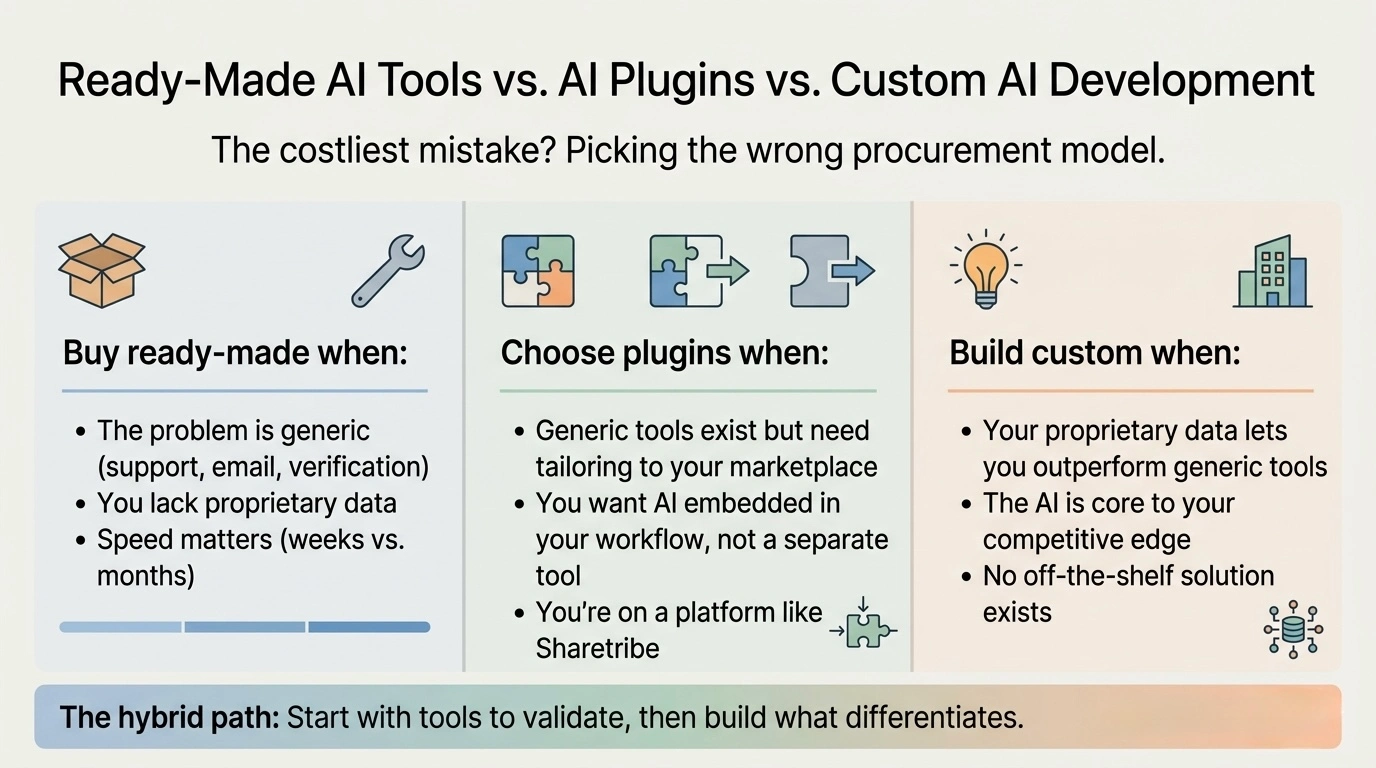
The most expensive AI mistake marketplace operators make is applying the wrong procurement model to the right problem. Sometimes you subscribe to something you should have built. Sometimes you spend six months building something you could have subscribed to for $500/month.
Here’s how to tell the difference.
When Ready-Made AI Tools Are Enough
Buy ready-made when:
- The problem is generic and well-solved (support automation, email marketing, identity verification). Building your own is rarely justified.
- You’re early stage without enough proprietary data. A custom recommendation engine trained on 200 users will underperform Recombee out of the box.
- Speed matters. Launching Algolia in two weeks beats three months of custom semantic search, especially when you don’t yet know what relevance signals actually work.
When AI Plugins Are the Better Option
Plugins are the right call when a generic tool exists but doesn’t quite fit your marketplace’s specific listing format, category vocabulary, or workflow. You want something tailored but don’t need (or don’t yet have the data for) a fully custom model.
The plugin pattern also works well when you want to embed AI functionality directly in your seller or buyer experience rather than pointing users to a separate tool. A listing generator that lives inside your seller onboarding flow, triggered by a button, feels like a platform feature. A standalone GPT-4o interface that sellers have to figure out themselves does not.
For marketplaces on platforms like Sharetribe, the plugin approach is often architecturally natural, extending the platform without replacing it.
When Custom AI Development Makes Sense
Build custom AI when your marketplace has accumulated enough proprietary data that your models can genuinely outperform general-purpose alternatives. Five years of transaction history, buyer-seller messaging, booking outcomes, and dispute records is the raw material for fraud detection, matching, and recommendation models that no SaaS tool can match, because no SaaS tool has your specific data.
Also build custom when the AI feature is core to your competitive differentiation. If the reason buyers choose your marketplace over a competitor is the quality of your provider matching, outsourcing that matching logic to a third-party recommendation engine is a genuine strategic risk. Own the thing that makes you different.
And build custom when the use case genuinely has no ready-made solution. Multi-party dispute resolution, dynamic commission optimization, cross-category supply forecasting for a niche vertical – these are problems where custom development is the only path.
The Hybrid Approach: Start with Tools, Then Build What Creates Differentiation
The most effective marketplace AI strategies we’ve seen follow the same pattern: move fast with tools, learn what actually drives behavior for your specific buyers and sellers, then invest in custom development for the specific capabilities where your proprietary data creates an edge.
An Algolia-powered search experience launched in month three can evolve into a custom semantic search layer built on your own embeddings in year two – once you’ve accumulated enough query and behavioral data to tune relevance signals that Algolia’s generic model doesn’t capture.
This isn’t settling for tools as a fallback. It’s using tools deliberately to validate, then building deliberately to differentiate. The AI marketplace features that generate real competitive advantage are always built on validated signals, never on speculation. That sequence is how most successful marketplace AI strategies actually develop in practice.
How to Evaluate AI Tools Before Adding Them to Your Marketplace
Adding AI tools for marketplaces without a clear framework creates tool sprawl fast. Subscriptions that don’t justify their cost. User data flowing to vendors you can’t properly audit. Integration debt that slows down every future development sprint.
Before committing, work through the AI tools for marketplace owners questions honestly:
Does it solve a problem you’ve actually validated? “We want to improve listing quality” is not a validated problem. “Our listings in the home services category have 40% fewer attributes than top-performing categories, and that correlates with a 28% lower conversion rate” is. AI tools for marketplace platforms work best when they’re solving specific, measurable problems, not when they’re answers to vague strategic anxiety.
What data does it need, and who owns it? Some AI marketplace tools require you to stream behavioral data, transaction records, or catalog data to third-party servers. Understand the data model before you integrate. For GDPR-compliant operations, this is a legal prerequisite.
What does the vendor’s model actually know about your category? A fraud detection tool trained primarily on consumer electronics transactions may perform poorly on a peer-to-peer handmade goods marketplace. Ask vendors directly about their training data and relevant verticals. Vague answers about “diverse training datasets” are a yellow flag.
What does success look like, and how will you measure it? Agree on KPIs before you sign. For search: query success rate, zero-result rate, search-to-conversion. For recommendations: CTR, incremental GMV, category diversity. For support: first-contact resolution, CSAT, cost per ticket. If you don’t define success before launch, you’ll spend months debating it after.
How does it integrate with your existing stack? The best marketplace AI tool in the world destroys value if integrating it requires six months of engineering time. Check API quality, documentation, existing integrations with your CRM, payment infrastructure, and analytics platform. Complexity compounds.
What happens when it’s wrong? AI marketplace integration services make mistakes. Recommendations surface irrelevant results. Fraud models flag legitimate transactions. Content moderation removes compliant listings. Understand the error modes, the override mechanisms, and the appeal processes before they become support tickets.
AI-Powered Marketplace Tools Implementation Roadmap for Businesses
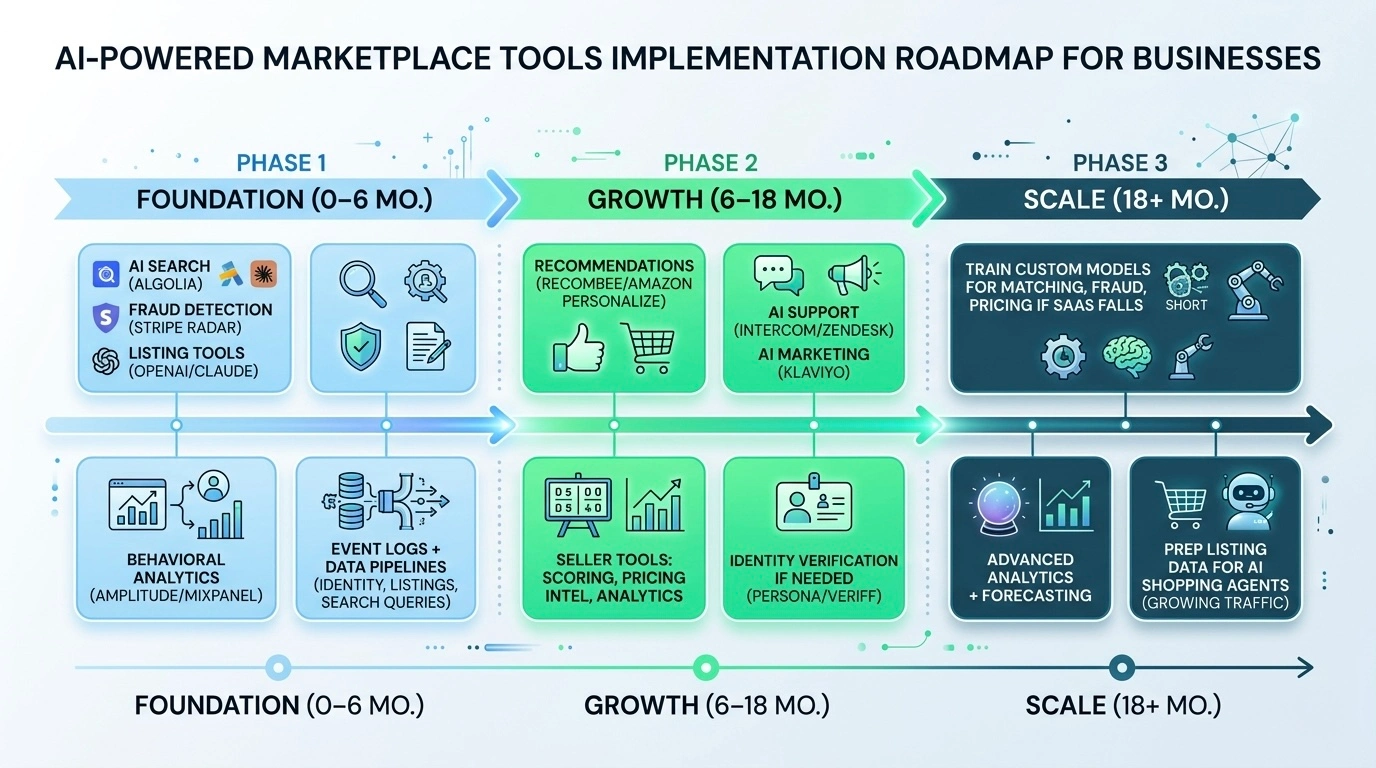
Foundation (0–6 months): If you have a marketplace startup, the priority is infrastructure and high-impact, low-configuration wins. Get AI search in place (Algolia), payment fraud detection running (Stripe Radar), and listing quality tooling active (OpenAI or Claude API for generation). Set up behavioral analytics (Amplitude or Mixpanel). Build the event logging and data pipelines you’ll need for more sophisticated AI later – user identity resolution, listing attribute tracking, search query logging.
Growth (6–18 months): Once you have transaction data and behavioral signals, personalization becomes viable. Deploy recommendation tooling (Recombee or Amazon Personalize), AI customer support automation (Intercom Fin or Zendesk AI), and lifecycle marketing with AI segmentation (Klaviyo AI). Start investing in seller-facing tools: listing quality scoring, pricing intelligence, and performance analytics. Add identity verification (Persona or Veriff) if your vertical or geography requires it.
Scale (18 months+): At scale, you have proprietary data worth training on. Evaluate whether custom matching, fraud, or pricing models genuinely outperform your current SaaS stack for your specific category. Invest in advanced analytics and forecasting. Start thinking about agentic commerce readiness, making sure your listing data is structured and accessible enough for AI shopping agents to interact with correctly, because that traffic is already growing.
Common Mistakes Businesses Make with Marketplace AI Tools
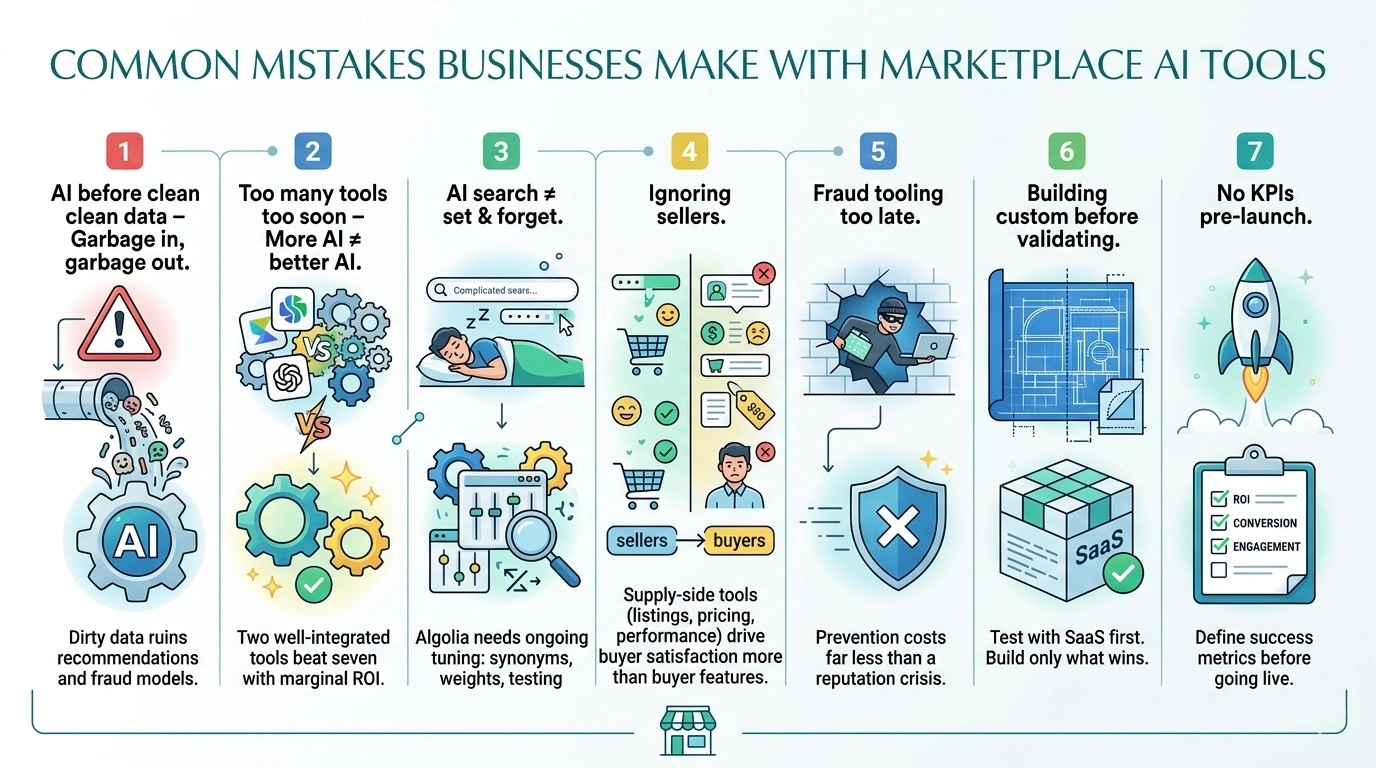
We’ve seen these patterns enough times that they’re worth naming directly.
Implementing AI before fixing data quality
Recommendation engines trained on dirty data surface irrelevant results. Fraud models calibrated on incomplete transaction records generate false positives constantly. AI amplifies whatever is in your data – the dirty version included.
Adding too many tools too early
Tool sprawl is real, and it’s expensive, not just in subscription costs, but in engineering maintenance, integration complexity, and the organizational attention required to actually use each tool well. A growth-stage marketplace with seven AI marketplace tools for businesses, most generating marginal ROI, is worse off than one with two well-integrated tools generating clear, measurable value. The goal isn’t more AI. It’s better AI.
Treating AI search as a checkbox
Algolia doesn’t tune itself. Relevance requires ongoing investment: synonym management, attribute weighting, query categorization, testing and iteration. AI search is infrastructure that needs tending, not a feature you launch and forget.
Ignoring the seller side
Most marketplace AI investment goes into buyer-facing features. That’s backwards. The supply side determines buyer satisfaction more than any buyer-facing feature. Investing in AI tools that help sellers create better listings, price more competitively, and understand their own performance pays dividends on both sides of the platform.
Skipping fraud tooling until it’s a crisis
The cost of a reputation-damaging fraud incident at scale is orders of magnitude higher than the cost of implementing Sift and Hive Moderation when you’re small. Fraud doesn’t wait for you to be ready.
Building custom before validating with tools
The most expensive mistake we see is investing months and a significant budget in building custom AI features before a ready-made tool has confirmed the use case actually moves the needle. Validate with SaaS tools first. Build custom to win.
For more on where AI-powered development (often called “vibe coding”) works and where it fails for marketplace projects, read our blog post on vibe coding for marketplaces: what works and what doesn’t.
No KPIs before launch
If you don’t define what success looks like before implementation, you’ll spend months debating whether it’s working after. Every marketplace AI tools implementation needs pre-defined success metrics agreed on before the tool goes live.
How Roobykon Helps Marketplace Businesses Implement AI
With over 14 years of experience building online marketplaces, Roobykon Software understands what makes marketplace AI different – from multi-sided transaction logic to custom algorithms and data infrastructure.
What we do:
- AI Strategy & Roadmapping: Define what to buy, what to build, and in what order.
- Custom AI Development: Build what ready-made tools can’t: personalized recommendations, semantic search, fraud detection, dynamic pricing, and AI chatbots.
- Platform Expertise: Add AI capabilities to Sharetribe-based marketplaces or build entirely custom platforms from scratch.
- Data Infrastructure: Ensure your data is clean, AI-ready, and properly integrated.
Our approach: Start with ready-made tools. Add plugins where needed. Then build custom AI for your true competitive advantages when you have the data to make it work.
Ready to build your AI-powered marketplace?
Roobykon Software has the expertise to guide you through every decision, from tool selection to custom AI development.
Let's talk
Recommended articles
 How to Understand That the Development Team Is Doing Something Wrong
Development problems rarely announce themselves loudly – they accumulate quietly until something breaks. Based on real project experience, this guide covers the most reliable warning signs of an underperforming dev team, and a symptom-to-root-cause diagnostic framework.
 Why AI-generated marketplace MVPs break early, and what stops them from scaling
Marketplaces are complex systems. AI coding tools optimize for the prompt, not the long term, producing code that demos well but collapses under users. Roobykon Software examines the seven architectural failures that break AI-generated MVPs.
 The Best Marketplace Software for Founders
Beneath every successful multi‑vendor marketplace lies a critical architectural decision. This technical deep dive from Roobykon Software examines the best software to build a marketplace.
 AI Integration in Marketplaces: Why It’s the Next Big Thing
AI is taking the e-commerce industry by storm, with a projected market value of USD 29.71 billion by 2031. As we continue to see the impact of AI across industries, it's no surprise that its integration in online marketplaces is transforming the way businesses operate.