Why marketplace products are more complex than they look
Where AI actually helps in marketplace development
What founders can realistically build with AI?
Where AI and “vibe coding marketplace” start breaking down
The biggest mistake founders make with a vibe coding marketplace
A better way to use AI in marketplace development
Subscribe and you will promptly receive new published articles from the blog by mail
Vibe coding is a term first coined by OpenAI co‑founder Andrej Karpathy in February 2025. He described it as “where you fully give in to the vibes, embrace exponentials, and forget that the code even exists”. In plain language, it means building software by describing what you want in natural language prompts while AI handles the code generation. You don’t write or even closely review the code – you just keep prompting until the result feels right.
This new approach has exploded in popularity: the vibe coding market hit $4.7 billion in 2026, 84% of developers used AI coding tools daily in 2025, and around 40% of all code written globally is AI‑generated. Gartner predicts that 40% of enterprise applications will feature integrated, task‑specific AI agents by the end of 2026, up from less than 5% today.
For founders dreaming of launching a marketplace, the appeal is obvious. Why wait months for a development team when you could “vibe” your way to a two‑sided platform in a few days? But marketplace products are more complex than they look. After spending 60+ hours trying to vibe code marketplace, Sharetribe’s CMO concluded: “Vibe coding is an exciting development, but it’s not a viable way to build and run a real online marketplace business”.
The line between a promising prototype and a production‑grade marketplace is where AI starts to break down. Our article explores exactly where AI helps, where it fails, and how founders can use vibe coding without falling into the trap that has sunk so many vibe coding marketplace attempts.
Why marketplace products are more complex than they look
On the surface, a marketplace looks simple: connect buyers and sellers, take a cut, and you’re done. In reality, a real‑world marketplace is a web of interconnected systems that all have to work flawlessly together:
- Two‑sided dynamics. You need separate but connected experiences for buyers and sellers – different dashboards, different permissions, different user flows.
- Transaction processing. Money changes hands, which means escrow, payment splitting, refunds, chargebacks, and compliance with PCI DSS.
- Trust and safety. User reviews, dispute resolution, identity verification, fraud detection – all of which require custom logic that AI models rarely get right the first time.
- State management across users. One person’s action (e.g., booking an item) must instantly update inventory, prevent double‑booking, and notify the other party.
- Legal and compliance. Depending on your niche, you may need to handle taxes, KYC, GDPR, or platform liability rules.
A traditional no code marketplace builder (like Bubble) forces you to understand application logic, data relationships, and workflow design. Vibe coding removes those guardrails entirely – you get maximum flexibility, but also maximum responsibility for every edge case.
Where AI actually helps in marketplace development
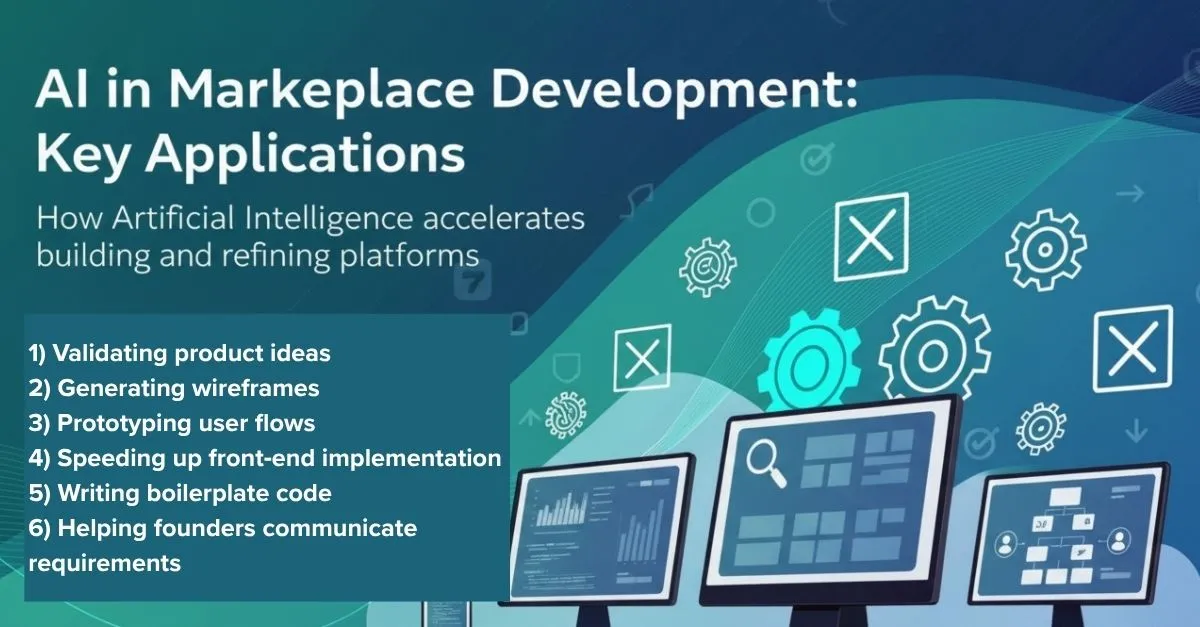
Despite its limitations, AI can be a powerful accelerant when used in the right contexts. Here are the areas where a vibe coding marketplace genuinely shines:
Validating product ideas
Before you write a single line of code, you need to know if your marketplace concept has legs. AI can help you quickly generate market research, draft value propositions, and even simulate user flows to test assumptions. Use AI to ask “what if” questions about your business model without committing to a build.
Generating wireframes
Tools like v0 or Lovable can turn a simple prompt like “a marketplace homepage with a search bar, product cards, and a seller dashboard link” into a functional wireframe in minutes. These wireframes are great for internal alignment and early user testing.
Prototyping user flows
Want to see how a buyer books a service or how a seller lists an item? AI can generate clickable prototypes that let you walk through key journeys. This is far faster than drawing boxes in Figma, and it gives you something tangible to show potential customers. Early-stage vibe coded apps marketplace experiments often start with these prototypes to validate demand before investing in full development.
Speeding up front‑end implementation
Front‑end work – building UI components, styling with Tailwind, handling form validation – is where vibe coding tools like Cursor, GitHub Copilot, and Claude Code excel. They generate clean, component‑based code that’s easy to tweak. With tools like StartupBolt, you can get a Next.js front‑end with built‑in authentication and payment components in under 30 minutes.
Writing boilerplate code
The boring parts – setting up routing, configuring a database connection, adding user authentication – are perfect for AI. Boilerplate generators like Marblism produce a complete starter kit with front‑end pages, backend API endpoints, and database schema from a single prompt. This can save days of manual setup.
Helping founders communicate requirements
If you’re a non‑technical founder, describing your vision to a development team is hard. Vibe coding lets you build a rough version yourself, then hand that working (if imperfect) prototype to engineers. Suddenly, “a dashboard for sellers to see their analytics” becomes a concrete thing they can see, click, and improve.
What founders can realistically build with AI?
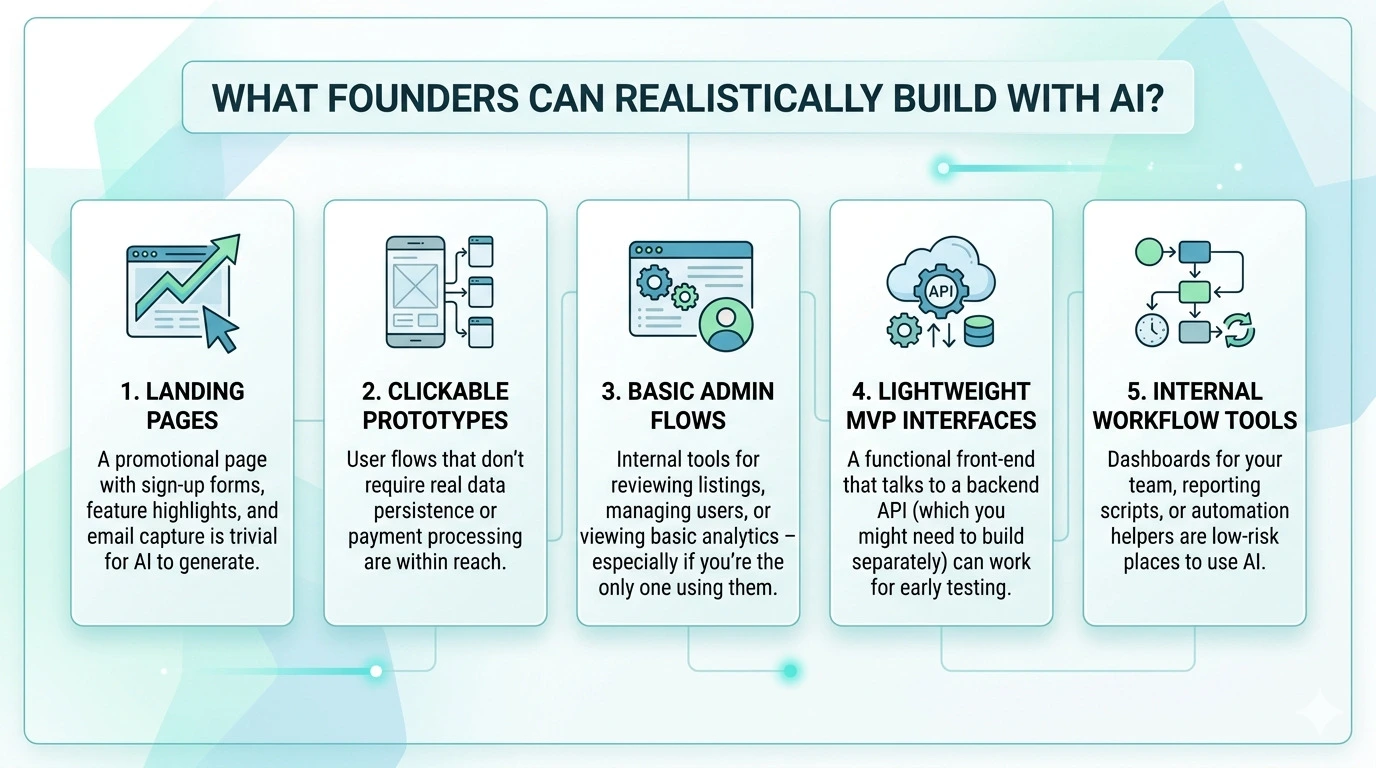
Not every marketplace component is equally well‑suited to vibe coding. Here’s what you can actually ship using current AI tools:
- Landing pages. A promotional page with sign‑up forms, feature highlights, and email capture is trivial for AI to generate.
- Clickable prototypes. User flows that don’t require real data persistence or payment processing are within reach.
- Basic admin flows. Internal tools for reviewing listings, managing users, or viewing basic analytics – especially if you’re the only one using them.
- Lightweight MVP interfaces. A functional front‑end that talks to a backend API (which you might need to build separately) can work for early testing.
- Internal workflow tools. Dashboards for your team, reporting scripts, or automation helpers are low‑risk places to use AI.
One founder built an AI‑powered marketplace prototype in just a few weeks using vibe coding to move fast and focus on product strategy. Another created a marketplace for “vibe coders” to connect with professional engineers. These examples show that vibe coded apps marketplace concepts can work – as long as you understand where the limits are.
Where AI and “vibe coding marketplace” start breaking down
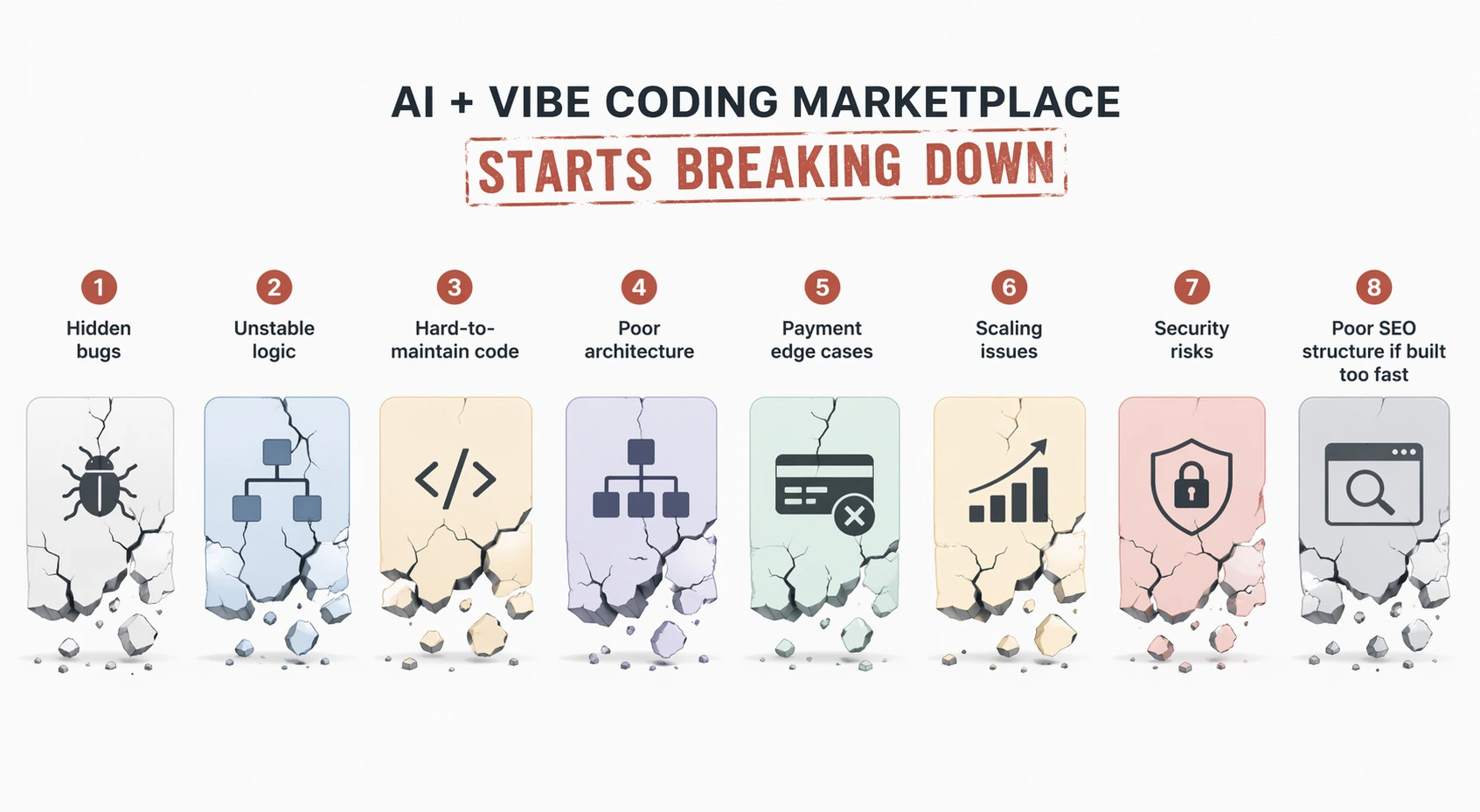
The real trouble begins when you try to turn your prototype into a production marketplace that handles real users, real money, and real data. Here’s where the vibes turn into nightmares.
Hidden bugs
Studies show roughly a quarter of AI‑generated Python and JavaScript snippets contain logic flaws or insecure defaults. These aren’t syntax errors – they’re subtle logic bugs that might only surface under specific conditions. A marketplace booking system with an off‑by‑one error in date handling could double‑book a service or charge the wrong amount.
Unstable logic
AI models don’t have a mental model of your entire system. They generate code that works for the prompt you just gave, but often breaks when you change something else. Even small updates can require new prompts or total regeneration of the codebase, creating a dangerous cycle where fixing one bug introduces three more.
Hard‑to‑maintain code
Vibe‑coded codebases tend to be brittle and poorly organized under the hood – inconsistent structure, minimal comments, ad‑hoc logic, and no proper documentation. Codebases like these accrue technical debt quickly. Adding new features or handling more users becomes difficult or impossible, and you may face an expensive rewrite of the whole app.
Poor architecture
AI doesn’t understand system architecture. It produces inconsistent naming, coding styles, and logic flows, making the codebase harder to navigate and maintain. For a marketplace that must handle concurrent users, race conditions, and transaction integrity, this lack of architectural discipline is a deal‑breaker.
Payment edge cases
Stripe integration is easy. Handling what happens when a payment fails after a service has already been delivered? That’s a messy edge case that AI consistently gets wrong. Payment flows require idempotency keys, webhook verification, refund logic, and dispute handling – all areas where AI‑generated code tends to cut corners.
Scaling issues
A vibe‑coded app that works for 10 users will almost certainly break at 1,000. AI doesn’t think about database indexing, connection pooling, rate limiting, or caching strategies. According to Forrester, frequently occurring issues in vibe‑coded apps include “missing or weak access controls, hardcoded secrets or passwords, unsanitized input, and insufficient rate limiting”.
Security risks
This is the most dangerous area. Veracode found that 45% of AI‑generated code contained an OWASP Top 10 vulnerability. Real‑world examples are mounting: a social networking platform built entirely through vibe coding was breached, exposing 1.5 million authentication tokens. A researcher found 16 vulnerabilities in a single vibe‑coded application, six of them rated critical, leaking the data of more than 18,000 users.
Forrester Analyst Janet Worthington warns: “Frequently occurring issues are missing or weak access controls, hardcoded secrets or passwords, unsanitized input, and insufficient rate limiting”. As one security expert put it, “By definition, Copilot is an average of all developers’ shared work. Unfortunately, all the security failings added to all known public codebases are part of the corpus on which it bases its suggestions”.
Poor SEO structure if built too fast
AI will happily generate React components without server‑side rendering, meta tags without Open Graph support, or content that search engines can’t crawl properly. A marketplace that can’t be discovered is a marketplace that fails.
The biggest mistake founders make with a vibe coding marketplace
The most common and costly mistake is treating vibe coding as a replacement for engineering instead of an accelerator for it. Founders see a working prototype and think, “I’m ready to launch.” They skip code review, skip security audits, skip load testing, and skip architectural planning. Then, when real users sign up, and real money starts flowing, the cracks appear – often catastrophically.
The difference between vibe coding success and disaster often comes down to a single security configuration, or the choice to review what the AI generated. Yet most non‑technical founders don’t have the skills to review code, and many technical founders get overconfident in AI output and skip validation.
A better way to use AI in marketplace development
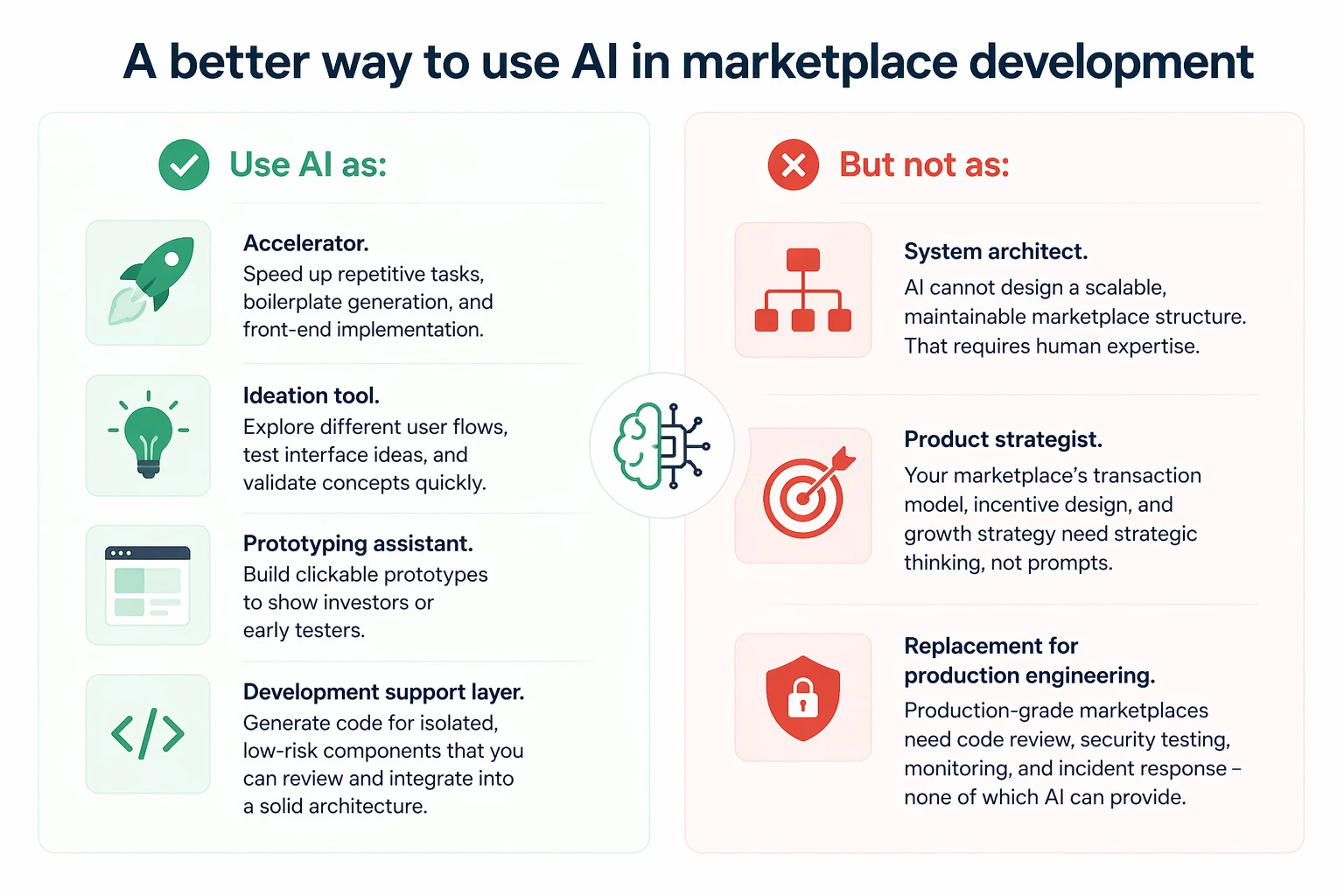
The goal isn’t to avoid vibe coding – it’s to use it wisely. Here’s the framework:
Use AI as:
- Accelerator. Speed up repetitive tasks, boilerplate generation, and front‑end implementation.
- Ideation tool. Explore different user flows, test interface ideas, and validate concepts quickly.
- Prototyping assistant. Build clickable prototypes to show investors or early testers.
- Development support layer. Generate code for isolated, low‑risk components that you can review and integrate into a solid architecture.
But not as:
- System architect. AI cannot design a scalable, maintainable marketplace structure. That requires human expertise.
- Product strategist. Your marketplace’s transaction model, incentive design, and growth strategy need strategic thinking, not prompts.
- Replacement for production engineering. Production‑grade marketplaces need code review, security testing, monitoring, and incident response – none of which AI can provide.
Even Sharetribe, a no code marketplace builder, acknowledges that professional developers use AI heavily in the development process. The difference is that they use AI within a robust engineering workflow, not instead of one.
What founders should prioritize instead?
If you’re building a marketplace, here’s where to focus your energy – whether you use AI or not.
- Validate the niche. Does a real problem exist? Are there enough buyers and sellers? AI can help with research, but you need to talk to actual users.
- Define the transaction model. Will you take a percentage fee, a subscription, or a listing fee? How will payments flow? Map every scenario before you write code.
- Design the user journey. Walk through every step from sign‑up to completed transaction. Identify friction points and edge cases.
- Plan a scalable structure. Choose your database schema, API design, and state management patterns upfront. A little architecture now saves a rewrite later.
- Choose the right platform. For many marketplaces, a specialized no‑code or low‑code builder like Sharetribe provides 90% of what you need with built‑in security and scalability. You can then extend it with custom code where necessary – and use AI to write that custom code faster.
- Think about SEO and discoverability early. Plan your URL structure, metadata strategy, and content generation approach before launch.
Final thoughts on vibe-coded marketplaces
Vibe coding is not a silver bullet for marketplace development. It’s a tool – a powerful one for some tasks, a dangerous one for others. The founders who succeed will be those who use AI to move faster without sacrificing the fundamentals: security, architecture, maintainability, and user trust.
Before you type that next prompt, ask yourself: are you building a prototype to test an idea, or a product to serve real customers? The answer determines whether your marketplace becomes a success story or another cautionary tale in the growing list of vibe coding marketplace review horror stories.
Let’s Discuss Your Software Needs
Ready to move beyond generalizations? Contact Roobykon Software for a complimentary technical consultation. We will listen first. Evaluate second. Build third. The only sequence that works.
Book Your Call Now
Recommended articles
 Top Exclusive Online Marketplace Ideas for Startups: The Ultimate Guide for 2026
Stop competing with giants. Learn how to build a specialized, trusted marketplace that transforms an industry. From niche rental ideas to B2B hubs, this guide provides the ideas, examples, and actionable steps for founders.
 The Ultimate Guide on How To Build a Multi-Vendor Marketplace in 2026
Unlock the secrets of successful marketplaces. This guide explains how a multi-vendor website works and provides a clear plan to build your own, from validating your idea to launching and driving growth.
 Top 5 Cryptocurrencies Used by Marketplaces
The competition between various marketplaces and retail networks has reached its peak. And each company is looking for a way to become more comfortable for its end users. So, it is not surprising that the cryptocurrencies entered into marketplaces as a new profitable method of payment!
 AI Integration in Marketplaces: Why It’s the Next Big Thing
AI is taking the e-commerce industry by storm, with a projected market value of USD 29.71 billion by 2031. As we continue to see the impact of AI across industries, it's no surprise that its integration in online marketplaces is transforming the way businesses operate.