How Do You Know a Development Team Is Doing Something Wrong?
Why Signs Of a Bad Software Development Team Are Hard to See Early
The Most Common Warning Signs Your Development Team Is Doing Something Wrong
Symptom vs Root Cause – What May Really Be Going Wrong
What to Check Before You Blame the Development Team
What Good Development Teams Do Differently
When You Should Fix the Current Setup vs Change the Team
What to Do in the First 30 Days After Spotting Development Problems
Subscribe and you will promptly receive new published articles from the blog by mail
You had a plan, a team, a launch date on a sticky note somewhere.
And yet – here you are, a few months in, with a product that doesn’t quite work, a backlog that keeps growing, and a vague feeling that something is off but you can’t put your finger on exactly what.
This is one of the most uncomfortable positions a founder or product manager can be in. You’re not a developer yourself. You don’t want to micromanage. You want to trust the team. But trust without visibility is just hope – and hope doesn’t ship software.
This article is for anyone who has felt that quiet unease and needed a framework to figure out whether it’s real. We’ll walk you through how to spot development issues early, how to tell the difference between a struggling team and a team in a bad environment, and, crucially, what to actually do about it.
How Do You Know a Development Team Is Doing Something Wrong?
Here’s the honest answer: most of the time, you get a feeling before you get proof.
Something feels off. Updates are vague. Demos get postponed. The features that were “almost done” two weeks ago are still almost done. And when you ask direct questions, you get a lot of words but not a lot of answers.
That feeling is worth paying attention to. But feelings don’t give you a plan – facts do.
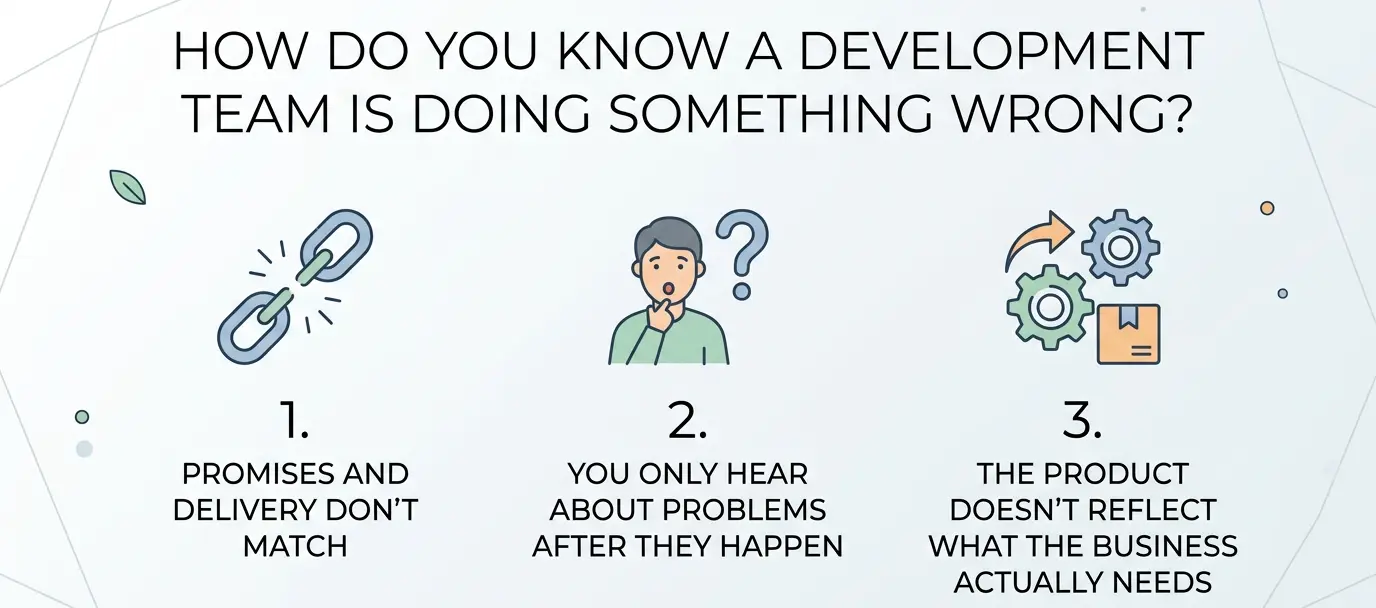
So let’s make it concrete. Your development team is doing something wrong when you see any of these three patterns consistently:
Promises and delivery don’t match. Not once – consistently. Sprint after sprint ends with work carried over, scope quietly shrunk, or features shipped that don’t actually work the way they were described. One miss is a bad week. Three misses in a row is a pattern.
You only hear about problems after they happen. Good teams surface blockers before they become crises. If you’re finding out about a serious issue the day before a deadline – or worse, after something breaks in production – your team isn’t bringing you into the conversation early enough.
The product doesn’t reflect what the business actually needs. Sometimes everything looks fine on paper: tickets closed, sprints completed, features shipped. But what gets shipped keeps missing the point. It works technically, but it’s not what users need. That gap between technical delivery and business intent is one of the most expensive problems in software – and one of the hardest to spot.
If any of these sounds familiar, keep reading.
Why Signs Of a Bad Software Development Team Are Hard to See Early
The tricky thing about software development is that it’s invisible. You can’t walk past the office and see whether the walls are up. You can’t look at a commit log and tell whether the decisions behind it were good or reckless. The whole thing operates behind a layer of abstraction that makes early software project warning signs genuinely hard to read – even for experienced people.
A few things make this worse.
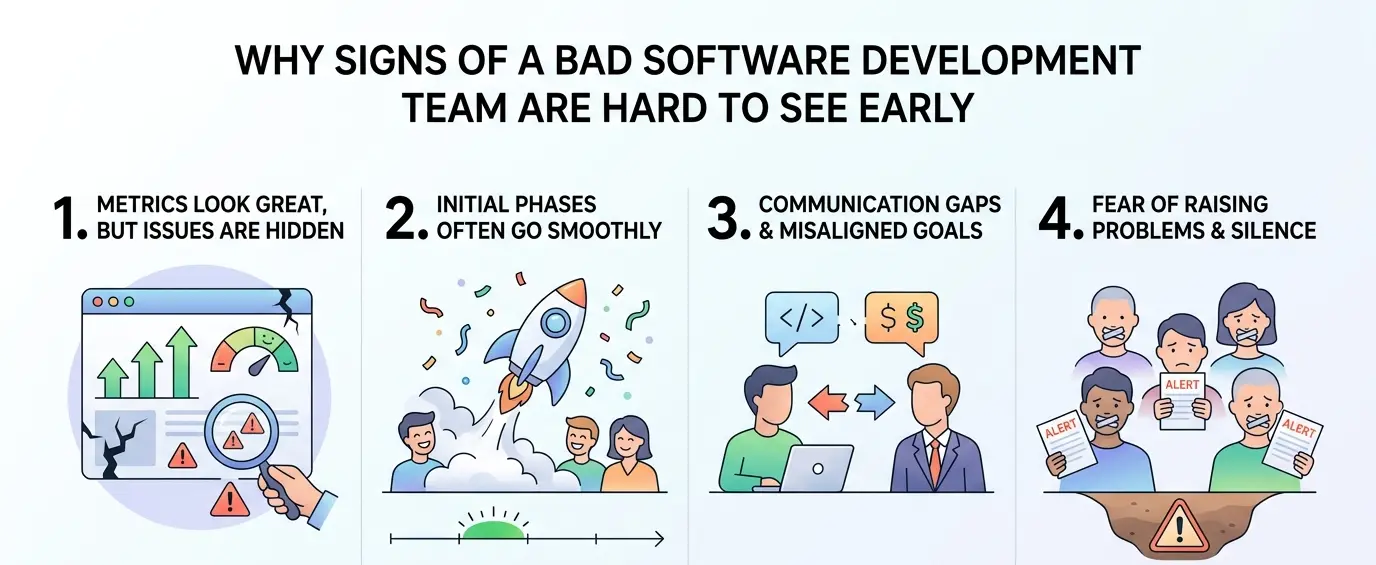
Metrics can look great while everything quietly falls apart. Story points closed, tickets resolved, commits pushed – all of these can show a healthy, productive team while underneath there’s mounting technical debt, a growing list of known bugs being deliberately suppressed, or a codebase that’s heading toward a wall at 60 miles an hour.
The first few weeks are almost always good. New projects, new teams, new energy – everyone is motivated, communication is smooth, and the early demos look impressive. That honeymoon phase can last long enough to delay the recognition of deeper problems. By the time the cracks show, you may have spent six months and a lot of money getting there.
Developers and business people don’t always speak the same language. “We’re 80% done” is one of the most misleading sentences in software. It rarely means what you think it means. The last 20% can take longer than the first 80%. When that translation layer breaks down, you end up with misaligned expectations on both sides – and neither party realizes it until someone is very unhappy.
Problems stay buried when people are afraid to raise them. In teams without psychological safety, issues get hidden rather than escalated. Developers downplay blockers. Team leads soften bad news. By the time a real problem reaches leadership, it’s been festering for weeks and has usually gotten much worse.
Knowing this is half the battle. The other half is knowing specifically what signs of a bad software development team to look for.
The Most Common Warning Signs Your Development Team Is Doing Something Wrong
These are the software development team red flags that experienced product leaders have learned to watch for. Not every single one means disaster – but if you’re nodding at multiple items on this list, you have work to do. Knowing when to choose a development outsourcing partner is one way to proactively avoid many of these issues from the start.
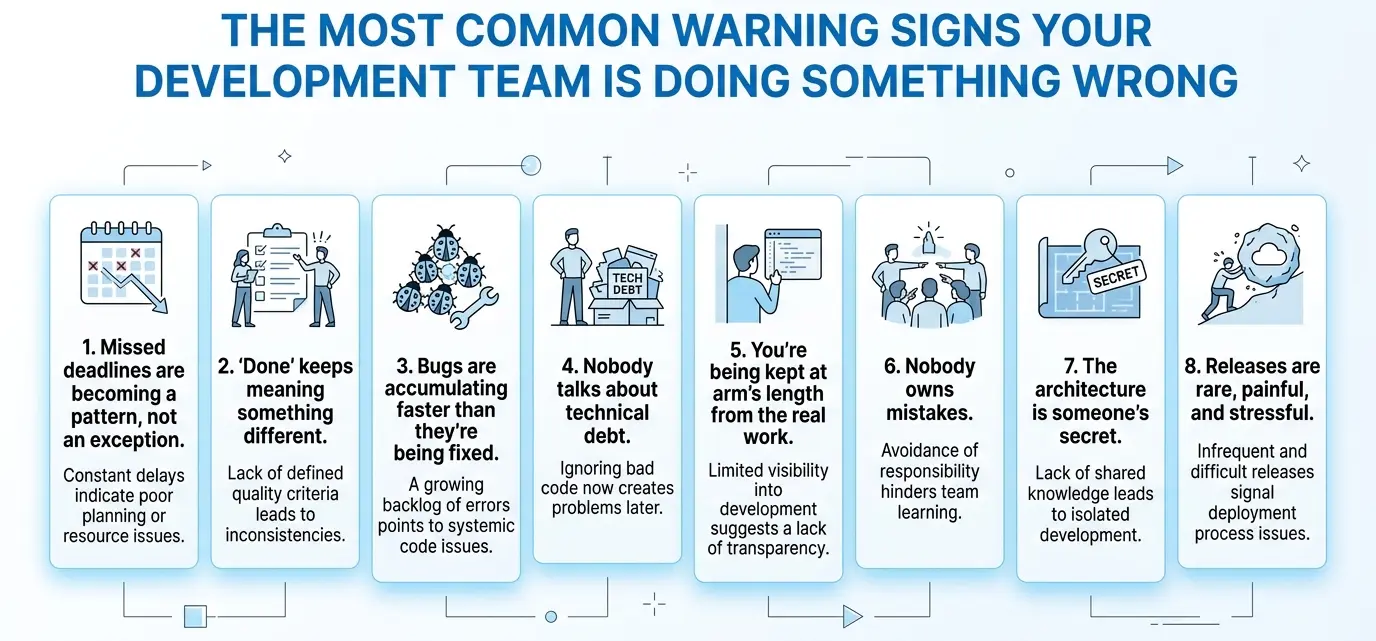
Missed deadlines are becoming a pattern, not an exception
Every team misses a deadline occasionally. That’s normal. But when it’s happening sprint after sprint, something structural is broken – whether that’s poor estimation, unclear requirements, technical debt slowing everything down, or a team that’s simply understaffed for the scope they’ve taken on.
The tricky part is that teams often explain away each individual miss as a one-off. “The scope changed.” “We hit an unexpected technical issue.” “It’s more complex than we thought.” All of these can be true sometimes. They can’t all be true every single time.
“Done” keeps meaning something different
If tasks that were marked complete keep coming back – because they weren’t actually finished, or because they break when integrated with other parts of the system – you might have a weak software development team. Done should mean: it works correctly, in the real environment, for real users. Not “it works on my laptop.”
Bugs are accumulating faster than they’re being fixed
A growing bug backlog isn’t just annoying. It’s a signal that the team is either moving too fast without adequate testing, writing code that’s hard to maintain, or both. When fixing one bug reliably creates two others, you’re probably deep into technical debt territory.
Nobody talks about technical debt
Every software product accumulates some technical debt. It’s not a sign of failure – it’s a natural byproduct of making decisions under time pressure. The difference between a healthy team and an unhealthy one is whether debt is acknowledged and managed or simply ignored until it explodes.
Teams that never talk about refactoring, never allocate sprint capacity to it, and treat architectural concerns as “future problems” are building on a foundation that will eventually give way. This is one of the weak development team symptoms that’s easiest to miss because it’s invisible until it isn’t.
You’re being kept at arm’s length from the real work
If demos keep getting postponed, if status updates are consistently vague, if you can’t get a straight answer about what’s blocking progress – pay attention. Healthy teams pull stakeholders closer to the work. Teams that are struggling tend to put up barriers, consciously or not.
Nobody owns mistakes
When something goes wrong (a missed deadline, a broken feature, a production incident), watch what happens next. Does the team analyze it, document the root cause, and change something to prevent it from happening again? Or does everyone point at someone else, and then the same thing happens again two months later?
Accountability culture, or the absence of it, is one of the strongest predictors of where a team is headed.
The architecture is someone’s secret
If the only person who truly understands how a core part of your system works is one developer – or, even worse, a developer who has already left – you have a single point of failure buried in your product. Good teams document, share knowledge, and build systems that other competent engineers can navigate without a guided tour.
Releases are rare, painful, and stressful
Modern best practice is small, frequent, automated deployments. When releases become big events that require heroic weekend effort and are preceded by weeks of anxiety, your DevOps culture and engineering practices have fallen behind where they need to be. This is one of the most reliable signs your software project is going off track – it’s just not obvious until you’ve seen what the alternative looks like.
Symptom vs Root Cause – What May Really Be Going Wrong
Here’s where most attempts to fix development problems go wrong: they treat symptoms as causes.
- If your team is missing deadlines and you respond by adding more deadline pressure, you haven’t fixed anything – you’ve just added stress to whatever was already causing the problem.
- If communication is poor and you respond by adding more meetings, you haven’t fixed communication – you’ve just made everyone’s calendar worse.
The real question is always: what’s actually causing this?
What You’re Seeing | What’s Actually Causing It |
|---|---|
Missed deadlines | Poor estimation, unclear requirements, or an overloaded team |
Growing bug count | No automated testing, no QA process, rushed delivery |
Poor communication | No defined processes, fear of escalation, unclear roles |
Scope creep | No change management, weak product ownership |
High turnover | Poor management, cultural problems, or burnout |
Slowing velocity | Technical debt compounding over time |
Features that miss the point | No discovery process, weak product-engineering collaboration |
Painful deployments | No CI/CD pipeline, no DevOps culture |
The most useful diagnostic question you can ask is “why”, and ask it five times. Not to assign blame, but to find the actual lever that, when you pull it, changes something. That’s the only intervention worth making.
What to Check Before You Blame the Development Team
Before you conclude that the problem lives inside your development team, be honest with yourself about the environment they’re operating in.
Some of the most common causes of underperforming dev team members behavior aren’t created by the team at all – they’re created by the systems, processes, and leadership around them.
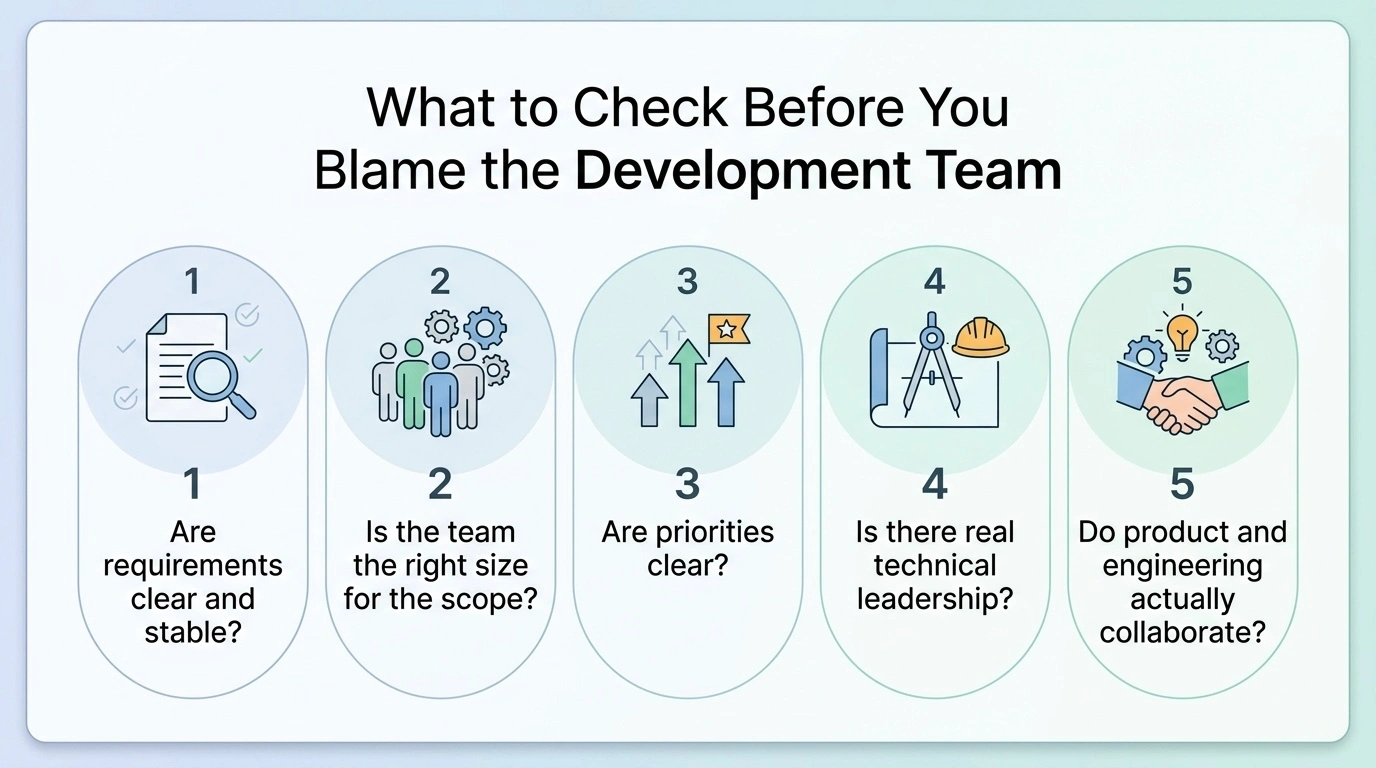
Are requirements clear and stable? Developers cannot build something that hasn’t been properly defined. If requirements arrive late, change frequently, or are communicated in casual Slack messages without documentation, the team is being set up to fail – regardless of how skilled they are.
Is the team the right size for the scope? This one is shockingly common. Roadmaps expand while team sizes stay flat. Five people cannot sustainably execute a ten-person scope, no matter how good they are. Pressure without adequate resourcing produces shortcuts, burnout, and eventually, collapse.
Are priorities clear? When everything is urgent, nothing gets done well. If your development team regularly receives five “top priority” items simultaneously, that’s a product leadership failure, not a development failure.
Is there real technical leadership? Without a senior technical lead or architect providing direction, developers make independent decisions in isolation. The result is an incoherent codebase that slows everyone down over time. Absence of technical leadership expresses itself as team-level dysfunction – but it’s not the team’s fault.
Do product and engineering actually collaborate? Finding the right product development team means finding one where developers understand why they’re building what they’re building, not just what. When product and engineering are siloed – when developers receive tickets without context or business rationale – you consistently get technically correct but strategically wrong outputs.
Be honest about what you find. Sometimes, the most important software development problems are created at the leadership level, not the team level.
What Good Development Teams Do Differently
It’s hard to recognize software project warning signs if you’ve never seen what right looks like. Here’s a realistic picture of how strong development teams actually operate – not an idealized fantasy, but observable patterns from real high-functioning teams.
They estimate with honesty, not optimism. Instead of “this will take five days,” they say “based on what we know, this is probably three to seven days, and here’s the main risk that could make it longer.” They treat estimation as communication, not as a commitment to look confident.
They push back on the scope when they need to. Strong teams say “no” (or at least “not now”) when necessary to protect quality. They’d rather deliver fewer things well than many things poorly.
They treat quality as built-in, not bolted on. Code review, automated testing, and intentional refactoring aren’t occasional luxuries – they’re part of how the team works every day. This is what makes it possible to move fast without constantly breaking things.
They surface problems before they become crises. Issues come up in standups, not in postmortems. Blockers get flagged before they become missed deadlines. There is no “we’ll figure it out” culture around serious risks.
They own outcomes, not just outputs. The question isn’t “did we ship the feature?” It’s “did the feature achieve what it was supposed to achieve?” High-performing teams care about impact, not just delivery.
They build for the long term, including support. The best teams understand that software is never truly finished – it evolves. They build with future maintenance in mind, and they treat ongoing product support as a natural part of the product lifecycle, not an afterthought.
When You Should Fix the Current Setup vs Change the Team
This is the question that keeps product leaders up at night – and it deserves a real answer, not a diplomatic non-answer.
One of the clearest signs your development team is underperforming is that the same problems keep resurfacing regardless of what you try. But before you act, you need to ask: is this a team problem, or a setup problem? Because the answer changes everything.
Fix the setup first when…
The problems are environmental. If your team has never had clear requirements, never had technical leadership, never had adequate tooling – and you haven’t genuinely addressed those conditions – changing the people without fixing the environment will produce the exact same problems with a new cast. What looks like weak development team symptoms from the outside is often a capable team operating in broken conditions.
The team is technically capable but working without structure. Process debt is much easier and faster to fix than skill gaps. If your developers are good engineers operating without sprint discipline, code review standards, or quality gates, introducing structure can unlock a significant improvement quickly. Don’t mistake the absence of process for signs of a bad software development team – they’re very different problems with very different solutions.
The issues are recent and have a plausible external cause. A team that was performing well and has recently declined may be going through something temporary – the loss of a key member, an unusually hard technical challenge, or a leadership transition. Don’t restructure before you diagnose.
Continuity has real value. If key team members hold critical institutional knowledge about a complex system, and you’re in a sensitive product phase, the disruption of replacement may create more risk than it removes.
Change the team when…
Core skills are genuinely absent – and have been demonstrated to be absent. If your product requires capabilities the team doesn’t have and has shown it can’t develop, no amount of process improvement closes that gap.
Cultural problems run deep. Chronic accountability avoidance, embedded blame culture, and communication failures that persist through multiple intervention attempts are sometimes fixed by leadership changes – but when they’re deeply embedded and long-standing, restructuring is often the only real path forward.
Trust has broken down between stakeholders and the team. Once the relationship has deteriorated to adversarial territory, the energy required to repair it often outweighs the benefit of keeping it together.
The trajectory is consistently downward. If things are getting measurably worse month after month, despite genuine structural efforts to fix root causes, that trajectory is your answer. At this point, you’re no longer looking at software project warning signs – you’re looking at a project that is definitely off track.
If you’re evaluating external options, remote development team services can sometimes offer a faster path to the right skills and team structure – without the time and cost of rebuilding from scratch.
What to Do in the First 30 Days After Spotting Development Problems
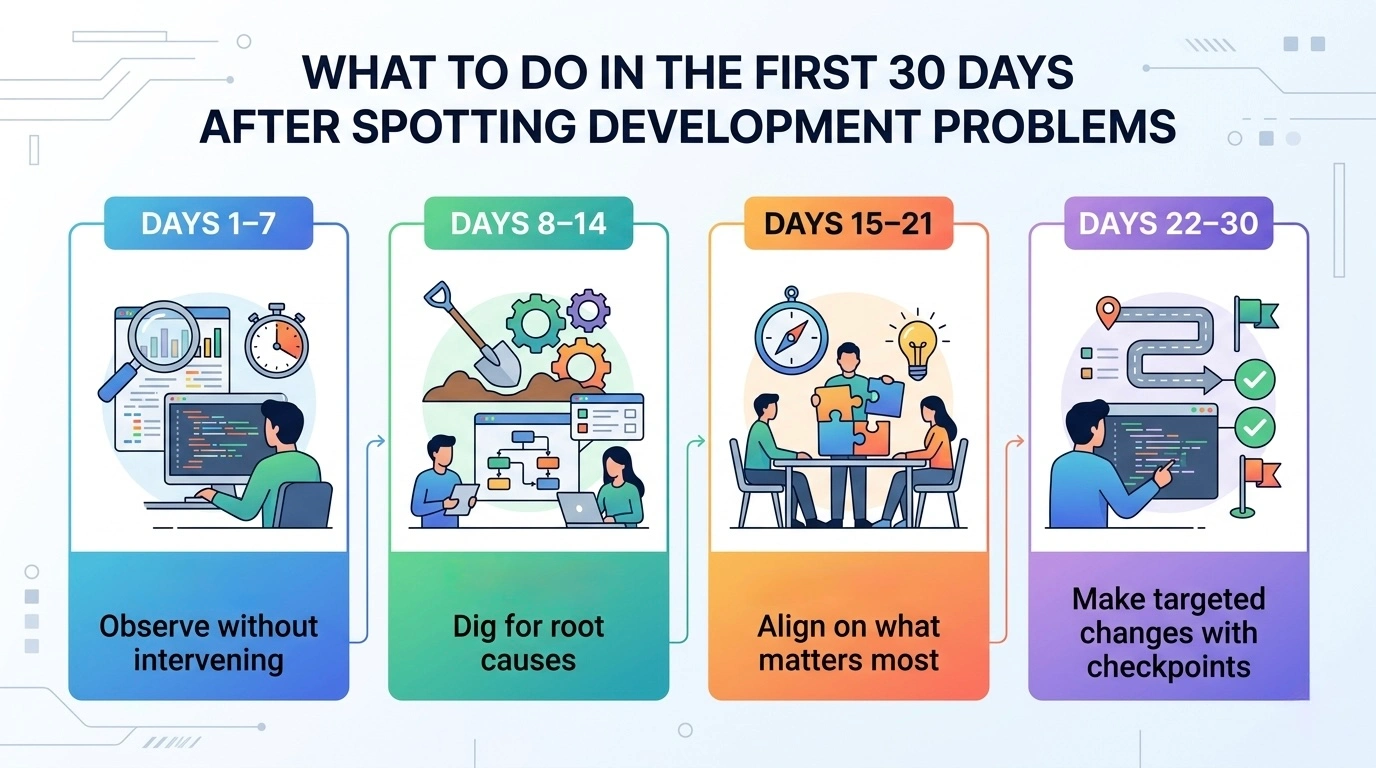
Acting on a gut feeling without structure tends to make things worse. Knowing how to spot development issues is only half the job – you also need to know what to do the moment you spot them. Here’s a grounded 30-day approach to moving from “something is wrong” to “we have a plan.”
Days 1–7: Observe without intervening
Resist the urge to act immediately. Spend the first week collecting facts – sprint completion rates, bug counts, deployment frequency, and communication patterns. Document what you’re seeing with specifics, not impressions. This is where you separate real signs your software project is going off track from one-off rough patches.
Since founders mostly communicate with the PM as their main point of contact, start there. Talk to the PM individually, ask open-ended questions, and actually listen. Look for patterns in how they describe blockers, team dynamics, and priorities – what you hear often tells you more than any metric.
Days 8–14: Dig for root causes
Map what you’re seeing to probable underlying causes. Are the problems concentrated in one area of the system? One part of the team? One phase of the development cycle?
If you can, bring in a neutral technical perspective – a senior engineer not directly involved, or an outside advisor. The goal is an honest structural assessment. Not an audit designed to justify a decision you’ve already made.
Days 15–21: Align on what matters most
Don’t try to fix everything at once. Identify the two or three root causes with the highest business impact and the clearest intervention paths.
Present your findings to the relevant stakeholders. Get genuine alignment on what success looks like after the intervention – specific and measurable, not vague. If you’ve been wondering whether your development team is doing something wrong, this is the stage where you get your answer and share it.
Days 22–30: Make targeted changes with checkpoints
Common first-wave interventions that actually move the needle:
- Restructuring sprint ceremonies so they produce real information (not theater)
- Establishing a shared definition of done that the team actually follows
- Allocating a consistent percentage of each sprint to technical debt reduction
- Clarifying the product roadmap so there’s a real priority order
- Designating or hiring a technical lead with actual architectural authority
Set a 60-day review checkpoint. If the trajectory hasn’t improved after two months of genuine structural change, escalate to team-level decisions.
How Roobykon Can Help If Your Development Team Is Off Track
We’ve been in this situation as the team that gets called in when something has gone wrong.
What we’ve learned from those engagements is that the companies that come to us rarely have a “bad team” problem. More often, they have a context problem: the wrong team for the specific product, or a capable team operating in conditions that set them up to fail, or a team that was fine for early-stage work but isn’t equipped for where the product needs to go next. Sometimes, founders have already seen the signs of a bad software development team clearly for months – they just needed a framework and a conversation to confirm it.
Our job starts with understanding which of those situations you’re actually in – before we recommend anything.
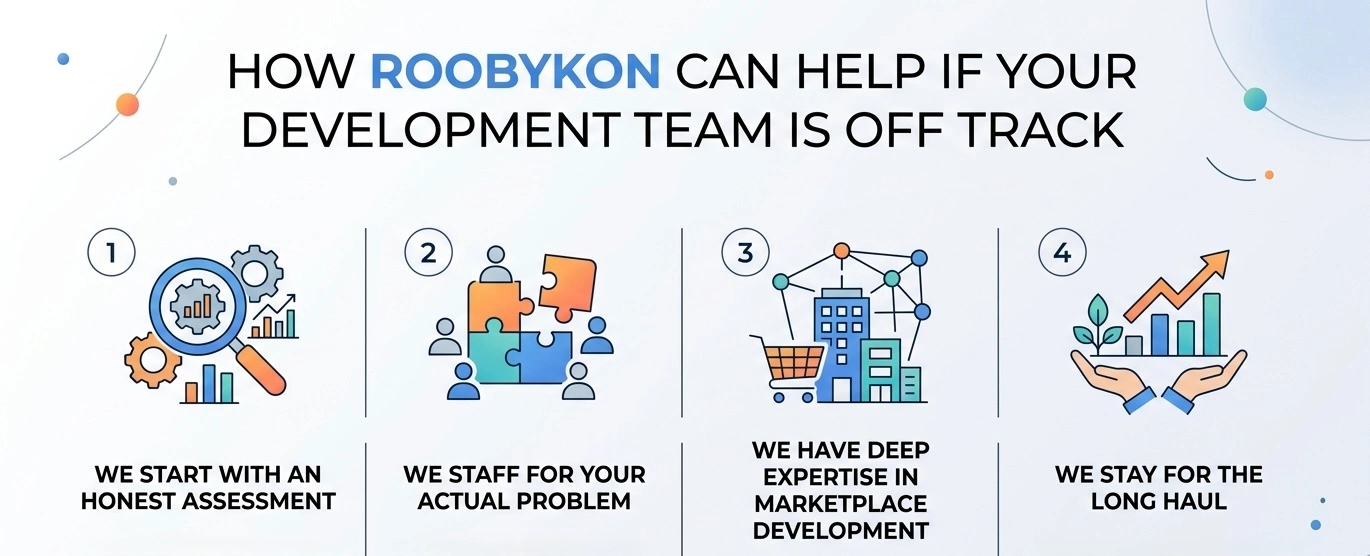
We start with an honest assessment. We look at codebase quality, team structure, process maturity, and the alignment between the technical work happening and the business goals it’s supposed to serve. We tell you what we find, even when it’s uncomfortable.
We staff for your actual problem. Whether you need one senior engineer to provide technical leadership to an existing team, or a dedicated team to take over a stalled project entirely, our remote development team services are built around flexibility. You’re not buying a package – you’re building the right team for the specific problem in front of you.
We have deep expertise in marketplace development. Roobykon has been building marketplace platforms – particularly on Sharetribe – for over a decade. If your product operates in this space and you’re not sure whether your current team has the right specialization, it’s worth talking to us. You can also read more about how to find the right Sharetribe expert if you want to evaluate your options first.
We stay for the long haul. We don’t disappear after launch. Our approach to ongoing product support means we remain accountable for what we build – monitoring, maintaining, and evolving the product as your business grows.
Roobykon Software steps in when development problems threaten your product
If your internal team is underperforming, a partner has gone silent, or you simply don't know how far off track you really are, Roobykon audits what exists, stabilizes what's salvageable, and builds a clear path to launch.
Contact us today for a no-obligation code auditRoobykon Case Studies
Theory is one thing. Here’s what it actually looked like in practice.
Rosella Street: Taking Over a Platform Mid-Flight

Rosella Street isn’t a typical e-commerce play. It’s an environmental and community sharing marketplace built around a genuinely important idea: reducing landfill waste by 5% in every community it enters, and allocating 1% of every sale to local environmental and community initiatives. Co-founders Mick and Sammy started building it in 2019 with a mission that was clear from day one.
By November 2023, the platform had real users and real ambitions – but it also had a problem. A previous development team had built the initial version, and over time, the codebase had accumulated significant technical debt. Compatibility issues between old and new features were slowing development. Scaling for growing user demand had become painful. And the handoff of institutional knowledge from the previous team to anyone new was incomplete at best.
That’s when Roobykon came in.
Our first job wasn’t to build anything. It was to understand what was already there – deeply. We spent weeks auditing the codebase, mapping the architecture, identifying where technical debt was concentrated, and meeting with the Rosella Street team to understand their vision and the specific pain points they’d been living with.
The result was a platform that could handle growing demand, support new feature development without the risk of cascading breakage, and finally move at the pace Rosella Street’s mission deserved.
Rabel: When a Good Idea Gets Handed Off to the Wrong Team First
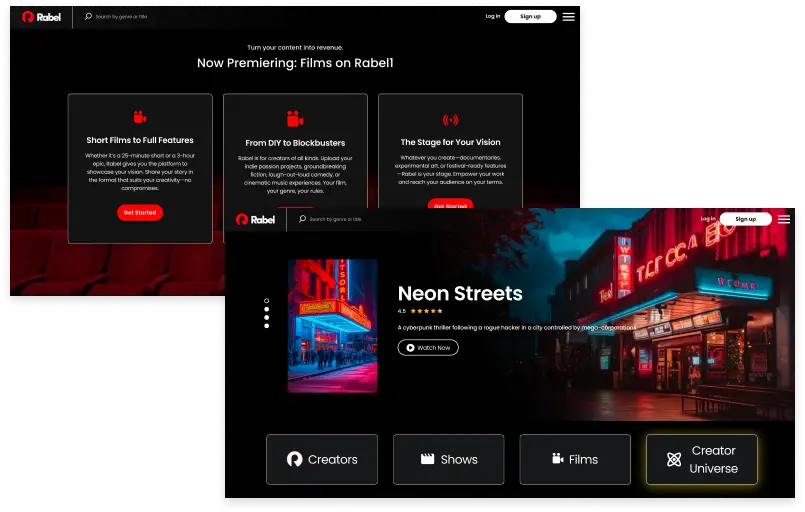
Kalyn’s vision for Rabel was refreshingly simple to explain: a content marketplace that actually treated creators fairly. Independent creators were handing over 40–50% of their earnings to platforms that didn’t really have their backs. Rabel flipped that model – a 90/10 revenue split in the creator’s favor, free to join, no restrictive contracts, and full pricing freedom.
When she came to us in April 2025, the platform wasn’t starting from zero – but the situation was complicated. A previous agency had started the build, and while there was working code, it had some unfinished features, inconsistencies, and areas that needed cleanup before Rabel could responsibly add anything new.
This is one of the most delicate situations in software development: inheriting someone else’s half-finished work. You’re accountable for what you ship, but you didn’t make the original decisions. The temptation is to rebuild everything. The reality is that’s rarely the right call – and it’s always expensive.
We took a disciplined approach. Before writing a single line of new code, we spent April doing a thorough audit: what was working, what needed fixing, what needed replacing, and what was actually solid. Then we stabilized. May was entirely focused on completing unfinished features and squashing the bugs that had accumulated before we could move forward with confidence.
CareerNavig8r: When the Previous Agency Goes Silent
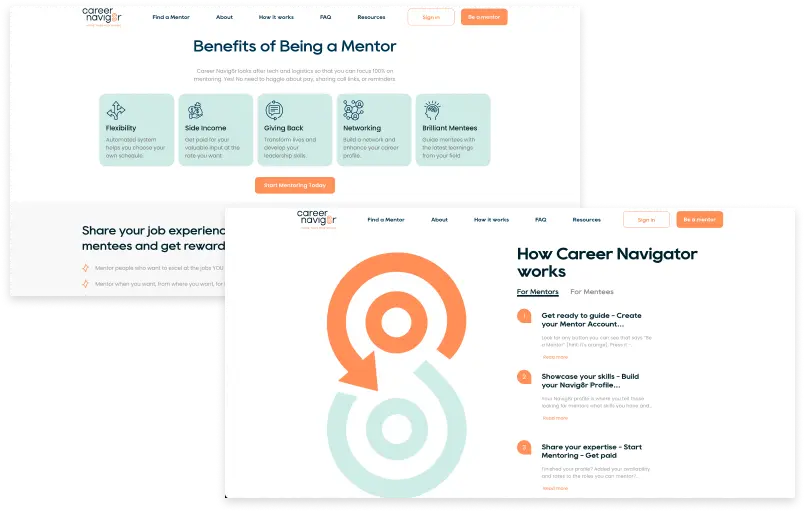
There is a deceptively simple idea behind CareerNavig8r: most career advice comes from people who’ve never actually done your job. Generic executive coaching is everywhere. What’s genuinely rare is getting guidance from someone who has literally held the exact role you’re aiming for – whether that’s bank teller, mechanical engineer, or math teacher.
The founder built CareerNavig8r on Sharetribe Flex to bring that idea to life. And then his development partner went silent – one of the clearest software development team red flags – leaving a half-built platform with no clear path forward. Rather than tearing everything down, Roobykon audited the existing codebase, stabilized what worked, and launched a fully functioning marketplace where anyone with job experience can sign up in minutes and get paid for what they already know.
Roobykon’s first instinct – as it always is in situations like this – wasn’t to tear everything down and start over. That’s the expensive, disruptive option that agencies often push because it means more billable work. Instead, we did what we always do: we looked at what was actually there before we made any recommendations.
We audited the existing codebase carefully, without documentation to guide us. We separated what was working from what needed attention. And we found that the foundation was salvageable – it just needed someone willing to do the unglamorous work of stabilizing it before building on top of it.
The result: CareerNavig8r went live as a fully functioning, production-ready marketplace – one where anyone with job experience can sign up in five minutes, set their own schedule and rates, and start getting paid for the knowledge they already have.
Final Checklist Before You Make a Decision
Before you decide whether to fix your current team, restructure it, or replace it entirely, go through this checklist honestly.
On your diagnosis:
- Have I documented specific, recurring patterns – not isolated incidents?
- Have I looked for root causes, not just surface symptoms?
- Have I genuinely ruled out environmental factors (unclear requirements, understaffing, missing tooling, absent leadership)?
- Have I gotten an independent technical perspective on codebase and architecture health?
- Have I talked to the PM at multiple levels to understand internal dynamics?
On the team:
- Does the team have the core technical skills this product actually requires?
- Is there a designated technical lead with real architectural authority?
- Have accountability gaps persisted through multiple genuine intervention attempts?
- Is turnover a new development or a long-standing pattern?
- Have quality standards ever been clearly defined and enforced – or just implied?
On process:
- Are sprint ceremonies producing real information or just going through the motions?
- Is there a definition of done that the team actually adheres to?
- Is technical debt being tracked and managed – not just accumulated?
- Is the product roadmap clear and genuinely prioritized?
- Is there a functional QA process – automated and/or manual?
On communication:
- Do developers proactively surface blockers, or do you find out after the fact?
- Are stakeholders included in real demos and reviews?
- Is there a clear path when something goes wrong?
- Does the team do honest post-mortems after failures?
On your decision:
- Have I given a structural fix a real chance, at minimum 60 days?
- If I’m replacing the team, do I have a knowledge transfer plan?
- Do I have a clear specification of what the replacement team needs to look like?
- Am I solving the right problem – or just the most visible one?
FAQ

Recommended articles
 How to Hire Ruby on Rails Developers: A Practical Guide for Founders and CTOs
Hiring Rails developers? Skip the generic checklists. This practical guide helps founders choose the right model, avoid costly mistakes, and know when to hire a team instead of a solo coder.
 How to Build an Online Marketplace Website (Complete Guide for 2026)
You have a marketplace idea. Now what? This complete guide answers the questions every founder faces: How do I validate my concept? What features actually matter in an MVP? This article provides practical answers to the challenges of building a marketplace startup from scratch.
 How to find a web development partner for your startup: a step-by-step guide
Choosing the wrong development partner can cost you months. Use this expert guide from Roobykon Software to find a trusted web development partner who treats your startup like their own.
 How to Hire a Sharetribe Developer
Sharetribe gives you the engine, but turning it into a product your users love takes experience. This guide breaks down how to hire Sharetribe developers who understand growth, UX, APIs, and the real-world dynamics of online marketplaces.