What Is a Two-Sided Marketplace?
How to Choose a Two-Sided Marketplace Business Model?
Two-Sided Marketplace Examples
What are the Challenges of Two-Sided Marketplaces?
Does It Make Sense to Build a Two-Sided Marketplace in 2026?
How to Build a Two-Sided Marketplace Without Coding?
What Features Are the Most Important for a Two-Sided Marketplace?
What Two-Sided Marketplace Software Should You Use?
Subscribe and you will promptly receive new published articles from the blog by mail
A two-sided online marketplace is exactly what it sounds like: you bring two groups of people together, help them do business with each other, and take a small slice of every transaction that happens on your platform. In 2026, the fastest way to test the idea is a no-code build on Sharetribe; the moment you need custom logic, multi-vendor payouts, or your own pricing engine, you migrate to a custom Ruby on Rails or Node.js build. Roobykon Software’s guide walks through the business model choices, the features that actually move the needle, and what it costs to build a two-sided marketplace with a dev partner instead of a template.
- A two-sided marketplace makes money by connecting supply and demand and taking a cut – the model (commission, subscription, listing fees) should match your transaction frequency and ticket size.
- It's realistic to build a two-sided marketplace without coding for validation using Sharetribe, but custom logic, payouts, and scale eventually push you toward a custom build.
- Ruby on Rails and Node.js are the two most common custom paths; there's no single right programming language for a two-sided marketplace, only the right one for your specific logic.
- Search, payments, reviews, and dispute tooling are the features that actually retain users, not the visual polish of the listing page.
- In 2026, vertical, niche marketplaces still make sense; horizontal general marketplaces are a much harder sell against incumbents.
What Is a Two-Sided Marketplace?
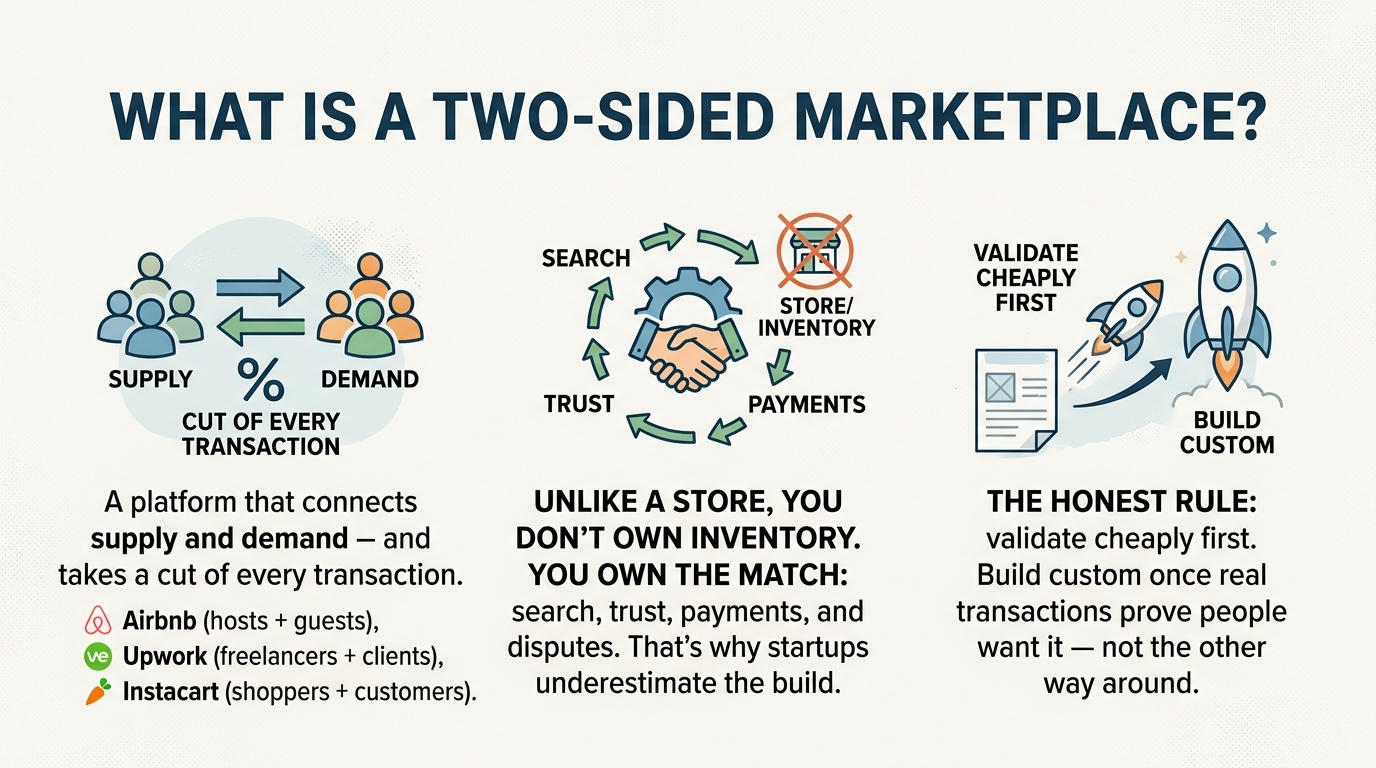
A two-sided marketplace is a platform that connects two distinct groups – supply and demand – and earns revenue by facilitating the transaction between them, usually through a commission. Airbnb connects hosts and guests. Upwork connects freelancers and clients. Instacart connects shoppers and shoppers who don’t want to shop.
Unlike a regular online store, a two-sided marketplace platform never owns the inventory. It owns the match: the search, the trust layer, the payment flow, and the dispute process around every transaction. That’s a very different engineering problem than building a storefront, and it’s why so many two-sided marketplace startups underestimate the build.
If you’re weighing whether to build one at all, the honest short answer to how to build a two-sided marketplace is: validate the model cheaply first, then invest in custom engineering once real transactions prove people want it, not the other way around.
How to Choose a Two-Sided Marketplace Business Model?
Pick the monetization model based on how often and how expensively your two sides transact, not on what competitors do. A high-frequency, low-ticket marketplace (food delivery, gig tasks) usually runs on a per-transaction commission. A low-frequency, high-ticket one (real estate, freelance dev work) often works better as a subscription or lead fee, because a 15% cut on a $20,000 project is a hard sell.
- Custom commission marketplace model: a percentage of each transaction; works when volume is high, and trust in the platform is the main value (Airbnb, Etsy).
- Subscription/membership model: a flat recurring fee for access to listings or leads; works for B2B and high-ticket niches.
- Listing or placement fees: sellers pay to post or get featured, regardless of whether a sale happens.
- Freemium + paid upgrades: free core matching, paid tools for power users (analytics, priority ranking, verified badges).
Most two-sided marketplace companies that scale past year one end up blending two of these – a base commission plus optional paid visibility – once they understand where their supply side actually feels the pinch.
Two-Sided Marketplace Examples
The clearest way to understand the model is to look at how different two-sided marketplace businesses monetize the exact same two-party structure in very different ways.
Company | Two sides | Primary model |
|---|---|---|
Airbnb | Hosts/guests | Commission on both sides |
Upwork | Freelancers/clients | Commission + client fees |
Etsy | Makers/buyers | Listing fee + commission |
Instacart | Shoppers/customers | Delivery + service fees |
Fiverr | Sellers/buyers | Commission on both sides |
Every two-sided marketplace example above started narrow – Airbnb was air mattresses at one conference, Etsy was handmade goods only – and widened after the core transaction loop proved itself. That sequencing matters more than the tech stack.
What are the Challenges of Two-Sided Marketplaces?
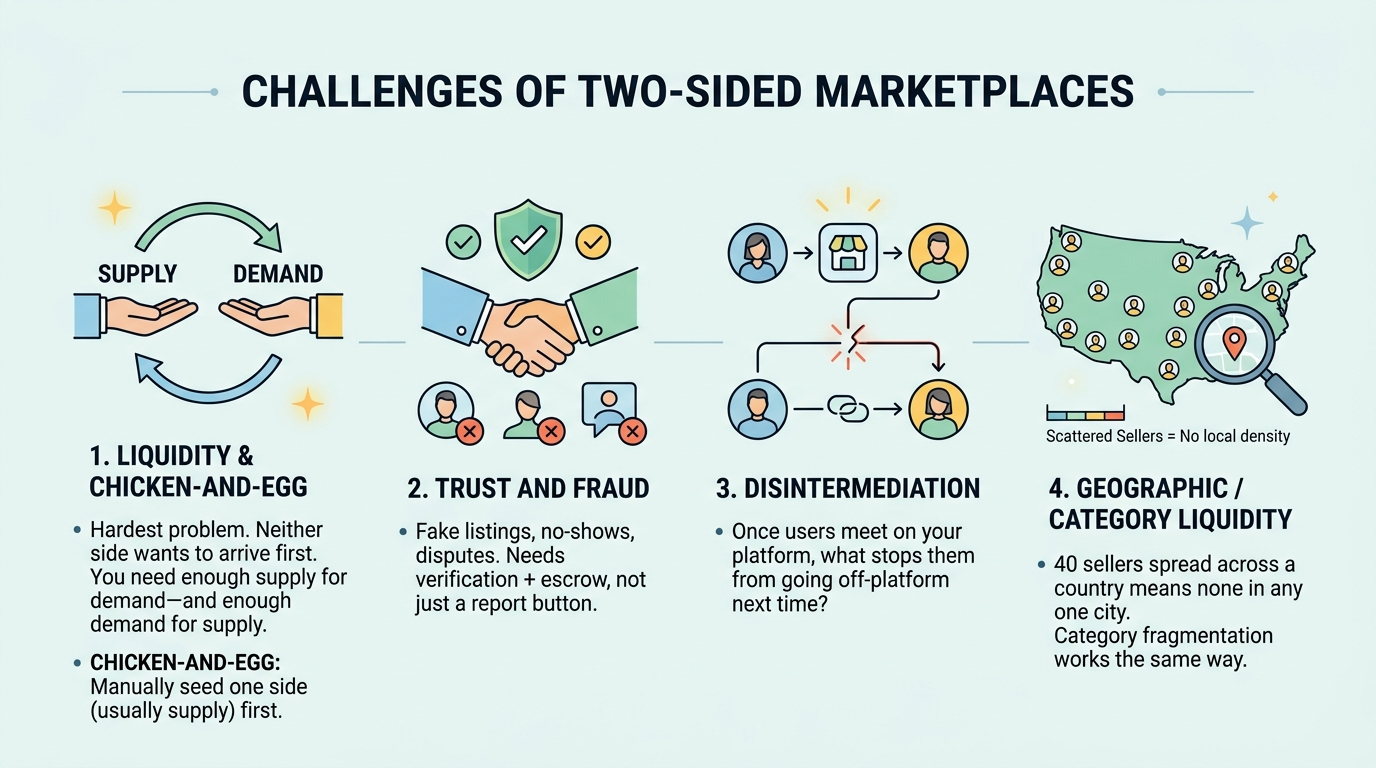
The hardest problem of two-sided marketplace platforms is liquidity. You need enough supply for demand to find something worth buying, and enough demand for supply to bother showing up, and neither side wants to arrive first.
- Chicken-and-egg problem: solved by manually seeding one side (often supply) before opening signups.
- Trust and fraud: fake listings, no-show sellers, payment disputes; needs verification and escrow, not just a report button.
- Disintermediation: once two users meet on your platform, what stops them from transacting off it next time?
- Geographic or category liquidity: a marketplace with 40 sellers spread across a country has none in any one city.
Does It Make Sense to Build a Two-Sided Marketplace in 2026?
Yes, but not as a horizontal, do-everything platform. General marketplaces (a new Craigslist, a new Etsy) are effectively closed categories now; the network effects are already owned. What’s still wide open is vertical: a two-sided marketplace platform for one narrow niche – industrial equipment rental, veterinary locums, wedding vendors in one region.
The signal to watch in 2026 is retention on the supply side. If sellers keep coming back without you chasing them, the liquidity problem is solving itself, and that’s the moment to invest in a real build instead of a validation prototype.
It also still makes sense as a side product for an existing business – a services company adding a two-sided online marketplace layer on top of an existing customer base skips the cold-start problem entirely, since one side already exists.
How to Build a Two-Sided Marketplace Without Coding?
Yes, it’s genuinely possible to build a two sided marketplace without coding for an MVP – platforms like Sharetribe let you launch dual-sided listings, built-in Stripe payments, messaging, and reviews in days, not months. That’s the honest answer, and it’s also where most agencies stop, because it’s the easy part to sell.
Where no-code hits a wall is custom logic: dynamic pricing, multi-party payouts with split commissions, non-standard onboarding flows (licensing checks, background verification), or anything that needs to talk to an existing ERP or CRM. At that point you’re not creating a two-sided marketplace anymore – you’re working around the tool that was supposed to save you time.
No-code (Sharetribe) | Custom build (Rails/Node.js) | |
|---|---|---|
Time to launch | 1–4 weeks | 8–16+ weeks |
Best for | Validating demand, simple commission model | Complex payouts, custom workflows, scale |
Ceiling | Hits limits past a few thousand active users or custom logic | No architectural ceiling |
Cost to change course | Low while on the platform | Higher upfront, cheaper long-term |
Our own rule of thumb, working as a Sharetribe Verified Expert agency: validate on a two-sided marketplace template first if you’re not sure people want this at all. Once you have paying transactions and know your model, migrate the parts that are actually load-bearing to custom code – you rarely need to rebuild everything.
What Features Are the Most Important for a Two-Sided Marketplace?
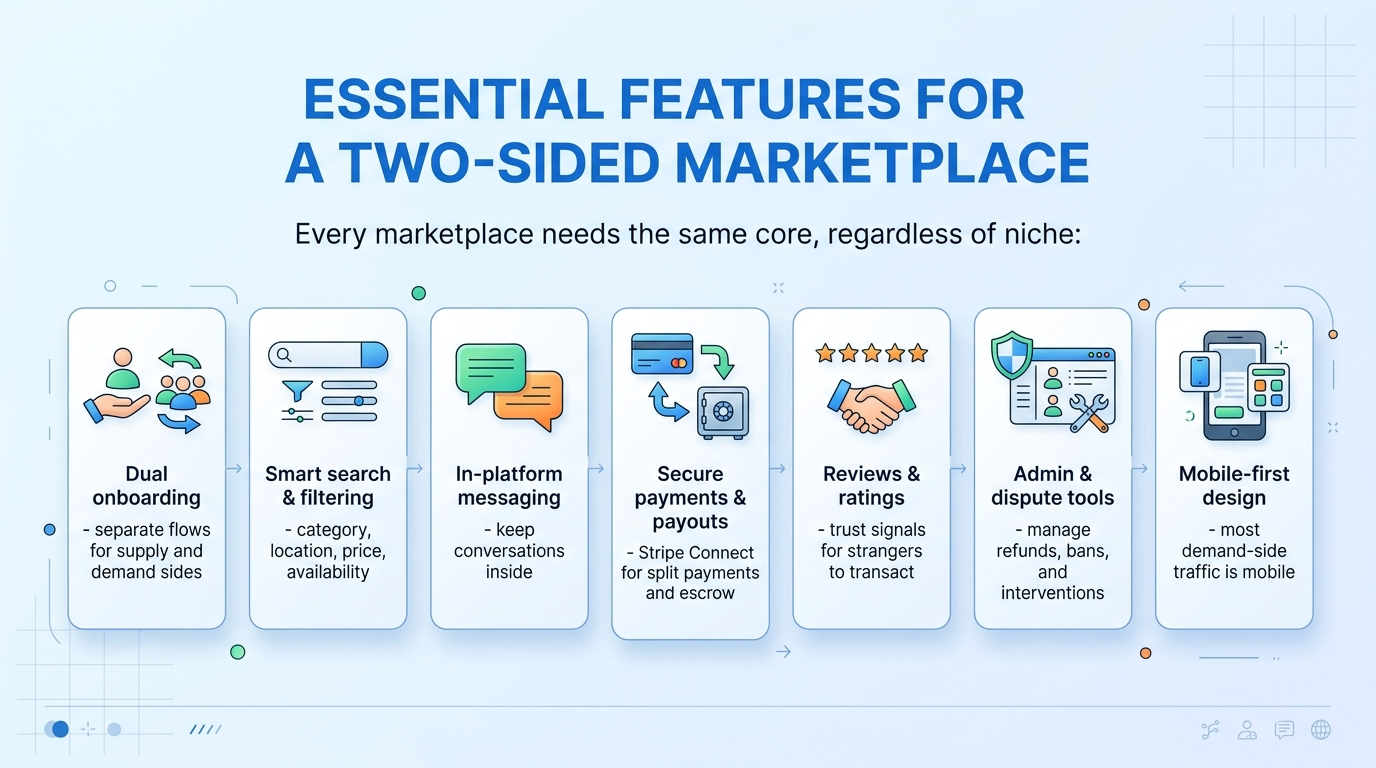
Every two-sided marketplace website needs the same functional core, no matter the niche – the differentiation happens in how well each piece is executed, not whether it exists.
- Dual onboarding flows: separate signup, verification, and profile logic for supply and demand sides.
- Advanced search and filtering on marketplace: category, location, price, and availability filters that update results instantly.
- In-platform messaging: keeps negotiation and coordination inside the marketplace instead of pushing users to WhatsApp.
- Implementing secure payments and payouts: Stripe Connect or similar for split payments, escrow, and automated payouts to multiple sellers.
- Reviews and ratings: the trust signal that lets new users transact with strangers.
- Dispute resolution and admin tools: a backend for your team to intervene, refund, or ban without touching the database.
- Mobile-first responsive design: most two-sided marketplace traffic, especially on the demand side, is mobile.
Get these right, and you’ve effectively answered how to make a two-sided marketplace website that people trust enough to pay through – the rest is design polish on top of a working trust system.
What Two-Sided Marketplace Software Should You Use?
There’s no single best two-sided marketplace software – the right choice depends on how custom your transaction logic needs to be, not on which tool has the best marketing.
Option | Good for | Trade-off |
|---|---|---|
Sharetribe (no-code) | MVP validation, standard commission model | Limited custom logic; you’re renting the ceiling |
Sharetribe customization | Launching fast with custom features – extended search, custom design, third-party integrations, and tailored UX built on top of Sharetribe’s core | Requires development expertise; still bound by Sharetribe’s platform limits at scale |
Medusa.js (headless commerce) | Marketplaces that need a flexible product/cart layer with custom frontends | Requires dev resources to wire up marketplace-specific flows |
Custom Ruby on Rails | Complex multi-vendor payouts, custom admin, long-term ownership | Longer initial build, needs an experienced team |
Custom Node.js | Real-time features (chat, live availability), microservice architecture | Same as above; team-dependent |
On the programming language question: there isn’t one correct programming language for a two sided marketplace, but Ruby on Rails remains a strong default for a reason – its conventions handle the unglamorous 80% of marketplace logic (auth, admin, background jobs, payments) fast, which is exactly the part you don’t want to hand-roll.
A Ruby on Rails two-sided marketplace build tends to reach a stable v1 faster than an equivalent from-scratch Node.js stack, though Node earns its place when real-time matching or heavy concurrent I/O is core to the product.
If your marketplace is closer to a product catalog with two-sided logic bolted on (like a curated goods marketplace), a headless commerce layer like Sharetribe or Medusa.js can be the faster custom path, since you’re not rebuilding cart and checkout from zero.
A quick way to sanity-check any programming language for two-sided marketplace work: ask how it handles background jobs, webhooks, and admin tooling out of the box, since that’s where most of the actual engineering hours go, not the listing page.
Roobykon Software Two-Sided Marketplace Case Studies
HomeCareDirect: Caregiving Recruitment Marketplace
When HomeCareDirect founders looked at the traditional care industry, they saw a system failing everyone – families struggling to find trustworthy help, and carers undervalued with agencies taking a significant cut of funding. Roobykon built HomeCareDirect on transparency, respect, and direct connection, where families browse detailed carer profiles and carers manage their own schedules and rates.
The biggest challenge was dynamic contract logic – relationships between families and carers involve changing schedules and evolving rates. Our team built a system where contracts update fluidly over time, using a Ruby on Rails two-sided marketplace architecture with PostgreSQL for data management, hosted on AWS for enterprise-grade security.
Swoop: Used Sports Equipment Marketplace
Born from the frustration of three friends struggling to find bicycle parts across social media groups, Swoop became Lithuania’s trusted marketplace for premium used sports equipment. Roobykon integrated Mapbox for geolocation features, enabling users to view product locations on interactive maps – transforming how buyers and sellers connect with real-time visualization.
THIRE: B2B Commercial Vehicle Rental Marketplace
THIRE founder saw thousands of commercial vehicles sitting idle across Switzerland while businesses struggled to find reliable, short-term equipment. Roobykon built THIRE on the Sharetribe Web Template, extending it with React.js and Redux for a fluid booking experience, Node.js with Express for custom middleware, and multi-language support for Italian, German, French, and English. This two-sided marketplace example caters to everyone from solo contractors to massive logistics firms.
HireCompare: B2B Equipment Rental Marketplace
Nestled in the heart of Ireland, HireCompare connects businesses across the country to rent and sell equipment with unprecedented ease. The project featured an unprecedented level of customer involvement – daily calls with three customers became the heartbeat of development. Roobykon built two complex features from scratch: RFQ (Request for Quote) and Tenders functionality, integrated Stripe Connect for payments, and used Google Cloud Platform for hosting.
Book Holistic: Wellness Service Marketplace
Book Holistic is a wellness service marketplace that links seekers and practitioners of holistic practices – yoga, meditation, psychotherapy, dance therapy, sound therapy, tarot, astrology, massages, and more. Roobykon took over an existing platform, cleaned up the codebase, stabilized production servers that were crashing due to filtering logic flaws, and integrated Stripe Connect, Google Maps API, and Voucherify for promo codes.
How to Build a Two-Sided Marketplace with Roobykon
Building a two-sided marketplace with Roobykon starts with a discovery phase, not a sales call about which framework is trendiest. We map your two user groups, your monetization model, and your liquidity plan before a single feature gets designed, because a marketplace built around the wrong monetization model fails no matter how clean the code is.
- Discovery and business model validation: sometimes this means launching first on Sharetribe, where we hold Verified Expert status, to prove demand cheaply.
- Custom build: when the model is validated, we move to Ruby on Rails or Node.js, with Stripe Connect for split payments and payouts (we’re a Stripe partner, not a Stripe integration novice).
- Trust and safety layer: verification, reviews, and dispute tooling built around your specific risk profile, not a generic template.
- Post-launch iteration: most of the real learning about your two-sided online marketplace happens after launch, so we build the admin tools that let your team adjust without filing a dev ticket for every tweak.
Creating a two-sided marketplace is rarely a one-shot project for the businesses we work with – it’s a first version, a few months of watching real usage, and a second, sharper version once the data tells you which features actually matter.
Ready to build your two-sided marketplace?
Roobykon has 15+ years of experience building marketplaces that scale. From no-code validation on Sharetribe to custom Node.js builds, we've got you covered.
Book a free consultationFAQ

Recommended articles
 How to Build an Online Learning Marketplace
Online learning is the industry that grows and expands every day. So it’s a great opportunity to start a nice business here. Even though there are lots of online courses, there are still a lot of free niches for special platforms and you can create one of those yourself.
 How to Build a Marketplace with Sharetribe: A Complete Guide
What can you build with no-code Sharetribe, and when do you need a developer? This article provides a clear roadmap for founders.
 The 2026 Blueprint for Building a B2B Marketplace That Actually Works
How to build a b2b marketplace in 2026. No fluff. Just a complete blueprint: b2b platform design, dev costs, features, and real monetization.
 How to Build an Online Marketplace Website (Complete Guide for 2026)
You have a marketplace idea. Now what? This complete guide answers the questions every founder faces: How do I validate my concept? What features actually matter in an MVP? This article provides practical answers to the challenges of building a marketplace startup from scratch.