What Is an Online Education Platform?
Anatomy of a Successful Education Two-Side Marketplace
EdTech Platform MVP vs. Full-Scale Product (Budget Validation)
Traps No One Writes About When You Build an Online Education Platform Marketplace
Roobykon Software Case Studies: Real Education Platform Startup Success Stories
Subscribe and you will promptly receive new published articles from the blog by mail
So you want to create an online education platform. Where do you even start?
MVP or full-scale product? Custom build or Sharetribe? How do you handle payments, video hosting, and trust between strangers? And what about the pitfalls that nobody warns you about?
This guide answers all of those questions. Drawing from real experience building education marketplaces at Roobykon Software, we’ll show you exactly how to build an online learning marketplace that actually works, not just in theory, but in the real world.
- An education marketplace is a trust and payments problem before it's a content problem.
- Student, teacher, and admin dashboards are three different products sharing one backend.
- Video hosting, live conferencing, and complex payment flows are the technical decisions that actually determine your architecture.
- Launch a narrow-niche MVP before a full-scale build. Most successful education platform startups started by manually recruiting a handful of instructors in one subject area.
- Sharetribe can shave months off validation for a curation-driven marketplace; custom development earns its cost once your business logic outgrows what a framework can flex to fit.
- The pitfalls that actually sink the EdTech platforms rarely show up in a feature-comparison spreadsheet, but they're the reason platforms stall out after launch instead of before it.
What Is an Online Education Platform?
An online learning platform is a piece of software that lets people teach and learn without being in the same room. That’s the simple version. The more useful version, for anyone about to spend six figures building one, is this: a consistent education platform has to pull off five things at once, and most of them have nothing to do with the course content itself.
Online Education Marketplace Requirements
- It needs to deliver content to any device, anywhere, without friction.
- It needs tools for instructors to build and upload courses without a developer holding their hand every time.
- It needs a way to track learning progress so students – and their employers, in the B2B case – can see what’s actually been absorbed rather than just “watched.”
- It needs some form of performance measurement: quizzes, certificates, completion rates.
- And it needs to support more than one content format, because not everyone learns from a talking head on video.
Types of Education Platforms: Which One Should You Create?
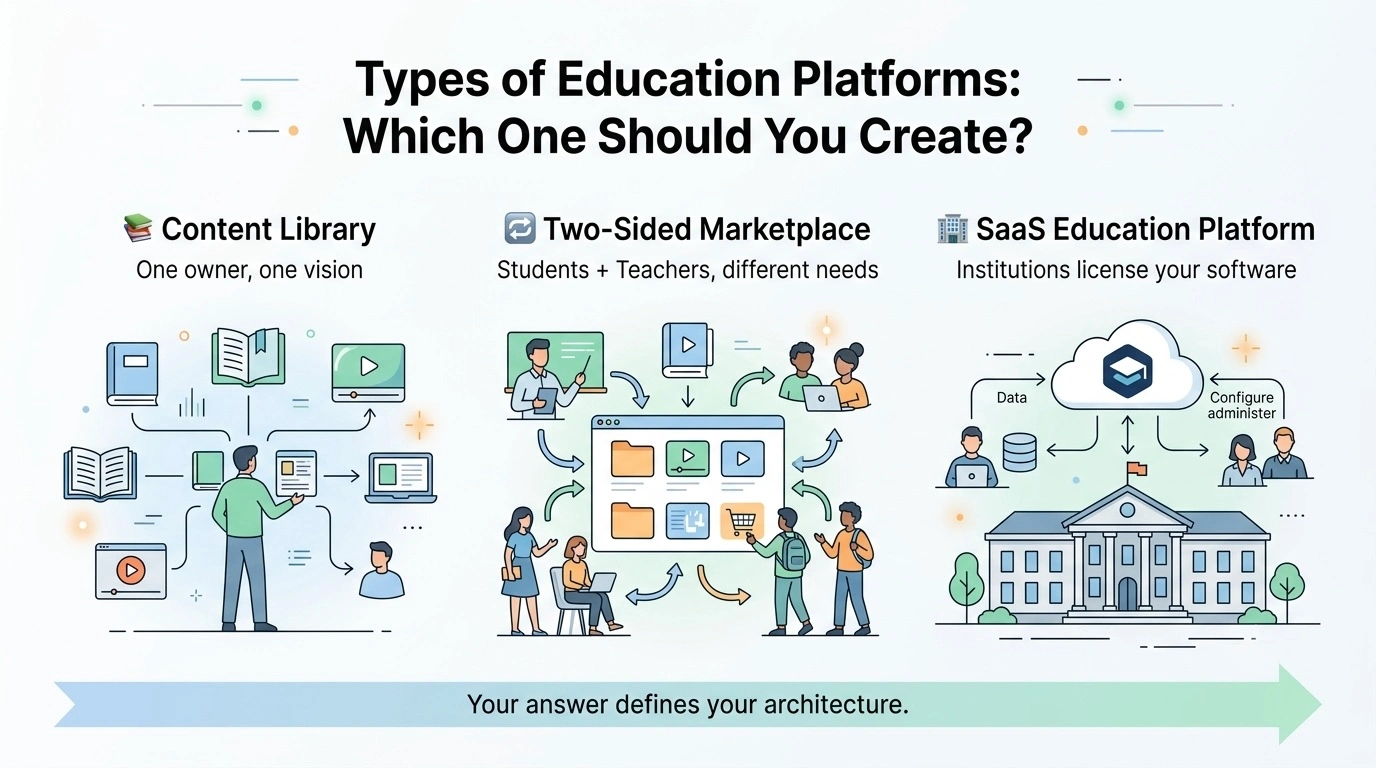
Here’s where it gets interesting, though. The moment you add a second side to that equation – independent teachers who list their own courses and get paid based on demand – you’ve stopped building a content library and started trying to create an EdTech marketplace infrastructure. That’s a bigger jump than it sounds. A content library answers to one master: the person who owns the content. A marketplace answers to two, and they don’t always want the same things.
There’s also a growing third category worth naming: the SaaS education platform, where institutions or corporate L&D teams license the software itself rather than buying access to courses. If you’re building for that model, the core marketplace mechanics below still apply – you’re just selling platform access instead of, or alongside, content access.
Whichever direction you take, the process of how to build an online education platform marketplace starts from the same question: who are the two (or three) sides of this business, and what does each one need to trust the other enough to transact?
Anatomy of a Successful Education Two-Side Marketplace
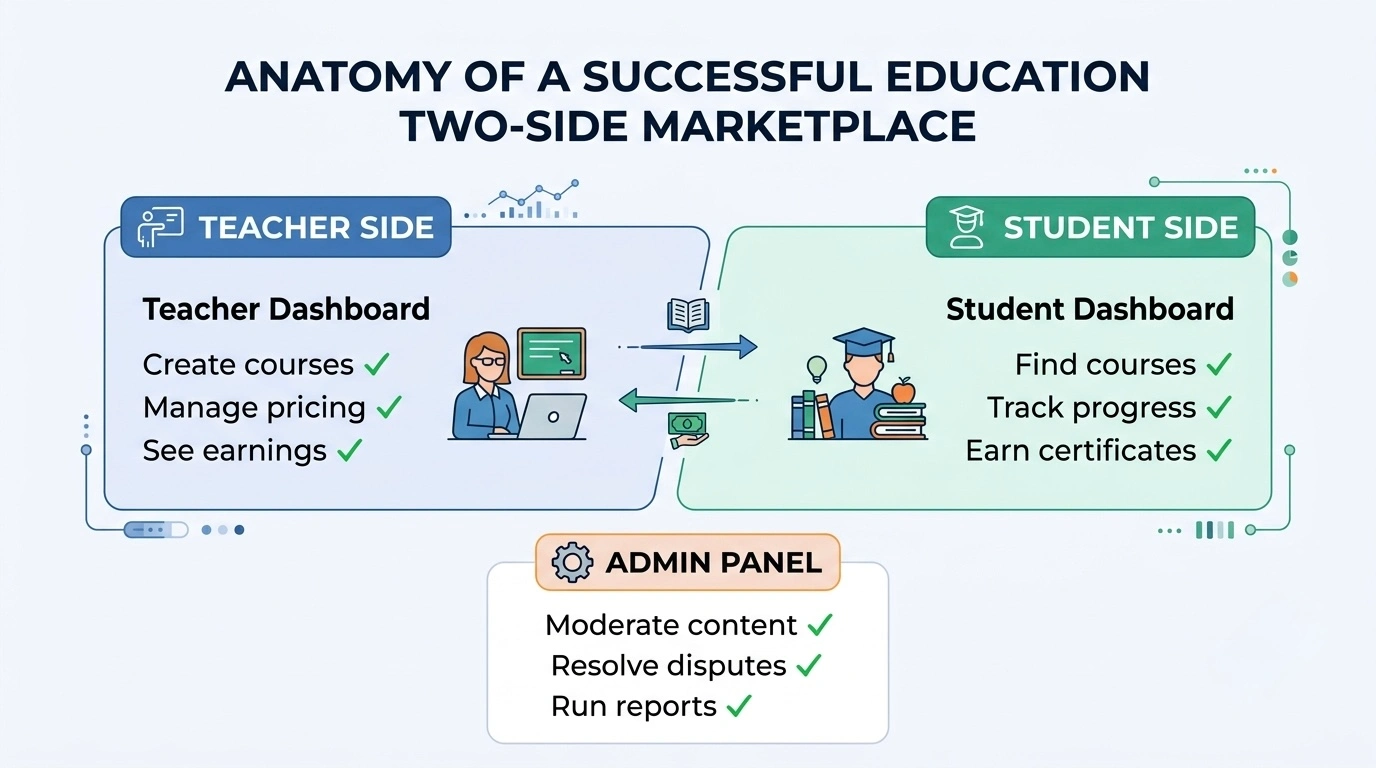
A two-sided education marketplace has three distinct audiences using the same underlying system, and each one needs an interface built around a different job to be done. Treat them as one generic “user dashboard,” and you’ll end up with a product that half-serves everybody.
Student Dashboard
The student side is where retention is won or lost. Students want three things: to find the right course quickly, track their progress, and feel their money is buying measurable outcomes. When you create online education platform solutions, the student dashboard is your most critical touchpoint.
Essential student dashboard features:
- Active and completed courses with detailed progress tracking (modules completed, assignments pending, next lesson up)
- Saved or wish-listed courses for future reference
- Certificates and downloadable materials
- Direct messaging to instructors or support
- Payment history and subscription status
Billing confusion is one of the top drivers of support tickets, so keep payment info visible and clear.
Search and Discovery
Search and discovery deserve their own attention. Filtering by skill level, format (self-paced vs. live cohort), price, and rating isn’t a “nice to have.” On a marketplace with more than a few hundred courses, it’s the difference between a student finding what they need in two minutes and bouncing after five.
For any education platform startup, investing in robust search and discovery early can significantly improve conversion rates and user satisfaction. Students who find what they’re looking for quickly are more likely to purchase and return.
Teacher Dashboard: Reducing Friction from “I Know” to “I Earn”
If the student dashboard is about trust and progress, the teacher dashboard is about reducing friction between “I know something” and “I’m earning money from it.” A course creation flow that feels like filing paperwork will quietly kill your supply side – instructors will simply stop uploading. When you build online education platform marketplace solutions, the teacher dashboard is where your supply side lives or dies.
Essential teacher dashboard features:
- Low-friction course builder with drafts and autosave (non-negotiable)
- Media upload pipeline that handles large video files without choking
- Syllabus and module structure editor
- Pricing and discount management tools
- Analytics hub: enrollments, completion rates, revenue, student feedback
For any SaaS education platform that handles instructor payouts, transparency here builds trust. Teachers who trust your payment system will recommend your platform to other instructors.
Payouts
Payouts are the single most scrutinized part of this dashboard. Teachers want to know, at a glance, how much they’ve earned, what’s pending, and when it clears, without emailing support. A dashboard that hides this behind three clicks will generate distrust regardless of how good your actual payment logic is.
Payout transparency checklist:
- Real-time earnings balance
- Pending vs. cleared amounts
- Payout schedule and history
- Clear breakdown of platform commissions and fees
Admin Panel
The admin panel is the part nobody shows in a pitch deck, and everybody wishes they’d invested in more. This is where platform owners manage the business.
Essential admin features:
- Content moderation and course approval queues
- Dispute resolution between students and teachers
- Commission structure and payout schedule management
- Business reporting: cohort retention, GMV, refund rates, instructor churn
A weak admin panel doesn’t show up as a problem on day one. It shows up on day 200, when your support team is manually cross-referencing spreadsheets to answer a billing dispute that the panel should have surfaced in one click.
Tech Stack & Architecture: What Actually Matters When You Build an Online Education Platform Marketplace
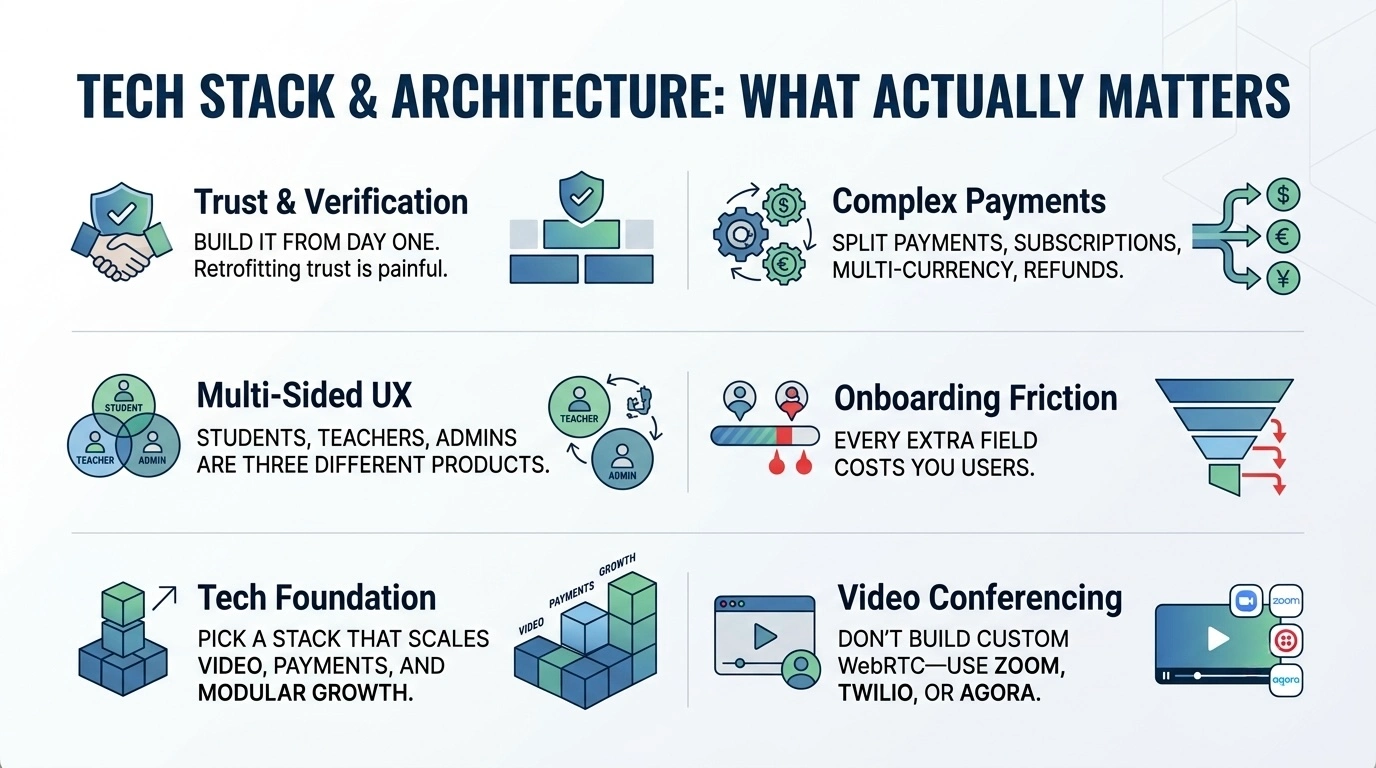
There’s no single “correct” stack for an EdTech platform, but there is a correct way to think about the architecture: start from the hardest problems, not from the easiest features. Six issues tend to define whether the technical foundation holds up under real usage.
Trust & Verification
Both sides are strangers exchanging money and credentials. Identity verification for instructors, manipulation-resistant reviews, and content moderation all need to be built in from day one. Retrofitting trust onto a live marketplace is painful, slow, and expensive.
When you create an online learning platform marketplace, remember: trust isn’t a feature you add later. It’s the foundation. Students need to trust instructors. Instructors need to trust they’ll get paid. Without trust, you have nothing.
Complex Payment Flows
This is not a simple Stripe integration. A real education marketplace needs:
- Split payments (your commission vs. instructor payout)
- Subscriptions alongside one-time purchases
- Multi-currency handling if you’re going global
- Refund logic that respects partial course completion
- Tax handling that varies by instructor AND student location
If you’re building a SaaS education platform, add enterprise billing, invoicing, and seat management to that list. Get this wrong, and you’ll drown in support tickets.
Multi-Sided UX
Students, teachers, and admins are effectively three different products sharing one backend. Yet most EdTech platform founders pour all their energy into the student side because it’s what looks good in demos.
Big mistake. Neglect the teacher dashboard and your supply dries up. Neglect the admin panel, and you’ll drown in manual work. Build for all three, or don’t build at all.
Onboarding Friction
Every extra field in a signup form costs you conversions on both sides. Teachers in particular abandon platforms during onboarding if the path from “sign up” to “first course live” is long. Progressive profiling (asking for the minimum up front and filling in details later) consistently outperforms one long form.
Tech Foundation
To build an online education platform marketplace, pick a stack that can handle video delivery (it’s heavy!), supports modular growth (you WILL add live classes later), and has a mature ecosystem for payments and video.
Ruby on Rails and Node.js both shine here: great libraries, strong community support around payments, proven scalability. The specific tech matters less than your architecture decisions. Focus on flexibility.
Video Conferencing
If your EdTech platform includes any live component – cohort classes, office hours, one-on-one tutoring – video isn’t an afterthought bolted onto a course library. Building custom WebRTC infrastructure is rarely worth it early on; integrating an established provider (Zoom, Twilio, Daily, Agora) buys you reliability that would otherwise take months to replicate, freeing your engineering budget for the marketplace mechanics that are actually your differentiator.
Here is the real-world checklist you need to focus on:
- The Frontend: Go with React or Next.js. They are industry standards, and you’ll find developers easily.
- The Backend: Node.js or Python (Django) are fantastic for MVPs because they allow for rapid development.
- The Database: PostgreSQL is usually our go-to for relational data (users, courses, orders).
EdTech Platform MVP vs. Full-Scale Product (Budget Validation)
One of the most common mistakes founders make when building an online education platform marketplace is trying to build everything at once. This approach is expensive, time-consuming, and almost always leads to failure.
What Is an MVP?
A Minimum Viable Product (MVP) is the simplest version of your platform that delivers value to early adopters. It’s about focusing on what matters most.
MVP Cost Breakdown
Building an education marketplace MVP typically costs $25,000–$50,000 and takes 12–24 weeks. A focused MVP with essential features like registration, course listing, video playback, and basic content management falls in this range.
For a full two-sided platform with mobile apps and automated payouts, expect $50,000–$100,000. A full creator marketplace with advanced features can run $120,000–$150,000.
What to Include in Your MVP
Feature | MVP | Full Product |
|---|---|---|
User registration/login | ✅ | ✅ |
Course browsing and search | ✅ | ✅ |
Video playback | ✅ | ✅ |
Basic payment processing | ✅ | ✅ |
Teacher course creation | ✅ | ✅ |
Student progress tracking | ✅ | ✅ |
Ratings and reviews | ✅ | ✅ |
Mobile app | ❌ | ✅ |
Advanced analytics | ❌ | ✅ |
Live classes | ✅ | ✅ |
Gamification | ❌ | ✅ |
Community features | ❌ | ✅ |
AI recommendations | ❌ | ✅ |
Why Start with an MVP?
- Validate your idea with real users before investing heavily
- Learn what users actually want (which is often different from what you assume)
- Attract early adopters and build a community
- Secure funding with a working product and traction
- Iterate quickly based on feedback
The key is to launch fast, learn fast, and iterate. Your MVP doesn’t need to be perfect; it needs to be viable.
Custom Build vs. Sharetribe
When deciding how to create an online e-learning platform, one of the first decisions you’ll face is whether to build custom or use an existing marketplace platform like Sharetribe.
Sharetribe Overview
Sharetribe is a purpose-built SaaS platform designed for two-sided marketplaces. It provides essential marketplace features out of the box, including listings, payments, user management, and messaging. Our full Sharetribe review goes deeper into pricing tiers and real customer feedback if you want the full picture before committing.
Pros of Sharetribe:
- Fast launch: you can go live in weeks, not months
- Lower upfront cost: no expensive custom development
- No maintenance worries: Sharetribe handles hosting, security, and updates
- Proven functionality: features that have been tested across thousands of marketplaces
- Headless architecture: allows for customization when needed
Cons of Sharetribe:
- Ongoing monthly costs: the Growth plan at $299/month adds up
- Limited customization: you’re working within Sharetribe’s framework
- Vendor lock-in: migrating away later is difficult and expensive
- Transaction fees: additional costs on top of your commission structure
Custom Build Overview
Custom development means building your platform from the ground up using your chosen technology stack.
Pros of custom build:
- Complete control: every feature is exactly what you want
- No ongoing platform fees: it’s a capital investment, not recurring
- Full ownership: you own the code, data, and intellectual property
- Scalability: designed specifically for your growth trajectory
- Competitive advantage: unique features that differentiate you from competitors
Cons of custom build:
- Higher upfront cost: $50,000–$250,000+ depending on scope
- Longer timeline: months of development before launch
- Technical risk: bugs, security issues, and architectural mistakes
- Maintenance burden: you’re responsible for updates, security, and scaling
Feature | Sharetribe | Custom Build |
|---|---|---|
Launch Time | Weeks | Months |
Upfront Cost | Low ($299/mo) | High ($50k+) |
Control | Limited | Full |
Ownership | Platform | Yours |
Customization | Limited | Unlimited |
Maintenance | Handled | Your team |
Best For | Validation, standard models | Unique features, scaling |
Which Path Is Right for You?
Choose Sharetribe if:
- You want to validate your idea quickly and cheaply
- You don’t have technical expertise in-house
- Your marketplace follows a standard model without unusual requirements
- You’re comfortable with monthly fees in exchange for convenience
Choose custom build if:
- You have a unique business model that requires custom features
- You’re building for long-term scale and want to own your technology
- You have (or can hire) technical expertise
- You want to create an EdTech marketplace with distinctive capabilities
As a Sharetribe marketplace agency, Roobykon Software helps clients navigate this decision and build successful platforms on either path.
Traps No One Writes About When You Build an Online Education Platform Marketplace
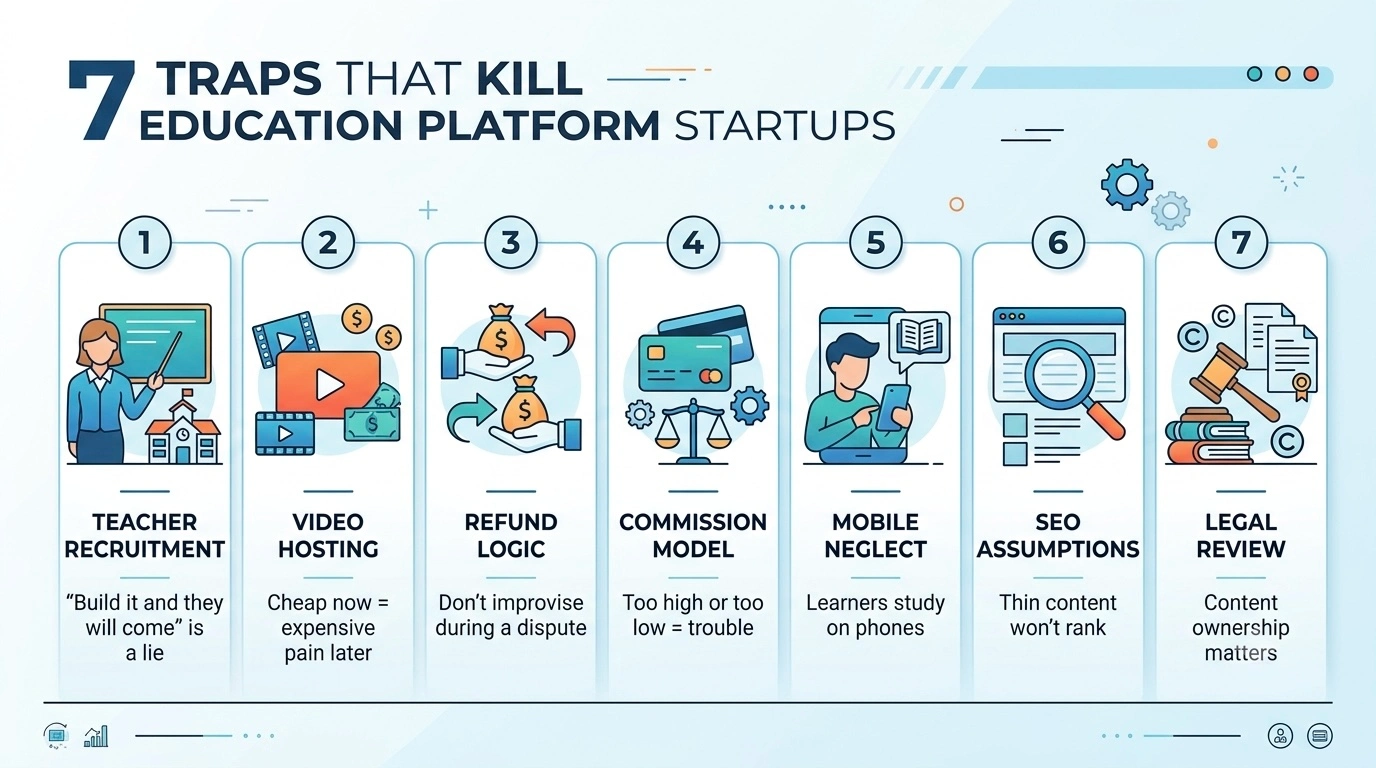
Most articles on this topic stop at features and architecture, because that’s the part that photographs well in a wireframe. Here’s what actually trips founders up after launch – the stuff that doesn’t show up until you’re three months in and wondering why growth has stalled. If you’re serious about launching an education platform startup, pay close attention to these.
Underestimating the Supply-Side Onboarding Cost
Getting teachers to list courses is not a “build it and they will come” problem, no matter how good your course-creation flow is. It requires active recruitment, hand-holding through the first upload, and often outright manual curation in the early months. Software doesn’t solve this on its own – people do.
This is one of the most overlooked aspects of how to build an online education platform that actually scales. You can have the best tech in the world, but if you don’t have a strategy for recruiting and supporting instructors, your supply side will remain thin.
Treating Video Hosting As an Afterthought
Bandwidth costs and video transcoding pipelines scale non-linearly with usage, and founders who pick the cheapest option early often end up doing a painful migration later, right in the middle of growth, which is precisely when switching costs the most and hurts the most.
When you build online education platform marketplace solutions, video infrastructure should be a top-tier priority from day one. Your MVP doesn’t need to be perfect, but it does need to handle video reliably at scale.
Ignoring Refund and Dispute Logic Until a Dispute Actually Happens
By the time your first “I paid for a course, and the instructor never delivered” ticket lands in your inbox, you need a policy and a workflow already built, not one you’re improvising over email while the customer is getting angrier.
This is a critical part of how to create an online education platform that maintains trust on both sides. If students feel they can’t get a fair resolution, they won’t come back.
Underpricing the Commission Model
Set commission too low and the business can’t sustain support, moderation, and infrastructure costs as it scales. Set it too high, and instructors leave for a competitor, or worse, take their students and go direct. This number needs modeling before launch, not adjustment after teachers have already built an audience on your platform and have leverage. Our breakdown of marketplace business models is worth a read before you lock in a commission rate.
Neglecting Mobile From Day One, Then Bolting It On
A meaningful share of learners study exclusively on a phone, often during a commute or a lunch break. A responsive web page is not the same thing as a genuinely usable mobile course-taking flow, and retrofitting mobile-first UX onto a desktop-first product is expensive, and it shows.
When you create online learning platform marketplace infrastructure, think mobile-first from the start. This doesn’t necessarily mean building a native app immediately, but it does mean designing every screen to work beautifully on a 6-inch screen.
Assuming SEO and Organic Discovery Will happen Automatically
A course catalog full of thin, duplicate-sounding descriptions won’t rank, and it won’t convert even on the rare occasion it does. Course and category pages need the same content rigor as any other marketplace vertical – nobody buys from a listing that reads like it was filled in by a form.
Skipping Legal Review on Instructor Agreements and Content Ownership
Who owns the course content if an instructor leaves the platform? What happens to enrolled students if a course gets pulled mid-term? These questions are cheap to answer in a contract before launch and expensive (sometimes reputation-damaging) to answer in a dispute after.
Roobykon Software Case Studies: Real Education Platform Startup Success Stories
It’s easy to write “onboarding friction kills your supply side” as a bullet point. It’s another thing to have actually hit that wall on a live project and had to fix it under a deadline. Here are two real builds from our own portfolio that ran into exactly the issues covered above.
AllCourse: The Education Marketplace That Launched in 10 Weeks
The Challenge
In 2022, AllCourse came to us with an ambitious vision: create an online education platform where teachers could seamlessly connect with students, and where schools and parents could effortlessly find the educators they needed. The platform had to serve a diverse user ecosystem – teachers, school officials, and parents – each with different needs and expectations. Verifying teacher credentials and ensuring student safety were also major hurdles.
Our Solution
We kicked off by defining a tight MVP scope, engaging in detailed discussions to iron out exactly what features would form the platform’s core. Then we crafted the visual identity and user interface. For the tech stack, we integrated Stripe Connect for secure payments, HubSpot as the CRM, Contentful for flexible content management, and WordPress for the blog. The backend runs on Node.js and React, with Sharetribe serving as the foundation for marketplace functionality.
The Result
The MVP rolled out in just 10 weeks. Users were already reaping the benefits of this innovative marketplace, connecting educators, schools, parents, and students.
Adepty: Rescuing and Elevating an Irish EdTech Startup
The Challenge
Adepty is an Irish education platform startup that champions a democratic space for talented individuals to thrive. Their marketplace caters to practitioners, educators, and trainers across fields like education, finance, sports, design, and technology. But here’s the twist: Adepty had already partnered with another development company to build their marketplace. When they realized they needed further enhancements and optimizations, they came to us.
The challenge was modernizing an existing EdTech platform while ensuring an optimal user experience.
Our Solution
We leveraged Sharetribe Flex’s powerful core to create a robust booking flow with dynamic availability management. We integrated SendGrid for automated, reliable email delivery across onboarding, booking, and feedback workflows. The backend runs on Node.js, delivering rapid development of scalable APIs, with Digital Ocean providing the cloud infrastructure.
The Result
Adepty was propelled to the forefront of the online service provider community, setting new benchmarks for user-centric experiences.
InsightGig: Competing with Giants on a Bootstrap Budget
The Challenge
In the wake of the 2020 pandemic, InsightGig emerged as a job search marketplace connecting employers with job seekers. But they faced a David-versus-Goliath situation: how do you compete with industry giants like Upwork and Fiverr when you have limited resources?
When you create online learning platform marketplace solutions on a bootstrap budget, every dollar counts. InsightGig needed maximum impact with minimal spend.
Our Solution
We embraced Sharetribe Flex as the foundational framework, facilitating rapid development without compromising on a unique user experience. The platform is built with a Node.js backend and React.js frontend, leveraging Flex’s transaction engine to enable tailored workflows for consulting engagements. Digital Ocean provides reliable hosting. This approach allowed us to create EdTech marketplace functionality without building everything from scratch—saving months of development time and significant budget.
The Result
InsightGig stands as a testament to the power of innovation and adaptability in overcoming the challenges inherent in creating a successful marketplace.
Hair Index: When the Deadline Was Set in Stone
The Challenge
The Hair Index is a game-changing digital platform where hair maestros and knowledge-hungry stylists connect. It transforms beauty education from a luxury into a currency, allowing visionary educators to monetize their craft directly.
The development was smooth until a critical deadline emerged. The client had an event on March 16, 2025, where the platform was to be presented. We needed to accelerate development fast. When you’re figuring out how to create an online e-learning platform infrastructure, tight deadlines are the ultimate test of your development process.
Our Solution
We made a strategic decision to bring in additional developers to bolster our efforts. By adding extra hands, we streamlined the final stages of development and stayed on track to meet the deadline. The platform is built on the Sharetribe Web Template with NodeJS for fast, scalable performance. Stripe Connect handles payments, with Stripe Subscriptions offering subscription plans for providers. Google Maps API enables powerful search-by-location features.
The Result
The platform was ready and fully functional for the big day.
What This Means for Your Roadmap
Pull all of the above together, and a rough build order emerges for anyone still mapping out how to build an online education platform marketplace from a blank page. If your goal is simply to create an online learning platform marketplace infrastructure without institutional licensing, start by deciding whether you’re building a course marketplace, a SaaS education platform for institutions, or some hybrid of the two – this decision shapes almost every subsequent tech and design choice.
Next, validate the niche and the two-sided demand with the leanest MVP you can ship, ideally on a framework if your differentiation is curation rather than proprietary mechanics. Only after retention and repeat usage prove out should you invest in the full custom build, the native mobile apps, and the advanced admin tooling.
The founders who get this sequence backwards – full build first, validation second – are the ones who end up as cautionary tales rather than case studies. The ones who get it right tend to look, in hindsight, like they had an unfair amount of foresight. Usually they just followed the order above.
Ready to Build Your Education Marketplace?
Building an online learning marketplace is not a website project. It’s a two-sided trust problem wrapped in a payments problem wrapped in a content problem, and the platforms that make it look easy are the ones that quietly got the unglamorous parts right – onboarding that doesn’t lose instructors, payment logic that doesn’t create disputes, an admin panel that scales with the business instead of becoming its bottleneck.
If you’re weighing how to create an online education platform for your own niche, or trying to decide between an MVP and a full custom build, get in touch. We’ve built enough of these to help you skip the expensive lessons.
Ready to build your online education platform?
You've got the vision. We've got the expertise. At Roobykon Software, we've built education marketplaces from scratch, rescued struggling platforms, and helped founders launch MVPs in record time.
Let's talk about your project
Recommended articles
 How to Build a Marketplace with Sharetribe: A Complete Guide
What can you build with no-code Sharetribe, and when do you need a developer? This article provides a clear roadmap for founders.
 How to Build an Online Marketplace Website (Complete Guide for 2026)
You have a marketplace idea. Now what? This complete guide answers the questions every founder faces: How do I validate my concept? What features actually matter in an MVP? This article provides practical answers to the challenges of building a marketplace startup from scratch.
 Caregiving Marketplace Development Guide for Founders
The health caregiving market is exploding. This guide shows you how to capture it. From caregiver business models that actually generate revenue to compliance strategies that win enterprise contracts – get the insights you need to build a defensible, fundable caregiving marketplace.
 How to Build an Online Marketplace MVP in 2026
Turning a marketplace idea into reality is fraught with risk. This guide cuts through the complexity, showing you how a focused MVP is the antidote.