What Is a Dedicated Software Development Team?
When Should You Hire a Dedicated Development Team?
When a Dedicated Team Is Not the Best Choice
What Roles Should Be Included in a Dedicated Software Development Team?
Dedicated Team Setup for Marketplace Projects
How to Hire a Dedicated Software Development Team: Step by Step
How to Evaluate a Dedicated Development Team Vendor
How Much Does a Dedicated Software Development Team Cost?
Red Flags When Hiring a Dedicated Development Team
Dedicated Team vs Other Engagement Models
Subscribe and you will promptly receive new published articles from the blog by mail
Can I hire a dedicated development team with Europe‑based project management and global engineers? What does it actually cost to hire an offshore team per month? And is a dedicated development team vs in‑house hiring really better for scaling quickly?
If you’re a founder or product owner, these aren’t academic questions. They’re the difference between launching in four months or twelve, between burning cash or building value.
We’ve written this guide to answer exactly those questions. No generic theory. Just practical, vendor‑neutral advice (okay, mostly neutral) on how to hire dedicated software development team that actually delivers.
This guide answers all of that. It’s written for founders, product owners, and startup operators who need to make real decisions.
What Is a Dedicated Software Development Team?
A dedicated software development team is exactly what it sounds like: a team assembled specifically for your project, working on your product full-time, under your direction, for as long as you need them.
Unlike hiring a freelancer for a one-off task or contracting an agency on a fixed-scope project, a dedicated team becomes an extension of your business. They learn your domain, your codebase, your users, and your goals. They don’t disappear when a sprint ends or quietly rotate to another client’s project when something more interesting lands in their queue.
In practice, when you hire dedicated software developers, you get a team that typically includes a mix of engineers, a QA specialist, a project manager, and sometimes a designer or business analyst, all coordinated through your chosen vendor, but pointed entirely at your product roadmap.
So why should I hire a dedicated development team over other models? The answer is simple: continuity. The model works especially well for complex, long-running projects where context matters. In marketplace development, for instance, the team needs to understand not just the technology stack, but the specific mechanics of two-sided platforms: how listings work, how trust is built, how payments flow between buyers and sellers, how disputes get resolved. That kind of domain knowledge takes time to build.
Dedicated Team vs Outsourcing vs Staff Augmentation
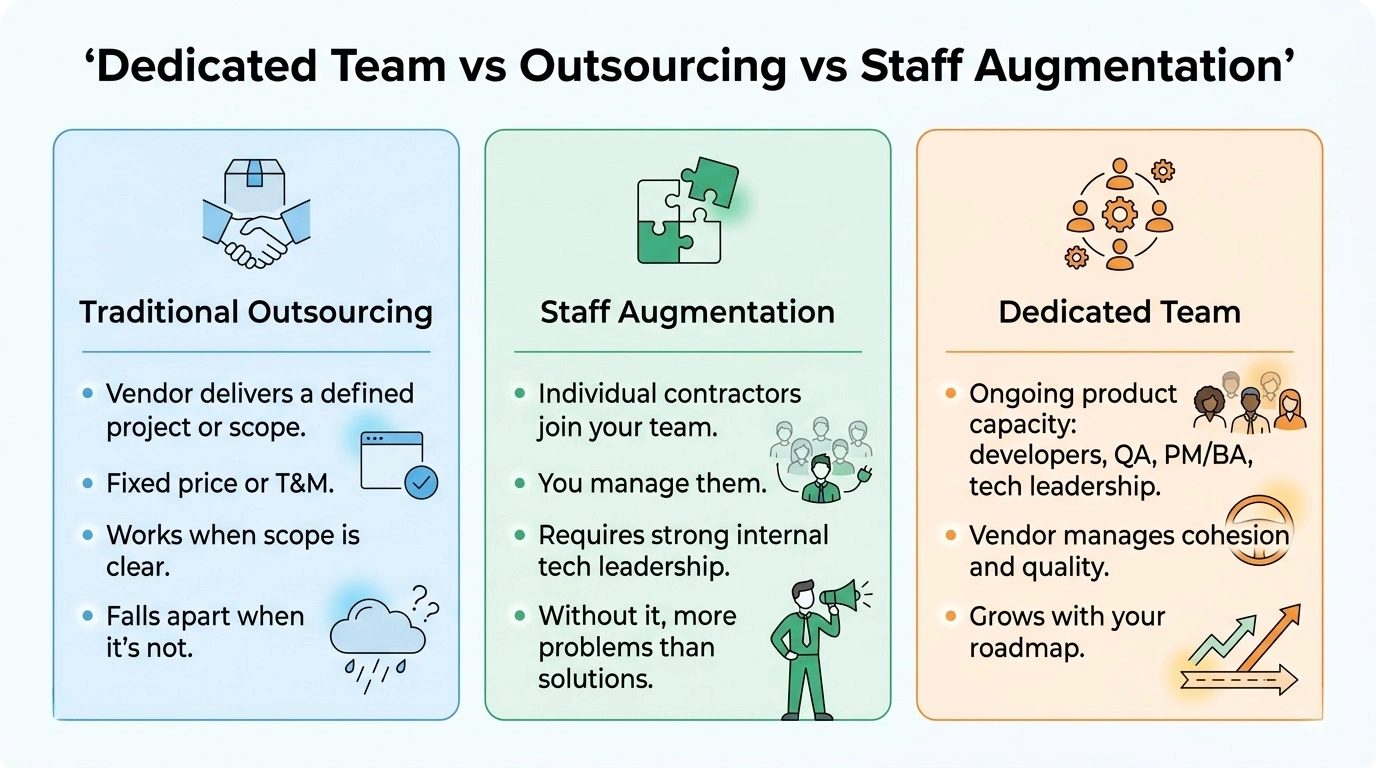
These three models get conflated constantly, but they’re genuinely different approaches with different trade-offs. Understanding the distinction upfront saves a lot of expensive confusion later.
- Traditional outsourcing usually means bringing in an external vendor to deliver a defined project, feature, or scope of work. The commercial model can be fixed price or Time & Material, but the engagement is typically structured around a specific delivery outcome. Works well when the scope is clear. Falls apart when it’s not.
- Staff augmentation means adding individual contractors or engineers directly to your existing team. You manage them yourself. You’re responsible for integrating them, directing their work, and keeping everything coherent. It’s flexible in theory, but it requires you to have management infrastructure and technical leadership already in place. If you don’t have a strong internal CTO or tech lead, this model creates more problems than it solves.
- A dedicated team sits between these models in a genuinely productive way. It gives you ongoing product development capacity with a stable team structure: developers, QA, PM/BA, technical leadership, and delivery coordination. Unlike simple staff augmentation, the vendor helps manage team cohesion, communication, and technical quality. Unlike project outsourcing, the team isn’t limited to one isolated scope – they grow with your roadmap.
When you hire dedicated development team for marketplace platform, the value multiplies. Marketplaces have unique demands (two-sided liquidity, payment splitting, trust, and safety mechanisms) that require deep, sustained focus. A dedicated team builds that expertise and keeps it, sprint after sprint.
When Should You Hire a Dedicated Development Team?
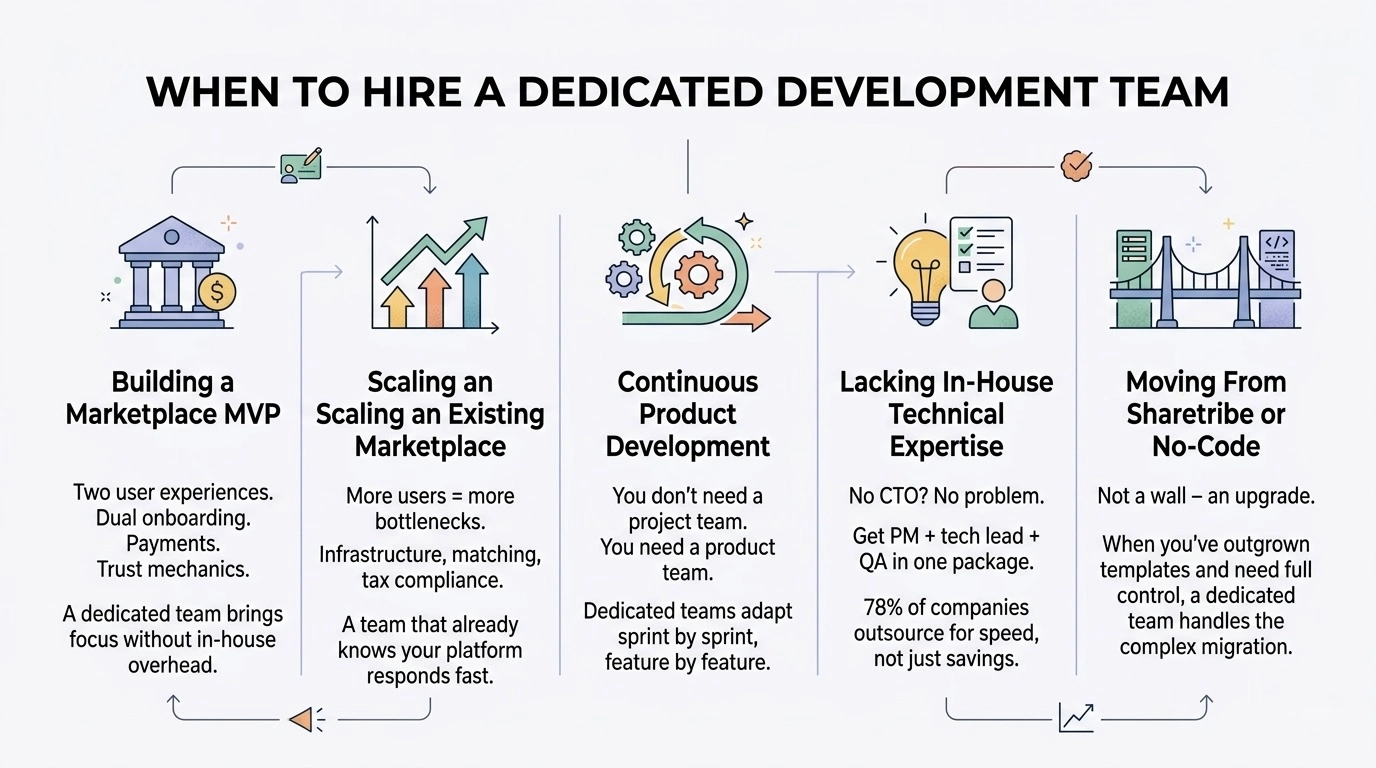
Not every project needs a dedicated team. But certain situations are almost tailor-made for it. Here are the scenarios where hiring dedicated developers is genuinely the right move.
You Are Building a Marketplace MVP
Launching a marketplace from scratch is harder than it looks. You’re building a platform that has to work simultaneously for buyers and sellers (or renters and hosts, or clients and service providers). That means two separate user experiences, dual onboarding flows, a listing and booking system, a payment and commission layer, trust and reputation mechanics, and an admin panel to manage all of it.
When you hire dedicated marketplace development team, the engineers work only on your platform. The PM tracks your roadmap. The QA team tests your flows. You get the focused output of an in-house team without the months of overhead required to build one.
For marketplace MVPs especially, the team needs to carry the full context from feature one through launch. And if you’re migrating from a no‑code foundation, you might also hire dedicated Sharetribe team experts who understand both the migration path and the architecture that comes after – because a dedicated model ensures that institutional knowledge doesn’t walk out the door at the end of a sprint.
You Are Scaling an Existing Marketplace
Scaling is a fundamentally different problem from building. When your marketplace starts growing – more users, more transactions, more edge cases – you hit bottlenecks you couldn’t have predicted at launch. Infrastructure needs to handle real load. Matching algorithms need refinement. Payment logic needs to account for tax compliance in new markets. The admin tooling you hacked together during the MVP phase starts to creak under real-world volume.
You Need Continuous Product Development
If your product is alive – if you’re iterating based on user feedback, running experiments, shipping new features, fixing bugs, and responding to market shifts – you don’t need a project team. You need a product team. There’s a real difference.
A dedicated development team is designed for exactly this rhythm. They plan in sprints, they adapt with your roadmap, and they’re available not just to build what you’ve specified but to help you figure out what to build next. That ongoing product partnership is where dedicated teams deliver the most compounding value over time.
You Lack In-House Technical Expertise
Not every founder is technical. Not every product owner has an engineering background. That’s completely fine, but it does mean you need a team structure that brings its own technical leadership to the table.
When you hire dedicated development team through a vendor like Roobykon, you’re getting a project manager who translates between business goals and technical work, a team lead who makes architectural decisions, and a QA process that catches issues before they reach users. You get the full stack of technical capability without needing to source, vet, interview, and manage each person yourself.
According to Deloitte’s Global Outsourcing Survey, 78% of companies outsource specifically to boost operations and accelerate innovation, not just to save money. That number reflects a real shift in how serious product teams think about external partners.
You Are Moving From Sharetribe or No-Code to Custom Development
A significant number of marketplace founders start on Sharetribe or Bubble, or another low-code platform. It’s often the smartest way to validate an idea and launch quickly without heavy upfront investment.
But as the marketplace grows, the model becomes clearer, and the business gains traction, a different set of needs often emerges: more control over backend logic, custom data structures, complex integrations, unique workflows, or a specific product direction that the original platform wasn’t designed to accommodate.
This isn’t about hitting a wall. It’s about outgrowing the initial setup and being ready for full control.
The transition itself is technically complex – migrating live data, replicating existing functionality in a custom codebase, and adding new capabilities without disrupting active users. A dedicated team with specific experience in this type of migration is invaluable here.
If you’re considering this path, Roobykon’s guide to choosing the right Sharetribe developer is worth reading alongside this one.
When a Dedicated Team Is Not the Best Choice
Honesty matters here. A dedicated team is not always the right model, and a good vendor will tell you so. Here’s when it isn’t.
If you have a small, well-defined task (a single integration, a specific bug set, a landing page), a dedicated team is overkill. Use a freelancer or a fixed-scope engagement for contained work. And before you ask what does it cost to hire an offshore dedicated development team per month, the honest answer is that for tiny, contained projects, even the smallest dedicated team will likely exceed your needs and your budget.
If you’re still validating the problem and aren’t sure whether your product concept has real demand, you may not yet need a full development team. A discovery phase or a lightweight prototype from a boutique agency can be a smarter first move.
If you have strong in-house engineering leadership and just need a few extra hands on specific problems, staff augmentation probably fits better than a fully managed dedicated team. You don’t need PM overhead if you’re already providing it.
The dedicated team model rewards commitment and continuity. It’s not the right tool for every job. Knowing that before you start is part of making a good decision.
What Roles Should Be Included in a Dedicated Software Development Team?
The right team composition depends on your stage and product complexity. But most dedicated product teams need some version of the following roles.
Project Manager (PM): The PM is your primary point of contact and the person responsible for keeping development aligned with your actual goals. They plan sprints, communicate progress, flag risks early, and translate between your business priorities and the engineering backlog. Without a strong PM, even a talented group of engineers tends to drift. This is the role most founders undervalue until they’ve felt what happens without it.
Front-End Developer(s): Responsible for everything users actually see and interact with. On marketplace projects, this includes buyer and seller dashboards, listing pages, booking flows, search and filtering, and making all of it work on mobile.
Back-End Developer(s): Handle the logic that powers the platform: APIs, databases, authentication, payment processing, search algorithms, business rules, and third-party integrations. This is usually where the most critical marketplace-specific complexity lives.
Full-Stack Developer(s): On leaner teams, full-stack engineers handle both ends, which can be cost-effective for earlier-stage products where the scope doesn’t yet justify separate specialists.
QA Engineer: Quality assurance is consistently undervalued until something breaks in production. A dedicated QA engineer tests features before they go live, maintains regression test coverage, and catches the edge cases that developers miss under deadline pressure. Cutting QA from the team to save cost is one of the most reliable ways to spend more in bug fixes later.
UI/UX Designer: If you’re building a new product or redesigning a major user flow, a designer on the team ensures that what gets built is not just functional but usable and conversion-optimized. On marketplace platforms, UX decisions directly affect listing creation rates, booking completion, and buyer trust. These aren’t decorative concerns.
Business Analyst (optional): On more complex projects, a BA helps translate business requirements into clear technical specifications, reducing the gap between what stakeholders want and what gets built.
DevOps Engineer (optional/shared): Infrastructure, deployment pipelines, CI/CD, and cloud configuration. Often shared across teams at the vendor level, but critical to include in planning if the product has real scale ambitions.
The most common mistake founders make when hiring a software team is under-resourcing the non-developer roles. Skipping the PM to reduce the monthly invoice almost always results in miscommunication and rework that costs more than the PM would have. Build the full team, even if some roles start part-time.
Dedicated Team Setup for Marketplace Projects
Marketplace platforms have specific technical requirements that shape how a dedicated team should be configured, and what skills matter most. This is worth understanding before you evaluate any vendor.
A generic web application has one user type. A marketplace has at least two – and often more, when you factor in admins, moderators, and different seller tiers. That means doubled complexity across nearly every feature: onboarding, notifications, dashboards, permissions, and support tooling. The team needs to have shipped this kind of work before.
Key areas where marketplace-specific expertise is essential:
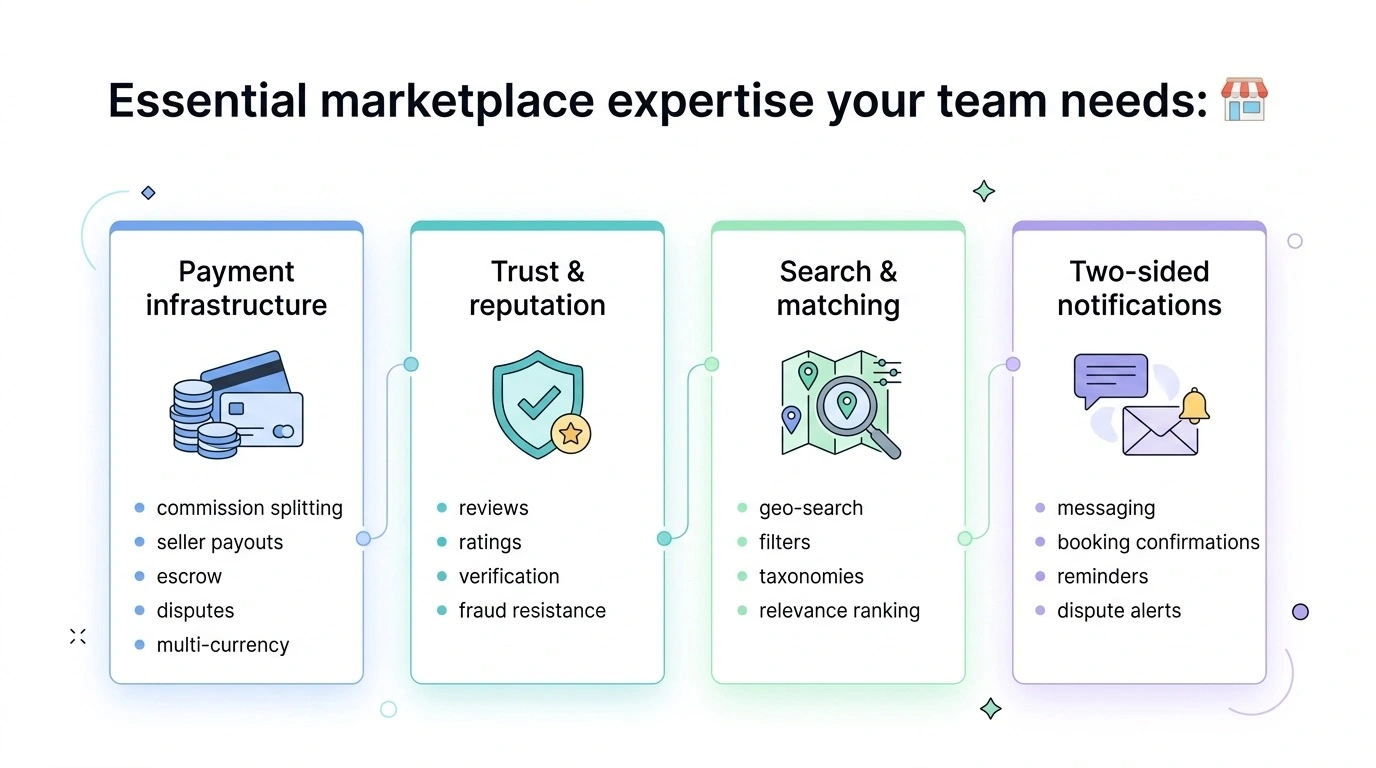
Payment infrastructure. Marketplace payments are fundamentally more complex than standard e-commerce. You’re dealing with payment splitting (how does the platform take its commission?), seller payouts (when and how do providers get paid?), escrow mechanics, refund and dispute flows, and often multi-currency support for international platforms. Developers who haven’t built marketplace payment flows before will underestimate this significantly, and the cost of getting it wrong is high, both financially and in user trust.
Trust and reputation systems. Reviews, ratings, identity verification, response rate tracking, these aren’t decorative. They’re structural to how a marketplace works. They need to be designed thoughtfully and built carefully to resist manipulation and actually serve buyers and sellers rather than just checking a feature box.
Search and matching. How buyers find what they’re looking for is one of the most consequential UX challenges in marketplace development. Filtering, Google Calendar integration, geo-search, category taxonomies, and relevance ranking – all of these require specific engineering attention, and all of them affect conversion rates directly.
Two-sided notifications and communication. Message threading between buyers and sellers, booking confirmations, reminder sequences, dispute notifications – managing the communication layer for two distinct user types is a non-trivial engineering challenge that’s easy to underscope and painful to retrofit.
A dedicated team set up for marketplace work should have engineers who have built these features before, not ones who will figure them out on your budget. When evaluating vendors, ask to see case studies of live marketplace platforms they’ve actually shipped.
How to Hire a Dedicated Software Development Team: Step by Step
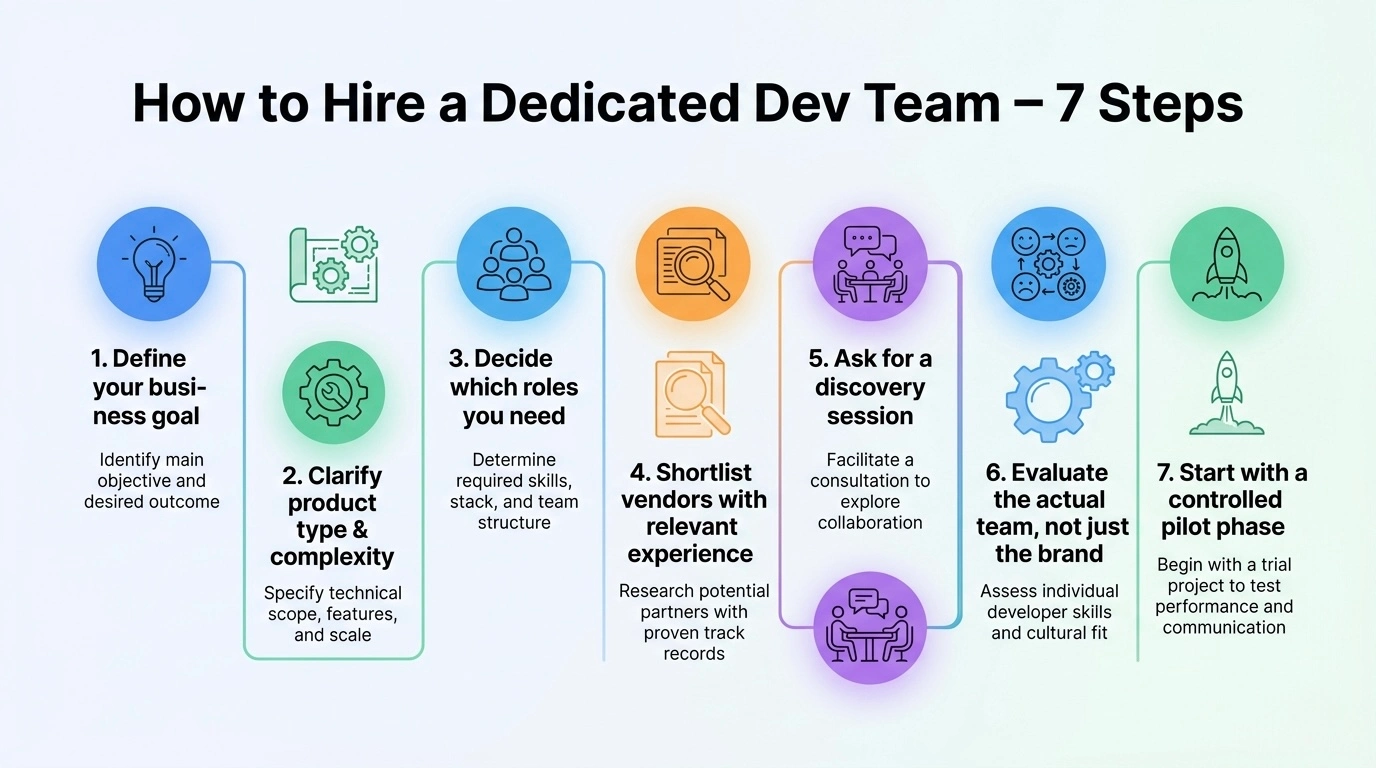
Here is a practical, sequential framework for how to hire dedicated development team for marketplace project, from initial clarity through signed contract to a productive first sprint.
Step 1. Define Your Business Goal
Before you talk to any vendor, get clear on what you’re actually trying to achieve. “Build a marketplace” is a direction, not a goal. A goal is more specific: launch an MVP to validate demand in a specific market within 90 days; rebuild the seller onboarding flow to reduce a known drop-off point; migrate from Sharetribe to a custom platform while maintaining all existing listings and user accounts.
Step 2. Clarify Your Product Type and Complexity
What kind of marketplace are you building? Rental, services, goods, peer-to-peer, B2B? What are the core mechanics – bookings, listings, auctions, subscriptions? Do you need real-time availability management? Does your payment model involve escrow or milestone-based releases? Is there a trust and verification layer for buyers or providers?
Answering these questions before vendor conversations will dramatically sharpen the quality of the proposals you receive – and your ability to actually assess them. In fact, this clarity is the foundation of how to hire dedicated development team for marketplace project successfully.
Step 3. Decide Which Roles You Need
Based on your stage and goals, determine the minimum viable team composition for your first phase. An MVP build has different needs than a scaling engagement. A greenfield project has different needs than a migration.
This prevents vendors from either padding the team with roles you don’t need or proposing a lean team that won’t have the capacity to deliver at the pace you need. And when you’re ready to hire dedicated software development teams, having this role clarity written down becomes your most powerful negotiation tool.
Step 4. Shortlist Vendors With Relevant Experience
Generic software development agencies are not what you want. Look for vendors with demonstrable marketplace experience, specifically in your product type if possible. Check Clutch, review portfolios carefully, look for published case studies, and verify that the work shown is real and recent.
If you’re building a marketplace, reading about the best digital marketplace agencies can give you a useful benchmarking framework. Look for depth of portfolio, not just volume. Ten unrelated projects tells you much less than three marketplace platforms in similar verticals.
Step 5. Ask for a Discovery or Technical Assessment
Before committing to a full engagement on hiring dedicated developers, ask shortlisted vendors to conduct a discovery session or technical assessment. This is where a vendor demonstrates their ability to understand your domain and propose a smart approach, not just quote hours.
Step 6. Evaluate the Proposed Team, Not Only the Company
When hiring dedicated development team, you’re not just buying into a company’s reputation; you’re entering a daily working relationship with specific people. Ask to meet the team members who would actually be assigned to your project. Assess their communication style, their ability to ask good questions, and whether their technical background aligns with your stack and domain.
Step 7. Start With a Controlled First Phase
Even with the right vendor and the right team on paper, structure the first engagement to produce something concrete and evaluable: a working MVP feature set, a specific product area, or a defined sprint cycle. This protects you from overcommitting before the working relationship is proven, and it gives both sides the chance to calibrate expectations before scaling up.
How to Evaluate a Dedicated Development Team Vendor
When assessing vendors during the process of hiring dedicated developers, these are the dimensions that actually matter.
Relevant portfolio. Has the vendor built products with similar complexity to yours, not just generic web applications, but systems with real user management, payment flows, and business logic that matches your domain? Ask to see live products, not just screenshots.
Technical depth, not just process claims. Many agencies talk about agile methodology and sprint-based development. What you need to understand is whether their engineers make sound architectural decisions – whether they’ll push back on a bad idea, propose a smarter approach, or flag a technical risk before it becomes a production incident. Process is a container. Engineering judgment is what fills it.
Communication structure. How often will you get status updates? What tools are used for project tracking? How are scope changes handled? Is there a clear escalation path if something goes wrong? These logistics determine whether the day-to-day experience of working with the team is smooth or exhausting.
Team structure and stability. In a dedicated team model, the question isn’t just “seniors vs juniors.” Ask: Who is full‑time on my project versus part‑time? Which roles (designer, DevOps, BA) are shared across clients? How stable is the team – will the same people stay for the duration, or is rotation expected? A transparent vendor will map this out clearly before you sign.
How Much Does a Dedicated Software Development Team Cost?
Cost is the question in nearly every conversation about how to hire a dedicated software development team, and the honest answer is that it varies significantly based on geography, team composition, and seniority. But the numbers are worth knowing, and comparing against the alternatives.
Here is a rough guide to monthly cost ranges based on typical team structures:
- Eastern European vendors (Ukraine, Estonia, Poland, Romania): generally the strongest value-for-quality ratio for English-speaking product teams. A dedicated team of 3–5 people (PM, 2 developers, QA) typically runs $15,000–$35,000/month, depending on seniority and specialization.
- South/Southeast Asian vendors (India, Vietnam, Pakistan): typically lower in cost, with similar team compositions running $8,000–$20,000/month. Cost differences within this range reflect real factors: seniority, English fluency, time zone overlap, process maturity, and how much responsibility the vendor actually takes. Lower cost usually means less of these, not a bargain.
- Latin American vendors (Brazil, Argentina, Colombia): increasingly popular for US-based teams due to time zone alignment, typically $18,000–$40,000/month for comparable team structures.
- Western European and North American vendors: significantly higher, typically $40,000–$90,000+/month for equivalent team compositions.
Yes, you can hire a dedicated team with US-style project management and global engineers – Roobykon (based in Estonia) offers exactly that. Compare to in-house: one US engineering hire takes 45–90 days, and Deloitte says unfilled roles cost $500/day. A five-person team means six months before you ship. And a bad hire? Up to 300% salary hit. Dedicated team = zero of that overhead.
Red Flags When Hiring a Dedicated Development Team
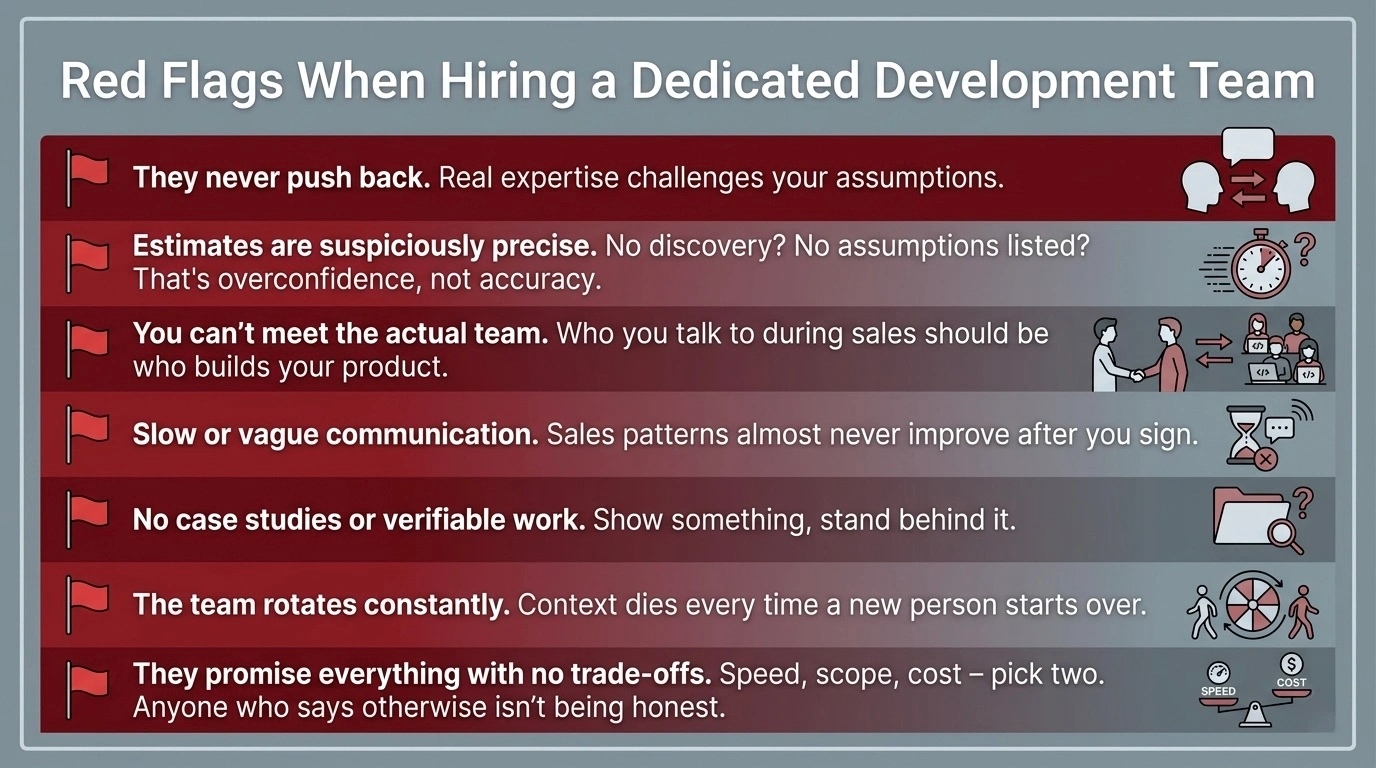
Not every vendor is what they present themselves to be. These are the warning signs that should give you pause, or prompt you to walk away entirely. For a deeper exploration of this topic, Roobykon’s analysis of red flags to watch for in your dev team is one of the most comprehensive frameworks available.
They never push back. A vendor who agrees with everything you say and never challenges your assumptions is a vending machine. Real expertise includes the ability to say “we’ve seen this approach fail before, and here’s why” or “there’s a more efficient way to solve this.” If they never do, their expertise may be more limited than their pitch suggested.
Estimates are suspiciously precise. A vendor who gives you a hard number for a complex product after just a sales call – without discovery, without technical review, without a clear list of assumptions – is signalling trouble.
Fixed-price can work perfectly well for small, well-defined scopes. That’s not the problem. The problem is overconfidence. Complex software cannot be scoped to the hour at the proposal stage without meaningful discovery. If a vendor hands you a precise estimate but can’t explain the risks, the unknowns, or what they’re assuming about your product, you’re looking at one of two outcomes:
- The scope has been quietly constrained to make the number look good, or
- The estimate will expand dramatically once real complexity surfaces.
Neither outcome is in your interest. A trustworthy vendor will give you a range, a list of assumptions, and a clear recommendation for a discovery phase before committing to any number.
You can’t meet the actual team. If a vendor is reluctant to introduce you to the engineers and PM who would actually work on your project before you sign, that’s a problem. You need to know who you’re building with. The relationship you evaluate in the sales process is a preview of the relationship you’ll have in the project.
Communication is slow or vague during the sales process. Pay attention to this. If emails take days to answer, if proposals are thin on detail, if calls are disorganized – that pattern almost never improves once you’re a client. It’s a preview, not an anomaly.
No case studies or verifiable work. Polished portfolio websites with no named clients, no reference contacts, and no live products to point to are a meaningful red flag. Build something, show something, stand behind it.
The team rotates constantly. Some vendors operate like staffing agencies, they assign whoever is available, and that person changes every quarter. This destroys the context accumulation that makes a dedicated team valuable in the first place. Ask explicitly about team stability, and ask what the typical tenure of team members on long-running client projects looks like.
They promise everything without trade-offs. Every real project involves trade-offs between speed, scope, and cost. A vendor who claims to deliver all three simultaneously, with no caveats, isn’t being honest with you. Honesty about constraints is a sign of a trustworthy partner. The absence of it is a sign of a vendor who will disappoint you later.
Dedicated Team vs Other Engagement Models
Here is a direct comparison to help frame the decision:
Dedicated Team | Fixed-Price Project | Staff Augmentation | In-House Hiring | |
|---|---|---|---|---|
Best for | Long-term, evolving products | Defined, scoped deliverables | Adding skills to existing teams | Fully internal control |
Cost structure | Monthly retainer | One-time project fee | Per-resource billing | Salaries + overhead |
Flexibility | High | Low | Medium | Medium |
Ramp-up time | 2–4 weeks | 1–2 weeks | 1–2 weeks | 45–90+ days |
Knowledge continuity | High | Low | Medium | High |
Management overhead | Low | Low | Medium | High |
Scalability | High | Low | Medium | Low |
The question of dedicated development team vs in-house hiring which is better for scaling quickly comes up constantly. Here’s the direct answer: if speed matters and you don’t already have a hiring pipeline, HR infrastructure, and technical leadership in place, a dedicated team can start building three to six months faster than an equivalent in-house team. Recruiting, interviewing, onboarding, and managing even five engineers internally is a substantial operational project, one that takes your focus away from the product itself.
According to Deloitte’s 2024 Global Outsourcing Survey, over 70% of companies now outsource IT functions. That’s not a trend driven by cost-cutting alone. It’s driven by the recognition that assembling and managing a high-quality technical team is a full-time job, one that most founders didn’t sign up for and that pulls energy away from the decisions only they can make.
How to Onboard a Dedicated Development Team
Hiring dedicated development team that is right is step one. Getting them up to speed effectively determines whether you gain or lose momentum in those critical first weeks.
Share everything upfront. Don’t trickle context. Give the team access to your product documentation, existing codebase, competitive landscape, user personas, key metrics, and current blockers on day one. The more they understand about your business (not just the technical spec), the better the decisions they’ll make when a question isn’t explicitly answered in the docs.
Establish communication rhythms early. Agree on daily standup format, sprint planning cadence, review cycles, and how async communication will work between sessions. The first few sprints are a good time to over-communicate; you can dial it back once the team has found their rhythm.
Define ownership clearly. Who approves feature designs? Who makes final calls on architectural decisions? Who does the PM escalate to when there’s a conflict? Ambiguous ownership creates friction and delays. Clear ownership creates velocity and trust.
Set the tone for honest communication. Let the team know you want to hear about problems early, not late. That you’d rather receive an honest “we’re behind and here’s why” on Tuesday morning than a confident “we’re on track” all the way up to a missed deadline. Teams that feel safe surfacing problems early are dramatically better to work with and dramatically better for your product.
Give it a real first sprint before judging. Sprint one is always a calibration. Both sides are learning how the other works. Evaluate the quality of output and communication after the first full cycle – that’s when you have real data on whether the partnership is working. Patience in week one tends to pay for itself.
Why Hire a Dedicated Development Team at Roobykon?
Roobykon Software has been building online marketplace platforms since 2011. We’re not a generalist development shop that builds CRM systems on Monday and games on Friday. We build marketplaces – specifically, complex, transactional, two-sided platforms where the product has to work for multiple user types simultaneously, at scale, with real money moving through it.
Here is what that focus means in practice when you choose our dedicated marketplace development team:
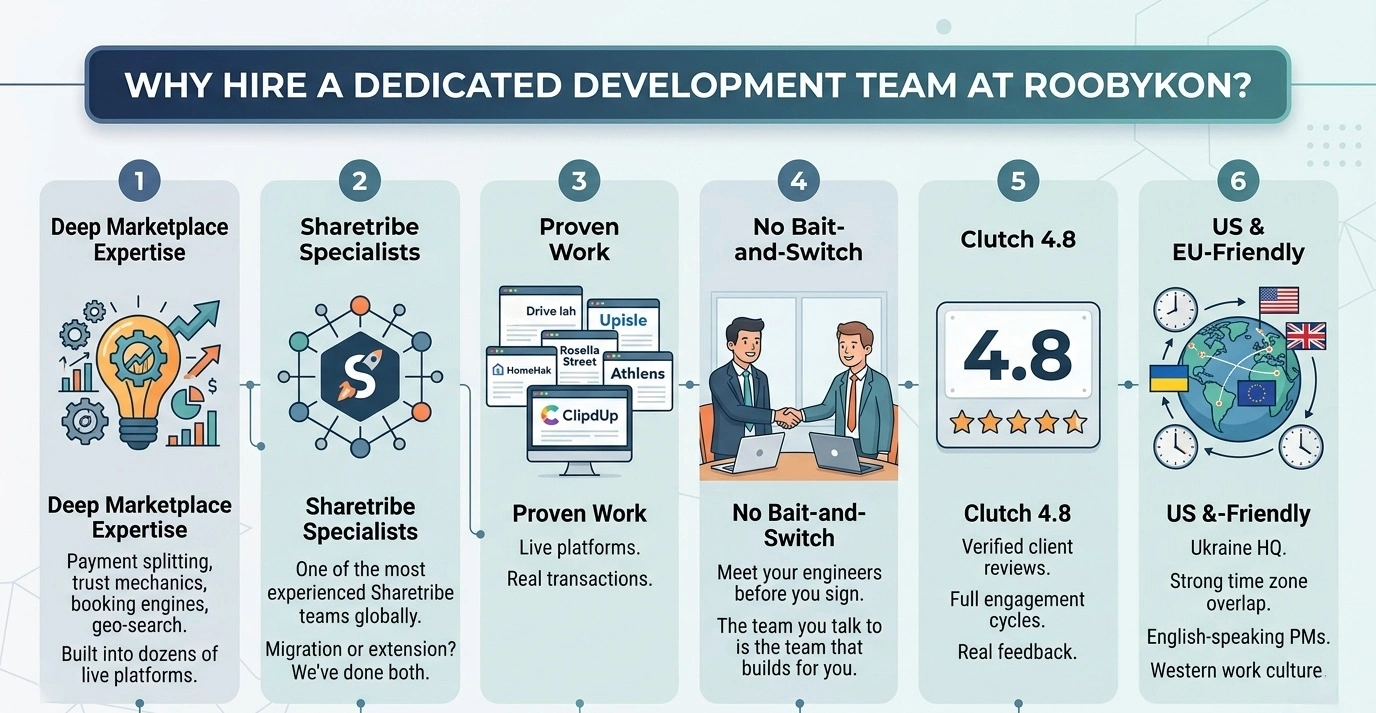
Deep marketplace domain expertise
Our engineers have shipped real payment-splitting systems, two-sided trust mechanisms, availability and booking engines, geo-search, and marketplace-specific onboarding flows across dozens of live platforms. We know where the complexity hides before you point it out.
Sharetribe specialists
If you’re running on Sharetribe or considering a migration off it, Roobykon is one of the most experienced Sharetribe development teams in the world. We’ve built, extended, and migrated Sharetribe platforms for clients across multiple verticals and geographies. For founders considering this path, our team can serve as your dedicated Sharetribe team from day one, managing the transition without disrupting the users who are already on your platform.
Proven, verifiable work
Our case studies include Drive lah (P2P car-sharing), Upisle (watercraft rental), HomeHak (tenant-first rental marketplace), Rosella Street (community sharing platform), Athlens (athletic self-promotion platform), ClipdUp (barbering marketplace), and more. These are live, operating platforms with real users and real transactions – not concept renders or internal demos. We don’t just show screenshots. We show working products.
Transparent team structure
When you work with Roobykon, you know exactly who is on your team. You meet the engineers before the engagement starts. You work directly with your project manager throughout. There is no bait-and-switch between the team that sells you and the team that builds for you.
Clutch rating of 4.8
Built on verified client reviews from people who have gone through full engagement cycles with us, not handpicked testimonials or self-reported metrics.
US and EU-friendly communication
Our team is headquartered in Ukraine, which gives us strong time zone overlap with both North American and European clients, English-speaking project management, and a Western-aligned work culture. You get Eastern European development rates with the communication experience of a partner in your time zone.
Ready to Build?
Hiring dedicated developers is one of the most consequential decisions a product founder makes. Done right, you get a team that compounds in value over time – one that learns your domain, builds institutional knowledge, challenges your assumptions productively, and helps your product evolve strategically. Done wrong, it’s an expensive, time-consuming reset that costs not just money but momentum.
The framework in this guide will help you avoid the most common mistakes: hiring too fast, evaluating vendors on surface signals rather than substance, under-resourcing the non-developer roles, and missing the warning signs that a partnership isn’t working until it’s already too late.
Ready to talk?
Let's discuss your marketplace – no sales pitch, just a real conversation about your goals.
Get in touch
Recommended articles
 How to Understand That the Development Team Is Doing Something Wrong
Development problems rarely announce themselves loudly – they accumulate quietly until something breaks. Based on real project experience, this guide covers the most reliable warning signs of an underperforming dev team, and a symptom-to-root-cause diagnostic framework.
 How to Hire Ruby on Rails Developers: A Practical Guide for Founders and CTOs
Hiring Rails developers? Skip the generic checklists. This practical guide helps founders choose the right model, avoid costly mistakes, and know when to hire a team instead of a solo coder.
 The Best Marketplace Software for Founders
Beneath every successful multi‑vendor marketplace lies a critical architectural decision. This technical deep dive from Roobykon Software examines the best software to build a marketplace.
 How to find a web development partner for your startup: a step-by-step guide
Choosing the wrong development partner can cost you months. Use this expert guide from Roobykon Software to find a trusted web development partner who treats your startup like their own.