Should You Hire Ruby on Rails Developers for Your Project?
First, Define What Kind of Rails Help You Actually Need
Ruby on Rails Developer, Dedicated Team, or Development Company: What Should You Choose?
What Skills Should a Ruby on Rails Developer Have?
Junior, Middle, or Senior Ruby on Rails Developer: Who Do You Need?
Where to Find Ruby on Rails Developers
How to Evaluate Ruby on Rails Developers Before Hiring
Red Flags When Hiring Ruby on Rails Developers
How Much Does It Cost to Hire Ruby on Rails Developers?
When Should You Hire a Ruby on Rails Development Company Instead of One Developer?
Why Roobykon Is a Strong Partner for Ruby on Rails Development
Subscribe and you will promptly receive new published articles from the blog by mail
Most guides on how to hire Ruby on Rails developers were written for recruiters. They tell you to post on the right job boards, ask for a GitHub profile, and run a coding test. That’s fine advice, if filling a seat is the goal.
This guide is for founders and CTOs who need something harder: the right type of Rails expertise, at the right moment, in the right hiring structure – without derailing a product that people are counting on.
Rails has quietly powered some of the internet’s most enduring products. GitHub, Shopify, Airbnb, Basecamp – all Rails. In 2026, it’s still one of the most productive choices for SaaS platforms, marketplaces, and MVPs. The real challenge with hiring Ruby on Rails developers is finding people who can actually ship. There are developers who know Rails syntax, and there are developers who know how to ship a reliable product. The gap between those two groups can cost you months and serious money.
By the end of this guide, you will know:
- What kind of Rails help you actually need before you open a job post
- Which hiring model reduces delivery risk for your specific situation
- How to evaluate candidates with technical precision, not just intuition
- What interview questions actually reveal production experience
- When to bring in a team instead of a single developer
If you’d rather skip straight to a conversation, the Roobykon team is happy to look at your project and give you an honest recommendation.
Should You Hire Ruby on Rails Developers for Your Project?
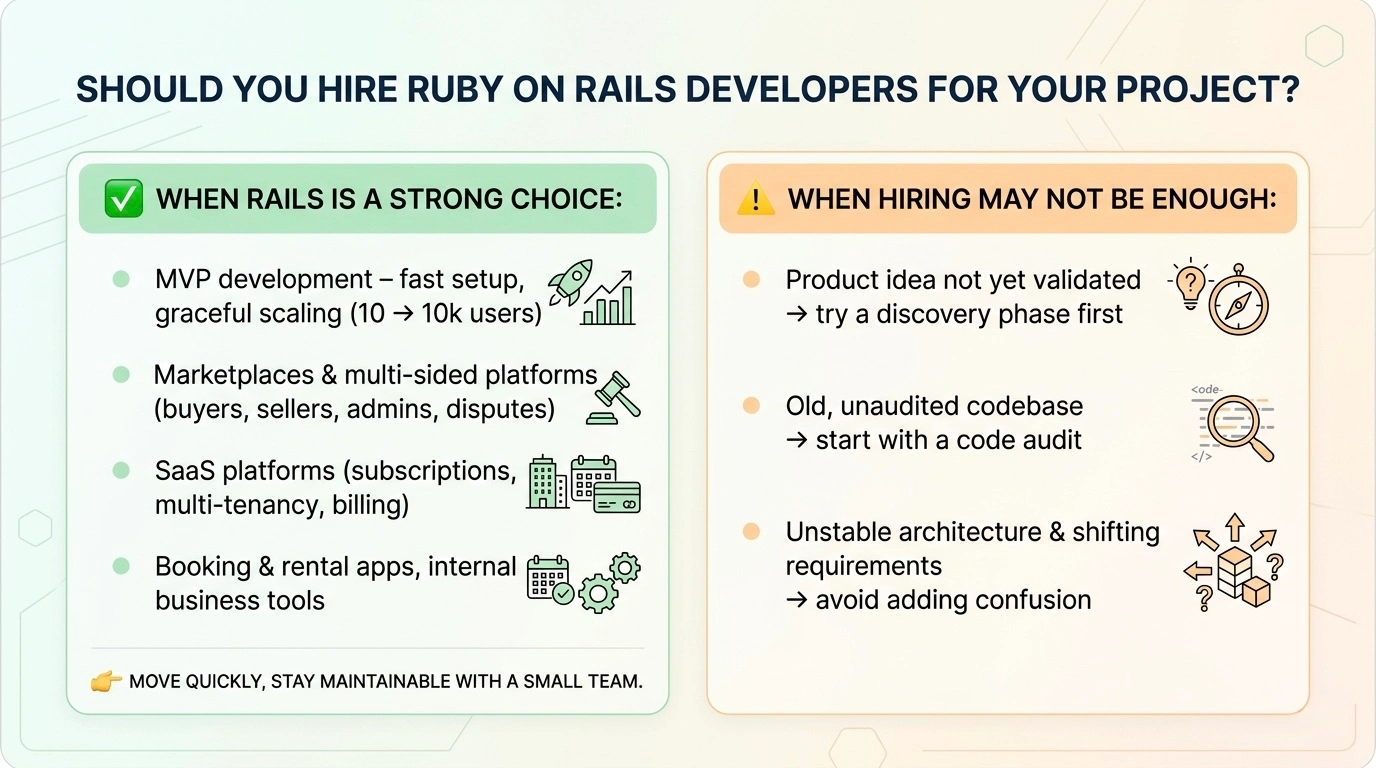
When Ruby on Rails Is a Strong Choice
If you’re building an MVP, Rails is hard to beat. The convention-over-configuration philosophy means developers spend less time on setup and more time on the features that will prove or disprove your idea. There’s a reason why Ruby on Rails is great for startups – it creates structure without overhead, and it scales gracefully from ten users to ten thousand.
Marketplaces are arguably Rails’ strongest domain. Multi-sided platforms – with buyers, sellers, admins, transactions, and disputes – require a mature ecosystem of well-maintained tools. Payment libraries, role management, background jobs, notifications, search – all of it has been solved, tested, and refined in the Rails world. The same applies to SaaS platforms: subscription logic, multi-tenancy, billing, and usage tracking are well-worn Rails territory.
Booking platforms, rental apps, internal business tools – these all fit the same profile. If your product needs to move quickly, stay maintainable with a small team, and handle complex business logic without becoming a nightmare to extend, to hire TOP Ruby on Rails developers is a genuinely good fit.
Not sure if Rails is right for you? You can compare Ruby on Rails and Node.js to make the right decision.
When Hiring Rails Developers May Not Be Enough
- If your product idea hasn’t been validated yet, writing production code is a premature move – a discovery phase or structured prototype will tell you more, faster, at lower cost.
- If the existing codebase hasn’t been properly maintained for years and no one has done an audit, putting a new developer on it without context is an expensive way to produce confusion.
- If your architecture is still undefined and requirements are shifting, adding developers to the uncertainty just creates more things to undo later.
In these situations, a code audit, technical consultation, or short discovery phase is the right first step, not a hiring process.
First, Define What Kind of Rails Help You Actually Need
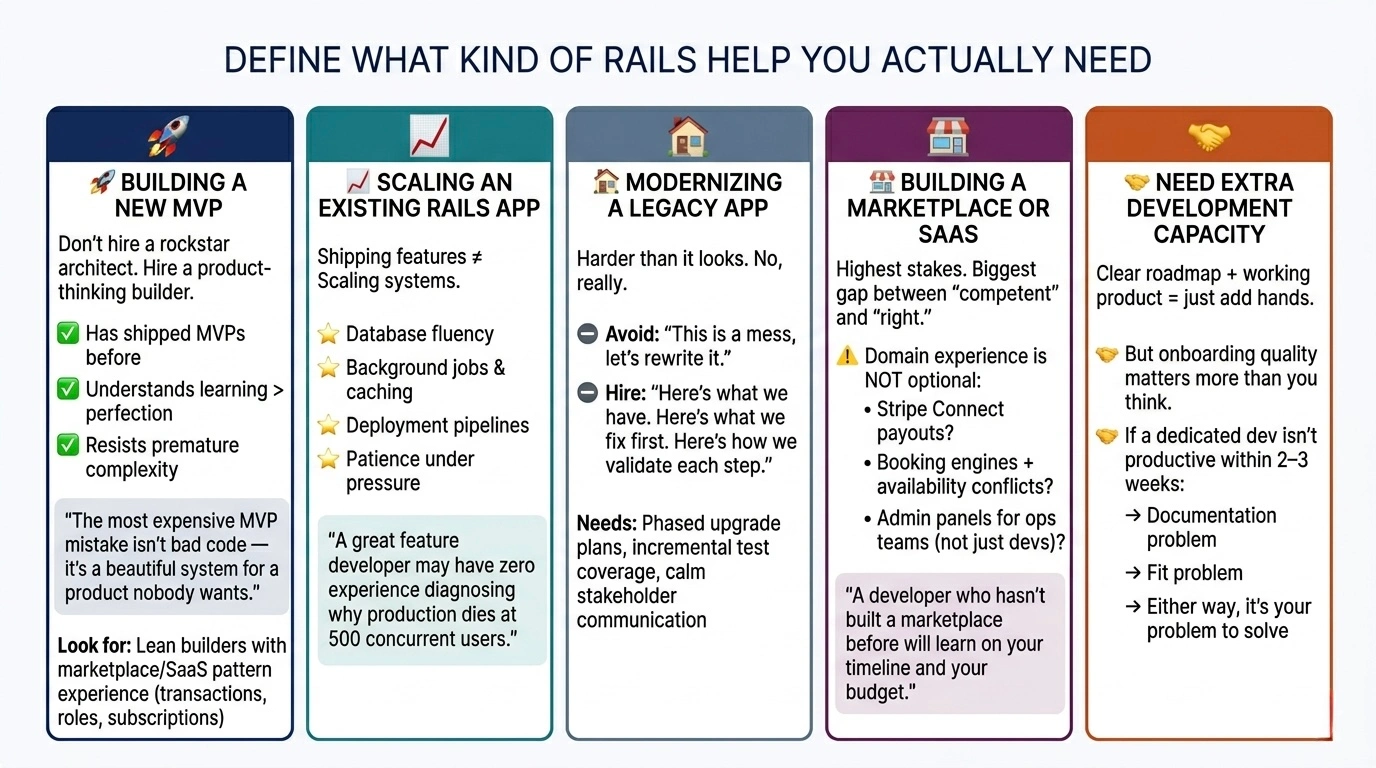
You Are Building a New MVP
For an MVP, the most experienced Rails architect in the world is probably the wrong hire. What you actually need is someone with genuine product thinking – a developer who has shipped MVPs before, understands that the goal is learning rather than perfection, and resists the pull toward premature complexity.
The most expensive MVP mistake isn’t bad code. It’s a developer who builds a beautiful, over-engineered system for a product that nobody wants yet. Hire Ruby on Rails programmers who can build lean, make deliberate architecture choices, and leave room for the product to evolve. If your MVP has marketplace or SaaS patterns (transactions, roles, subscriptions), make sure they’ve worked in those domains before.
You Are Scaling an Existing Rails App
Scaling and building are genuinely different skill sets, and it’s surprisingly common to mix them up. A developer who is excellent at shipping features may have zero experience diagnosing why a production app falls over at 500 concurrent users.
Scaling work requires database fluency along with experience in background job systems, caching strategies, and deployment pipelines. It also requires a particular patience: the ability to change things carefully, without breaking what’s already working, under the pressure of a live product.
You Are Modernizing a Legacy Rails Application
Legacy modernization is underestimated by almost everyone who hasn’t done it. It’s not just running bundle update and hoping for the best. You need to hire RoR developers who can audit an unfamiliar codebase methodically, form a phased upgrade plan, improve test coverage incrementally, and communicate clearly with stakeholders who have very reasonable concerns about breaking production.
The developer who says “this is a mess, we should rewrite it” is usually the wrong choice. The one who says “here’s what we have, here’s what we fix first, and here’s how we validate each step” is the one you want.
You Are Building a Marketplace or SaaS Platform
This is where the stakes are highest, and where the gap between a competent Rails developer and the right Rails developer is most costly. A marketplace is a system with trust mechanisms, financial flows, role logic, dispute workflows, commission structures, payout timing, admin operations, and edge cases that only appear after launch.
When you need to hire dedicated Ruby on Rails developers for a marketplace, domain experience isn’t optional. A developer who has never built a marketplace before will learn on your timeline and your budget. The questions to ask are specific: have they handled Stripe Connect payouts? Have they designed booking engines with availability conflicts? Have they built admin panels for operational teams, not just developers?
You Need Extra Development Capacity
Sometimes the situation is simpler: you have a functioning product, a clear roadmap, and you just need more hands. A dedicated Rails developer or team extension is the right answer here – but the quality of onboarding matters more than most companies realize. When you hire dedicated RoR developer, a person who can’t get productive within two or three weeks usually signals a documentation problem as much as a fit problem. Either way, it’s your problem to solve.
Ruby on Rails Developer, Dedicated Team, or Development Company: What Should You Choose?
One of the most expensive decisions a founder makes (usually without realizing it’s a decision) is the hiring model. Most people default to hire best Ruby on Rails developers without thinking through what they actually need from that arrangement.
Hiring model | Best for | Main risks | When to choose |
|---|---|---|---|
Freelancer | Small fixes, short-term tasks, isolated features | Availability, quality control, limited accountability | When scope is small and clearly defined |
In-house developer | Long-term product ownership, core team | Slow hiring, high cost, hard to replace | When Rails is central to the business and you have internal technical leadership |
Dedicated Rails developer | Ongoing development, team extension | Needs onboarding and active management | When you have a CTO or PM and need delivery capacity |
Rails development agency | MVPs, marketplaces, SaaS, legacy work, scaling | Higher upfront cost than a freelancer | When you need product thinking, architecture, QA, and accountability together |
The question that cuts through most of the noise: who is accountable if something goes wrong? A freelancer delivers milestones. A development agency delivers outcomes, and their reputation depends on getting those right. For most non-technical founders, that distinction is worth more than the hourly rate difference.
Not sure which model fits your case?
Share your project context with Roobykon and we'll help you choose the safest path – no sales pitch, just a straight answer based on your situation.
Contact usWhat Skills Should a Ruby on Rails Developer Have?
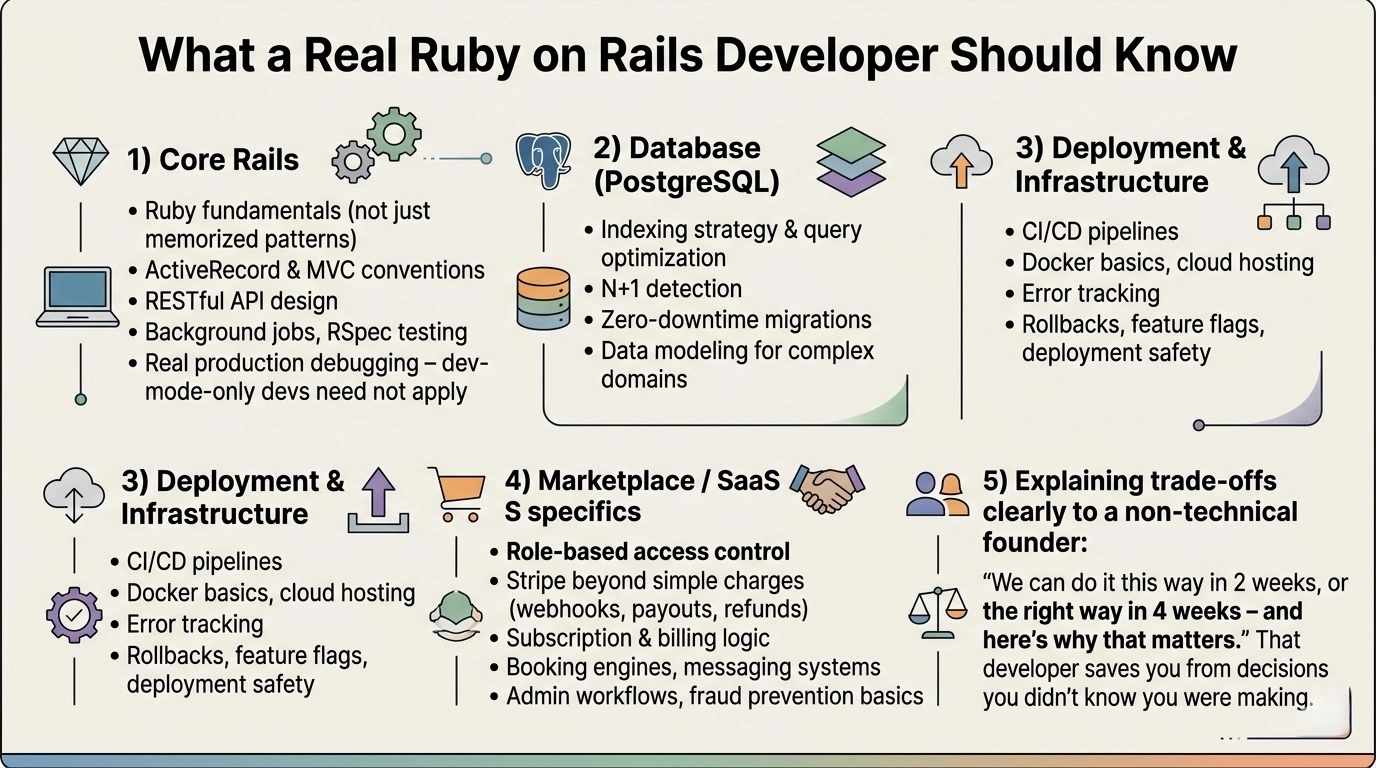
Knowing exactly what to look for is what separates founders who hire expert Ruby on Rails developer from those who hire someone who merely knows the syntax. Here is the honest version of the skills list – things that actually separate strong candidates from weak ones in a real hiring process.
- On the core Rails side: Ruby fundamentals, ActiveRecord, MVC conventions, RESTful API design, background jobs, testing with RSpec, and real debugging experience in production environments. A developer who has only ever worked in development mode is not a production developer.
- On the database side: PostgreSQL fluency beyond “can write queries.” Indexing strategy, N+1 detection, query optimization, zero-downtime migrations, and data modeling for complex domains. Database problems are invisible until they’re catastrophic.
- On the deployment and infrastructure side: CI/CD pipelines, Docker basics, cloud hosting platforms, error tracking, and deployment safety – rollbacks, feature flags, the ability to release without fear. If a developer doesn’t think about deployment, they’re only doing half the job.
- For marketplace and SaaS products, specific experience matters: role-based access control, Stripe integration beyond simple charges (webhooks, payouts, refund flows), subscription and billing logic, booking engines, messaging and notification systems, admin workflows, and fraud prevention fundamentals.
The skill that’s hardest to screen for is the ability to explain trade-offs clearly to a non-technical founder. A RoR developer who can say “we can do it this way in two weeks, or the right way in four weeks, and here’s why it matters” is saving you from a decision you didn’t know you were making.
Junior, Middle, or Senior Ruby on Rails Developer: Who Do You Need?
Getting seniority wrong is expensive in both directions. Overhire, and you’re paying for experience you don’t need. Underhire and you’re generating technical debt that a senior developer will eventually charge you to clean up.
A junior developer is appropriate for bug fixes on stable, well-documented code, small admin panel updates, and test coverage improvements under supervision. They are not appropriate for architecture decisions, payment flows, marketplace logic, or anything where a mistake is painful to reverse.
A middle developer can handle feature development independently, API integrations, database work, and reasonable test coverage without hand-holding. They’re the right choice for most incremental product work on an established codebase.
When it comes to the decision to hire senior Ruby developers, these are the right people, as decisions will define the product for the next two or three years. Marketplace architecture, legacy modernization, performance issues, payment systems, security-sensitive features, and technical leadership – these require someone whose instincts have been sharpened by doing them before.
What you need | Recommended level |
|---|---|
Small fixes, admin updates | Junior / Middle |
New features on stable codebase | Middle |
Marketplace or payment logic | Middle / Senior |
Rails version upgrade | Senior |
Performance optimization | Senior |
Full MVP from scratch | Senior + small team |
Scaling and architecture evolution | Senior / Architect + team |
Where to Find Ruby on Rails Developers
The channel you use to find Ruby on Rails developers should match what you need from them – which means the answer is different depending on whether you need a two-week fix or a two-year partnership.
Freelance platforms like Upwork, Toptal, and Arc.dev are the right tool for short-term, well-scoped work. Toptal’s vetting process is more rigorous; Upwork requires more effort from you to screen. Both work when the task is clear and accountability is limited to the contract. Neither works well when the project is complex or evolving — because when the contract ends, the developer moves on, and what they built is entirely your problem.
Job boards and developer communities – LinkedIn, Wellfound, Rails-specific GitHub communities – are where you find developers actively engaged with the ecosystem. The sourcing effort is real, and senior talent with genuine marketplace or SaaS experience is rare in the open job market.
Development agencies and dedicated teams are the right choice when you need delivery accountability rather than availability. When you hire a Ruby on Rails development company, you’re buying a process, not just hours: code review standards, project management, QA, institutional experience with what works in production. For a founder without an internal CTO, this model often reduces total cost even if the day rate looks higher, simply because the output requires less rework.
The clearest signal that you shouldn’t search alone and may need to hire Ruby on Rails development team rather than one person: there’s no internal technical leadership, the product involves marketplace or payment logic, the codebase is legacy or undocumented, or you need parallel delivery across multiple workstreams.
How to Evaluate Ruby on Rails Developers Before Hiring
Most hiring tests measure the wrong things. Algorithms don’t tell you if someone can ship a trustworthy product.
Start With Project Fit
Has this person shipped something similar in production – real users, real product? What was their actual role? “Contributed to” is not “owned and shipped.” A developer with marketplace or SaaS experience saves weeks of context.
Review Their Code Before the Interview
Look for readable structure, Rails conventions, clean migrations, and real test coverage. Red flags in code are more reliable than interview answers.
Use Realistic Technical Tasks
Ask them to fix a slow ActiveRecord query, review a controller with anti-patterns, or design a booking schema for a marketplace. These reveal judgment, not memorization.
Ask architecture questions that separate experience from familiarity:
- How would you design a multi-vendor marketplace?
- How would you handle refunds and disputes?
- How would you upgrade a Rails app with minimal tests?
Their confidence, caveats, and genuine uncertainty tell you more than any certification.
Red Flags When Hiring Ruby on Rails Developers
Some patterns consistently predict painful outcomes. Watch for them before you sign anything.
Red flag | Why it matters |
|---|---|
Only talks about syntax, not business logic | Good developers connect code decisions to product outcomes. This one optimizes for the wrong thing. |
Can’t explain trade-offs – only “the right way” | Every architecture decision involves trade-offs. No acknowledgment of them means shallow understanding. |
No production experience | Side projects and tutorials don’t prepare you for incidents, data migrations, or real user behaviour. |
Dismissive of testing and documentation | These aren’t preferences. They’re the standards that protect the next person on the codebase. |
Underestimates legacy code | Anyone who calls legacy “easy to fix” without reading it hasn’t dealt with real legacy code. |
Promises unrealistic timelines | Confidence without having seen the codebase comes from not knowing what they don’t know. |
Describes a marketplace as “users and listings” | A marketplace has financial flows, trust mechanisms, dispute logic, and admin operations. This person will recreate that complexity as bugs. |
Overconfident architecture answers | Strong candidates acknowledge trade-offs and edge cases. Overconfidence in interviews becomes overconfidence in production. |
How Much Does It Cost to Hire Ruby on Rails Developers?
According to Clutch’s 2026 web development pricing data, Ruby on Rails agencies typically charge between $25–$49 per hour – that’s the verified average across client-reviewed engagements on the platform. The average total cost of a web development agency project sits at $66,499, with a typical timeline of around 9 months and a monthly spend of roughly $7,100.
Those are aggregate numbers across all project types. A Rails-specific product will land differently depending on what you’re building, who you hire, and where they’re based.
Rails Developer Rates by Location (2026)
Geography is still one of the biggest pricing levers, and the spread is significant:
Region | Average Hourly Rate |
|---|---|
United States | $100 – $149 |
Canada | $100 – $149 |
Australia | $100 – $149 |
Poland | $50 – $99 |
Ukraine | $25 – $49 |
Philippines | $25 – $49 |
Spain | $25 – $49 |
Mexico | $25 – $49 |
India | < $25 |
Eastern Europe (Ukraine in particular) has become the default for founders who want to hire senior Ruby developers without a Series A budget to justify it. Time zone overlap with Western Europe is workable, English proficiency among senior developers is consistently solid, and the Rails community in that region is active and well-established.
Project Cost by Type
To make the numbers more concrete:
Project type | Typical range | Key cost drivers |
|---|---|---|
Simple MVP | $15,000 – $40,000 | Scope discipline, seniority of lead dev |
SaaS platform | $40,000 – $100,000+ | Subscription logic, integrations, QA |
Marketplace (2-sided) | $60,000 – $150,000+ | Payment flows, roles, admin, trust mechanisms |
Legacy modernization | $20,000 – $80,000 | Codebase complexity, test coverage gap |
Team extension (ongoing) | $5,000 – $15,000/month | Team size, engagement model |
When Should You Hire a Ruby on Rails Development Company Instead of One Developer?
A development company is the safer choice when you’re building a marketplace, which requires product architecture, payment expertise, QA, admin design, and security thinking simultaneously – not one developer cycling through each. You might also need Ruby on Rails consulting specialists when you’re entering a complex domain (fintech, healthcare, multi-vendor logistics), where someone with domain pattern recognition is more valuable than generic Rails knowledge.
It’s also right when you’re modernizing a legacy application, which is a coordinated multi-discipline process, not a solo sprint. And when there’s no internal CTO to evaluate, direct, and onboard a developer, a Ruby on Rails development company fills that gap – providing the technical leadership that converts business requirements into engineering decisions.
As a marketplace development partner, Roobykon works with founders who need the full picture: backend architecture, payment flows, admin operations, QA, and the kind of technical leadership that turns business requirements into reliable software.
Why Roobykon Is a Strong Partner for Ruby on Rails Development
Roobykon Software builds Rails products – marketplaces, SaaS platforms, MVPs, and modernization projects – with a focus on what matters at the end: software that works reliably, scales without drama, and doesn’t create problems for the next team.
The marketplace specialization is genuine. Roobykon has built and improved platforms across rental, car-sharing, tourism, environmental sharing, and B2B/B2C traceability verticals. The team understands how marketplaces work as businesses – commission structures, trust flows, payout logic, dispute handling, operational admin – not just how to write the code that underlies them.
Need Rails developers?
Tell us about your product, and we'll recommend the right setup with honest reasoning behind every suggestion.
Get in touchFinal Checklist Before You Hire Ruby on Rails Developers
Before you make any hiring Ruby on Rails developers decision, run through this:
- You’ve defined your project type: MVP, marketplace, SaaS, legacy modernization, or team extension
- You’ve chosen a hiring model that fits your stage and internal capabilities, not just your budget
- You’ve verified real production experience – not assumed it from a strong CV
- You’ve reviewed actual code, not just a portfolio summary
- You’ve asked architecture questions, not algorithm puzzles
- You’ve tested communication: can this person explain trade-offs to a non-technical founder?
- You’ve clarified ownership expectations and availability before day one
- You’ve planned onboarding with documentation, environment setup, and low-risk first tasks
- You’ve budgeted for QA, DevOps, and post-launch support
- You’ve chosen a partner who understands your business model, not just your tech stack
Hiring Ruby on Rails Developers FAQ

Recommended articles
 Top Ruby on Rails Development Companies in 2026
Choosing the right technical partner can accelerate your product launch by months and save six figures in unnecessary rework. In our definitive 2026 guide, we cut through the noise to rank the world's best Ruby on Rails development companies.
 The Best Marketplace Software for Founders
Beneath every successful multi‑vendor marketplace lies a critical architectural decision. This technical deep dive from Roobykon Software examines the best software to build a marketplace.
 How to find a web development partner for your startup: a step-by-step guide
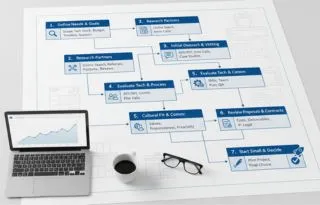
Choosing the wrong development partner can cost you months. Use this expert guide from Roobykon Software to find a trusted web development partner who treats your startup like their own.
 The Best Marketplace Development Companies in 2026
Master the art of selecting the right marketplace software development company. Explore detailed profiles of top marketplace developers, evaluation criteria, and strategic insights for building category-defining marketplaces in 2026.