Why choosing the right partner is 50% of startup success
The difference between regular outsourcing and strategic partnerships
Key criteria for choosing a technical partner
Where to look for developers: a comparison of the main channels
Potential partner evaluation process
What questions should you ask before signing a contract?
Roobykon Software is your trusted technology partner
Conclusion: Start your journey to a successful product today
Subscribe and you will promptly receive new published articles from the blog by mail
Finding the right web development partner can feel like searching for a needle in a haystack – especially when your startup’s future depends on getting it right. With over 305 million startups created each year globally, the competition is fiercer than ever. Yet here’s the sobering truth: around 90% of startups ultimately fail, and 42% of those failures happen because the product simply didn’t solve a real market need. The difference between joining that statistic and beating the odds often comes down to one crucial decision: who builds your product.
This guide will walk you through exactly how to choose the right software development partner – not just a vendor who writes code, but a true strategic ally who helps you validate, launch, and scale.
Why choosing the right partner is 50% of startup success
The numbers don’t lie. Over 60% of software outsourcing relationships fail to meet expectations, and the average failed partnership costs startups anywhere from 6 to 12 months of development time, often wiping out their entire initial funding round. When you’re racing to market, that’s a death sentence.
But successful partnerships tell a different story. Companies with mature partnership programs grow revenue nearly twice as fast as their competitors and are five times more likely to exceed their profitability targets. For startups, the stakes are even higher: your software development outsourcing partner is helping you test assumptions, avoid costly mistakes, and get to market before your window of opportunity closes.
The global software outsourcing market was valued at USD 544.22 billion in 2024 and is projected to reach USD 888.69 billion by 2033. More startups than ever are choosing to outsource development rather than build in-house teams. Why? Because hiring in-house engineers requires months of recruiting, expensive onboarding, office space, equipment, and salaries, even during downtime – all before you’ve validated that anyone actually wants your product. Understanding these fundamental reasons to outsource software projects is the first step toward building a strategic and cost-effective partnership.
The difference between regular outsourcing and strategic partnerships
Not every software development outsourcing partner is created equal. Many startups make the mistake of treating their development partner as a transactional vendor – someone you hand specifications to and expect finished code back from. That’s outsourcing. A true web development company partnership, however, is something entirely different.
A strategic partner:
- Acts as an extension of your team, not a separate entity
- Challenges your assumptions and asks tough questions before writing a single line of code
- Shares in your product vision and contributes strategic insights
- Adapts to your changing needs as you pivot based on market feedback
- Helps you prioritize ruthlessly to launch an MVP that actually validates your business model
The key is turning a vendor relationship into a true product partnership where development partners operate as extensions of your team – with shared OKRs, unified roadmaps, embedded roles, and aligned incentives. When you’re searching for a product development partner, look for someone who asks “why” – not just “how.”
Key criteria for choosing a technical partner
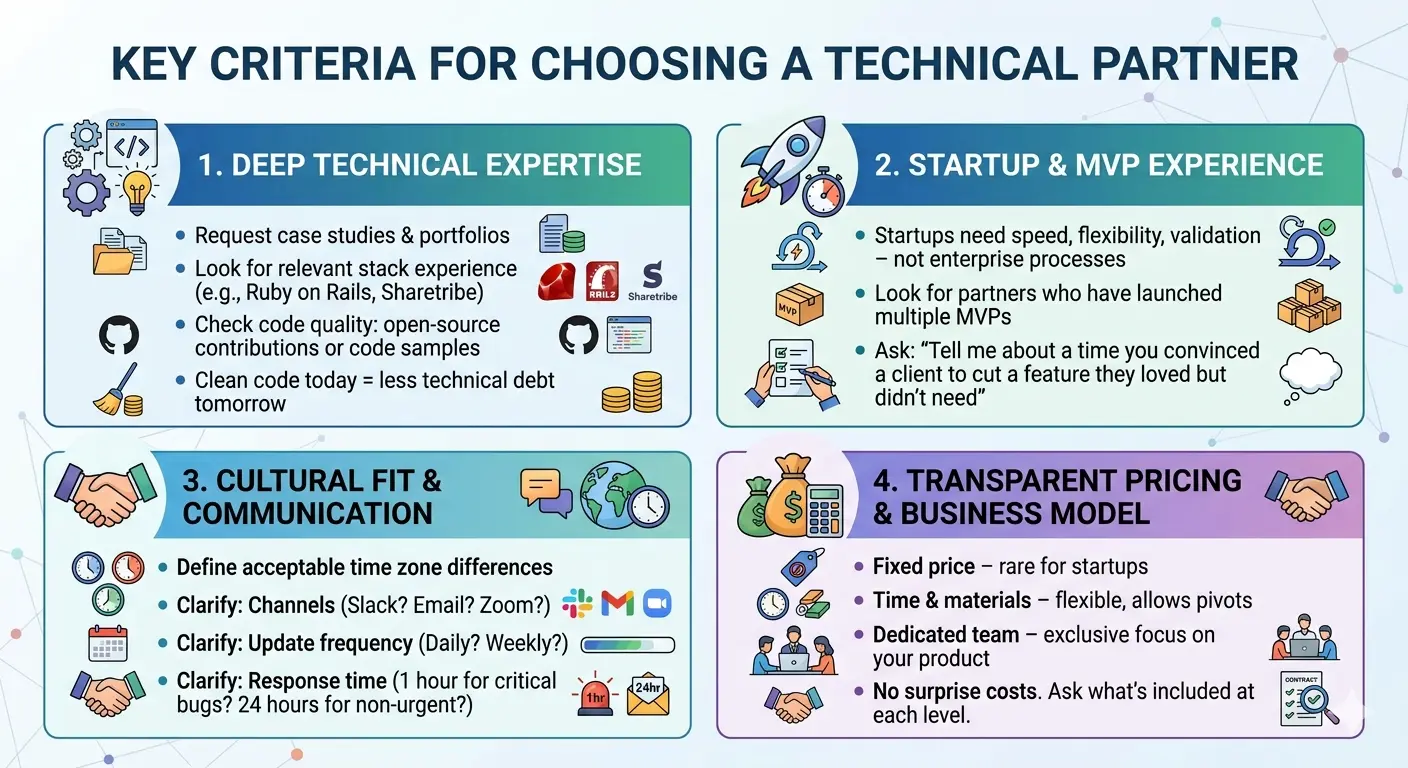
Before you start looking for software development partner options, you need to know exactly what to look for. Here are the four non-negotiable criteria.
Deep technical expertise and technology stack
Your partner’s technical capabilities should be your first stop. Request detailed case studies and portfolios demonstrating their industry-specific experience. This documentation provides crucial insights into their work quality and requirements-gathering processes.
If your startup is building a Ruby on Rails application, for example, you need a partner with deep Rails expertise – not just a team that “can figure it out.” At Roobykon Software, our Ruby on Rails development practice has delivered dozens of successful products, and we also work extensively with Sharetribe to help startups launch scalable marketplaces.
Beyond the stack itself, look for evidence of code quality. If possible, review open-source contributions or ask for a sample code snippet to gauge whether they follow best practices. A partner who writes clean, maintainable code today saves you months of technical debt tomorrow.
Experience working specifically with startups and launching MVPs
This is perhaps the most critical criterion when searching for a product development partner. Building software for an enterprise is fundamentally different from building for a startup. Enterprise projects have fixed requirements, long timelines, and established processes. Startups need speed, flexibility, and validation-first thinking.
Look for a partner who has launched multiple MVPs and can demonstrate a systematic approach to validation. 95% of products still fail because MVPs have become rushed iterations lacking real customer feedback. The right partner knows how to build just enough to test your riskiest assumptions – and no more.
Ask potential partners: “Tell me about a time you convinced a client to cut a feature they loved but didn’t need.” The best partners will have stories of saving clients from overbuilding.
Cultural fit and communication processes
You’re going to spend countless hours with this team. They’ll attend your meetings, review your designs, and help you make tough product decisions. Cultural fit matters immensely.
When evaluating partners, define the location and time difference you’re comfortable with. Would you be open to working with a team that’s four hours ahead or behind your time zone? Beyond geography, assess communication styles. How often will they update you?
Communication protocols
When evaluating how to find a developer for your startup, communication protocols are often the difference between a smooth partnership and a daily nightmare. Before signing any agreement, you need crystal clarity on three specific areas:
1. Communication channels
Through what channels will you interact daily? Email? Slack? Discord? Telegram? Microsoft Teams? Zoom for weekly calls? The right channel mix depends on your team’s preferences and the developer’s workflow. Some partners prefer synchronous channels like Slack for real-time problem-solving; others rely on asynchronous tools like GitHub Issues or Linear to maintain deep focus. Neither is wrong, but both parties must agree upfront.
2. Update frequency
How often will you receive progress updates? Daily standups? Weekly sprint reviews? Bi-weekly demo days? For early-stage startups moving at high velocity, daily or near-daily updates are strongly recommended. You cannot afford to discover three weeks later that the team has been building the wrong feature.
3. Typical response time
What’s their expected response time for different types of messages? A critical production bug might require a 1-hour response window, while a non-urgent design question might allow 24 hours. Get these expectations in writing. A partner who takes 48 hours to acknowledge a blocker could cost you weeks of momentum.
Business model transparency and pricing
Nothing kills a web development partnership faster than surprise costs. Before signing anything, understand exactly how your partner structures their pricing.
Common models include:
- Fixed price: Best when requirements are crystal clear and unlikely to change (rare in startups)
- Time and materials: More flexible, allows for pivots and changing priorities
- Dedicated team: You pay for a team that works exclusively on your product
Ask about what services are included at each price level and ensure you understand how project scope changes will affect the cost. A transparent partner will walk you through their pricing model in detail – not hide behind vague estimates.
Where to look for developers: a comparison of the main channels
When looking for a web development partnership, you have multiple channels to explore. Each has its strengths and weaknesses.
Search platforms (Clutch, GoodFirms, Upwork)
Clutch is the premier B2B marketplace for organizations seeking reliable software development partners, providing comprehensive research and verified client experiences that simplify the vendor selection process. You’ll find detailed reviews including star ratings, approximate costs, engagement timeframes, and breakdowns of client feedback.
Upwork and similar freelance platforms work well for small projects or independent developers, but exercise caution when looking for a software development partner for a full-scale product. Freelancers typically lack the redundancy, project management infrastructure, and quality assurance processes that a dedicated agency provides.
Here’s the irony: trying to save money by hiring just one freelancer doesn’t always lead to real savings. More often than not, a small team where each person focuses on their specific role ends up being more efficient – and sometimes even more affordable – than a single developer spread too thin, making avoidable mistakes along the way.
Beyond these platforms, don’t underestimate the power of referrals. Speak with startup peers, advisors, or community leaders – they often know exactly where to find developers for startups that thrive in fast-paced environments.
Potential partner evaluation process
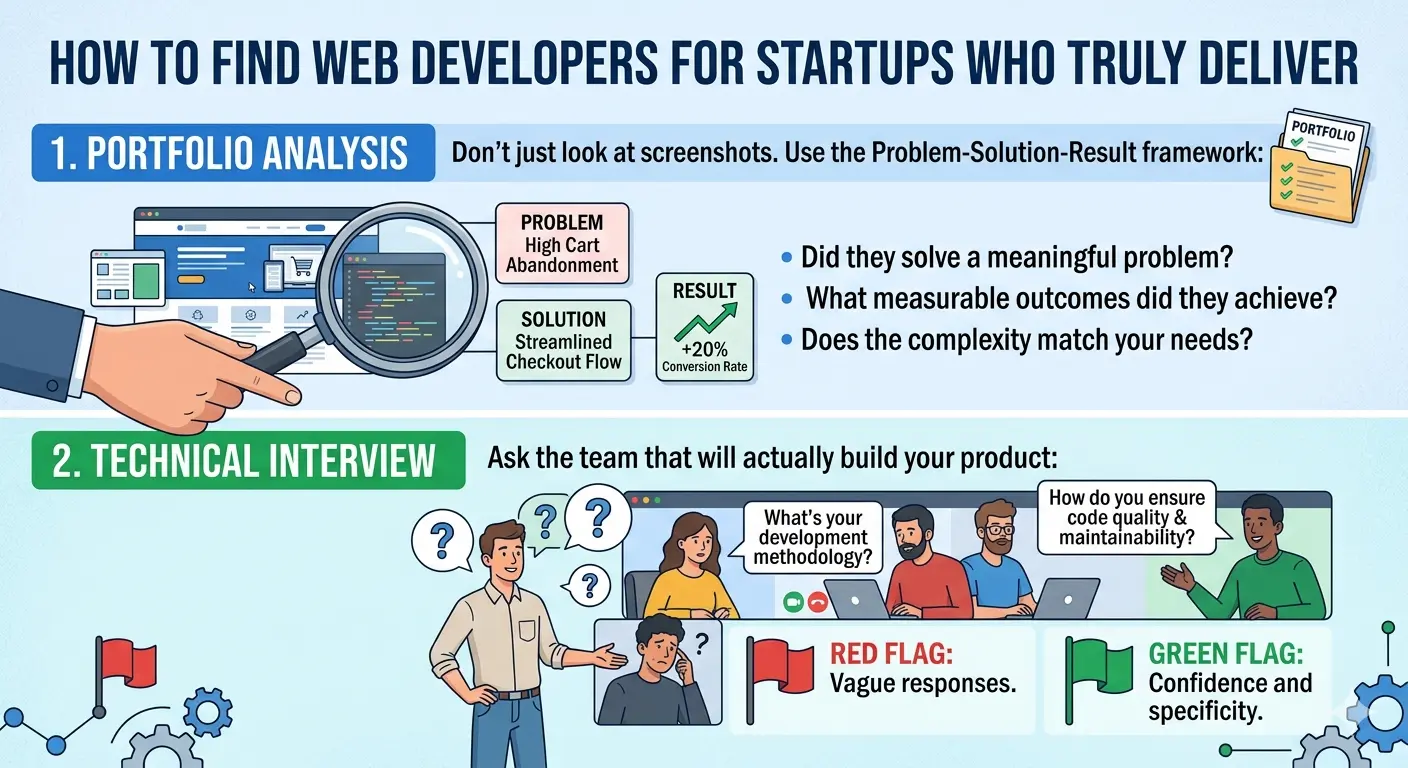
Once you’ve built your longlist, it’s time to evaluate and narrow it down systematically. This is where you truly find web developers for startups who can deliver, not just talk a good game.
Portfolio analysis and checking customer reviews
A company’s portfolio reveals whether it can actually deliver real results. Review past projects to see if the partner has built solutions similar to your requirements. But don’t just look at screenshots – use a Problem-Solution-Result framework that moves beyond vague descriptions and provides concrete evidence of success.
Ask yourself:
- Did they solve a meaningful problem?
- What measurable outcomes did they achieve for their client?
- Does the complexity match what you’re building?
Technical interview with the team
Before committing, conduct a proper technical interview with the people who will actually build your product. This is about assessing their process and competence.
Ask questions like:
- “What’s your development methodology?”
- “How do you ensure code quality and maintainability over the long term?”
- “How do you handle changes in project requirements mid-development?”
Pay attention not just to their answers, but to their confidence and specificity. Vague responses are a warning sign.
What questions should you ask before signing a contract?
Before you put pen to paper, protect both parties by asking these critical questions:
- Who owns the intellectual property? This must be absolutely clear in writing. The developed software should belong to you – no exceptions.
- What’s your process for scope creep management? How do you derisk requirements that change mid-project?
- Can you provide references from past clients?
- What’s your quality assurance and testing process? Understanding how they validate code before delivery is essential.
- How do you handle post-launch support and maintenance?
- What happens if timelines slip? Are there penalties? Remedies? Clear escalation paths?
The contract should also define deliverables, payment schedules, milestones, and testing periods to set clear expectations and safeguard both parties’ interests.
Roobykon Software is your trusted technology partner
At Roobykon Software, we become your web development partner for the long haul. With deep expertise across the full spectrum of web development services, we’ve helped dozens of startups transform ideas into thriving products.
Our approach to product development from scratch
We start with discovery, not coding. Before a single line of code is written, we work with you to:
- Validate your assumptions through market research and user interviews
- Define your MVP scope with ruthless prioritization
- Select the right technology stack for your specific needs
- Establish clear metrics for success
Our team has particular depth in complex domains like the healthcare industry, where regulatory compliance, data security, and reliability aren’t optional – they’re essential. But whether you’re building a healthcare platform, a fintech tool, or the next B2B SaaS product, our process remains the same: understand deeply, build thoughtfully, and iterate rapidly.
What our clients say about us
Don’t just take our word for it. Here’s what some of our partners have shared about working with us:

Alex Macpherson
CEO, Burst SMS


Carsten Hokema
CEO, Sharepar


PAOLO SPILUTTINI
Founder & CEO, Taskyourneighbor

From MVP to full-scale market solution
Launching an MVP is just the beginning. The true test comes when real users interact with your product. Our partnership software development model means we stay with you through every stage:
- MVP Launch — Get something valuable into users’ hands fast
- Measure & Learn — Analyze real usage data to identify what works
- Iterate — Build only what users actually need
- Scale — When you’ve achieved product-market fit, we help you scale without breaking things
We’ve seen too many startups fail because they built the wrong thing perfectly. Our job is to make sure you build the right thing – efficiently, affordably, and with quality that lasts.
Conclusion: Start your journey to a successful product today
Finding the right software development partners isn’t easy, but it’s the single most important investment you’ll make in your startup’s future. The statistics are clear: poor partnerships cost startups months of time and entire funding rounds. Great partnerships accelerate growth, reduce risk, and multiply your chances of success.
Knowing how to find a developer partner for a startup is a skill that separates founders who succeed from those who struggle. Take the time to evaluate potential partners thoroughly. Look for deep technical expertise, startup experience, cultural alignment, and transparent business models. Check portfolios, conduct technical interviews, and ask the hard questions before signing anything.
And when you’re ready to build something remarkable, Roobykon Software is here to help. Don’t let another day pass with your great idea still on paper. Contact Roobykon Software today, and let’s start building your success story together.

Recommended articles
 The Best Marketplace Development Companies in 2026
Master the art of selecting the right marketplace software development company. Explore detailed profiles of top marketplace developers, evaluation criteria, and strategic insights for building category-defining marketplaces in 2026.
 Best Sharetribe Alternatives: Choosing the Marketplace Platform for 2026
Our 2026 comparison of alternatives to Sharetribe breaks down features, costs, and use cases for Arcadier, Mirakl, open-source options, and more to help you decide.
 Roobykon’s Implemented Favorites Feature: Save Time, Stay Organized
With just a click of a button, you can now save your favorite products and sellers, creating a personalized list of all the items you're interested in. Not only does this save you time and effort, but it also allows you to keep track of the products or services you're considering.
 A Case Study on RFQ and Price Negotiation by Roobykon
From unpredictable configurations to competitive bargaining, we faced and conquered the challenges of RFQ functionality for marketplaces. Here’s how we did it.