First: Why Choosing the Wrong Platform Is So Expensive
The Major Categories of Marketplace Software
1. Sharetribe: The Best Marketplace Website Builder for Speed to Market
2. Mirakl: The Best B2B SaaS Marketplace Software for Enterprise
3. CS.Cart Multi-Vendor: A Serious Platform to Build a Marketplace Website
4. WordPress + Marketify: No Code Marketplace Builder for Digital Products
5. OpenCart + Multi-Vendor / Drop Shipper: The Budget-Friendly Open Source Option
6. X-Cart Multi-Vendor: Administrator Control at the Center
7. Medusa: The Open-Source Alternative for Total Ownership
8. Shopify: The E-Commerce Juggernaut, Adapted for Marketplaces
Marketplace Platform Comparison at a Glance
How to Actually Choose: A Framework for Founders
Why Founders Partner with Roobykon for Marketplace Development
The Honest Bottom Line about the Best Software to Build Marketplace
Subscribe and you will promptly receive new published articles from the blog by mail
Every founder who has ever dreamed of building the next Amazon, Airbnb, or Etsy knows that the first – and most daunting – question is: “Where do I actually start?” You have the vision, the niche, and the drive. What you need is the right foundation – the best marketplace software that will turn your concept into a functioning, scalable marketplace without breaking the bank or requiring a team of 50 engineers.
The opportunity is massive. By 2027, marketplaces will drive 59% of all global e‑commerce transactions. In 2026, the options for building an online marketplace are better, more affordable, and more diverse than ever. No matter your background or scale – non-technical founder on a no-code journey or enterprise deploying a custom B2B SaaS marketplace – a purpose-built tool fits your budget and timeline.
Roobykon Software has spent over 15 years helping founders navigate these exact waters, building marketplaces for healthcare, rentals, professional services, and everything in between. We know the landscape inside and out.
So let’s talk about the top marketplace platforms options available to you right now.
First: Why Choosing the Wrong Platform Is So Expensive
Before we dive into the best software to build marketplace themselves, it’s worth sitting with this uncomfortable truth: choosing the wrong foundation doesn’t just cost money. It costs time – months of rebuilding, of migrating users, of watching competitors pull ahead while your team patches a platform that was never designed for what you need.
The best online marketplace platform for someone building a hyperlocal food delivery network is not the same as the best platform for a founder launching a freelance marketplace for legal professionals. The technology that powers one can actively work against the other.
The Major Categories of Marketplace Software
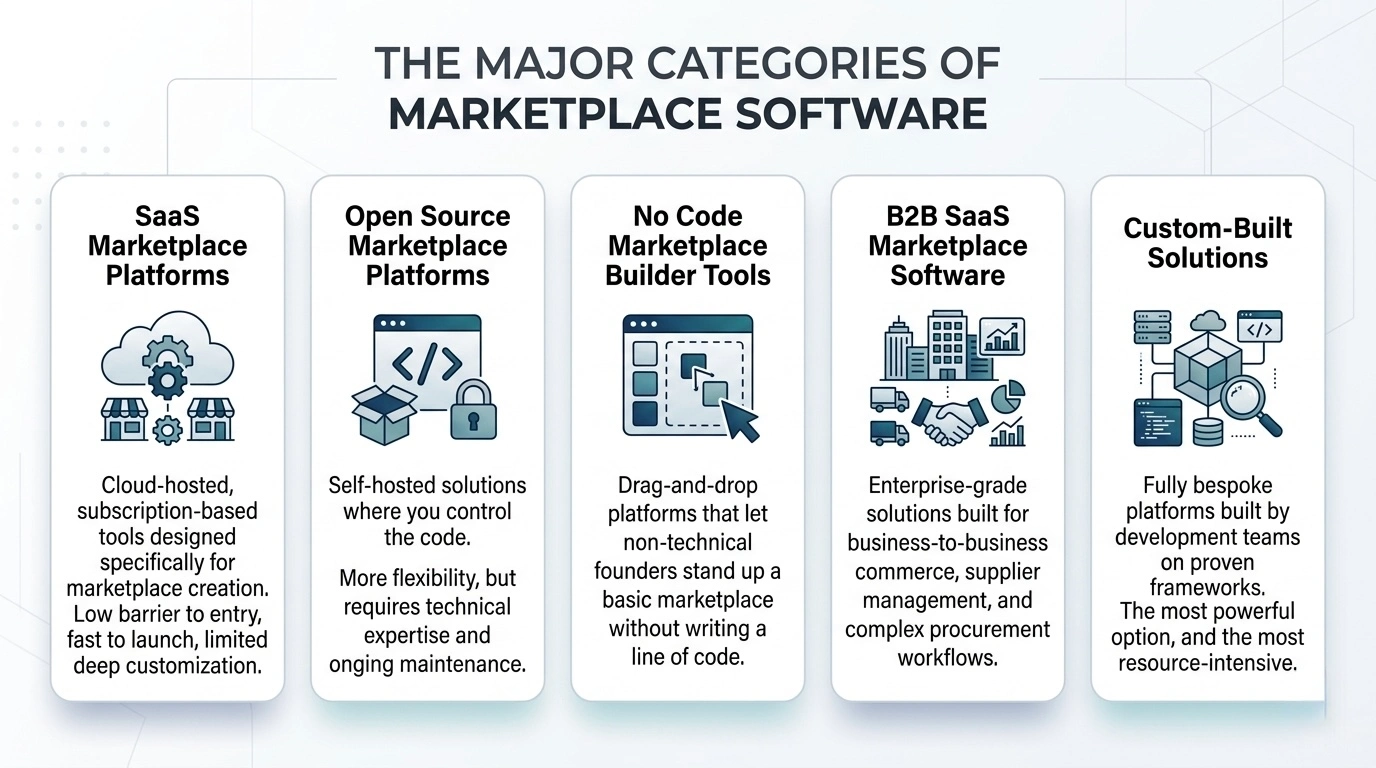
Before listing platforms, it helps to understand what type of solution you’re actually looking for:
SaaS Marketplace Platforms
Cloud-hosted, subscription-based tools designed specifically for marketplace creation. Low barrier to entry, fast to launch, limited deep customization.
Open Source Marketplace Platforms
Self-hosted solutions where you control the code. More flexibility, but requires technical expertise and ongoing maintenance.
No Code Marketplace Builder Tools
Drag-and-drop platforms that let non-technical founders stand up a basic marketplace without writing a line of code.
B2B SaaS Marketplace Software
Enterprise-grade solutions built for business-to-business commerce, supplier management, and complex procurement workflows.
Custom-Built Solutions
Fully bespoke platforms built by development teams on proven frameworks. The most powerful option, and the most resource-intensive.
Now, let’s look at the best options in each category.
1. Sharetribe: The Best Marketplace Website Builder for Speed to Market
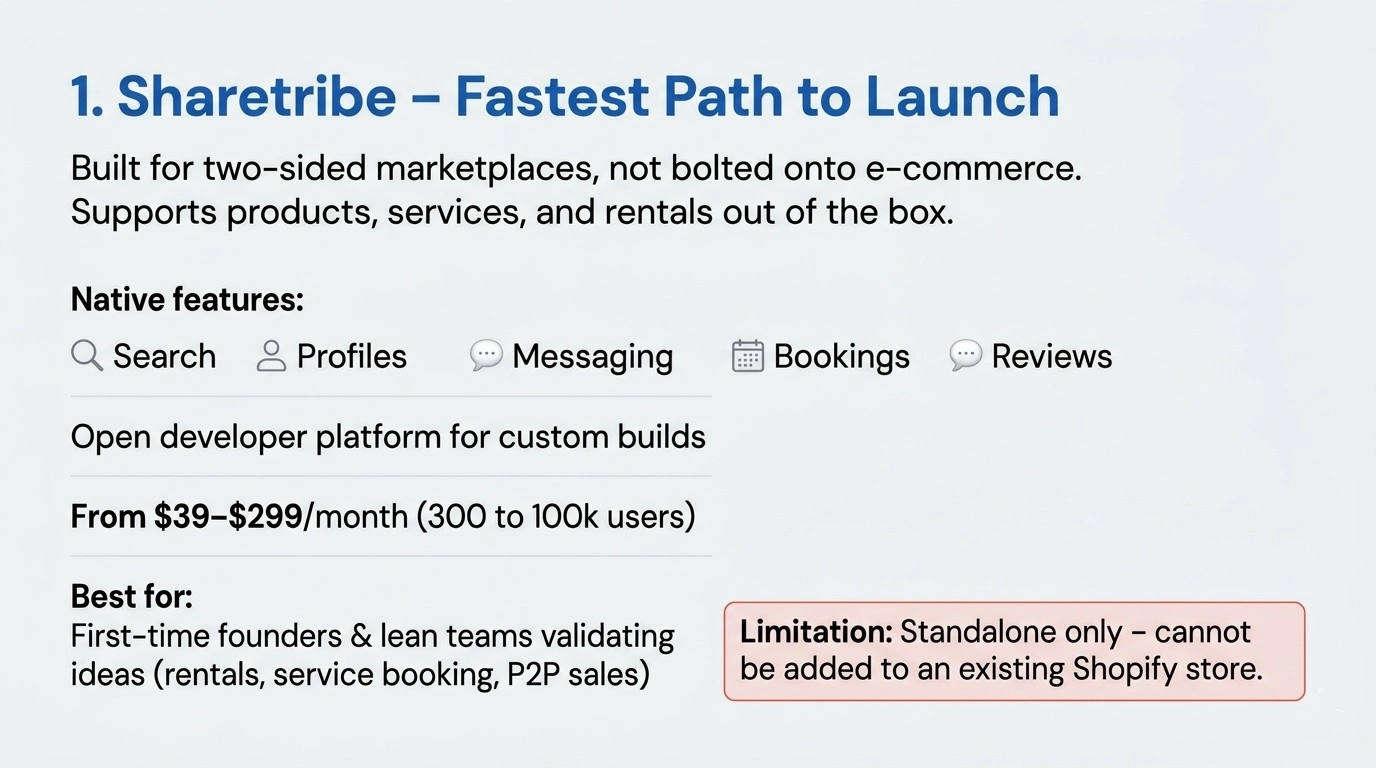
If you want to validate a marketplace idea without spending six figures on development, Sharetribe is, for many founders, the best marketplace website builder and the most intelligent starting point on the market.
Sharetribe is a purpose-built marketplace SaaS platform – not an e-commerce tool with marketplace bolt-ons, but a system designed from the ground up for two-sided transaction platforms. It supports product marketplaces, service marketplaces, and rental platforms out of the box. Subscription tiers range from managing 300 to 100,000 users, with pricing from roughly $39 to $299 per month.
What makes Sharetribe stand out:
- Built for marketplaces, not adapted for them. This distinction matters enormously. Every feature – search and filtering, seller profiles, messaging, booking flows, review systems – is designed for the marketplace model, not retrofitted from a single-vendor store.
- Sharetribe Developer Platform opens the codebase for custom development, allowing experienced teams to build virtually anything on top of its solid foundation.
- Members can sell, lease, and offer services, making it one of the few platforms that natively supports both product and service marketplace models.
Best for: First-time founders, solopreneurs, and lean teams who need to validate a marketplace concept without writing a single line of code. Sharetribe is the top choice for rental platforms (car-sharing, equipment hire), service booking marketplaces (like Airbnb), and peer-to-peer product sales – basically, any marketplace where the core workflow is “one party posts something, another party books or buys it, and the platform takes a cut.”
The honest limitation: Sharetribe cannot be dropped into an existing e-commerce site. It is a standalone platform. If you’re running a Shopify store and want to add a marketplace layer, you’ll need a different approach. However, for founders looking to create an Amazon-like ecommerce platform from scratch with minimal upfront investment, Sharetribe offers the fastest path to market validation.
At Roobykon Software, Sharetribe is one of our primary platforms of expertise. We’ve built everything from niche wellness marketplaces to high-value car-sharing platforms on Sharetribe’s foundation, extending it with custom booking engines, Stripe Identity verification, multi-unit rental logic, and deep third-party integrations. When a founder asks us, “What’s the best platform to build a marketplace website?”, Sharetribe is very often our first recommendation for early-stage validation.
2. Mirakl: The Best B2B SaaS Marketplace Software for Enterprise
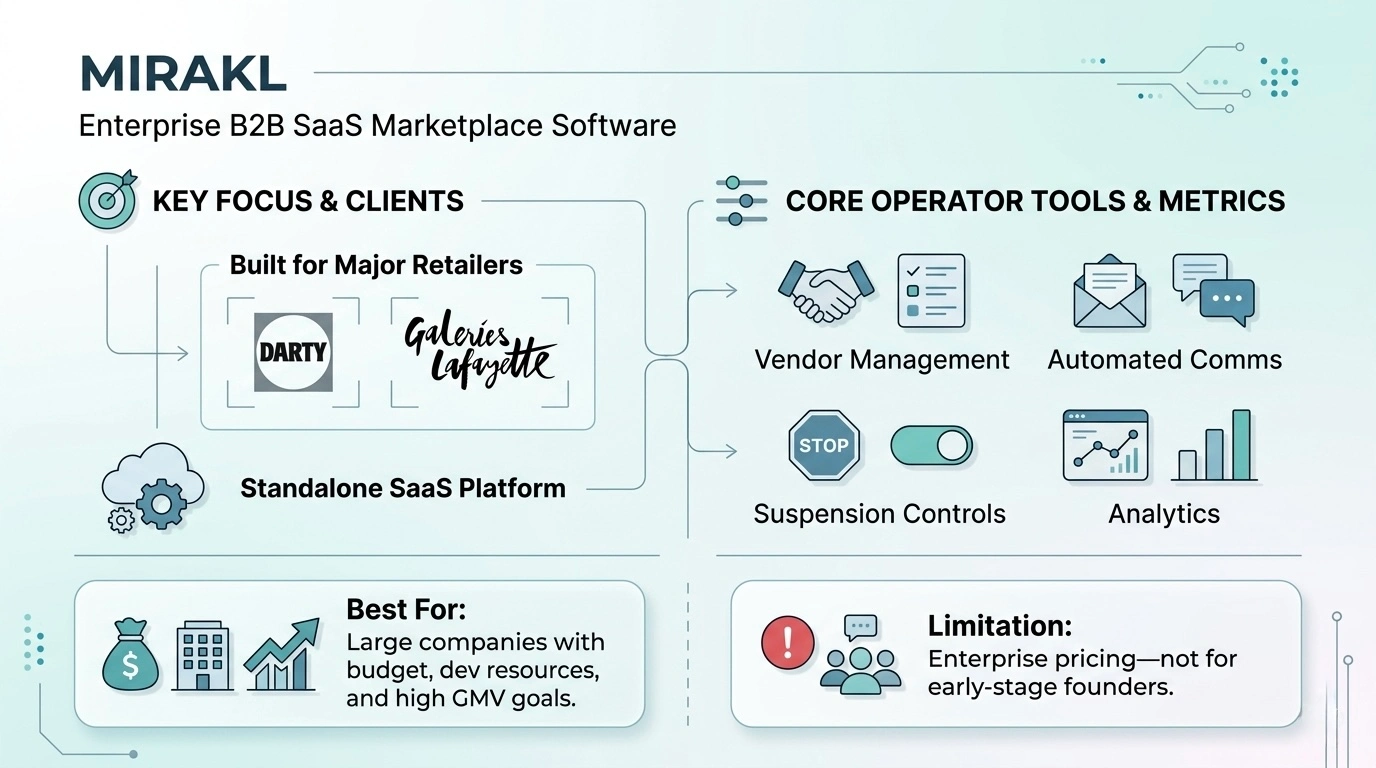
If Sharetribe is the scrappy founder’s best friend, Mirakl is the enterprise powerhouse that major retailers trust with billions in GMV.
Founded in 2012 and backed by nearly a billion dollars in funding, Mirakl is the platform of choice for brands like Darty, Galeries Lafayette, Auchan, and Boulanger. It’s not a plugin or an extension – it’s a standalone SaaS application that can be integrated with virtually any existing e-commerce ecosystem. That’s a rare and extremely valuable architectural decision.
What sets Mirakl apart as one of the best B2B marketplace platforms is its operator-centric design. Where most platforms focus on making things easy for vendors, Mirakl gives marketplace operators sophisticated tools: vendor account management, automated customer communications, suspension controls, and deep analytics. It automates the complexity that kills marketplace operations at scale.
Best for: Large retailers and brands looking to add a third-party seller layer to an existing operation. Companies with a budget, development resources, and a clear path to significant GMV.
The honest limitation: Mirakl prices individually per client, and those prices are not small-business-friendly. If you’re a first-time founder, Mirakl is almost certainly not where you should start.
3. CS.Cart Multi-Vendor: A Serious Platform to Build a Marketplace Website
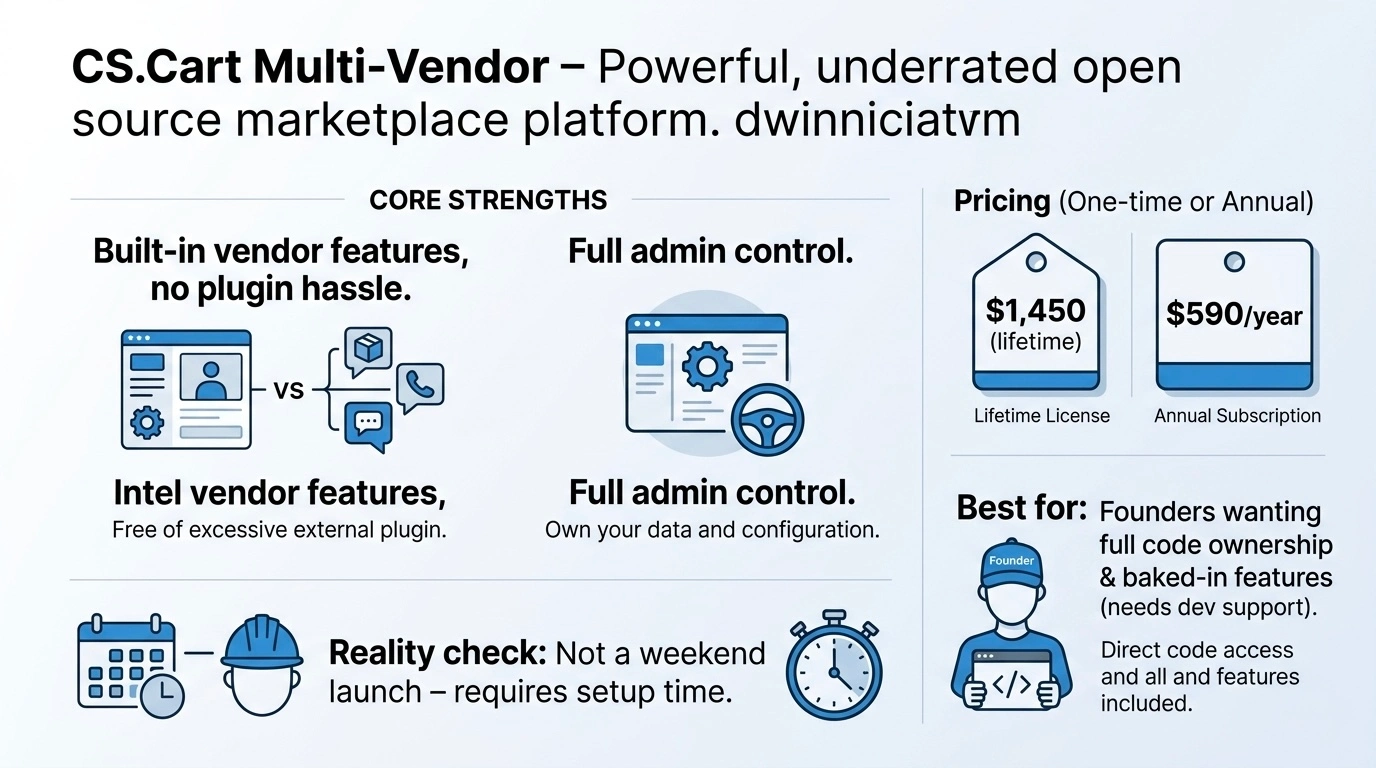
CS.Cart Multi-Vendor is not glamorous, but it is genuinely powerful – and often underrated in conversations about the top marketplace platforms.
This is one of the best open source marketplace platforms with a package that ships with marketplace features built in, so there’s no plugin installation or configuration gymnastics required. Each vendor gets their own customizable interface, while you maintain administrative control over the whole operation. Pricing sits at $1,450 for a lifetime license or $590 per year – significant, but reasonable for what you get.
Best for: Founders who want full ownership of their codebase, need rich out-of-the-box marketplace features, and have either technical resources in-house or a development partner to help with customization.
The honest limitation: The price and the self-hosted nature mean this isn’t a “launch over a weekend” option. Plan for setup time.
4. WordPress + Marketify: No Code Marketplace Builder for Digital Products
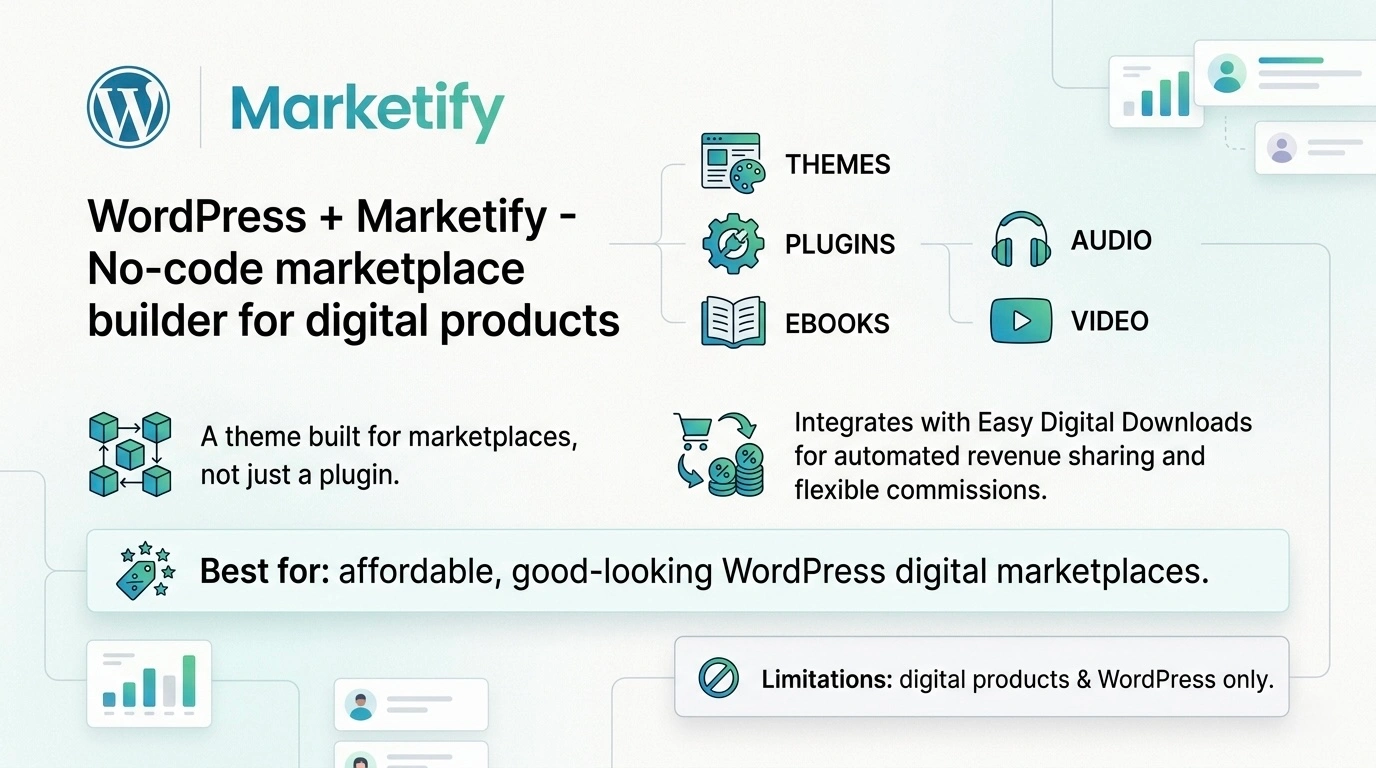
If you’re selling digital products – themes, plugins, audio, video, ebooks – and you’re already in the WordPress ecosystem, Marketify is a remarkably elegant solution.
Unlike most marketplace solutions (which are plugins added to a theme), Marketify is itself a theme – one built specifically for marketplace creation. It integrates seamlessly with the Easy Digital Downloads plugin, which handles the actual e-commerce functionality, including an automated revenue-sharing system for partner sales and flexible commission configuration per vendor.
At $64, it’s by far the most affordable option on this list – and for its target use case, it genuinely delivers.
Best for: Digital-product marketplaces built on WordPress where price efficiency and aesthetic quality both matter.
The honest limitation: Marketify is exclusively for digital products and exclusively for WordPress. Outside those constraints, look elsewhere.
Also read: Sharetribe vs WordPress: Choosing the Right Platform for Your Marketplace
5. OpenCart + Multi-Vendor / Drop Shipper: The Budget-Friendly Open Source Option
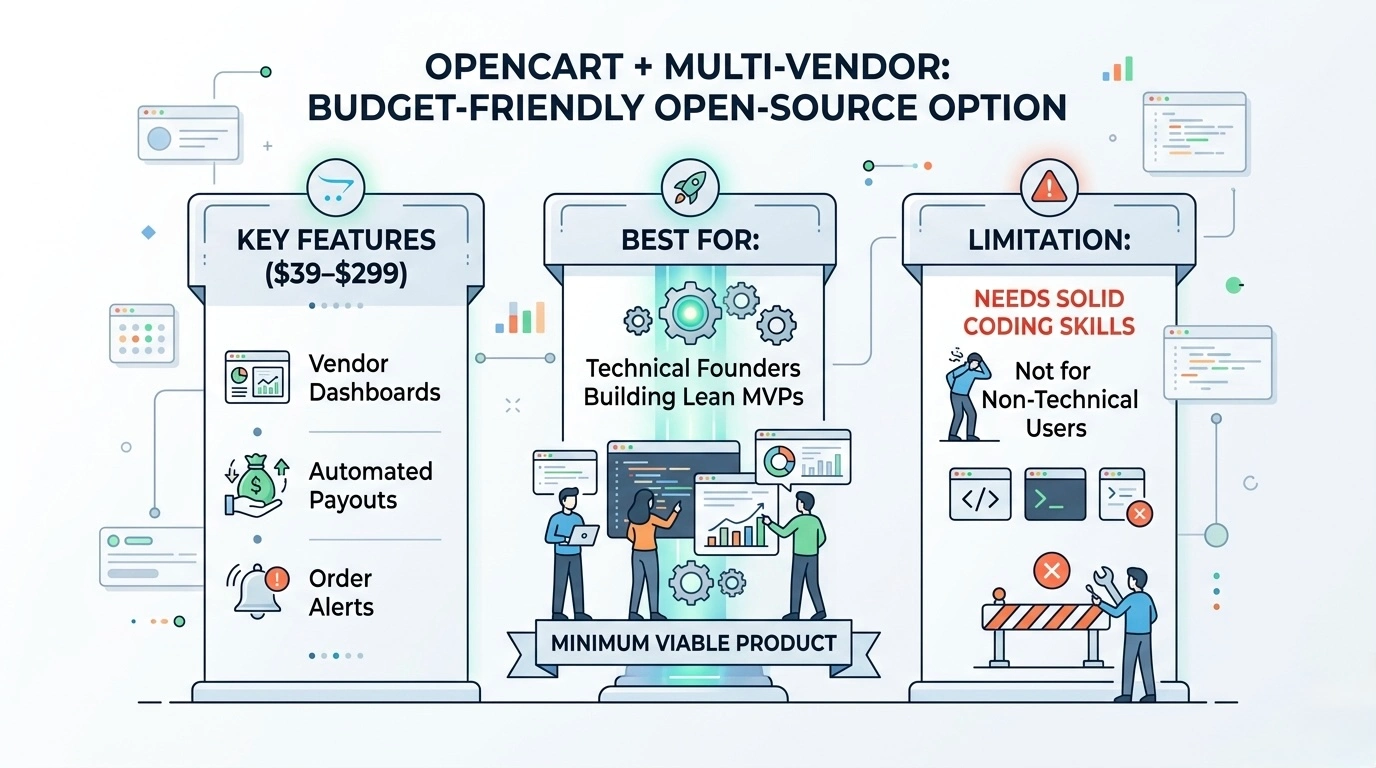
OpenCart is a lightweight, open-source platform that’s often overlooked in marketplace conversations – but for small to medium-sized operations with technical resources, it’s worth considering.
The Multi-Vendor / Drop Shipper extension (priced between $39 and $299) adds vendor management, per-vendor dashboards, automated monthly payouts, and order notification systems. It’s not the most feature-rich option among top marketplace platforms, but it gets the fundamentals right without breaking the budget.
Best for: Technical founders or teams building lean MVPs who prioritize low cost over feature depth.
The honest limitation: OpenCart requires solid coding knowledge. It is definitely not for non-technical founders going it alone.
6. X-Cart Multi-Vendor: Administrator Control at the Center
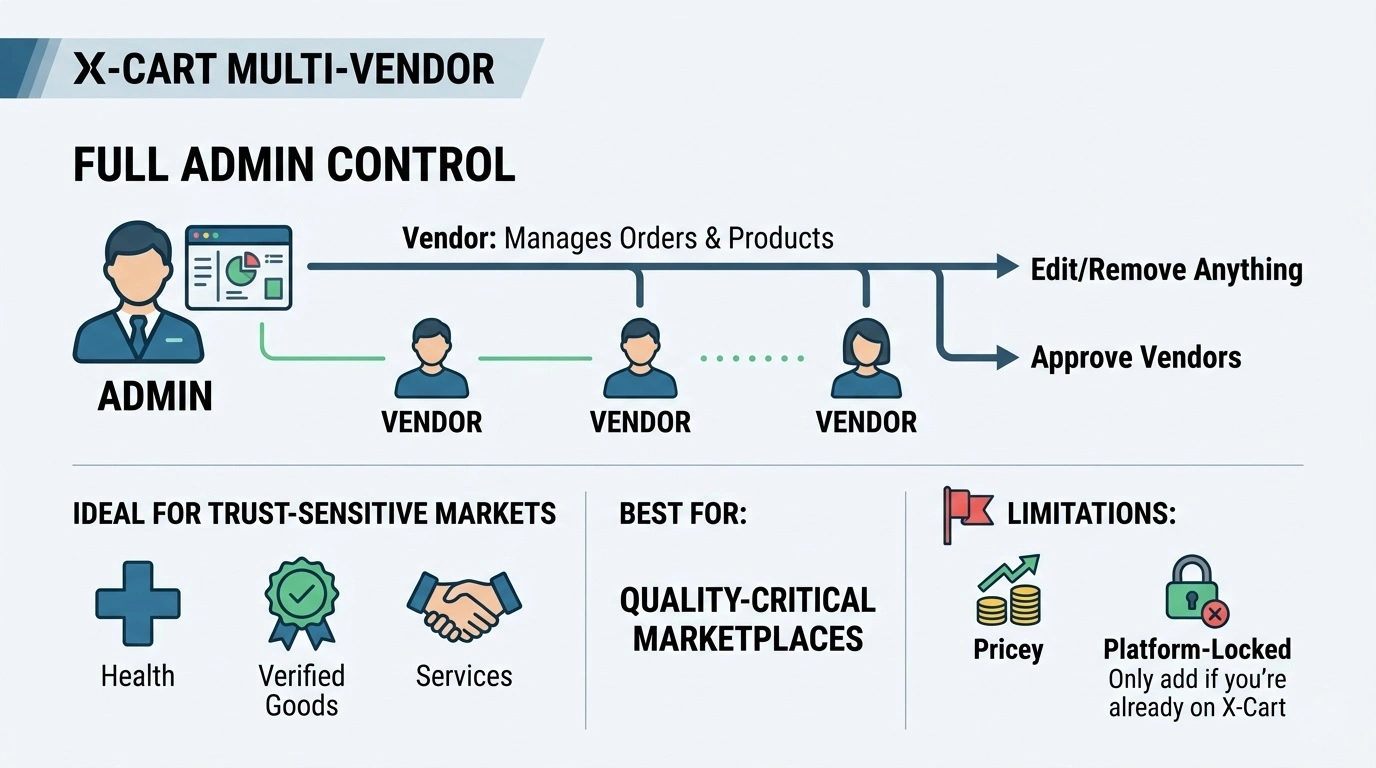
X-Cart’s eCommerce platform puts the administrator firmly in the driver’s seat. While vendors can manage their own orders, delivery terms, and product categorization, the administrator retains the ability to modify or remove any product on the platform and to control vendor registration.
For marketplace operators building trust-sensitive categories – health products, professional services, verified goods – this level of central control makes X-Cart a strong platform to build a marketplace website where quality assurance is non-negotiable.
Best for: Marketplaces where quality control and administrator oversight are business-critical from day one.
The honest limitation: Platform-locked and on the expensive side. Ensure X-Cart is already your foundation before investing in the multi-vendor layer.
7. Medusa: The Open-Source Alternative for Total Ownership
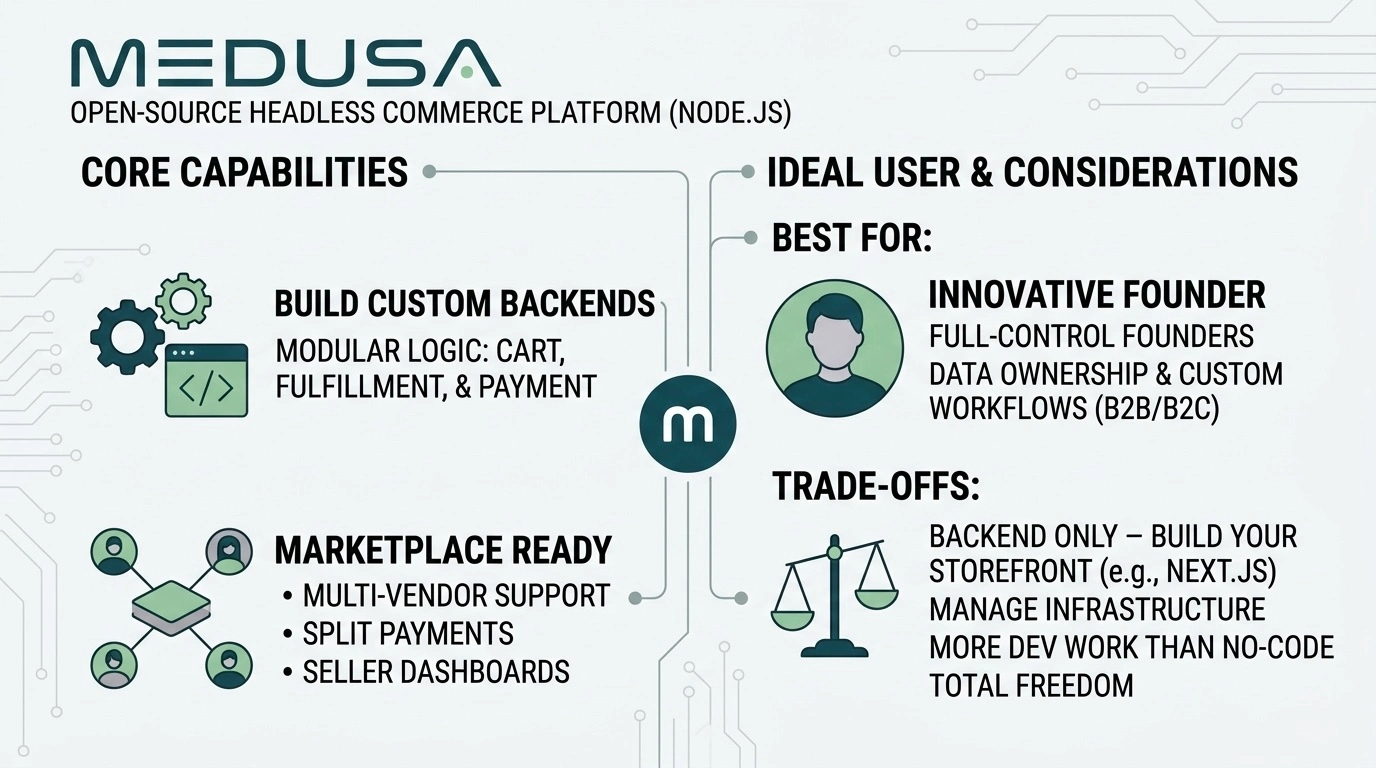
Medusa is a relatively new but rapidly ascending open-source, headless commerce platform. Built with a modular architecture on Node.js, it allows developers to compose a custom e-commerce backend, swapping out or extending components like cart logic, fulfillment, and payment processing. With the addition of official marketplace starters like Mercur, Medusa now provides a robust, pre-built foundation for multi-vendor functionality, including unified checkouts with automatic payment splitting and complete seller dashboards.
Best for: Founders and businesses that want the full control of a custom build but the head start of a modern, well-architected framework. It’s ideal for B2B and B2C marketplaces where data ownership, custom checkout logic, or unique backend workflows are non-negotiable.
The honest limitation: Medusa is a headless backend, not an all-in-one solution. This means you are responsible for building and maintaining your own storefront (often with a framework like Next.js) and for managing the entire technical infrastructure. While this provides incredible freedom, it also means that even the most basic “quick launch” requires significantly more development effort than a no code marketplace builder.
Also read: What Fits Your Marketplace Best: Sharetribe or Medusa.js?
8. Shopify: The E-Commerce Juggernaut, Adapted for Marketplaces
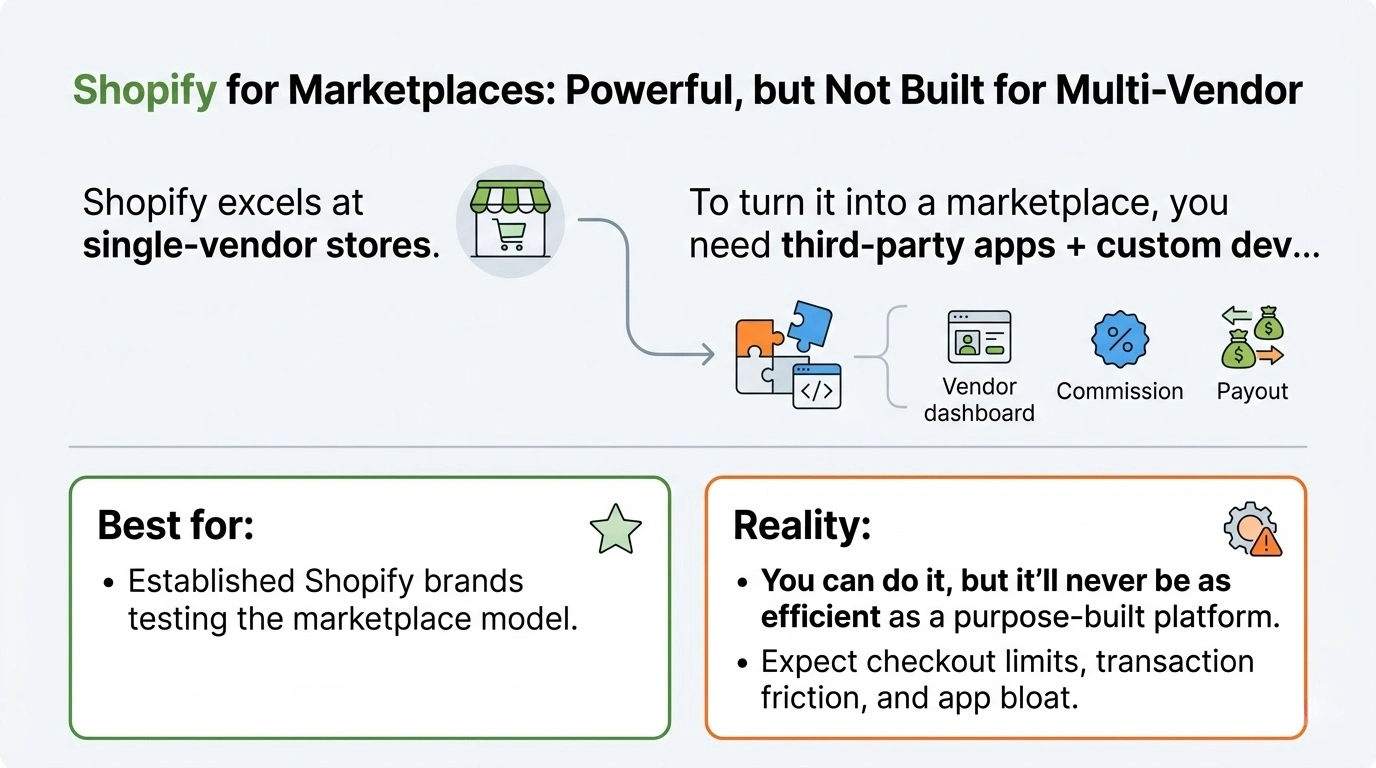
Shopify is the undisputed titan of e-commerce, powering millions of single-vendor online stores. However, its core solution was never designed to be the best online marketplace platform. To build a multi-vendor marketplace on Shopify, you must rely on a patchwork of third-party apps (like Webkul’s Multi-Vendor Marketplace) and custom development to add features like vendor dashboards, commission splits, and separate payouts.
While this is entirely possible – and Roobykon has the expertise to navigate these complexities – it’s essential to understand that you are essentially retrofitting marketplace functionality onto a single-store architecture.
Best for: Established e-commerce brands that already have a massive presence and operational infrastructure on Shopify and now want to dip their toes into the marketplace model. It can also be a viable path for a marketplace where the primary value is not in the software itself but in a curated product assortment, and the vendor management can be handled through app-based workflows.
The honest limitation: Building a true marketplace on Shopify can be done with enough modifications, but it will never be as efficient or purpose-built as a vehicle designed for that specific task. You’ll likely encounter limitations with complex checkout flows, native multi-vendor transaction logic, and a potential “app bloat” that complicates maintenance and increases monthly costs.
Also read: Sharetribe vs Shopify Comparison
Marketplace Platform Comparison at a Glance
Platform | Type | Pricing | Technical Requirement | Best For |
|---|---|---|---|---|
Sharetribe | SaaS / no-code marketplace platform | Build from $39/month; live plans from $99/month billed annually. | Low; no coding required for basic setup. | Founders validating an MVP, especially service or rental marketplaces. |
Mirakl | Enterprise SaaS | Quote-based; public pricing not disclosed. | High; usually needs integration with existing commerce systems. | Large retailers and manufacturers building B2B or enterprise marketplaces. |
CS-Cart Multi-Vendor | Self-hosted marketplace software | Multi-vendor plugin ($1,495) | Moderate to high; self-hosting and configuration required. | Teams wanting broad out-of-box marketplace features and code control. |
WordPress (Dokan) | WooCommerce plugin | Free core; Pro/lifetime pricing varies by official plan and bundle. | Low to moderate; WordPress and WooCommerce familiarity helps. | Existing WordPress site owners launching multi-vendor quickly. |
OpenCart | Self-hosted + extension | Core free; multivendor modules often range from about $25 to $99+. | Moderate; OpenCart setup plus plugin configuration. | Budget-conscious founders comfortable with PHP/open-source tooling. |
X-Cart | Self-hosted / hosted commerce platform | Starts at $249/month. | Moderate; implementation and customization may be needed. | SMBs wanting a managed commerce stack with marketplace capability. |
Medusa | Open-source headless commerce | Core open-source; Medusa Cloud starts at $29/month. | High; developer-led custom frontend and integrations. | Teams needing maximum customization and ownership. |
Shopify | SaaS + marketplace app | Core plans start at $29/month; marketplace apps add separate fees. | Low to moderate; app-dependent. | Existing Shopify stores adding marketplace functionality. |
How to Actually Choose: A Framework for Founders
Reading about the best marketplace platforms is useful. Making a decision is what matters. Here’s how we help founders at Roobykon Software think through this choice:
Step 1 – Know what you’re actually building
Define your transaction model before you evaluate a single platform. A product marketplace, a service marketplace, and a rental platform have fundamentally different requirements.
Sharetribe handles all three natively. Shopify and WordPress lean toward product retail. Medusa is flexible enough to support almost any model – but only if you have the engineering team to shape it. Define the transaction first, and then choose the platform.
Step 2 – Be honest about your technical resources
Sharetribe, WordPress, and Shopify are accessible to non-technical founders. OpenCart, X-Cart, and CS.Cart offer real flexibility but need a developer to configure and maintain them properly. Medusa is built for engineering teams who want full-stack control. Mirakl requires significant organizational resources to implement correctly, regardless of how technically capable your team is. Ambition is not a substitute for execution capacity.
Step 3 – Match the platform to your stage
For validation – Sharetribe or Shopify with the best multi vendor marketplace platform app. Fast, cheap, real user data within weeks. For production scale – CS.Cart, or Medusa. For enterprise operators adding a marketplace layer to an existing retail operation – Mirakl, which is not a starting point but a destination for businesses that have already proven their model.
Step 4 – Calculate total cost of ownership, not sticker price
OpenCart’s extension starts under $40. CS.Cart carries a $1,450 lifetime license. Sharetribe begins at $39 per month. But sticker price is the wrong number to optimize. Add development cost, maintenance cost, and migration cost if you outgrow the platform. A cheap tool that requires $60,000 in workarounds is not cheaper than a purpose-built solution that works from day one. Run the five-year number, not the month-one number.
Step 5 – Build for your sellers, not just your buyers
Every platform on this list will let you build something buyers can use. The harder question is what the seller experience looks like. CS.Cart and X-Cart give operators strong admin control with solid vendor dashboards. Sharetribe offers sellers clean, intuitive interfaces with minimal onboarding friction.
Why Founders Partner with Roobykon for Marketplace Development
Roobykon Software is a marketplace development company with clients across 50+ countries, a Stripe Verified Partner designation, and a portfolio that spans rental platforms, B2B procurement systems, healthcare service marketplaces, crypto and blockchain talent networks, and local community platforms.
Our core expertise includes:
- MVP development: We specialize in focused, fast MVPs that test your core transaction loop with real users before you invest in full-scale development. We’ve seen too many founders build everything before they’ve validated anything.
- Multi-vendor marketplace platforms: Whether you’re building B2B, B2C, C2C, or P2P, we’ve built them all. We understand the nuances of each model and the technical decisions those models demand.
- Payment integration: From Stripe to ACH to region-specific payment methods, we handle the complexity of money moving between buyers, sellers, and platform operators.
- Ongoing support: We don’t disappear after launch. Our team provides continuous support, security auditing, performance optimization, and feature development as your marketplace grows.
The Honest Bottom Line about the Best Software to Build Marketplace
The best online marketplace software is the one that fits your specific business model, your technical reality, your budget, your timeline, and your growth trajectory – in that order.
What we can tell you with confidence, after years of building and watching marketplaces succeed and fail:
- Start with your transaction, not your tech. Every platform decision should flow from a clear understanding of how your buyers and sellers transact.
- Launch lean, but design for scale. Your MVP shouldn’t have every feature, but your architecture should support the features that matter.
- Your seller experience is your competitive moat. Platforms that make it easy for great sellers to do business attract great sellers. Everything else follows.
- Choose partners who’ve done this before. Building a marketplace is not like building a website. The two-sided dynamics, the trust mechanics, the payment flows – they require specific experience to get right.
If you’re ready to move from research to reality, the Roobykon team is ready to talk. We’ll listen first, evaluate second, and build third. It’s the only sequence that works.
Don't Choose Your Platform Alone
You've seen the options. The right choice depends on your business model, not just a feature list. Roobykon Software has spent 15+ years matching founders to the exact technology stack they need to launch, scale, and dominate.
Book a Free Consultation With Our Marketplace Architects
Recommended articles
 How to find a web development partner for your startup: a step-by-step guide
Choosing the wrong development partner can cost you months. Use this expert guide from Roobykon Software to find a trusted web development partner who treats your startup like their own.
 How to Build an Online Marketplace Website (Complete Guide for 2026)
You have a marketplace idea. Now what? This complete guide answers the questions every founder faces: How do I validate my concept? What features actually matter in an MVP? This article provides practical answers to the challenges of building a marketplace startup from scratch.
 Best Sharetribe Alternatives: Choosing the Marketplace Platform for 2026
Our 2026 comparison of alternatives to Sharetribe breaks down features, costs, and use cases for Arcadier, Mirakl, open-source options, and more to help you decide.
 How to Build an Online Marketplace MVP in 2026
Turning a marketplace idea into reality is fraught with risk. This guide cuts through the complexity, showing you how a focused MVP is the antidote.