What does Sharetribe include for shipping by default?
How do you know your marketplace has outgrown Sharetribe built-in shipping?
How do you know your marketplace has outgrown Sharetribe built-in shipping?
How does a Sharetribe shipping API integration actually work?
Real-world cases: shipping integration for Sharetribe marketplaces
Which shipping provider fits your marketplace?
What else gets customised in Sharetribe besides shipping?
What does a website shipping integration project actually look like?
Subscribe and you will promptly receive new published articles from the blog by mail
Sharetribe ships with flat-rate and pickup delivery only – nothing that calculates real cost. Once your catalog gets heavier or more varied, you need a proper shipping API integration: Shippo, EasyPost, Sendcloud, ShipStation, or a direct carrier API, wired into Sharetribe’s transaction process. Below is what that website shipping integration looks like, what it costs in project terms, and how to pick a provider without guessing.
- Sharetribe only ships with a flat per-listing fee and pickup – no live rates, labels, or tracking, so any real e-commerce shipping integration has to be built on top through the Integration API.
- A proper shipping API integration adds live carrier rates, in-dashboard label printing, self-updating tracking, and address validation – the same integrated shipping solutions Shopify and WooCommerce sellers already take for granted.
- Shippo, EasyPost, Sendcloud, and ShipStation each fit a different seller base; the right shipping gateway integration depends on carrier mix and geography, not on which name is most popular.
- The build sits inside Sharetribe's transaction process as new states and privileged transitions, so it extends the existing checkout flow instead of replacing it.
- Roobykon has shipped this kind of website shipping integration for marketplaces in Germany, across the EU, and in Denmark – three different shipping problems, three different solutions.
What does Sharetribe include for shipping by default?
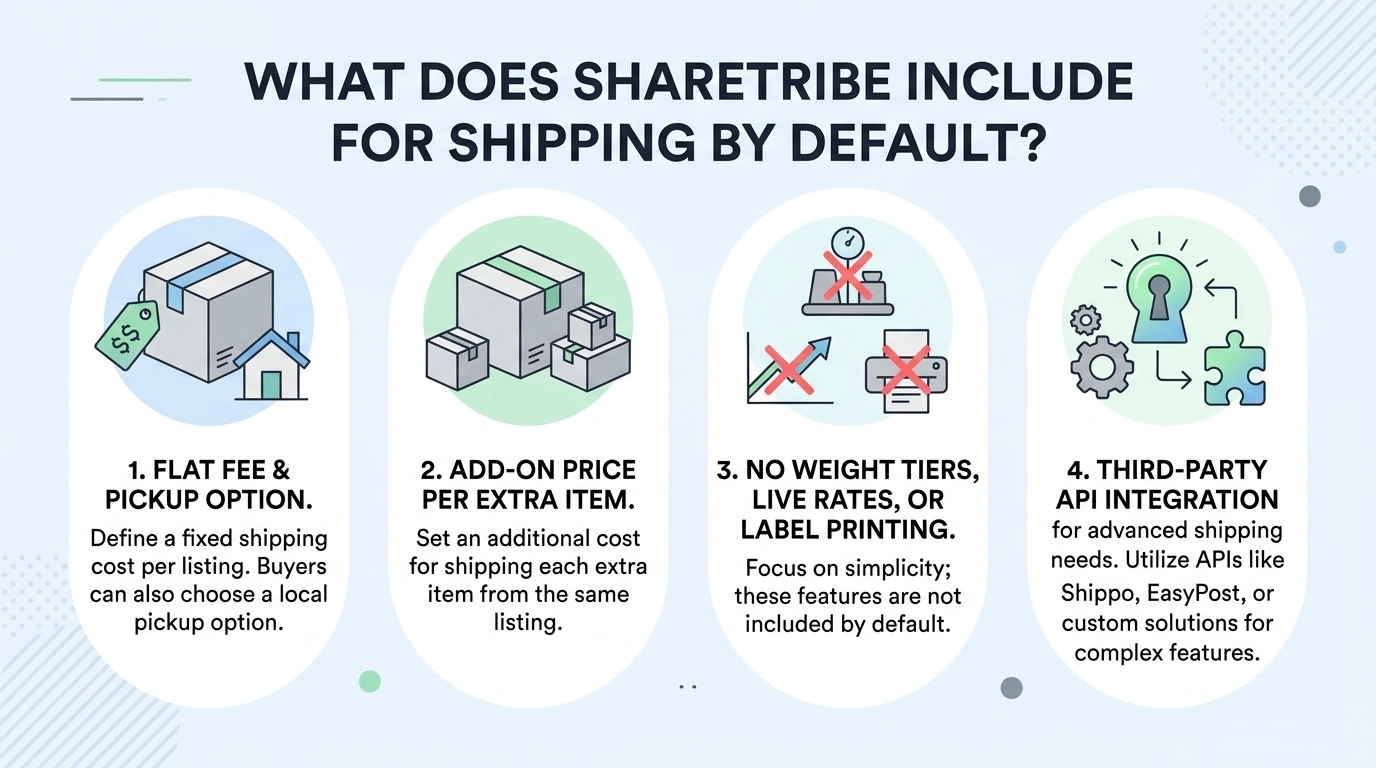
By default, Sharetribe only offers a flat shipping fee per listing plus pickup as an alternative. When you set up a listing, you pick shipping, pickup, or both, and for shipping you set one flat price plus an add-on price per extra item. There are no weight tiers, no live rates, and no label printing.
We get asked fairly often whether this is a bug or a gap Sharetribe just has not filled yet. It is neither – Sharetribe’s own Help Center states directly that the platform “does not have a built-in way of printing shipping labels” and that adding one requires custom code and, usually, a third-party shipping integration.
That gap is exactly where shipping API integration comes in. To get real-time rates, weight-based pricing, and printable labels, you need to connect your marketplace to an external shipping provider. That is the same underlying pattern as any other API integration for ecommerce shipping. The same principle applies to shipping, which can be layered on through integrated shipping services that talk to your platform via API.
For plenty of marketplaces, that is fine. If most items are roughly the same size and weight, a flat $8 fee works and nobody complains. The trouble starts once your catalog stops being uniform.
How do you know your marketplace has outgrown Sharetribe built-in shipping?
A handful of recurring symptoms tell you it is time to look past the flat rate. A few patterns come up again and again in the marketplaces that end up asking us for help with shipping API integration:
- Sellers list everything from a keychain to a kayak, and one flat rate either overcharges light buyers or quietly loses money on heavy ones.
- Buyers bail at checkout because the shipping number feels arbitrary, or shows up too late in the flow.
- Sellers create labels somewhere else entirely and paste tracking numbers into chat threads by hand – and the mistakes pile up as volume grows.
- International orders stall because nobody on the seller side has dealt with customs paperwork before.
- “Where’s my order” tickets outnumber every other support category combined.
Two or more of these ringing a bell usually means it’s time to look at real marketplace integration services rather than tweaking the flat rate again.
What does a real website shipping integration actually add?
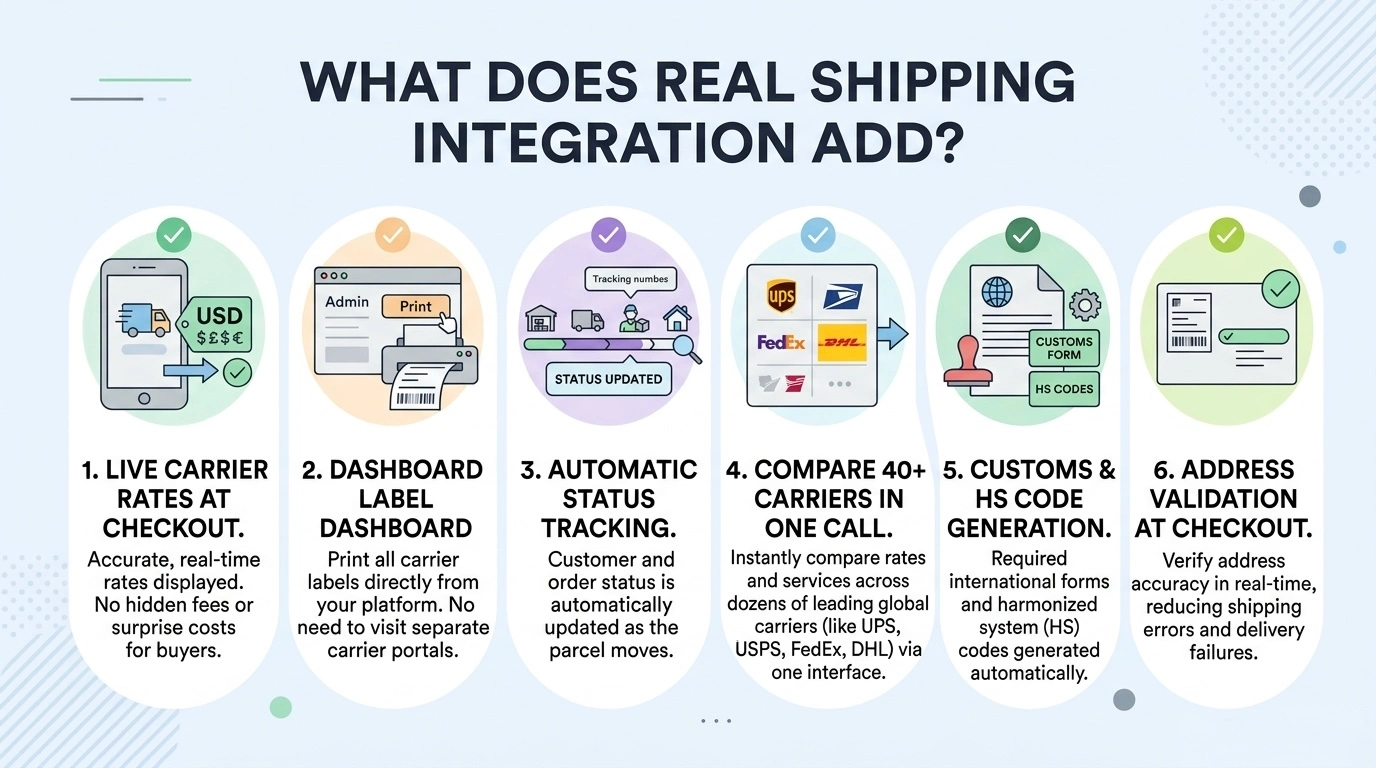
Integrated shipping solutions replace guesswork with numbers pulled from the carrier itself, at the exact moment they matter – checkout, not after the sale. Here is what changes once integrated shipping services are wired into the marketplace.
Live, accurate rates
The buyer sees a real number based on weight, dimensions, and both addresses, not a price the seller picked at random six months ago. This is one of the most powerful conversion levers in e-commerce, because it removes the single biggest source of checkout abandonment: surprise costs.
Labels without leaving the platform
Sellers stop bouncing between Sharetribe, a carrier’s site, and a spreadsheet just to ship one order. They buy and print shipping labels directly from their order dashboard inside the marketplace, with no separate carrier portal and no copy-pasting addresses.
The label is generated with the correct carrier, service level, weight, and destination, and the tracking number is automatically attached to the order.
Tracking that keeps itself up to date
Once a label exists, status updates flow back automatically. The integration polls the carrier for tracking updates and pushes those updates into the marketplace’s order status, so buyers see progress without leaving the site and sellers see when a package is delivered.
Multi-channel shipping integration
Compare UPS, USPS, FedEx, DHL, and regional carriers in one call, whether the order came through the web marketplace, a mobile app, or a seller’s own storefront. A shipping gateway integration can query multiple carriers for the same shipment and return the cheapest or fastest option.
Shippo, for example, connects to over forty carriers through a single API, so you do not have to build and maintain separate integrations for each one. This is the core of a multi-channel shipping integration: one connection, many carriers.
International logic
Customs forms and HS codes get generated instead of relying on a seller who has never shipped past their own border. For cross-border shipments, the integration can generate commercial invoices, customs declarations, and the right documentation for the destination country.
Address validation
Bad addresses cause failed deliveries, which cause refunds, support tickets, and unhappy buyers. A shipping API integration validates the buyer’s address at checkout and, in many cases, corrects it before the label is even created.
None of this is exotic. It is the same payment-processor-adjacent plumbing that Shopify and WooCommerce sellers take for granted – Sharetribe simply leaves it out on purpose, so it has to be added.
How does a Sharetribe shipping API integration actually work?
Two pieces of Sharetribe’s architecture make this possible: the transaction process and the Integration API. If you have ever wondered how to integrate shipping into my website when the site is a Sharetribe marketplace, this is the honest answer – not a plugin, but a few deliberate extensions to logic that is already there.
The transaction process defines every step an order goes through: inquiry, payment, delivery, completion. Shipping gets added as new states and privileged transitions – rate requested, label purchased, shipped, and delivered.
At checkout, a privileged transition calls the shipping gateway integration with the listing’s weight, dimensions, and the buyer’s address, and returns a live rate before payment. It is conceptually close to how we handle Google Calendar integration with Sharetribe – an external service plugged into the same transaction-process backbone.
Once payment clears, a second transition buys the label and stores the tracking number as protected metadata, visible to both sides. Webhooks close the loop, updating order status automatically when the carrier reports a change, so nobody has to check in manually.
Real-world cases: shipping integration for Sharetribe marketplaces
E-commerce shipping integration is not a theoretical exercise. It decides whether a marketplace can scale past its first hundred orders or stalls out because sellers are drowning in manual logistics. Roobykon Software has built shipping customizations for Sharetribe marketplaces across Europe – here are three real projects.
Worth flagging before the case studies: solving a shipping problem in Sharetribe generally comes down to one of two paths. You can integrate an external shipping service such as Shippo or EasyPost, wiring the transaction process to a real carrier API for live rates and labels, or you can customize Sharetribe’s default functionality to fit your marketplace’s specific rules, without connecting to an outside provider at all. The three projects below are all examples of the second path – custom shipping logic built directly on Sharetribe, not external API integrations.
Natuja: weight-based shipping across multiple regions
Natuja is a German marketplace for eco-friendly products, with sellers listing everything from handmade soaps to reusable kitchen items. Shipping started the Sharetribe way: a fixed fee per item, set by each seller.
As sellers grew and buyers started ordering from Austria, Switzerland, and the wider EU, the flat fee fell apart. A bar of soap shipped to Munich and one shipped to Vienna cost very different amounts, so sellers were overcharging locals and losing money on international orders.
What we built:
- Complete cart functionality with weight-based shipping calculation
- Weight fields added to listing creation
- Regional shipping rates for Germany, Austria, Switzerland, and the EU
- A seller dashboard where vendors manage their own rates without touching code
This was not a case of integrating an external shipping API. Instead, we customized Sharetribe’s default shipping logic directly, building region-specific rate rules that matched each country’s actual cost structure. The result was accurate shipping costs, transparent pricing, and sellers who no longer lose money on cross-border orders.
BorderBuys: adaptive shipping for cross-border trade
BorderBuys connects buyers and sellers across national borders. The challenge here was building a system that could adapt as the marketplace expanded into new markets.
What we built:
- An adaptive shipping fee system with configurable weight-based rules
- Different rates for different product categories, seller regions, and destinations
- An admin interface so the marketplace team could update shipping logic themselves
This project reminded us that website shipping integration is not just about connecting to a carrier API. It is about building something flexible enough to grow with the marketplace – a rigid integration works for one market and fails for the next.
Your Local Flower: delivery time estimation and geolocation
Your Local Flower is a Danish marketplace connecting local florists with customers who want fresh flowers delivered. The shipping challenge here was different, because flowers are perishable and delivery time matters enormously.
What we built:
- Customized delivery time estimation tools at checkout
- Geolocation to determine the buyer’s location
- Logic to identify which florists can deliver to that area
- Delivery windows calculated from florist capacity and distance
No shipping labels, no carrier APIs, no external service at all – another customization rather than an integration, built on the same underlying principle: connect the transaction flow to the logistics reality. Buyers know exactly when their flowers will arrive, florists manage their capacity, and the platform handles coordination automatically.
Which shipping provider fits your marketplace?
Shippo gets mentioned most because it is the easiest starting point, but it is not automatically right for every marketplace. The choice comes down to your carrier mix, your order volume, and where your sellers and buyers actually live.
Provider | Best for | Carrier coverage | Notable feature |
|---|---|---|---|
Shippo | Fastest to launch, general-purpose marketplaces | 40+ US and international carriers | Simple single API, strong docs, good default for a first Sharetribe Shippo integration |
EasyPost | Marketplaces needing granular tracking webhooks | 100+ carriers worldwide | Very detailed tracking events, solid customs-form generation |
Sendcloud | EU-heavy seller bases | Deep coverage of European regional carriers | Localized checkout rules and return portals built for EU buyers |
ShipStation | High order volume with existing e-commerce stack | Broad US carrier network | Strong batch label printing and order-management dashboard |
Shiprocket | India-first or India-heavy marketplaces | Domestic Indian courier network plus some international | Built around COD workflows and Indian logistics norms |
A caveat on Shiprocket: Sharetribe itself has limited adoption in India, in part because Stripe Connect – the payments layer Sharetribe relies on for split payouts – does not fully support Indian sellers. A Sharetribe Shiprocket integration is technically possible, but it fits a narrow case: a marketplace with a non-Indian legal and payments setup that still needs to ship to Indian buyers, rather than an India-first seller base.
A marketplace with mostly EU sellers usually gets more out of Sendcloud’s local carrier depth than a US-first tool. A niche case is a marketplace that ships to Indian buyers but is not built around an India-based seller base or payments setup – there, a Sharetribe Shiprocket integration can cover domestic Indian delivery without adding a second provider. And a platform with a negotiated UPS contract might skip an aggregator entirely and build a direct API integration for e-commerce shipping instead – more control, more work up front.
There is no single best answer here. It is a decision that should follow your shipping data, not a generic list. It is usually worth mapping this out with a partner alongside broader marketplace platform development work, before any code gets written.
What else gets customised in Sharetribe besides shipping?
Shipping rarely shows up on its own. Once a marketplace starts extending Sharetribe past its defaults, a handful of other requests tend to land in the same conversation:
- Scheduling for marketplaces that mix physical goods with bookable services.
- Consultations tied to a purchase, integrating Sharetribe with video services like Zoom or Jitsi.
- Lower signup friction with social login for Sharetribe marketplaces.
- Website shipping integration paired with split payouts, so shipping costs and platform fees settle correctly between buyer, seller, and marketplace.
Automation is the other request that usually follows close behind – connecting order and shipping events to the rest of a seller’s tools through Zapier integrations for Sharetribe marketplaces so a new label or tracking update can trigger a notification, a spreadsheet row, or a CRM entry automatically.
Shipping just tends to be the most visible gap of the bunch, since it touches money, timing, and trust all at once – the stuff buyers actually notice.
What does a website shipping integration project actually look like?
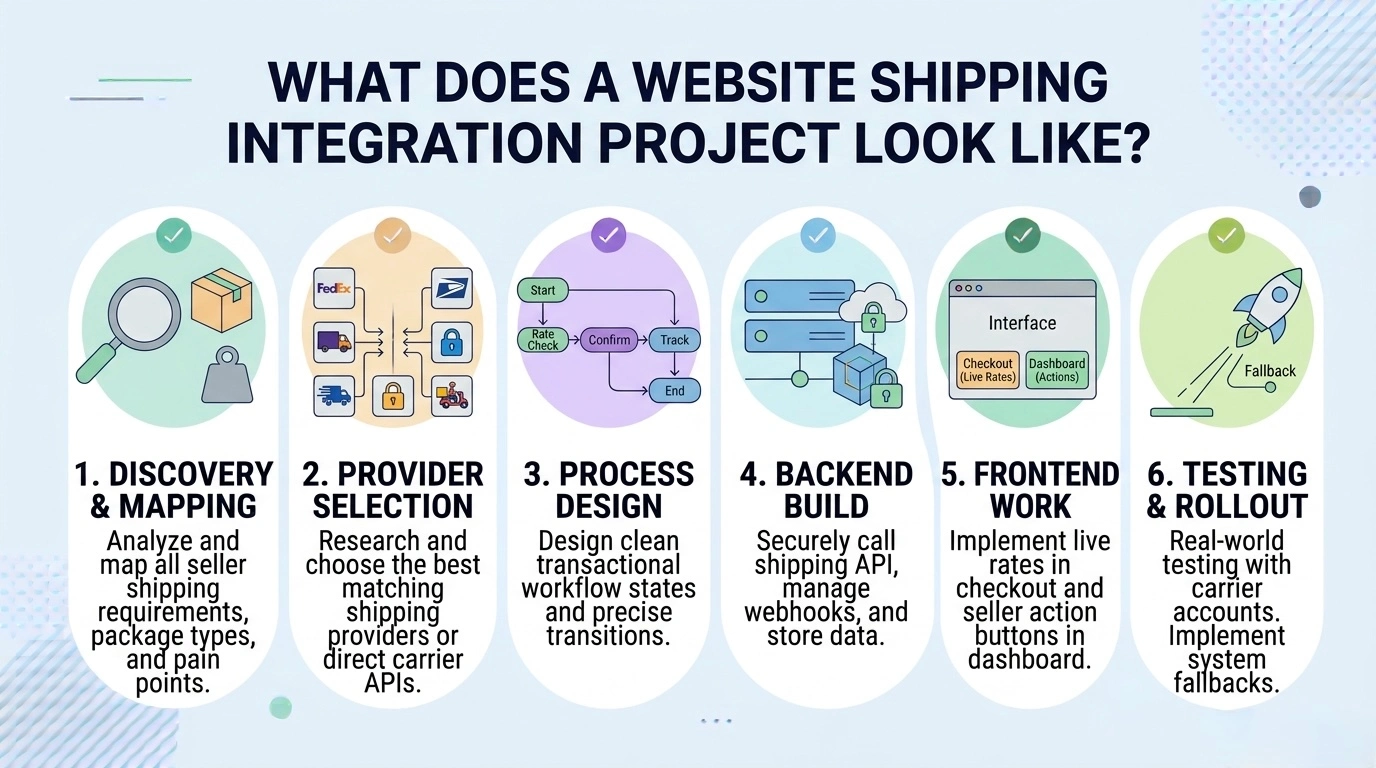
For anyone scoping e-commerce shipping integration out, here is roughly how the work breaks down in practice:
- Discovery: mapping your sellers’ real shipping needs: package types, weight ranges, domestic vs. international split, current pain points.
- Provider selection: matching that against Shippo, EasyPost, Sendcloud, ShipStation, or a direct carrier API.
- Transaction process design: new states and privileged transitions for rate checks, label purchase, and tracking.
- Backend build: Custom backend is calling the shipping API securely, storing tracking data, handling webhooks.
- Frontend work: live rates at checkout, label and tracking actions in the seller dashboard.
- Testing and rollout: sandbox testing with real carrier accounts, plus a fallback if the shipping API goes down briefly.
Timelines vary, but a focused build is usually weeks rather than months, since it extends an existing transaction process rather than rebuilding the platform. If payments have not been set up properly yet either, it is worth reviewing Sharetribe marketplace payment options at the same time, since both flows tend to touch the same checkout logic.
That combination is what we usually mean when we offer shipping API integration services rather than a one-off script.
Ready to add real shipping to your Sharetribe marketplace?
We build shipping API integrations that plug directly into Sharetribe's transaction process – live rates at checkout, labels in the seller dashboard, tracking that updates itself. No plugins, no workarounds, no flat-rate guesswork.
Talk to a Sharetribe shipping specialistFAQ

Recommended articles
 Best Marketplace Ideas Worth Building on Sharetribe in 2026-2027
Discover the strongest Sharetribe marketplace ideas for 2026–2027 across rental, services, products, and B2B trade. Learn how to validate demand before writing a feature spec, and when to bring in a Sharetribe development partner like Roobykon.
 AI App Security Checklist for Founders: From Working Demo to Safe Product
AI startup security best practices for founders: ownership lists, payment tests, package checks, backup restore proof, and the six demonstrations to ask your developer for.
 Sharetribe Design: How to Turn a Template Marketplace into a Branded Product
A default Sharetribe marketplace looks clean but generic. This guide breaks down exactly what you can customize without code, when to hire a Sharetribe marketplace designer, and how real founders turned templates into branded products. Includes case studies.
 Sharetribe Customization: How Far Can You Really Go?
Every Sharetribe founder asks the same question: can I customize it? The real question is which layer: Console, Extend, or full custom development. Our guide breaks down exactly what you can build at each level
