Case Study: An AI Listing Assistant We Built for a Peer-to-Peer Rental Marketplace
Why Did AI and Sharetribe Start Showing Up in the Same Sentence?
What Sharebot Is – and How It Differs From a Regular Chatbot
What Sharetribe AI Bot Actually Does for Marketplace Owners?
What Third-Party AI Services Are Plugged Into Sharetribe?
What to Choose for Your Marketplace?
Where the Risks Are: Why “AI Will Do It All” Is a Myth
What Is the Final Verdict On AI-Powered Sharetribe Marketplaces?
Subscribe and you will promptly receive new published articles from the blog by mail
Sharetribe no longer works purely “out of the box.” The platform is increasingly paired with artificial intelligence, from the official Sharebot assistant to custom AI features built directly into a marketplace’s listing flow, search, or moderation. We build these features ourselves – most recently an AI listing assistant that turns a single product link into a complete, ready-to-review marketplace listing. Below, we walk through that build in detail, then break down the wider Sharetribe AI ecosystem.
- Sharetribe now works alongside AI – from the official Sharetribe AI bot (Sharebot) to custom features and third-party integrations.
- We built an AI listing assistant that turns a single product link into a complete, ready-to-review draft – grounded only in the scraped page plus known context, with no invented specs.
- Human-in-the-loop by default. It never publishes; the owner reviews, edits, and can regenerate individual fields with one click.
- Sharebot is admin-facing, not a buyer chatbot. It helps operators configure the platform and lowers the barrier for non-developers.
- AI-assisted coding has limits. It handles routine tasks well, but complex logic, payments, and integrations still need an experienced developer.
- Third-party AI adds analytics, support chatbots, moderation, and personalization – best combined with built-in tools, not chosen over them.
Case Study: An AI Listing Assistant We Built for a Peer-to-Peer Rental Marketplace
One of Roobykon Software’s clients runs a peer-to-peer marketplace for renting outdoor gear. The people listing gear there are locals renting out their own equipment. Asking them to hand-write a title, a description, a full spec sheet, and other details was the single biggest reason listings ended up thin, inconsistent, or never finished at all.
We built an AI listing assistant to remove that friction, and it’s a pattern we can adapt for any Sharetribe marketplace with complex, attribute-heavy listings.
How AI Listing Assistant Works
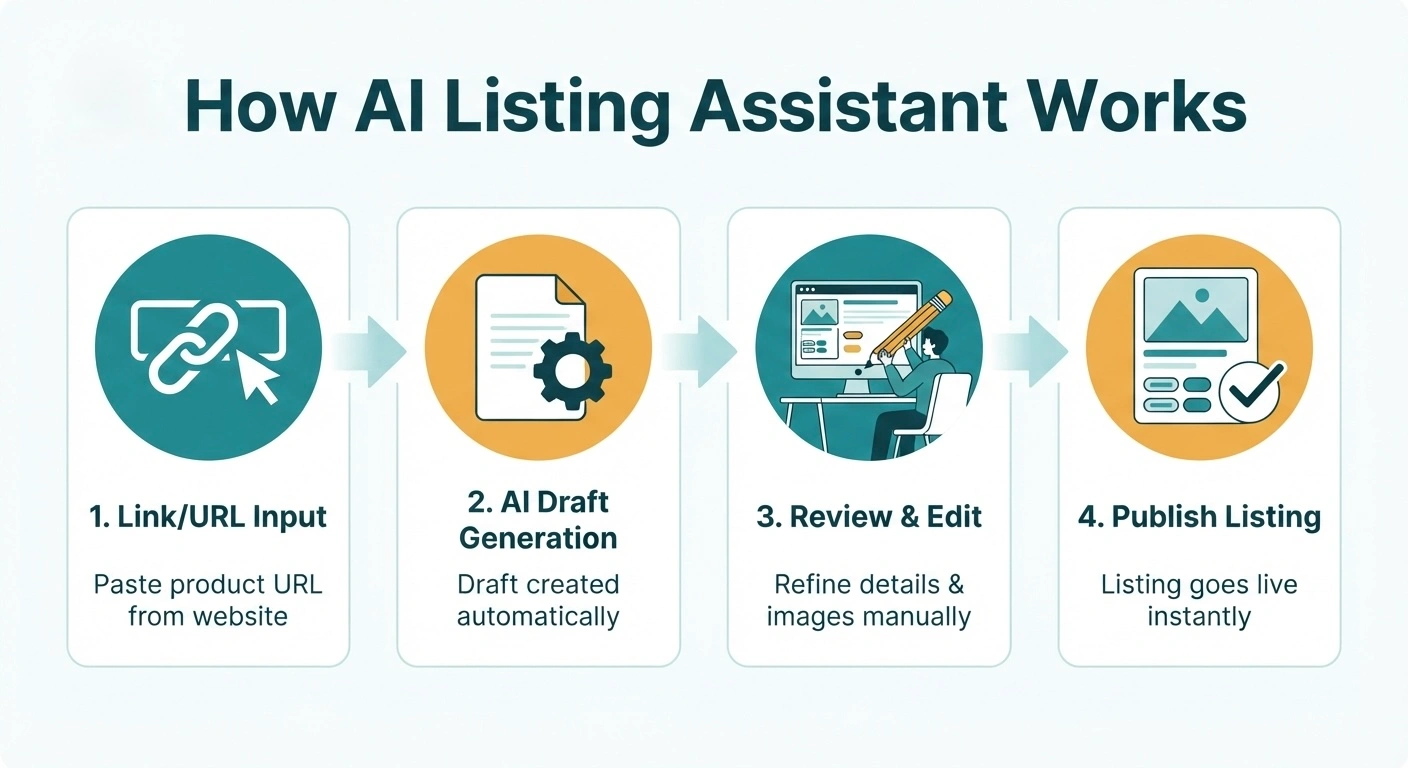
The owner pastes a link to the product page for the gear they’re listing, optionally hints at a category, and the system builds a complete draft listing. The owner reviews it, edits anything, and publishes. We designed two capabilities:
- Prefill runs once at the start of listing creation and produces the full draft.
- Regenerate runs on demand for a single field, when the owner wants a different version of just that field.
Prefill runs in the background as a queued job, so a slow scrape or a slow model never freezes the listing wizard. Regenerate is scoped to one field and returns directly.
What Data We Fetch, and How We Keep It Grounded
The AI listing assistant fetches from exactly one source: the product page behind the URL the owner provides. A web scraping service retrieves that page’s content and metadata – nothing else is queried. The rest of the input is already known: the category hint the owner selects, and their city and province from their account. Everything the assistant writes is grounded in the scraped page plus that context. If a spec, measurement, accessory, or model year is omitted, rather than invented.
What the Assistant Produces
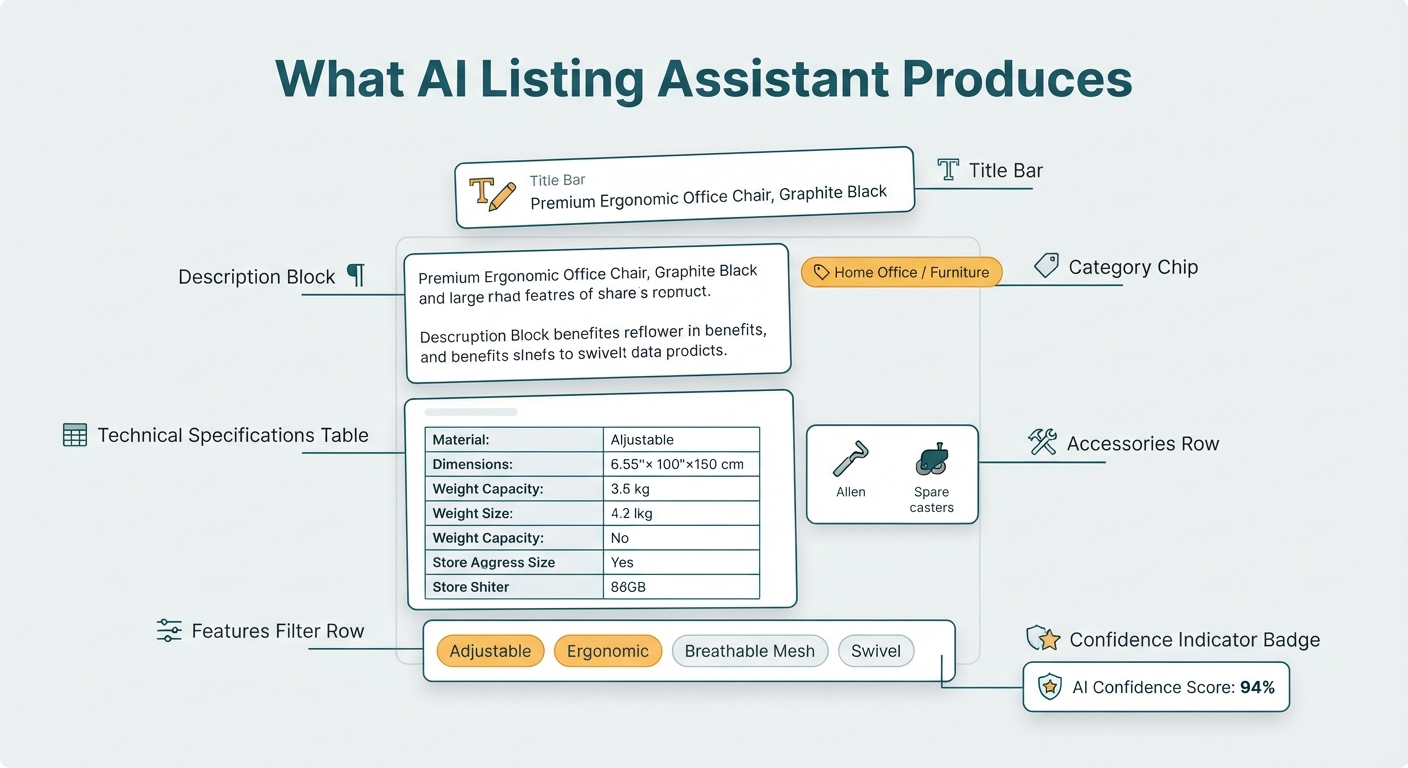
AI listing assistant produces a complete listing draft: title, description, category placement, technical specifications, included accessories, and category-specific feature attributes – the structured filters renters use to narrow search. It also returns a confidence indicator flagging whether the result is complete or partial.
Output then passes a cleanup stage: text is trimmed, feature values are mapped onto the platform’s vocabulary, accessories and features are capped for readability, and monetary values are normalized to CAD. One decisive detail: the model returns human-readable labels like “Mountain Bikes,” while the marketplace stores categories as internal keys. We built a resolution layer that maps model output onto the real taxonomy. Without it, AI-generated categories would be plausible text, placing a listing nowhere findable.
How We Process the Data
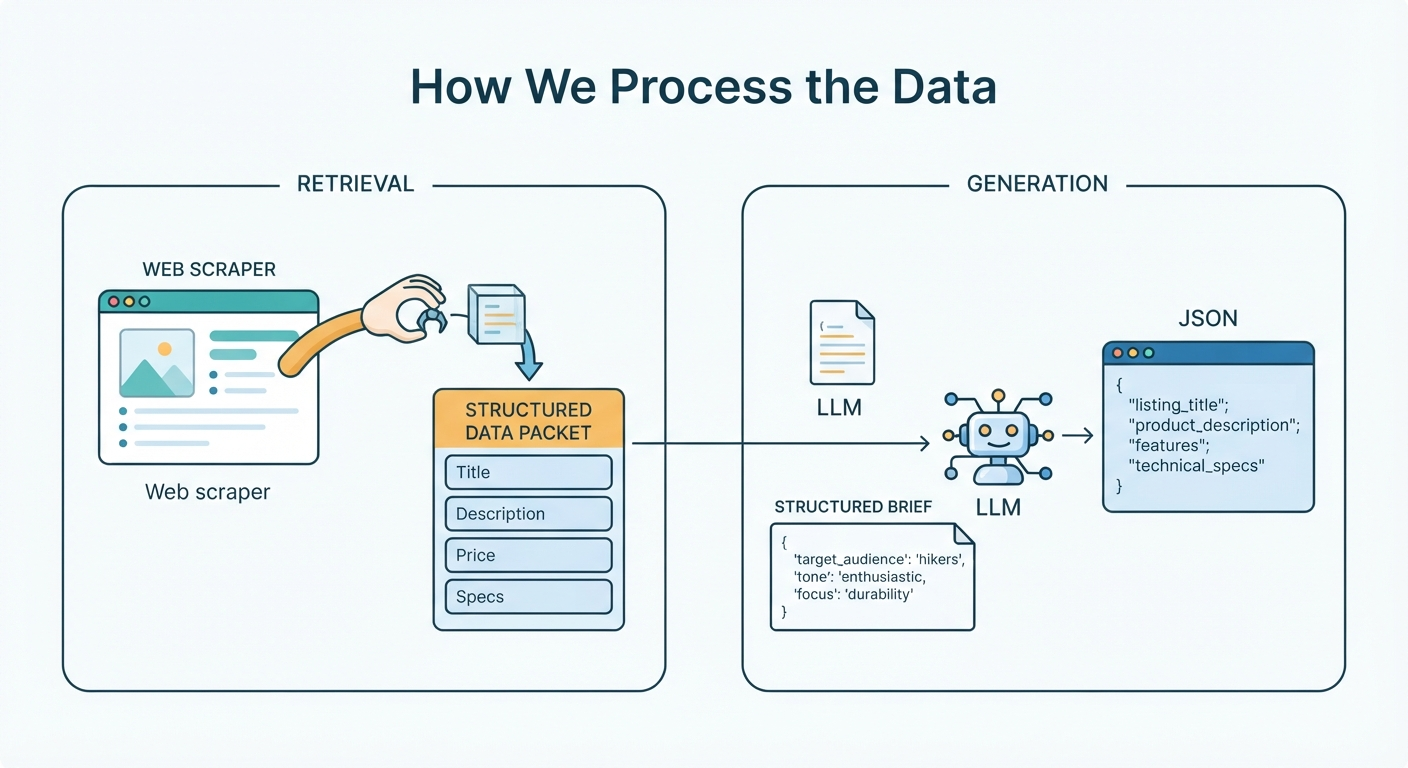
Two stages:
- Retrieval: the product page is scraped.
- Generation: a large language model receives a structured brief and returns the listing as strictly structured data, constrained by a schema so the editor can always parse it.
The description follows a defined editorial brief: second person, rental intent throughout, city placed early, two short mobile-readable paragraphs, no superlatives or emojis, no condition claims, no prices, and nothing not present in the supplied data. If the source is too thin, the model writes one shorter paragraph instead of padding.
Prompts and model selection live in an admin layer, so they can be tuned without a release. If a model is retired, the system falls back automatically. For regeneration, the model receives the current listing state plus a field-specific instruction
What the Owner Can Review or Edit
AI listing assistant never publishes. It fills a draft, and the owner decides. Every field is editable, and four support one-click regeneration: title, description, specifications, and features. Regeneration is per field, so improving the description doesn’t discard a title the owner liked.
Human-in-the-loop by default: AI does the typing, the owner does the deciding.
Why Did AI and Sharetribe Start Showing Up in the Same Sentence?
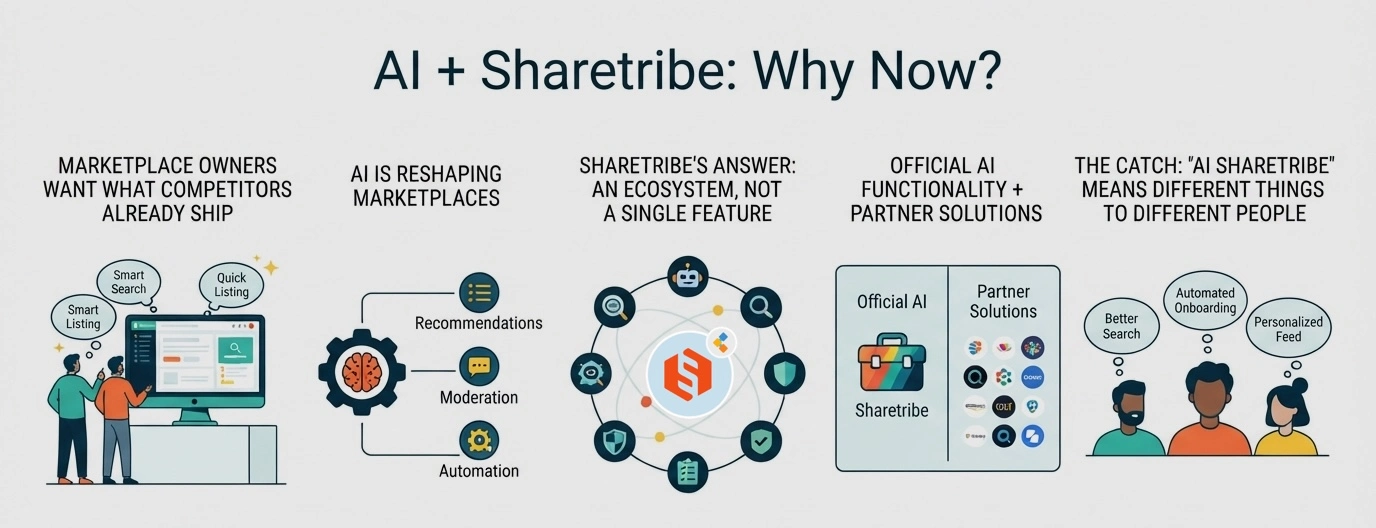
Search interest in AI Sharetribe setups has climbed steadily as more founders realize that a marketplace launched two years ago is already missing features their competitors ship by default.
A few years ago, launching a marketplace on Sharetribe was straightforward: pick a template, configure categories, do the marketing part, and the product was ready. Now there’s one more question on the list: what about AI?
The reason is simple. Marketplace owners have watched how AI is transforming marketplaces – from personalized recommendations to automated listing moderation – and they want the same capabilities for their own platform. Sharetribe, as a flexible no-code/low-code platform, has also introduced AI internally, including an AI chatbot built by the Sharetribe team to help founders and users with platform-related questions.
This is where the confusion starts. Some people are looking for an AI Sharetribe chatbot for buyer support, others want something to speed up custom development, and some mean something else entirely.
What Sharebot Is – and How It Differs From a Regular Chatbot
Sharebot (also known as the Sharetribe AI bot) is the official AI assistant built into the Sharetribe admin console. These are not two separate tools: they are the same chatbot, fed with Sharetribe documentation. It isn’t a storefront chatbot for buyers, and it isn’t something you integrate or connect to your marketplace. It’s a tool for the marketplace operator: it helps you make sense of configuration options, suggests how to implement a given feature, and cuts down the time spent digging through documentation. Because it lives in the admin console, it offers no direct benefit to buyers or sellers; only administrators use it.
In plain terms: previously, understanding how to set up custom listing fields or change booking logic meant scrolling through dozens of help-center pages. Sharebot lets you ask a plain-language question and get a specific answer – often with links to the relevant docs or even a ready-made code snippet.
For teams without an in-house developer, this noticeably lowers the barrier to entry. For teams already working with a contractor, Sharebot becomes the first line of defense: simpler questions get resolved instantly, while developers are left to handle the genuinely non-trivial tasks.
Furthermore, the Sharetribe team often picks up support requests directly, with developer advocates sharing practical approaches for achieving a specific business goal from a technical perspective.
What Sharetribe AI Bot Actually Does for Marketplace Owners?
There is no separate Sharetribe AI bot product beyond Sharebot. The name refers to the same admin-facing chatbot described above: an AI assistant trained on Sharetribe documentation and available inside the admin console. It does not need to be connected anywhere, and it does not add storefront functionality. It can help an administrator understand configuration options, find relevant documentation, and get guidance on platform setup. It does not serve marketplace users, buyers, or sellers, and it provides no direct benefit to them – only to the administrator.
Sharetribe’s own documentation walks through how to use Sharebot in detail – and, importantly, spells out which tasks it’s suited for and where it makes more sense to bring in specialized third-party AI services instead.AI-Assisted Coding: When a Non-Developer Can Still “Finish the Code”
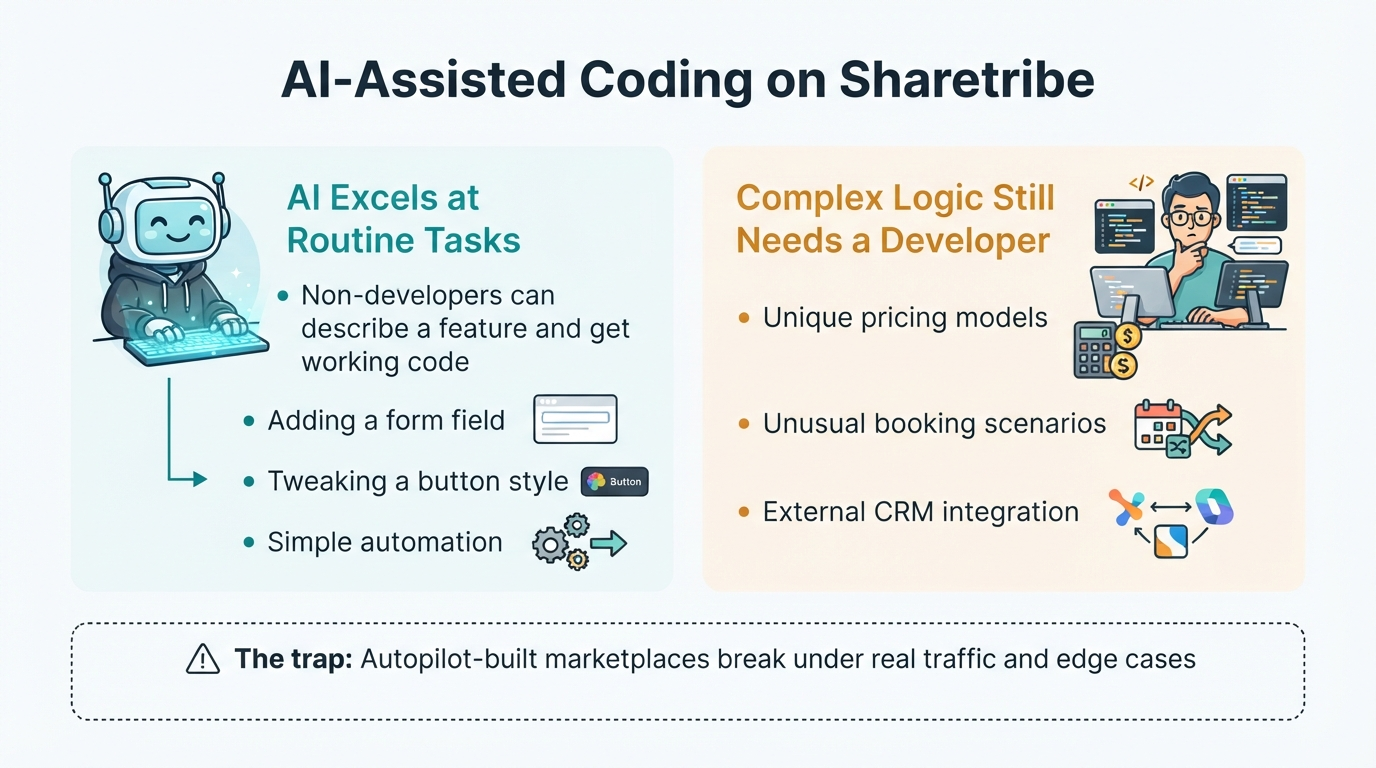
One of the most visible trends of the past couple of years is AI-assisted coding built on top of Sharetribe. The idea is that someone with no programming background can describe a desired feature in plain language, and an AI assistant generates a working code snippet to customize the marketplace.
But let’s be honest about the limits. AI coding tools handle routine, template-like tasks well: adding a field to a form, tweaking a button style, setting up a simple automation. More complex logic – a unique pricing model, unusual booking scenarios, integration with an external CRM – still needs an experienced developer who understands the Sharetribe architecture and can anticipate the downstream effects of a change.
That’s exactly why AI marketplaces often struggle when they’re built entirely on autopilot: AI-generated code may work fine in a demo, but break under real traffic or in edge cases real users actually hit.
What Third-Party AI Services Are Plugged Into Sharetribe?
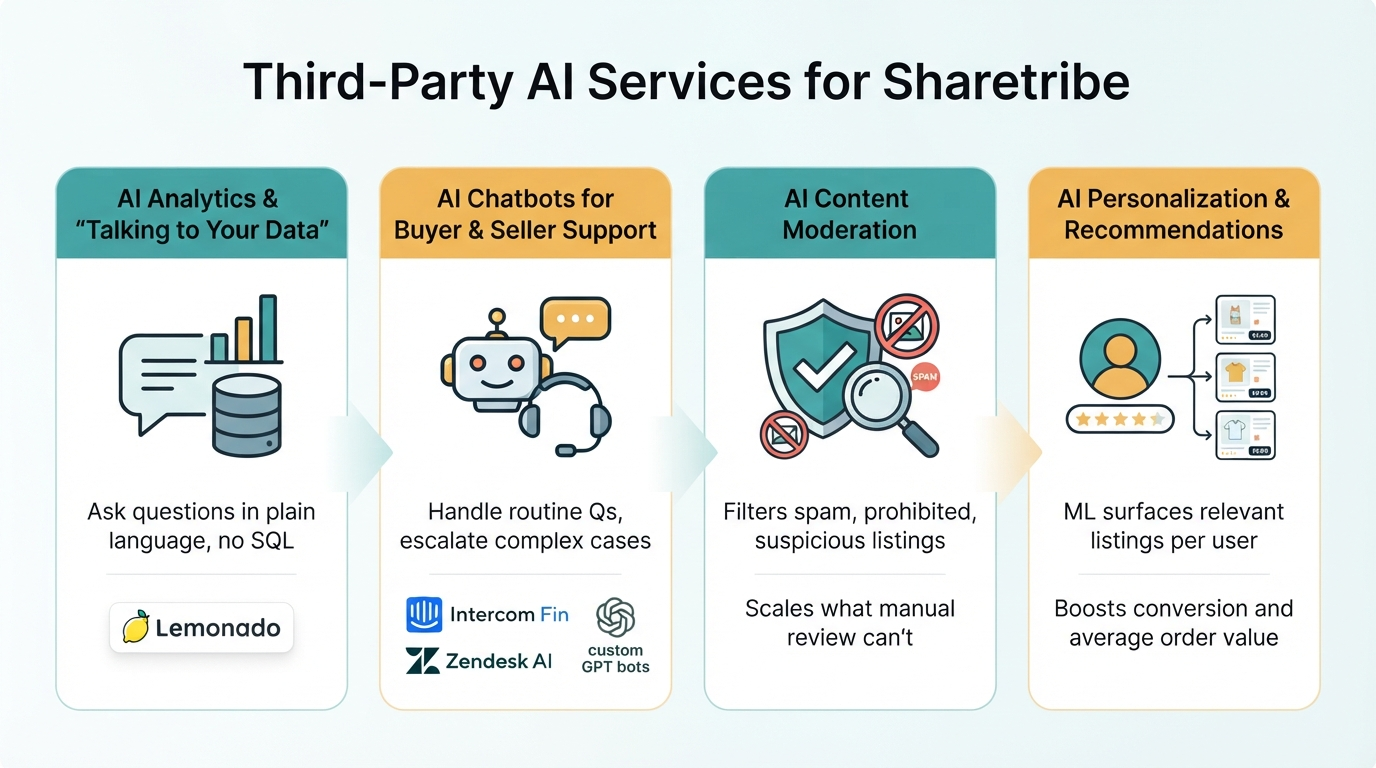
Beyond the tools built into Sharetribe itself, there’s a whole category of external AI solutions that marketplace owners connect via API or ready-made integrations. Here are the most common directions.
AI Analytics and “Talking to Your Data”
One standout example is Lemonado. It lets a marketplace owner literally ask questions about their own data in plain language – for instance, “which listing categories are growing fastest this quarter” – and get an answer without writing a single line of SQL.
AI Chatbots for Buyer and Seller Support
This is a different layer from the admin-facing Sharebot – think external solutions like Intercom Fin, Zendesk AI, or custom GPT-based bots connected to the marketplace’s knowledge base. They handle routine questions – “where’s my order,” “how do I get a refund,” “how do I become a seller” – without human involvement, escalating trickier cases to a live agent.
AI Content Moderation
For marketplaces with user-generated content (listings, photos, reviews), AI moderation automatically filters out spam, prohibited content, or suspicious listings before they even go live – a task that’s essentially impossible to scale manually.
AI for Personalization and Recommendations
Machine-learning-based recommendation systems help surface relevant listings to each user, boosting conversion rates and average order value. This is one of the directions covered in detail in our roundup of must-have AI tools for marketplace businesses.
What to Choose for Your Marketplace?
Task | Built-in Sharetribe solution | External AI service |
|---|---|---|
Help configuring the platform | Sharebot | – |
Custom features without a developer | AI-assisted coding | Third-party AI coding tools |
Analytics and reporting | Sharetribe’s basic tools | Lemonado and similar services |
Customer support | None built-in for marketplace users; Sharebot (the Sharetribe AI bot) is admin-only | Specialized chatbots |
Content moderation | Limited | Dedicated AI moderation services |
In practice, the best results come not from an “either/or” choice but from combining both: routine admin tasks are handled by Sharebot (the Sharetribe AI bot), while more complex, business-specific scenarios go to dedicated external services connected through integrations.
Where the Risks Are: Why “AI Will Do It All” Is a Myth

The main trap is expecting AI tools to fully replace a developer. In practice:
- Complex business logic still needs a human. AI generates routine solutions well, but unique pricing models or multi-party transaction scenarios require architectural thinking.
- Security and scalability aren’t automatically checked by AI. Generated code might work fine on test data and still fail under real production load.
- Someone still has to coordinate multiple AI services. When Sharebot, an external analytics tool, and a support chatbot are used alongside the same marketplace, someone needs to understand what each tool is responsible for and make sure the information they provide is consistent and useful.
That’s exactly why, for projects where an AI-generated MVP started falling apart under real users, there’s a dedicated AI rescue service: a team of developers digs into what actually went wrong in the code and brings the product to a stable state without rewriting everything from scratch.
What Is the Final Verdict On AI-Powered Sharetribe Marketplaces?
AI on Sharetribe today is a part of the standard toolkit: from the official Sharebot and Sharetribe AI bot to third-party services like Lemonado for analytics and AI chatbots for support. AI-assisted coding genuinely lowers the barrier to entry for non-technical founders, and today’s AI coding tools let teams test hypotheses quickly without looping in a developer for every small request.
At the same time, a marketplace built entirely on auto-generated code risks running into scaling and security problems down the road. The most durable approach combines AI tools with the expertise of a team that understands Sharetribe architecture and knows how to tell the difference between a task worth handing to AI and one that genuinely needs an experienced developer – the difference, in short, between using AI Sharetribe features as a shortcut and using them as a substitute for engineering judgment.
Planning AI features for your marketplace?
Sharebot handles the admin side. But listings, search, moderation, and integrations still need real engineering. We've built AI listing assistants, custom moderation, and third-party integrations for Sharetribe marketplaces — and we know exactly where AI helps and where it breaks.
Book a free consultation with Roobykon SoftwareFAQ

Recommended articles
 AI Translation for Marketplaces: How We Built a Multilingual Engine for a Cross-Border Marketplace
Most marketplaces translate buttons and footers, but what about user-generated listings? This case study shows how a cross-border marketplace uses AI language translation to auto-translate bike descriptions, profiles, and details into French, German, and English.
 How to Build an Online Marketplace Website (Complete Guide for 2026)
You have a marketplace idea. Now what? This complete guide answers the questions every founder faces: How do I validate my concept? What features actually matter in an MVP? This article provides practical answers to the challenges of building a marketplace startup from scratch.
 Advanced Search for Sharetribe Marketplace: How We Built a Smarter Way for Users to Find What They Need
Internal search users convert at 2-3x higher rates, but only if the search actually works. We walk through building a smarter search for marketplace on Sharetribe, adapting it for aviation, real estate, rentals, and beyond.
 How to Build an Online Marketplace MVP in 2026
Turning a marketplace idea into reality is fraught with risk. This guide cuts through the complexity, showing you how a focused MVP is the antidote.