Why Is Translating Static UI the Easy Part?
How Does AI Translation for Marketplaces Actually Work?
What Does a Real-World AI Translation Look Like With a Listing?
Why Build an AI Translation Engine for Marketplaces That Way?
What Is the Bigger Pattern Behind the AI-Powered Translation Feature?
What Are the Most Common Questions About AI-Powered Translation?
What Should You Watch Out For With AI Translation?
Subscribe and you will promptly receive new published articles from the blog by mail
Anyone can translate a button. “Sign Up,” “Checkout,” “Menu” – that’s the easy 20% of localization. The hard part is translating real people in real time. You can’t pre-translate a listing that doesn’t exist yet. So Roobykon Software built an AI translation engine that does it automatically – into French, German, and English – the moment a listing is created. We stored those translations natively inside Sharetribe, so there’s no extra system to manage.
What we got was a marketplace that actually works across borders: less friction, more trust, and a genuinely useful experience for everyone. It’s proof that good AI translation software isn’t a feature you tack on. It’s an architectural decision you build in.
- Translating static UI is the easy part. The real value of multilingual AI is handling unpredictable, user-generated listings in real time.
- This case study shows how AI language localization can work seamlessly: translations trigger at content creation, store natively, and render dynamically – no manual effort required.
- Good AI translation software treats translation as part of the content pipeline, not a separate workflow, saving time and operational overhead.
- Multilingual AI reduces friction, builds trust, and makes cross-border marketplaces genuinely useful for everyone.
- Watch for trade-offs: API costs scale with volume, and niche terms may need occasional human review, but the benefits far outweigh the costs..
Why Is Translating Static UI the Easy Part?
Translating a website’s chrome is genuinely the easy part of localization. That content is finite. Someone writes it once, in each language, and it barely changes after that. You could hand it to a freelancer on a Tuesday and have it wrapped up by Friday.
The real headache – the thing that actually makes or breaks a multilingual marketplace – is what happens after launch. Real people typing real listings, descriptions, and bios in whatever language pops into their head that day. You can’t pre-translate that. It doesn’t exist until someone sits down and hits “post.” That’s where AI-powered translation goes from “cool” to “absolutely essential.”
Picture this in a place like Luxembourg. A seller in Esch-sur-Alzette writes up their bike in French because that’s natural. A buyer across the border in Trier only reads German comfortably. Neither should have to copy-paste into Google Translate just to figure out what’s for sale.
That friction kills trust before anyone even says hello. What they need is an AI translation tool that just works in the background, no clicks required. Getting this right is precisely the kind of problem we like sinking our teeth into as part of our AI marketplace development work.
How Does AI Translation for Marketplaces Actually Work?
We could have bolted on a third-party translation widget and called it a day. Plenty of platforms do exactly that. You can usually tell because the translated text reads stiff, generic, and slightly out of place.
We wanted something that felt native to the platform instead of stapled onto it, so we designed a multilingual AI architecture that automates localization of user-generated content end-to-end. The goal, stated simply, was this: every visitor, no matter what language they land on the site in, should see listings and profiles in their own language, without the seller or buyer having to lift a finger.
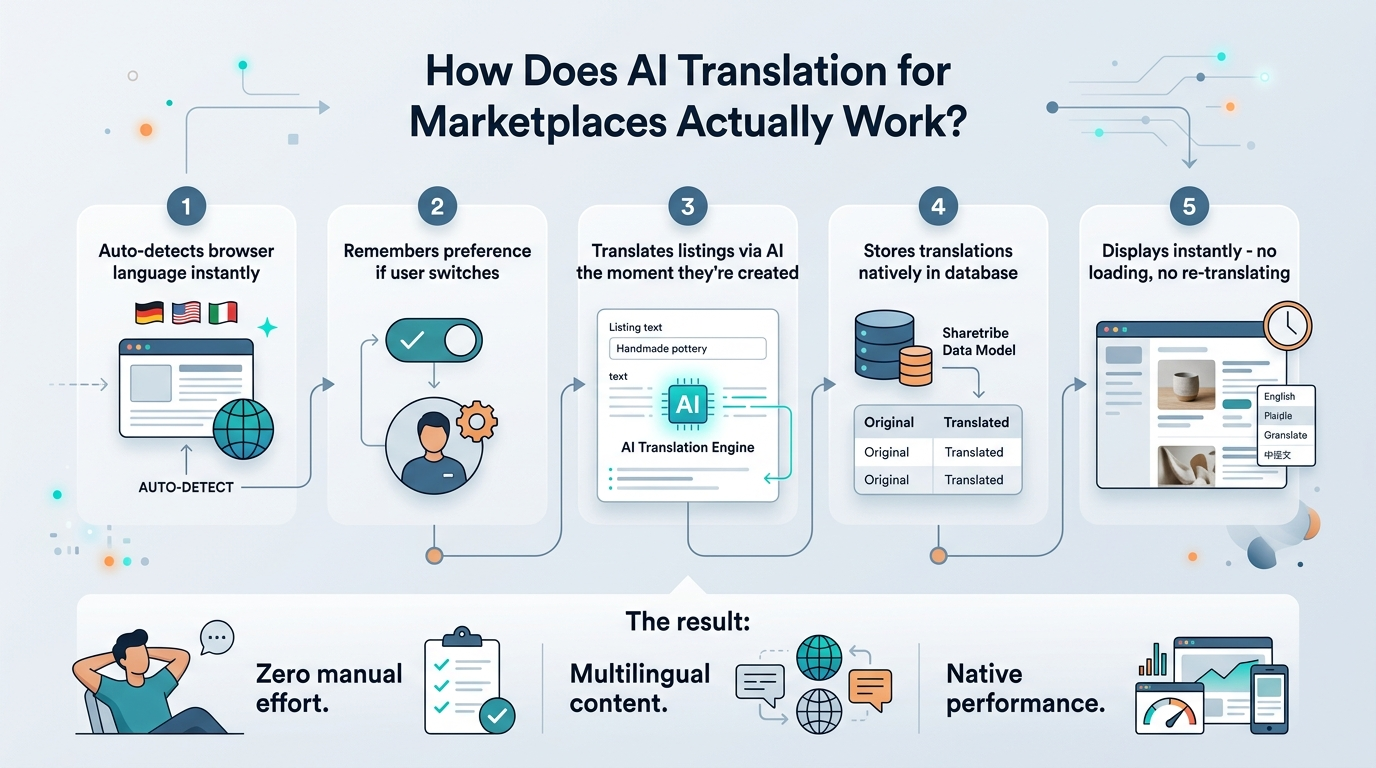
Here’s how the AI-powered language translation actually plays out, step by step.
1. The Site Figures Out Your Language Before You Do Anything
The moment a new visitor lands on the marketplace, the platform reads their browser locale settings. It renders everything in the matching language. There is no pop-up asking you to pick from a dropdown before you’ve even seen the homepage. Browser set to French? The site opens in French. German or English? Same story.
AI and language localization sounds like a small thing, and it is. But it’s the difference between a site that feels like it was built with you in mind, and one that feels like it was translated by committee.
2. But It Never Forgets What You Actually Want
Automatic language detection is a sensible starting point, not a cage. People can change the language at any time through an on-site switcher, and that choice sticks. It gets saved directly to the user’s profile and respected on every visit after that.
A Luxembourgish local who just prefers browsing in English gets English. A cross-border commuter whose phone happens to be set to German but who thinks in French gets French. The platform defers to what you actually want, not just what your device settings assume about you.
3. When Does the AI Translation Actually Happen?
This is the part we spent the most time getting right, and honestly, it’s the part that makes the whole feature worth writing about. The moment a listing is created or edited, or a profile is filled in, that text gets sent through an API to OpenAI, and the model generates translations into every language the platform supports.
There’s no manual translation queue sitting in the background, nobody waiting on a freelance translator to get to it by Thursday, no plugin the seller has to remember to click.
Someone finishes typing their listing, hits publish, and by the time the page has loaded, the translation is already quietly sitting there waiting.
Translating fresh, unpredictable, occasionally typo-ridden, user-generated text on every single submission is a different order of problem entirely. That’s the part most off-the-shelf AI translation software quietly isn’t built for.
Feature | Traditional Translation | AI Translation Engine |
|---|---|---|
Timing of Translation | After content creation, often batched. | Instant, at the moment of creation. |
Content Scope | Static UI elements. | Dynamic, user-generated listings and profiles. |
Effort Required | High manual effort (freelancers, vendors). | Zero manual effort; fully automated. |
Scalability | Poor; costs scale with human labor. | Excellent; costs scale predictably with API usage. |
4. Where the Translations Actually Live
Instead of standing up a separate translation database, we stored the generated translations directly inside Sharetribe’s native publicData field. Each language gets its own structured key: description_en, description_fr, description_de, and so on.
It’s a deliberately unglamorous decision, and that’s exactly why it works so well. There’s no new system to babysit. There is no second source of truth that can drift out of sync. This treats AI translation for Sharetribe as a native extension of the platform’s own data model.
5. How AI Translation Shows Up on Screen
On the frontend, the site checks whatever locale the user currently has selected. It pulls the matching text straight out of publicData. Flip the language toggle from French to German, and the listing description updates instantly.
There is no spinner, no re-fetching, and no live re-translation happening in front of you. All the heavy lifting happened once, back when the listing was created. Every read after that is just a fast, boring, native lookup. That is exactly what you want a production system to be.
What Does a Real-World AI Translation Look Like With a Listing?
At launch, the marketplace supports English, French, and German. This is a direct reflection of who actually lives, works, and shops for bikes in this particular market.
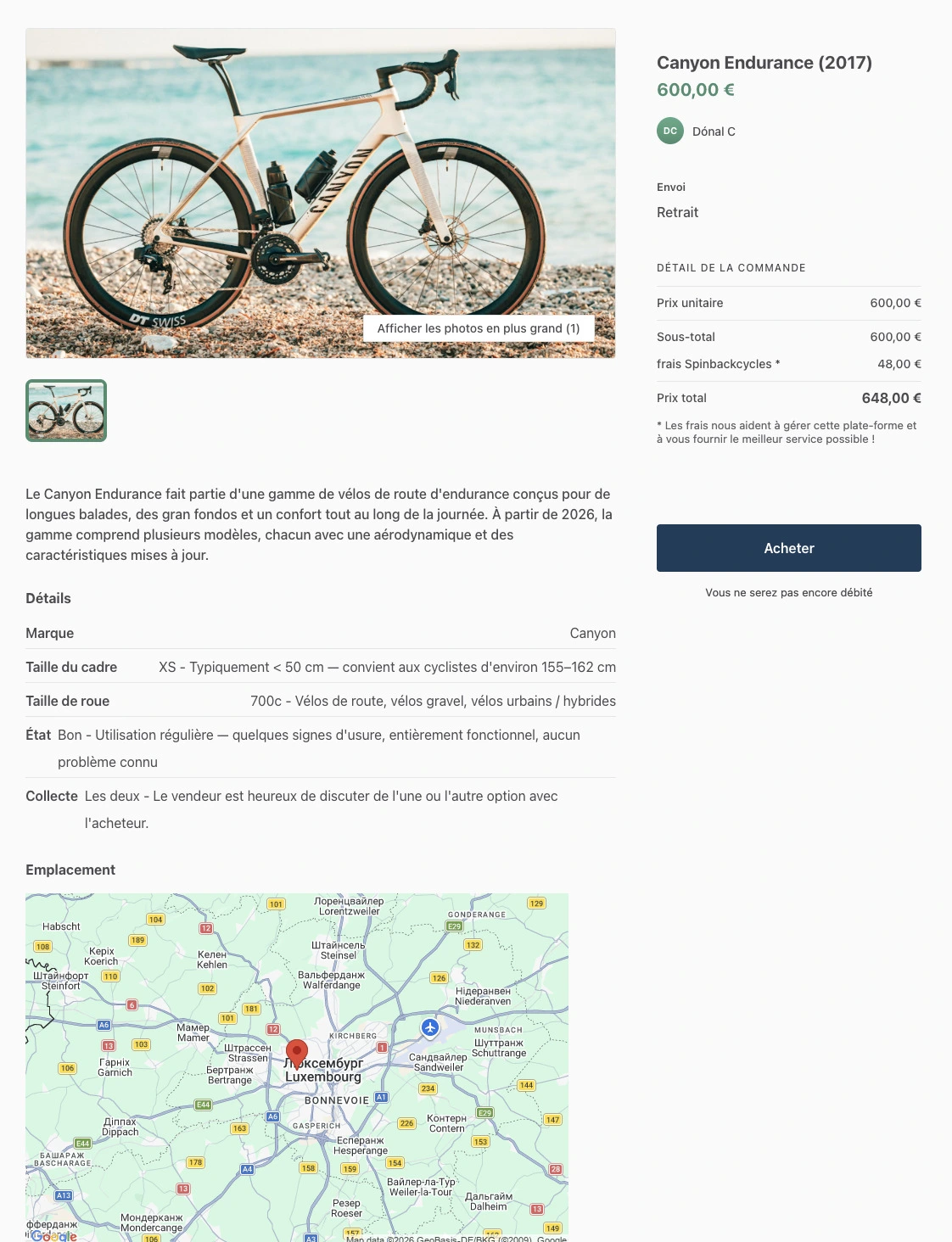
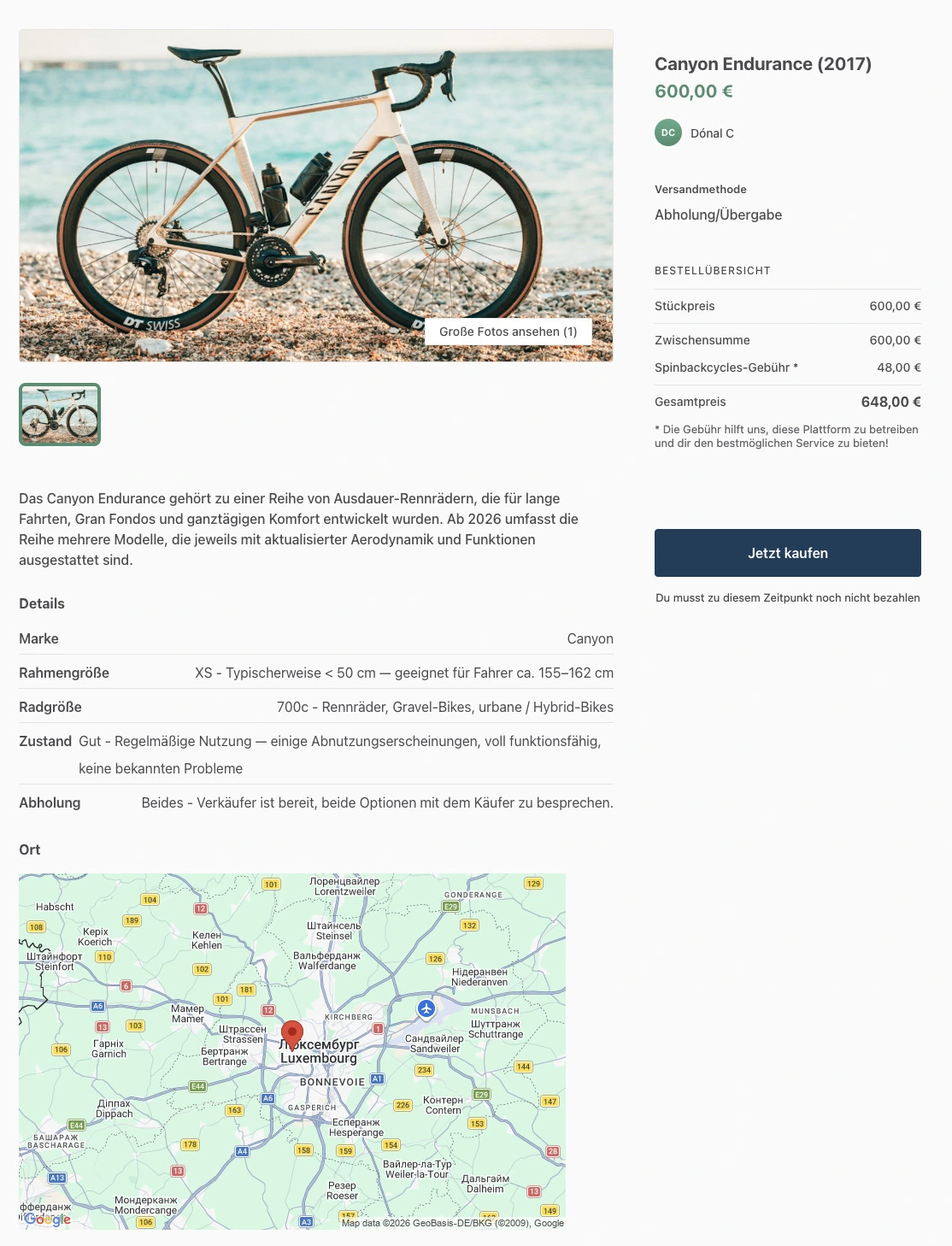
The listing shown in this AI-powered translation case study is a nice, concrete illustration. It is a 2017 Canyon Endurance road bike. It is priced at €600, listed by a seller in Luxembourg. The listing includes all the structured details a bike buyer actually cares about: brand, frame size, wheel size, condition, and a pickup or delivery preference.
The description explaining what the Canyon Endurance line is, and why it’s built for long rides, exists in every supported language. The seller never wrote it more than once. They typed it out in one sitting, in one language, and the platform quietly did the rest.
You can see this in action if you flip the same listing between locales. Switch to French, and the “Delivery method” field becomes “Envoi”. The buy button reads “Acheter”. The product description reads as if a French speaker wrote it themselves.
Switch to German, and the same listing becomes “Jetzt kaufen”. The delivery field becomes “Versandmethode”. Every structured detail is rendered in fluent German. It is the same listing, same seller, and same single write-up in the original language. Yet, you get three completely different reading experiences depending on which locale you’re sitting in.
That’s the whole AI translation technology working exactly as intended, quietly, in the background, on a listing nobody translated by hand.
Why Build an AI Translation Engine for Marketplaces That Way?
A few things stood out once the dust settled and the feature had been living on staging for a while.
- It’s invisible to the people who matter most. Sellers and profile owners never touch a translation tool or pay a translator. The multilingual AI layer just works, quietly, as part of publishing a listing like they always would have.
- It doesn’t fight the platform it lives on. Because translations live inside Sharetribe’s own publicData field, there’s no extra database to deploy, monitor, or eventually forget about. It’s an AI localization approach that works with the grain of the platform instead of against it.
- It grows without a rebuild. Adding a new language later means updating an OpenAI prompt and adding a frontend variable, not standing up new infrastructure. Compare that to most enterprise AI translation technology, which tends to demand fresh plumbing for every new locale you add.
What Is the Bigger Pattern Behind the AI-Powered Translation Feature?
Step back from bikes and Luxembourg for a moment. What you’re really looking at is a case study in how to solve the problem of localization in AI-driven products more broadly. The old playbook assumes content is finite and centrally authored. That model works fine right up until your content is being generated continuously, by thousands of independent people.
At that point it just stops working. An AI translation tool that only handles static strings can’t keep up with that pace. What actually works is AI language translation woven into the content pipeline itself. It must fire the instant something is created or edited.
And it applies far beyond bike marketplaces: rental platforms, service marketplaces, freelance platforms, real estate listings – anywhere strangers generate content that other strangers need to read and trust. If you’re exploring different rental business ideas, the same content-creation challenge involves the moment users start listing items in more than one language.
What Are the Most Common Questions About AI-Powered Translation?
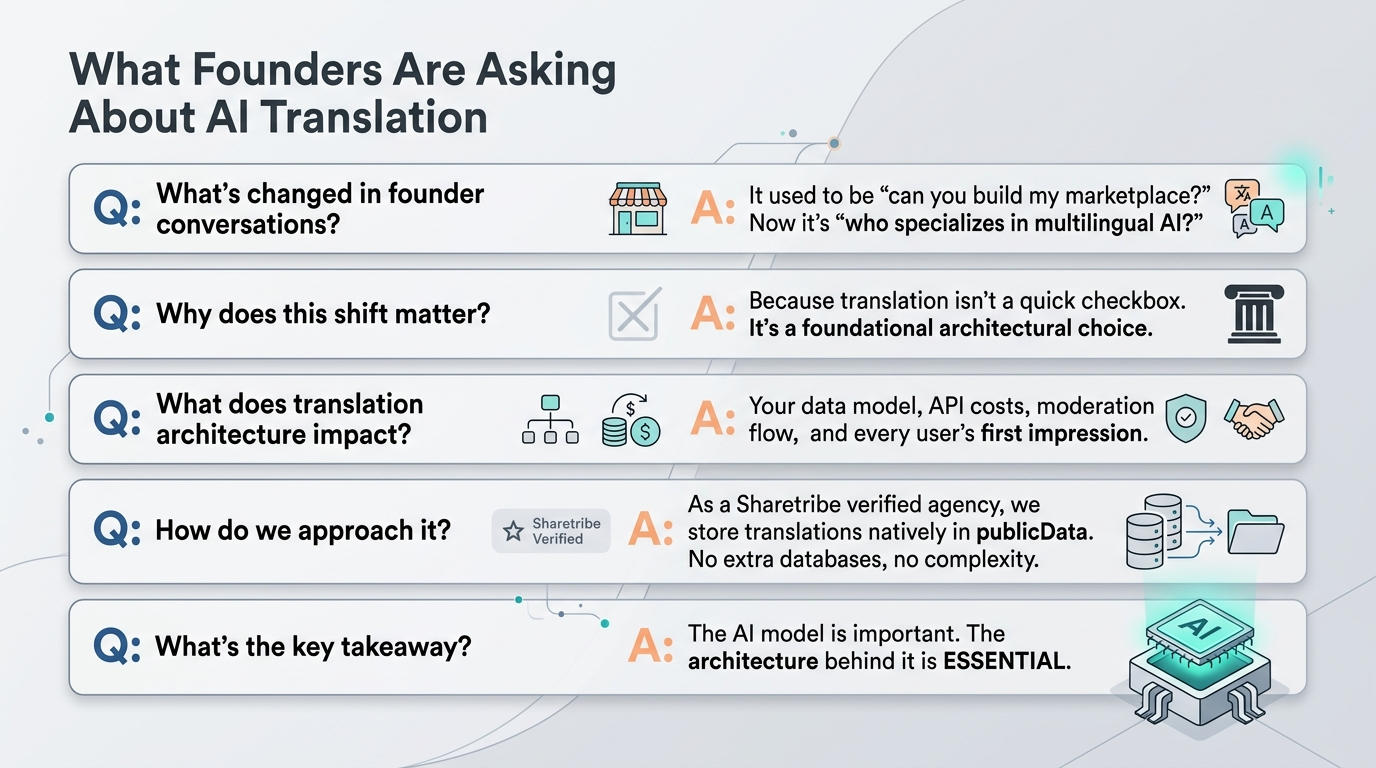
There has been a noticeable shift in the conversations founders bring to us lately. It used to be enough to ask “can you build my marketplace on Sharetribe?” Now we are increasingly fielding a more pointed version of that question.
Founders want to know what consulting companies specialize in multilingual AI integration. This is coming from founders who are targeting markets with more than one official language. They have already learned, sometimes the hard way, that translation isn’t a checkbox you tick off in week twelve.
It is an architectural decision. It touches your data model, your API costs, your moderation flow, and the first impression every single visitor gets.
As a Sharetribe verified agency, this is exactly the kind of problem we enjoy sitting inside of. We already know Sharetribe’s data model inside and out. That is precisely why storing translations in publicData rather than spinning up a new database felt obvious to us.
If you’re weighing multilingual AI software development solutions for your own platform, Sharetribe or otherwise, the architecture underneath matters just as much as which model you plug in behind it.
What Should You Watch Out For With AI Translation?
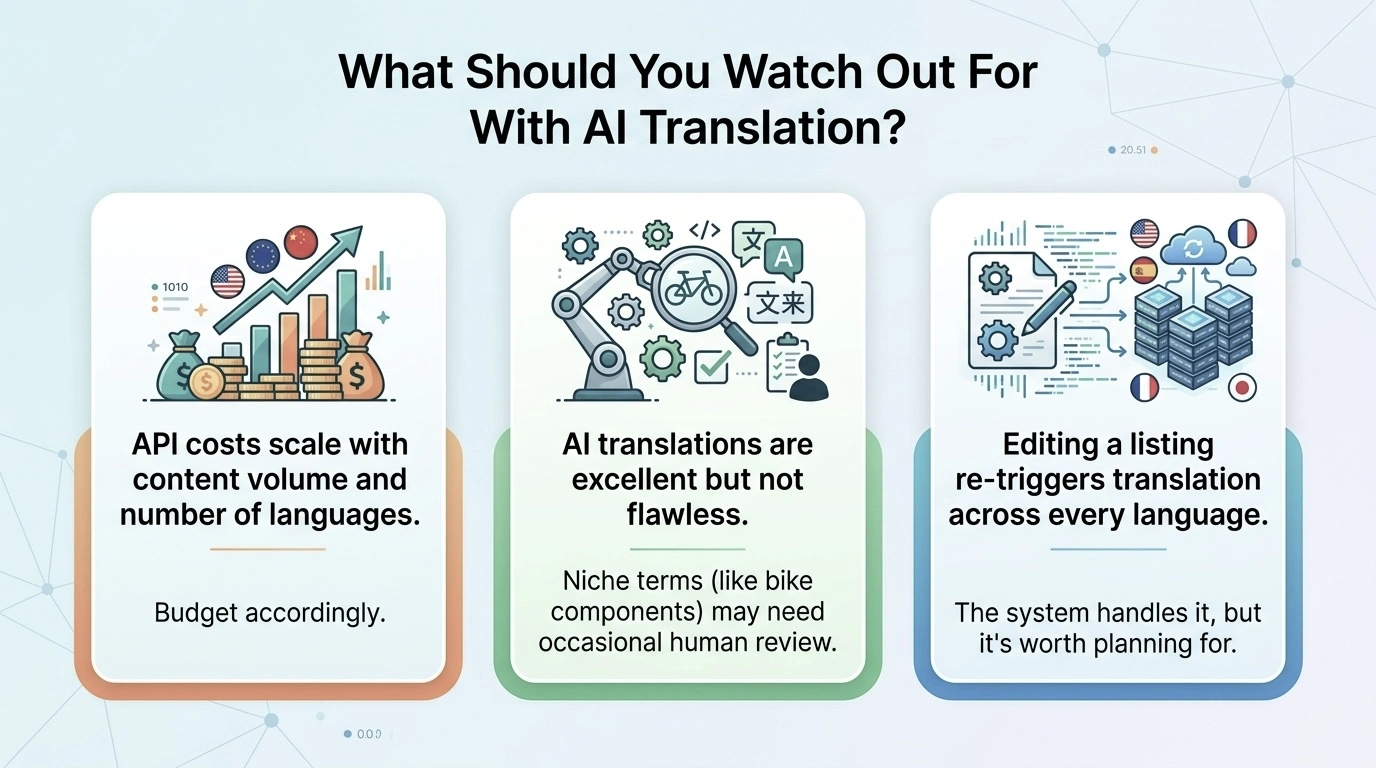
No architecture comes free of trade-offs. We would rather be upfront about them than pretend otherwise.
Every listing creation or edit triggers an OpenAI API call for each supported language. Translation cost scales with both content volume and the number of languages you support. It is worth budgeting for this honestly as the catalog grows.
AI-generated translations are very good but not flawless. This is especially true with niche technical vocabulary (bike component names are a good example). It is worth keeping a lightweight review path in your back pocket.
Because translations are generated once at creation time, editing the original listing needs to re-trigger translation across every language. The system already handles this. However, it is a detail worth knowing if you are scoping something similar yourself.
Does AI Translation for Marketplaces Ever Show Up Alone?
Multilingual AI translation rarely arrives as a lone feature request. It tends to show up alongside a broader marketplace build, or a rethink of an existing one. Founders are usually thinking about search, discovery, payments, and trust between strangers transacting online, all at once.
If a platform already has advanced search functionality on Sharetribe, multilingual content makes that search noticeably more useful. Buyers can find and understand listings regardless of what language the seller wrote them in.
And if you’re still weighing whether Sharetribe is the right foundation in the first place, it’s worth understanding how the platform holds up in practice before committing engineering time to features like this one.
Closing Thoughts on AI Translation for Marketplaces
This marketplace set out to solve a small, local, almost mundane problem: helping people in a cross-border region buy and sell bikes without wading through classifieds built for a totally different market.
Solving that properly meant confronting a bigger one underneath it. How do you make content written by strangers genuinely readable across three languages, without asking a single one of those strangers to do any extra work? The answer we landed on was AI-powered translation. It triggers the moment content is created, stores natively inside Sharetribe, and renders dynamically based on locale.
This is a pattern we suspect a lot of marketplaces are going to need sooner or later. If you’re building a marketplace that needs to speak more than one language, this is worth solving properly. It is better to do it with a partner who’s done it before, rather than duct-taping a plugin on top and hoping.
Ready to stop losing buyers to language barriers?
Book a free consultation with our team and let's map out a multilingual AI translation strategy for your platform.
Get In Touch
Recommended articles
 From SEO to AEO for B2B Marketplaces: How to Make Your Platform Visible in AI Search
Traditional SEO isn't enough anymore. Discover the shift from SEO to AEO for B2B marketplaces. This guide covers everything from understanding the AI citation landscape to optimizing your technical architecture, category pages, and trust signals for AI visibility.
 AI Marketplace Transformation: Why Your Platform Won’t Survive Without It
AI is revolutionizing marketplaces, not as a bolt-on feature, but as the new operating system of commerce. This article breaks down the trends, the data, and the practical steps founders need to take to build for an agent-driven future.
 Why AI-generated marketplace MVPs break early, and what stops them from scaling
Marketplaces are complex systems. AI coding tools optimize for the prompt, not the long term, producing code that demos well but collapses under users. Roobykon Software examines the seven architectural failures that break AI-generated MVPs.
 Integrating BTCPay Server into Sharetribe: A Field Guide to Bitcoin Payments for Marketplaces
Everything you need to know about BTCPay Server integration for Sharetribe: from Bitcoin payment processing and custom APIs to decentralized payment infrastructure and Web3 marketplace growth.