What Is a Musician Booking Marketplace?
Who Should Consider Building This Type of Platform?
How a Musician Booking Marketplace Works
Core MVP Features for a Musician Booking Marketplace
Advanced Features for Scaling the Music Booking Platform
Monetization Models for Artist Booking Marketplaces
Payment, Commission, and Payout Logic
Music Marketplace Development Options: No-Code, Sharetribe, or Custom Marketplace
How Much Does It Cost to Build Marketplace For Musicians?
Common Mistakes When Building a Music and Artist Booking Marketplace
Already Have a Music Marketplace? When to Bring in a Development Partner
Subscribe and you will promptly receive new published articles from the blog by mail
The music industry has always run on connections – the right band for the right venue on the right night. But the way those connections happen has changed dramatically. Spreadsheets, cold calls, and agency rolodexes are giving way to platforms where event organizers browse artist profiles at midnight, send a booking request before breakfast, and confirm everything before lunch.
If you’re thinking about how to build a musician booking marketplace, you’re entering a market that’s genuinely underserved. Platforms that handle the full booking cycle (discovery, negotiation, contracts, payment, reviews) still have plenty of room for well-built competitors. The opportunity is real. The question is how to build the marketplace right.
This guide is for founders, booking agencies moving to software, and existing marketplace owners who want to understand what a professional musician marketplace actually requires: the features, the logic, the mistakes, and the development path.
What Is a Musician Booking Marketplace?
A musician booking marketplace is a platform that connects event organizers, venues, private clients, or agencies with musicians, bands, DJs, singers, and other performers. Think of it as the infrastructure layer between the person who needs live music and the artist who provides it.
The model works like most service marketplaces: artists create profiles, clients search and filter, both sides negotiate availability and price, a booking is confirmed, money changes hands through the platform, and reviews are left afterward. Simple in concept – complex to build well.
What makes musician marketplace development different from a generic service marketplace is the domain-specific logic. Availability calendars matter more here than in most verticals. Media portfolios (audio samples, video clips, past performance footage) drive conversion. Pricing is often negotiated, not fixed. And the stakes of a bad booking – a no-show at a wedding or corporate event – are high, which means trust signals, contracts, and secure payment escrow carry real weight.
The same platform logic applies to adjacent verticals: entertainment booking for corporate events, DJ platforms, performer marketplaces for festivals, and even education-focused musician platforms. Once you understand the core model, it extends naturally.
Who Should Consider Building This Type of Platform?
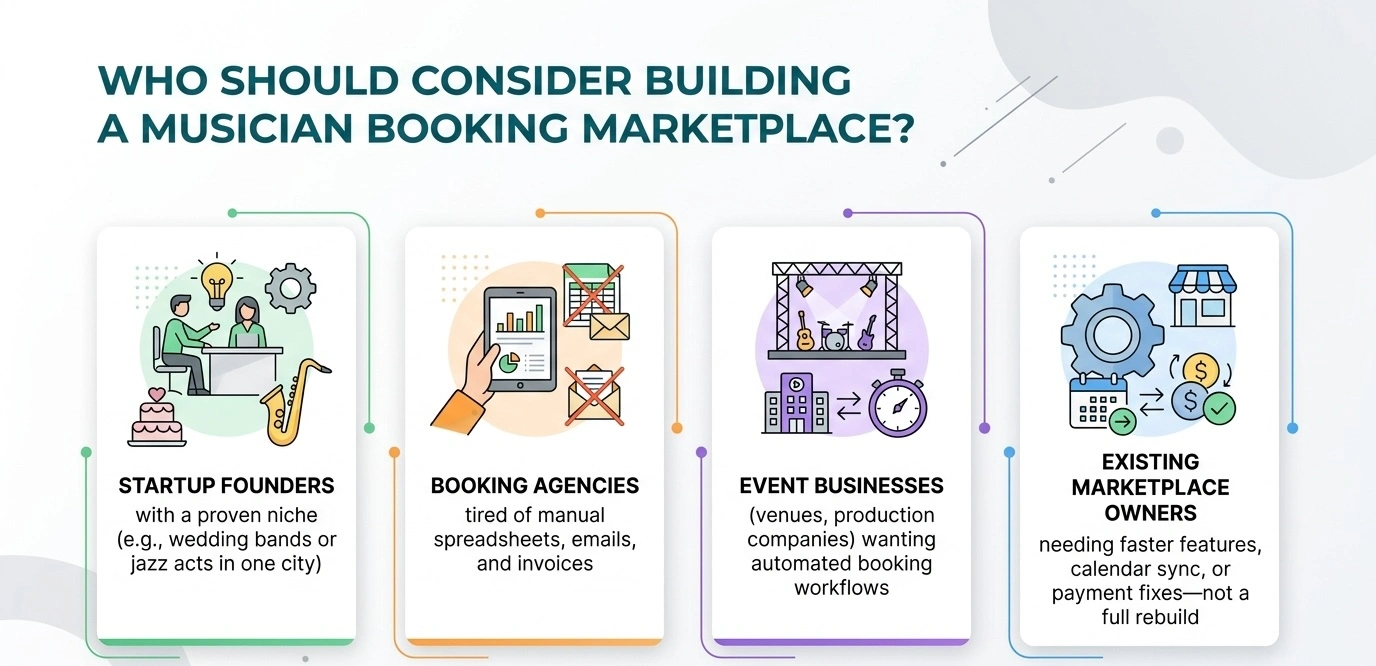
Not everyone who could build a musician booking platform should build one right now. But several groups have a strong case:
- Startup founders with a validated niche. Maybe you’ve identified a gap in a specific city, genre, or event type. A platform designed for booking musicians for weddings in one region, or for jazz acts specifically, can outperform a generalist marketplace by going deep rather than wide.
- Booking agencies moving away from manual operations. If your team is managing availability over email, tracking deposits in spreadsheets, and chasing invoices manually, you’re ready for software. Building your own platform – rather than relying on existing tools – gives you full control over the client experience and commission logic.
- Event businesses that need automated booking workflows. Venues, event production companies, and entertainment agencies that book talent regularly can build marketplace for musicians that serves both their internal operations and opens up as a marketplace for others.
- Existing marketplace owners who need support or scaling. If you’ve already launched a music booking platform and you’re hitting walls – slow feature delivery, unreliable calendar sync, payment logic that doesn’t match your business model – you don’t need a rebuild from scratch. You need a development partner who can work with what you have.
All of these are real use cases that Roobykon Software works with. The starting point is different for each, but the questions are often the same: what do I build first, how do I handle payments, and what comes next?
How a Musician Booking Marketplace Works
A musician booking marketplace runs on a few key flows. Understanding them clearly is essential before writing a single line of code.
- Search and direct book. A client browses artist profiles, filters by genre, location, availability, and price range, finds someone they like, and sends a booking request. The artist confirms, the client pays (or puts down a deposit), and the booking is locked.
- Post an event, receive proposals. The client describes what they need – a four-hour set for a corporate dinner in Tallinn, jazz preferred, budget around €800 – and musicians submit proposals. The client reviews them, picks one, and books. This reverse-marketplace model works well when clients don’t know exactly who they want yet.
- Quote request flow. A hybrid approach where the client sends a request to a specific artist asking for availability and pricing, and the artist responds with a custom quote. Common for higher-value bookings where the price isn’t fixed publicly.
User roles in a typical musician booking platform:
Role | What they do |
|---|---|
Client/event organizer | Searches, books, pays, leaves reviews |
Musician/artist / band | Creates a profile, manages availability, accepts or declines bookings, gets paid |
Agency | Manages multiple artists, handles bookings on their behalf, receives consolidated payouts |
Venue | Posts availability, connects with artists directly |
Admin | Moderates profiles, manages disputes, oversees payments and platform operations |
The interactions between these roles determine a lot of the platform’s complexity. A simple two-role platform (clients and artists) is buildable as an MVP. Add agencies, venues, and multi-artist management, and you’re in custom development territory. This is where a professional musician marketplace starts to get real – understanding these trade-offs early can save you months of headaches later.
Musician Marketplace Examples
Looking at what already exists in this space is useful, and not to copy, but to see what users already expect. And honestly, studying how musician marketplace development has played out for others helps you avoid reinventing the wheel.
- GigSalad is one of the more established platforms that books musicians for US events. Its strength is a large, categorized artist catalog with detailed profiles, reviews, and a quote-request model.
- Encore Musicians (UK-focused) was built around verified artists and a vetted booking process, which drove higher trust among corporate clients.
- Backstage has expanded from actor casting into musician and entertainment booking, showing how platform logic transfers across entertainment verticals.
- Soundcharts and similar tools focus more on the data and analytics layer for music industry professionals – a different product, but a reminder that the ecosystem extends beyond pure booking.
What these musician booking marketplaces have in common: strong artist profiles, reliable search, secure payment, and enough trust signals to convince a client to hand over money to a stranger for a live performance. That combination is the baseline for any serious platform that books musicians.
Core MVP Features for a Musician Booking Marketplace
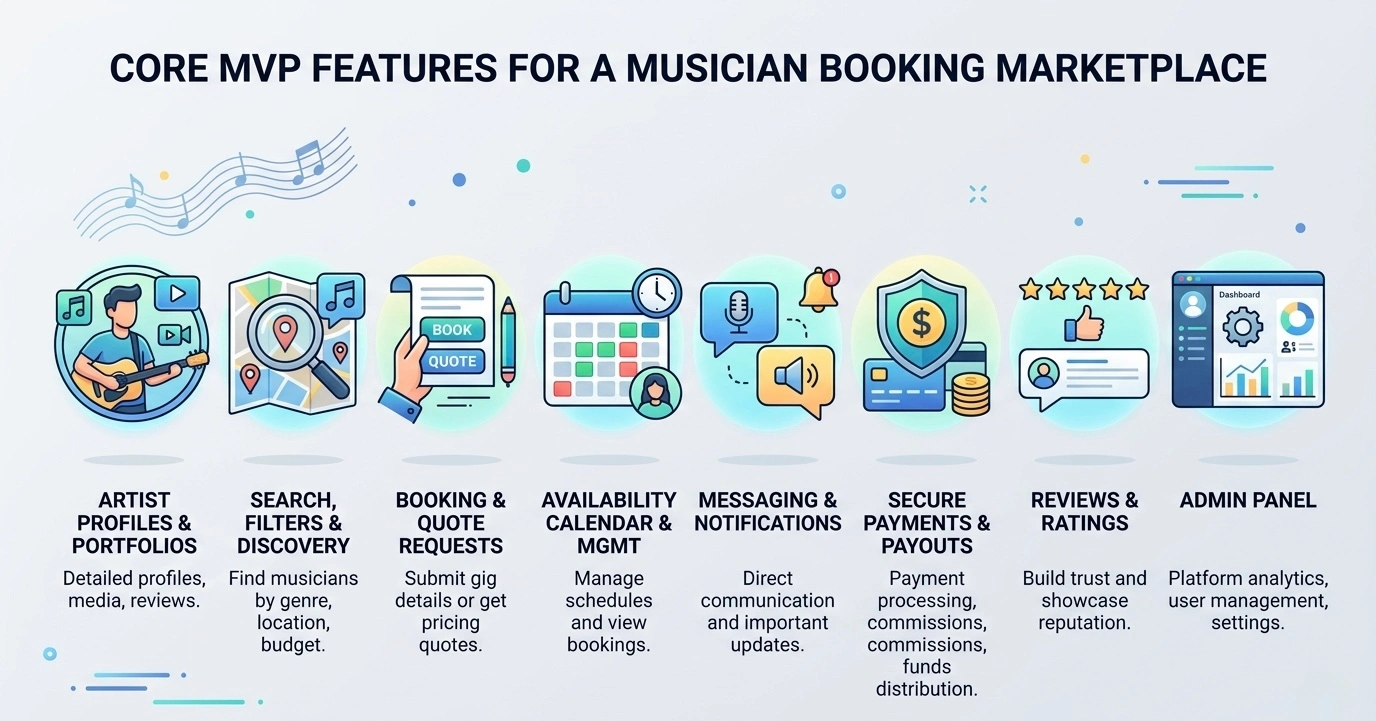
The MVP question is the one that founders get wrong most often. The instinct is to build everything. The right approach is to build the minimum that proves the business model works, and no more.
For a musician booking marketplace, that minimum is roughly:
Artist profiles and media portfolios
Name, bio, genre tags, location, pricing range, and crucially – audio and video samples. A musician profile without media is almost useless. Clients book based on what they hear and see, not what they read.
Search, filters, and location-based discovery
Genre, location, availability, price, event type. These don’t need to be elaborate on day one, but they need to work reliably. Bad search is a conversion killer.
Booking request or quote request form
The mechanism by which a client initiates contact. Whether it’s a direct booking request or a quote inquiry depends on your model, but you need at least one working path from “I like this artist” to “booking confirmed.”
Availability calendar and booking management
Artists need to mark their availability. Clients need to see it before requesting. This sounds simple and is genuinely complex to implement correctly, especially when syncing with external calendars like Google Calendar.
Messaging and notifications
Clients and artists need to communicate, negotiate, and confirm details. A basic in-platform messaging thread, plus email notifications for key actions, is the MVP version.
Secure payments, commission tracking, and payout logic
This is where most early-stage professional musician marketplaces take shortcuts, and where most operational problems originate. You need a payment provider, an escrow mechanism (holding the client’s money until the booking is fulfilled), a commission calculation layer, and a payout process for artists. More on this in the payment section below.
Reviews and ratings
Post-booking. Keeps quality high, builds trust for future clients, and gives artists a reason to deliver excellent work.
Admin panel
Profile moderation, dispute resolution, payment oversight, and user management. An overlooked MVP component that becomes urgent the first week you go live.
That’s a complete, functional platform. Everything beyond this is either a growth feature or a scaling feature.
Advanced Features for Scaling the Music Booking Platform
Once the core model is validated and you’re seeing real booking volume, the next layer of investment makes sense. This is where you move from “does it work?” to “how do we grow?”, and where you really create musicians marketplace features that drive retention and revenue.
Feature | What it unlocks |
|---|---|
AI-based matching and recommendations | Suggests artists based on event type, past bookings, and preferences, increasing conversion and cutting time-to-booking |
Dynamic pricing and featured listings | Artists adjust rates by demand or season; featured placement becomes a platform revenue stream |
Agency dashboards and multi-user accounts | Consolidated booking views, shared calendars, and delegated access for agencies managing many artists |
Contract templates and e-signature | Formal, legally binding agreements that reduce disputes on high-value bookings |
CRM, analytics, and reporting | The data operators need to run the platform professionally: booking trends, conversion rates, revenue by market |
Mobile apps for artists and organizers | Artists manage bookings on the go; organizers browse and book from any device |
Integrations | Google Calendar for availability sync, Stripe and PayPal for payments, CRM tools for agencies, marketing platforms for growth |
None of these belong in an MVP. All of them become important when the business model is proven and the platform is scaling. If you want to build booking platform for musicians that lasts, resist the urge to add these too early. Get the core right first, then layer in the smart stuff.
Monetization Models for Artist Booking Marketplaces
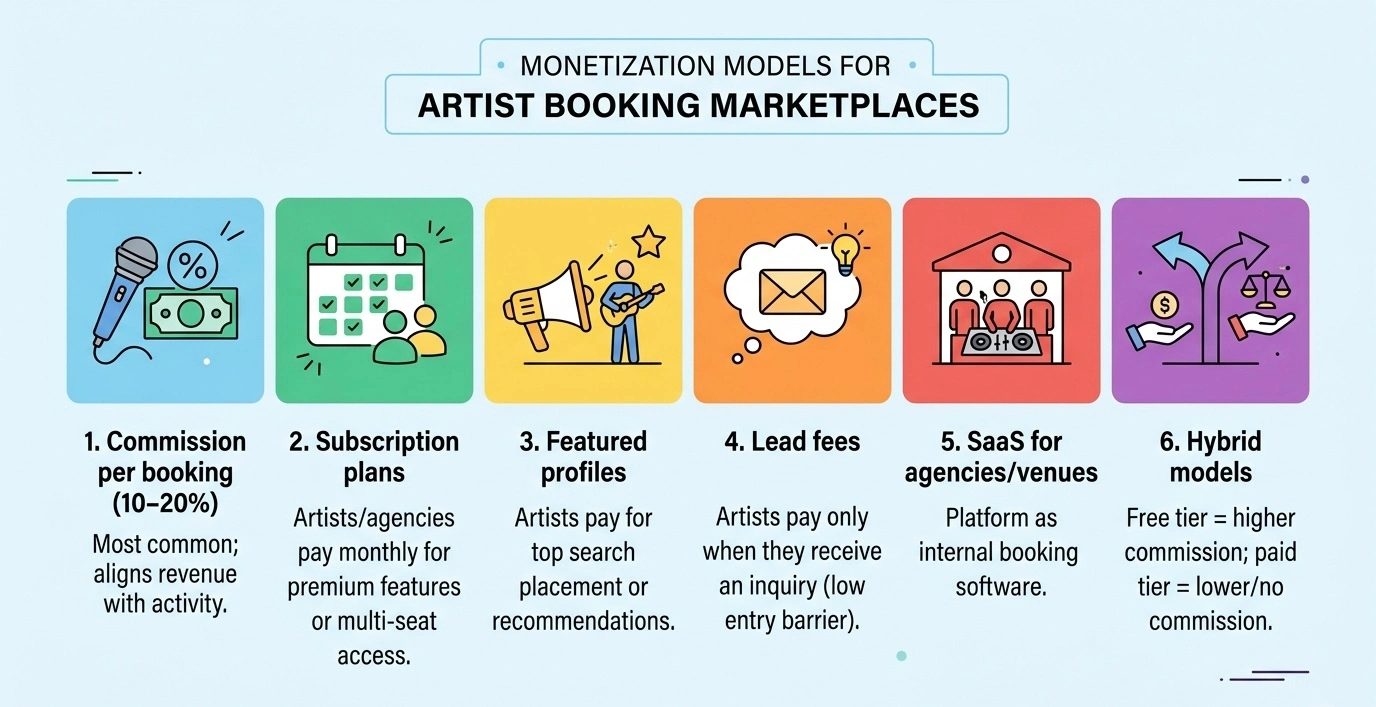
A performer booking marketplace has several practical ways to generate revenue:
- Commission per booking is the most common model. The platform takes a percentage of each transaction – typically 10–20% from the total booking fee. Some platforms split this between the buyer and seller side commissions. It aligns revenue with platform activity and scales naturally.
- Subscription plans for artists or agencies provide predictable recurring revenue. Artists pay a monthly fee for access to the platform or for premium features (more media uploads, better search ranking, analytics). Agencies pay for multi-seat access and management tools.
- Featured profiles and paid promotion let artists pay to appear at the top of search results or in recommended sections. Works well once you have enough organic traffic to make visibility valuable.
- Lead fees charge artists only when they receive a booking inquiry, rather than a subscription or commission. Lower barrier to entry, but harder to scale.
- SaaS model for agencies or venues positions the platform as software for an organization’s internal use – they pay a platform fee to run their booking operations through your system, rather than using it as a public marketplace.
- Hybrid models combining commission and subscription are common at scale. Artists on a free tier pay higher commissions; premium subscribers pay lower commissions or none at all. This gives users a choice and the platform multiple revenue levers.
The right model depends on your market, your supply side (are artists price-sensitive?), and your growth stage. Commission-only is the simplest to start. Subscriptions require volume to feel fair.
Payment, Commission, and Payout Logic
Payment is where music booking platforms either earn client trust or lose it. And it’s far more complex than adding a payment button.
A typical booking payment flow looks like this:
- Client pays a deposit (or full amount) to confirm the booking. Money is held in escrow – the artist doesn’t receive it yet.
- The event happens. Artist fulfills the booking.
- Platform releases the payout to the artist, minus the commission.
But the real-world complexity multiplies quickly:
- Deposits vs. full payments. Do you take 30% upfront and 70% a week before the event? 50/50? Full payment on booking? Each model has different escrow and refund implications.
- Cancellation and refund rules. What happens if the client cancels two weeks out? What if the artist cancels? Your artist booking platform cancellation policy needs to be encoded in the payment logic, not just described in terms of service.
- Platform commission. Calculated on the gross amount or net? Deducted from artist payout, client charge, or both? Split commission models are common but add calculation complexity.
- Payment provider fees. Stripe, PayPal, and similar processors charge their own fees. These need to be accounted for in your commission math.
- International payouts. Artists in different countries mean different banking systems, currencies, tax requirements, and payout methods.
- Disputes. When a client claims the performance didn’t happen or wasn’t as described, the platform needs a mechanism to hold funds, review evidence, and release or refund appropriately.
For platforms using Stripe Connect, much of the escrow and payout infrastructure is
available out of the box, but configuration for marketplace-specific logic still requires careful implementation.
Music Marketplace Development Options: No-Code, Sharetribe, or Custom Marketplace
When you build a musician marketplace, you don’t need to over-engineer it on day one. The “right” choice is about finding the best technology for your current stage of validation, booking complexity, budget, and long-term vision.
Let’s break down the 3 most common paths (and a sneaky fourth option) to see where your platform fits.
1. No-Code: Fast, Cheap, and Beautifully Scrappy
Think of No-Code tools as your ultimate reality check. They are fantastic for early validation and simple workflows. If your main goal is to launch next week, test market demand, and see if users will actually click “book,” this is your starting point.
- When it works: You’re an early-stage startup with a tight budget. If you’re building a basic singer platform where you handle a lot of the matchmaking and booking manual logic behind the scenes, no-code is perfect.
- The Catch: You will hit a wall. The moment you need complex commission structures, automated split payouts, advanced search filters, or multi-layered user roles, no-code starts to feel like fitting a square peg into a round hole.
2. Sharetribe: The Marketplace Shortcut
Sharetribe is the sweet spot for founders who want a marketplace that actually acts like a marketplace out of the box, without reinventing the wheel. It gives you an immediate head start with built-in user accounts, messaging, listings, and essential payment flows.
- When it works: You have a clear business model for your professional musician marketplace and want to launch a highly functional MVP without the massive price tag of custom code. It drastically cuts down your time-to-market.
- The Catch: Out-of-the-box templates only take you so far. As you scale, you’ll inevitably want unique payment logic or bespoke workflows. This is where working with a Sharetribe development partner becomes valuable.
3. Custom Development: Unlimited Power (At a Price)
If you can dream it, you can build it. Custom marketplace development gives you absolute control over your architecture, user experience, and scalability. It is the gold standard for platforms that need to handle heavy lifting. The talent marketplace development process follows the same logic – validate first, then invest in custom architecture once the model is proven.
- When it works: You’re building a professional, high-volume music booking platform. We’re talking about advanced features like agency dashboards, AI-driven talent recommendations, automated contract management, dynamic pricing, or deeply integrated CRMs.
- The Catch: High freedom comes with high costs. This path requires a significant upfront financial investment and a much longer runway before launch.
The Secret Weapon: The Hybrid Approach
You don’t have to marry your first tech stack.
Many of the most successful marketplaces use an evolution-based hybrid strategy. They validate their idea with no-code or Sharetribe to get cash flowing and users talking. Once they prove the concept and find product-market fit, they reinvest that revenue into a custom-built powerhouse.
Here’s a quick comparison to help orient the decision:
No-code | Sharetribe | Custom | |
|---|---|---|---|
Best for | Early validation | Standard MVP | Complex models |
Time to launch | Weeks | 6–12 weeks | 4–12 months |
Custom booking logic | ✗ | Partial | ✓ |
Agency management | ✗ | With customization | ✓ |
Mobile apps | ✗ | ✓ | ✓ |
Long-term scalability | Low | Medium | High |
As а marketplace solution for startups, Roobykon works across all three approaches – helping founders choose the right starting point, not just the one that creates the most development work.
How Much Does It Cost to Build Marketplace For Musicians?
There’s no honest single number here, because the cost is driven almost entirely by scope. But the variables are predictable.
What drives cost up:
- Number of distinct user roles with unique interfaces (client, artist, agency, venue, admin)
- Calendar complexity: especially two-way sync with external calendars and multi-timezone support
- Custom payment logic: deposits, split commissions, multi-currency payouts, dispute handling
- Mobile apps for iOS and Android (roughly double the frontend cost versus web-only)
- Advanced search: location radius, availability filtering, AI-based matching
- Third-party integrations: Stripe Connect setup, CRM, e-signature, marketing tools
- Migration from an existing platform or legacy codebase
What keeps costs in range:
- Starting with a Sharetribe base and customizing rather than building from scratch
- Limiting the MVP to two user roles and the core booking flow
- Deferring mobile apps to a post-validation phase
- Using a development partner with marketplace-specific experience (no learning curve on common patterns)
A Sharetribe-based MVP with core customization typically runs in the range of tens of thousands of dollars and can launch in two to four months. A fully custom musician booking marketplace with agency management, mobile app development, and complex payment logic is a six-figure project over six to twelve months.
The most expensive mistake is building too much before validation. The second most expensive is under-building the payment and admin systems because they feel less exciting than the product features.
Common Mistakes When Building a Music and Artist Booking Marketplace
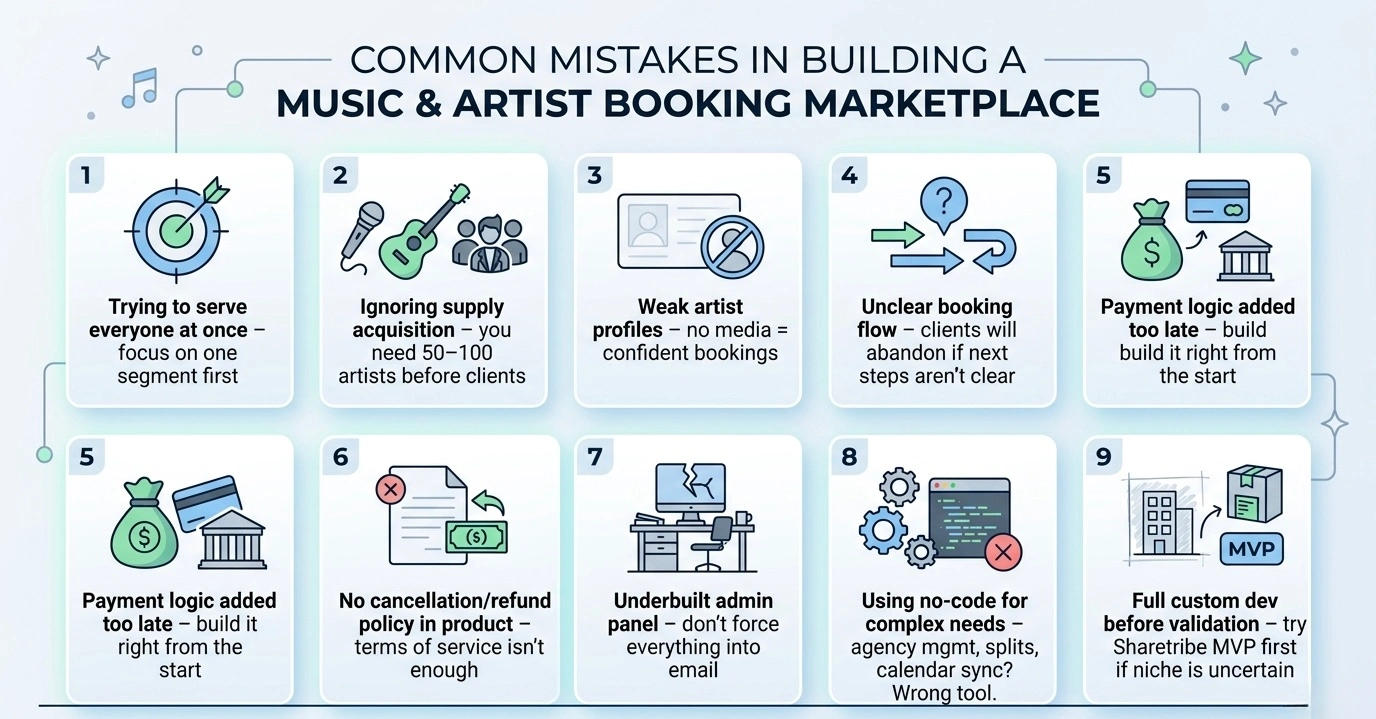
These come up repeatedly in musician marketplace development conversations and post-launch support requests:
Building for everyone before proving value to anyone. A platform that serves musicians, DJs, event speakers, wedding entertainers, and corporate acts simultaneously sounds comprehensive. It’s actually unfocused. Start with one segment, serve it deeply, and expand.
Ignoring supply acquisition. The marketplace chicken-and-egg problem is real. A platform without musicians isn’t useful to clients. Plan for how you’ll get the first 50 to 100 quality artists onboarded before worrying about client acquisition.
Weak artist profiles. If musicians can’t upload audio and video samples, clients can’t make confident decisions. Media capabilities need to be in the MVP.
Unclear booking flow. If a client doesn’t know what happens after they click “Request Booking” – how long until they hear back, when they pay, what confirms the booking – they’ll abandon the process. Every step needs a clear next action and expectation.
Payment logic added too late. “We’ll handle payments properly in v2” is how you create six months of accounting problems, client disputes, and artist frustration. Build the payment and commission layer correctly from the beginning.
No cancellation or refund policy encoded in the product. A terms-of-service page isn’t enough. The platform needs to enforce cancellation rules automatically – timing-based refund calculations, deposit release rules, payout holds.
Underbuilt admin panel. Operators who can’t moderate profiles, review disputes, or manually adjust payouts end up handling everything by email. The admin panel isn’t a nice-to-have.
Choosing no-code when the requirements are already complex. If your booking flow has agency management, custom commission splits, and calendar sync on day one, no-code won’t get you there. Start with the right tool.
Choosing full custom development before validating the model. If you’re not sure the niche is viable, a Sharetribe-based MVP at a fraction of the cost is the smarter first step.
Already Have a Music Marketplace? When to Bring in a Development Partner
Not every client Roobykon works with is building something new. A significant portion are founders and teams who built a platform (sometimes years ago) and now need help with what comes next.
These are the signals that it’s time to bring in a musician platform development partner. If three or more of these feel familiar, the conversation is overdue:
🔲 Confirmation emails are still being sent manually
🔲 Payment records live in a spreadsheet, not the platform
🔲 Artists are getting double-booked because the calendar isn’t reliable
🔲 Clients and artists are completing payment off-platform via bank transfer or personal PayPal
🔲 Reconciling monthly commissions takes your team hours every month
🔲 Search results don’t reflect what clients are actually looking for
🔲 You can’t add a new city, category, or user role without significant rework
🔲 Every new feature takes weeks longer than it should because of old code
All of these are situations where Roobykon’s entertainment platform development team has helped existing marketplace owners get unstuck — without necessarily starting from scratch.
How Roobykon Can Help
Roobykon is a marketplace development company that specializes in building, improving, and scaling platforms.
Specifically for musician and artist booking marketplaces, Roobykon offers:
- Marketplace MVP development. For founders at the idea stage who need a working platform, not a proof of concept. Includes scoping, design, development, and launch support.
- Sharetribe customization and migration. As a certified Sharetribe development partner, Roobykon extends Sharetribe platforms beyond what the standard configuration supports – custom booking flows, payment logic, user roles, and integrations – and handles migrations when clients are ready to move to a custom stack.
- Custom musician booking marketplace development. For complex business models that require purpose-built architecture. Multi-role platforms, custom payment and commission systems, agency management, and mobile apps.
- Payment and booking flow improvement. For existing platforms where the payment logic, commission tracking, or payout system needs to be rebuilt or significantly improved.
- Long-term marketplace support and feature development. For founders who want an ongoing technical partner rather than a one-time vendor. Roobykon works with clients through launch, growth, and scaling phases.
Not sure where to start?
You don't need perfect specs, just a partner who's built this before. Roobykon has helped founders launch artist booking platforms, agency dashboards, and payment-ready marketplaces. Let's explore what's possible for yours.
Get a free consultationRoobykon’s Music Booking Platform Case Studies
Roobykon has built real platforms in the musician booking and entertainment space – not just adjacent projects, but systems that tackled the exact problems this article has been discussing: complex search, secure payments, trust between strangers, and the challenge of making a creative industry work like a reliable marketplace.
Musiclift – Musical Service Platform (P2P & B2C)
Musiclift started from a deeply personal place. The founders watched their son and his peers struggle to break through as emerging performers. Finding gigs, connecting with venues, building an audience: all of it was fragmented, manual, and frustrating. Their answer was a platform built to democratize access to opportunities for independent musicians.
The problem was about building something that felt native to the music world – not a generic marketplace with a musician skin on top. That meant rethinking the design from the ground up: asymmetrical, media-forward layouts that put audio and video at the center.
Key challenges Roobykon solved:
- Deep search: The engine needed to go far beyond genre and location, filtering by subgenre, band size, specific instruments, pricing range, and more – all with enough precision that a client booking a jazz quartet for a corporate dinner could narrow the field meaningfully
- Custom payment layer: The team built a custom in-platform digital wallet alongside Stripe Connect escrow, giving musicians transparent earnings breakdowns and clients clear payment information at every step
- Platform integrations: Artists link their Spotify and SoundCloud profiles directly to their Musiclift pages, letting their existing music speak before a client ever sends a booking request
- Design that fits the industry: Streaming video banners, a three-column search layout, non-symmetrical visual design – built to feel like a professional platform designed for booking musicians, not a generic marketplace
Tech stack: Sharetribe Flex · ReactJS · Redux · NodeJS · Express · Digital Ocean
Built on Sharetribe Flex extended with a modern React frontend, Musiclift launched as a platform that felt genuinely designed for musicians rather than adapted for them.
Cordially – Service Marketplace for Event and Party Planning (B2C)
Not every entertainer booking is a musician. Cordially was built around the broader world of event service providers – chefs, animators, tableware suppliers, party planners – connecting them with clients organizing weddings, corporate events, birthday parties, and private dinners. The booking and trust logic is identical to a musician platform: clients need to verify quality, communicate with providers, pay securely, and know what happens if plans change.
This performer booking marketplace project moved quickly from concept to launch. The interesting challenge came later, when a Sharetribe template update introduced native support for variable pricing within listings – a feature Roobykon had already implemented through custom code. Reconciling those two implementations without breaking the client’s live platform required careful coordination and multiple rounds of testing.
Tech stack: Sharetribe Web Template · ReactJS · Redux · NodeJS · Express
Musician Booking Marketplace FAQ

Recommended articles
 How to Hire a Dedicated Software Development Team: A Practical Guide for Founders and Product Owners
Most founders hire a dedicated development team backward – they pick a vendor, negotiate a price, and then figure out what they actually need. By then, it's usually too late. This guide flips that.
 How to find a web development partner for your startup: a step-by-step guide
Choosing the wrong development partner can cost you months. Use this expert guide from Roobykon Software to find a trusted web development partner who treats your startup like their own.
 Caregiving Marketplace Development Guide for Founders
The health caregiving market is exploding. This guide shows you how to capture it. From caregiver business models that actually generate revenue to compliance strategies that win enterprise contracts – get the insights you need to build a defensible, fundable caregiving marketplace.
 The Ultimate Guide on How To Build a Multi-Vendor Marketplace in 2026
Unlock the secrets of successful marketplaces. This guide explains how a multi-vendor website works and provides a clear plan to build your own, from validating your idea to launching and driving growth.