When Do You Actually Need to Hire a Node js Developer?
When Node.js may not be the best first choice
What Type of Node.js Developer Do You Need?
Hiring Models: Freelancer, In-House Developer, Dedicated Team, or Development Company?
How to Define Your Node.js Development Requirements Before Hiring
Core Node.js Skills to Look For
Marketplace-Specific Skills Your Node.js Developer Should Have
How to Assess Node.js Developers Before Hiring
Common Mistakes When Hiring Node.js Developers
How Much Does It Cost to Hire Node.js Developers?
Node.js Version, Framework, and Stack Considerations
Should You Hire Node js Developers or Work With a Marketplace Development Partner?
Subscribe and you will promptly receive new published articles from the blog by mail
Building a marketplace or SaaS platform is one of the most ambitious and rewarding challenges a founder can take on. But the fact is, your success hinges on one critical decision – who you hire to build it.
Many marketplaces and SaaS products have selected Node.js as the backend engine. It powers real-time features, handles high concurrency, and scales beautifully with modern API-first architectures. But if you’re looking for Node js developer who can actually deliver on that promise? That’s where things get tricky.
This Node.js developer hiring guide walks through everything a founder, product manager, or CTO needs to know before starting a search: when you actually need Node.js, what type of developer fits your project, how to evaluate candidates, what it costs, and how to avoid the mistakes that turn a promising hire into a six-month rebuild.
- Node.js shines for real-time features, API-heavy platforms, and high-concurrency workflows – the backbone of most modern marketplaces and SaaS products.
- The right hire depends on your stage. A single backend developer might cover an MVP; a scaling marketplace usually needs a dedicated team or an architect. If you're looking for top Node js developers, be honest about where you are in your journey.
- Define the business problem before writing a job post. The skill set you are hiring for is shaped by the marketplace model, the workflows, and the technical constraints.
- Marketplace experience is more important than general Node.js experience. Payments, payouts, matching logic, and multi-sided permissions are where generalist developers usually struggle. That is why founders hire dedicated Node js developers who've been there before.
- A practical test beats a resume every time. Portfolio review, targeted technical questions, and a small marketplace-flavored coding exercise reveal far more than years of experience alone.
- Hiring models range from freelancers to full development partners. Each comes with trade-offs in cost, speed, and long-term reliability.
When Do You Actually Need to Hire a Node js Developer?
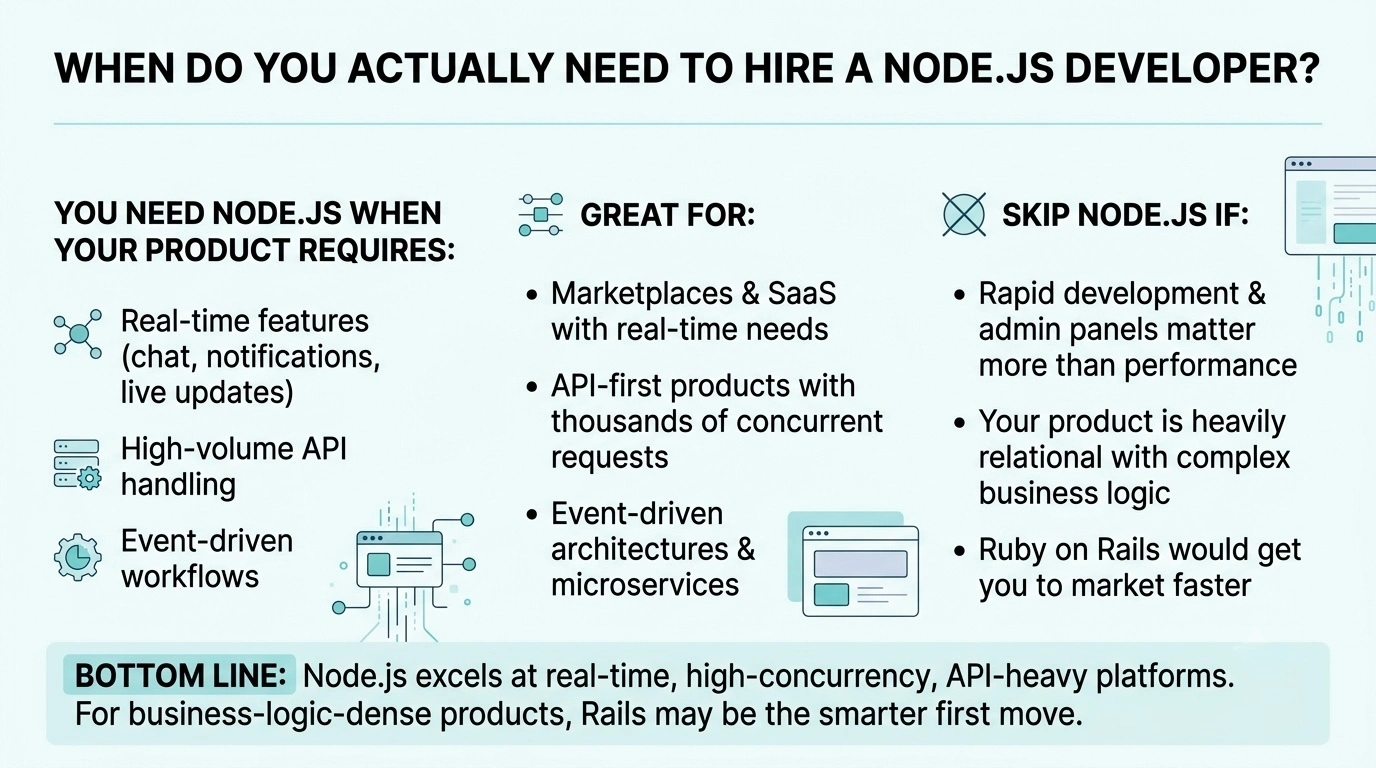
You need to hire a Node.js developer when your product requires real-time features, handles high volumes of concurrent API requests, or needs to process event-driven workflows efficiently.
Before you start interviewing candidates, it’s worth pausing on a more fundamental question: does your product actually need Node.js? Plenty of founders skip this step, hire a Node.js developer based on what’s trendy or what their first engineer prefers, and end up with a stack mismatch a year later. Node.js is an excellent choice for a specific set of problems, and a mediocre one for others.
Marketplaces thrive on immediacy. When a buyer books a service, makes an offer, or sends a message, they expect instant feedback. Node.js, with its event-driven, non-blocking architecture, is built for exactly this.
Roobykon Software has delivered this in practice. In the Rabel digital content platform, Node.js with Express powered the backend for a creator-first ecosystem, handling complex workflows like video file processing, secure storage for purchased assets, and seamless integration with Stripe for a flexible pay-as-you-go subscription model.
If your marketplace needs live chat, instant notifications, collaborative editing, or real-time inventory updates, you need to hire Node js experts.
You need Node.js for API-heavy products
Modern SaaS products are rarely monolithic anymore. They are ecosystems of microservices, 3rd party integrations and APIs talking to each other. Node.js is great for building lightweight, fast APIs that can easily handle thousands of concurrent requests.
At Roobykon, the Xnomad commercial property booking platform runs on Express.js, a Node.js framework that offers efficiency and flexibility, with hosting on Digital Ocean’s microservice architecture. This combination offers complex search, rental and booking abilities for commercial real estate.
If your product is API-first (or will become one), you need to hire the best Node js developers who understand RESTful API design, rate limiting, versioning, and documentation. That’s Node.js territory.
You need Node.js for event-driven and high-concurrency workflows
Node.js uses an event loop with a single server to handle thousands of concurrent connections. This makes it perfect for:
- Event-driven architectures where actions trigger other actions (e.g., a booking triggers payment, which triggers a notification, which triggers calendar updates)
- High-concurrency workloads, such as handling thousands of users browsing listings simultaneously
- Microservices where services communicate via events
If your marketplace or SaaS will have spikes in traffic – think Black Friday for e-commerce or a viral launch – Node.js handles the load. And with the rise of remote work, you can easily hire remote Node js developer who brings this expertise without being tied to your location.
When Node.js may not be the best first choice
Node.js isn’t the best choice for projects where rapid development and a rich admin panel matter more than raw performance – Ruby on Rails often gets you to market faster in those cases.
Node.js excels at real-time features, high concurrency, and API-heavy architectures. But if your product is heavily relational or dominated by complex business logic, a more opinionated framework like Rails may serve you better. Rails’ “Convention over Configuration” philosophy and extensive ecosystem let you launch weeks or months sooner. If you’re still weighing your options, it’s worth reading our breakdown on how to choose between Rails and Node.js before committing to a hiring plan – the wrong stack decision is far more expensive to reverse than a slow hiring process.
What Type of Node.js Developer Do You Need?
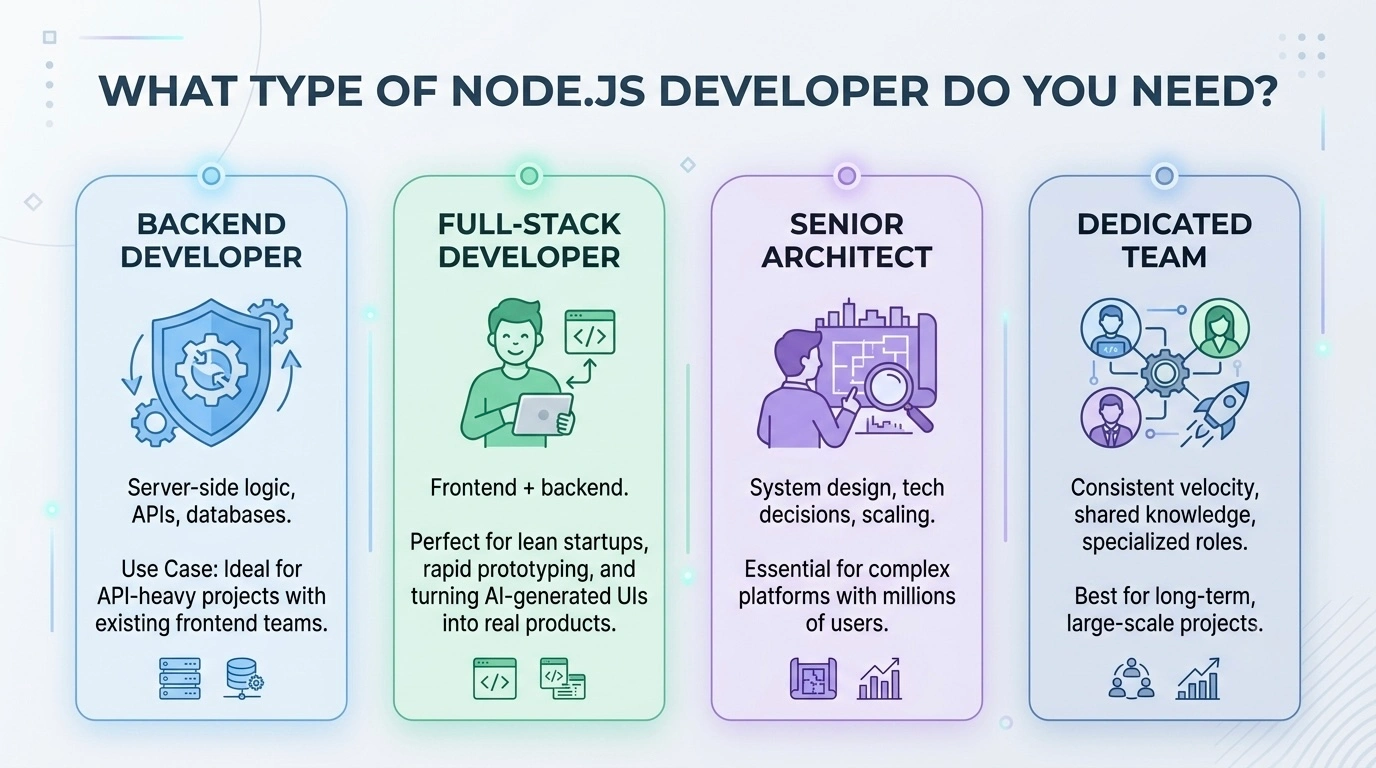
You need a backend Node.js developer for API-heavy, server-side work; a full-stack developer for lean teams and tight frontend-backend coupling; a senior architect for complex, scalable systems; a dedicated team for consistent, long-term velocity; or a marketplace development partner for end-to-end strategic guidance.
Here’s how to match the type of developer to your project’s needs.
Backend Node.js developer
A backend Node js developer focuses on server-side logic, APIs, database interactions, and system architecture. They may not touch the frontend at all. You need this role if:
- You already have a frontend team (or a separate frontend stack)
- Your project is API-heavy
- You need deep expertise in performance optimization and system design
Full-stack JavaScript developer
The full stack Node js developers handle both frontend (React, Vue, Angular) and backend (Node.js). They’re ideal for:
- Startups with lean teams
- Projects where the frontend and backend are tightly coupled
- Rapid prototyping and MVP development
- Turning an AI-generated frontend into a real product
In the last option, it’s increasingly common for non-technical founders to prototype a UI with an AI tool, then hit a wall when they need an actual backend behind it. A full-stack developer can wire up that frontend to real data, authentication, and business logic (in practice, this usually means rebuilding a fair amount of the frontend too, not just bolting on a backend).
When you hire full stack Node js developers, you get professionals who can navigate the entire stack – from database to UI. This versatility reduces team dependency, speeds up development, and leads to more cohesive architecture decisions.
Senior Node.js architect
When you’re building something complex like a multi-vendor marketplace, a fintech SaaS, or a platform with millions of users, you need someone who thinks beyond code. A senior architect:
- Designs system architecture
- Makes technology decisions (frameworks, databases, deployment)
- Mentors junior developers
- Anticipates scaling challenges before they happen
Hire senior Node js developers when your product needs to last. Junior developers can write code; senior developers build systems.
Dedicated Node.js development team
Sometimes one developer isn’t enough. You might need a dedicated Node.js development team – a pod of developers working exclusively on your project. This model offers:
- Consistent velocity
- Shared knowledge (no bus factor)
- Specialized roles (backend, frontend, DevOps)
If you’re considering this route, explore options to hire dedicated Node js developers company – partnering with an established firm rather than building a team from scratch.
Marketplace development partner
This is the most comprehensive option. When you hire Node js development expert like our team at Roobykon, you’re getting strategic partners who understand the full lifecycle of marketplace platforms.
We have spent nearly 15 years helping founders build service marketplaces, from early-stage MVPs to enterprise-grade platforms. We’ve launched 130+ platforms across multiple industries, combining Sharetribe expertise with full-cycle capabilities in Ruby on Rails, React.js, and Node.js.
Hiring Models: Freelancer, In-House Developer, Dedicated Team, or Development Company?
Once you know what type of developer you need, the next decision is how you want to bring that skill in. Each model trades off cost, control, and risk differently.
Model | Best for | Trade-offs |
|---|---|---|
Freelancer | Small, well-defined tasks or short-term support | Often the cheapest option per hour, but limited accountability, availability risk, and no built-in backup if they disappear mid-project |
In-house developer | Long-term product ownership once you have steady funding and a clear roadmap | Highest fixed cost, slowest to hire, but deepest product knowledge over time |
Dedicated team | Marketplaces scaling fast that need multiple skill sets working in sync | Higher monthly cost than a freelancer, but much more reliable throughput and built-in redundancy |
Development company/marketplace partner | Founders who want strategy and execution together, not just code | Higher upfront cost, but better product decisions that prevent expensive mistakes and reduce total development costs |
Most marketplace founders end up mixing models over time: a freelancer or small team for the MVP, then a dedicated team or development partner once the product has traction and the cost of getting the backend wrong starts to outweigh the cost of hiring properly.
How to Define Your Node.js Development Requirements Before Hiring
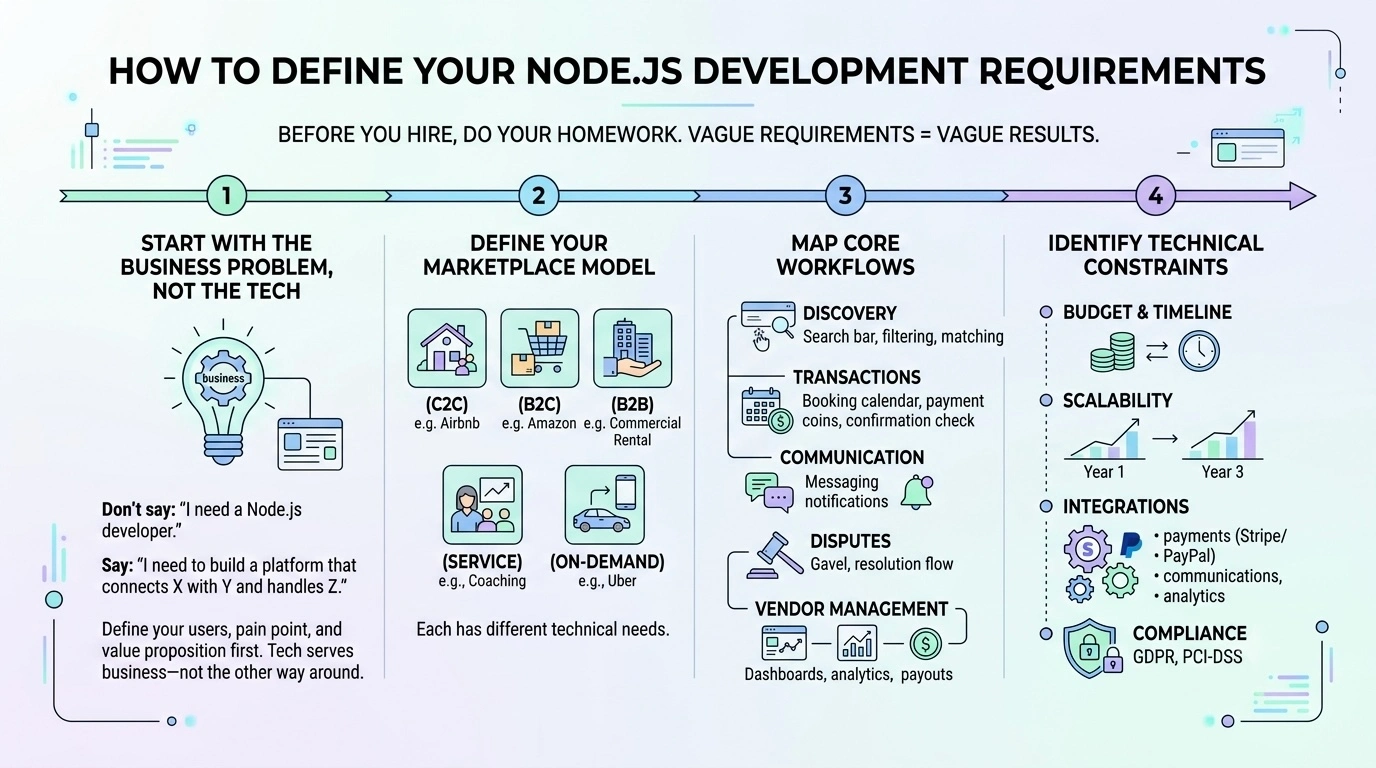
Before you post a job or reach out to a partner, do your homework. Vague requirements lead to vague results.
1. Start with the business problem, not the technology
Too many founders say: “I need to hire a Node js developer.” What they really mean is: “I need someone to build a platform that connects X with Y and handles Z.”
Define your business problem first. What pain point are you solving? Who are your users? What’s the core value proposition? The technology should serve the business, not the other way around.
Once you’ve clarified the business problem, you can determine what kind of technical expertise you actually need. A Node.js API developer is essential if your platform will handle heavy data exchange between frontend and backend, integrate with multiple third-party services, or expose functionality to external partners. Knowing this upfront prevents you from hiring a generalist when you really need an API specialist.
2. Define your marketplace model
Are you building a:
- C2C marketplace (consumer-to-consumer, like Airbnb)?
- B2C marketplace (business-to-consumer, like Amazon)?
- B2B marketplace (business-to-business, like THIRE’s commercial vehicle rental)?
- Service marketplace (like The Coaching Hut)?
- On-demand marketplace (like Uber)?
Each model has different technical requirements. Roobykon builds all of these, with dedicated services for C2C marketplace development, B2C marketplace platforms, and job and service marketplaces.
3. Map your core marketplace workflows
List every user journey:
- How do users discover listings? (Search, filtering, matching)
- How do they transact? (Booking, payment, confirmation)
- How do they communicate? (Messaging, notifications)
- How do you handle disputes? (Resolution, refunds)
- How do you manage vendors? (Dashboards, analytics, payouts)
These workflows will dictate your technical requirements.
4. Identify your technical constraints
Be honest about:
- Budget: How much can you spend?
- Timeline: When do you need to launch?
- Scalability: How many users in year one? Year three?
- Integrations: Payments (Stripe, PayPal), communications (Twilio), analytics, etc.
- Compliance: GDPR, PCI-DSS, industry regulations
Core Node.js Skills to Look For
Regardless of marketplace specialization, there’s a baseline of Node.js competence every serious candidate should demonstrate:
- JavaScript and TypeScript fundamentals: not just syntax familiarity, but a real understanding of asynchronous patterns, closures, and the event loop.
- Express.js, NestJS, or Fastify experience: the frameworks that make up the bulk of production Node.js APIs today. A NestJS developer brings more structure and is often a better fit for larger codebases; an Express.js developer may move faster on smaller, simpler builds.
- API design and integration experience: REST and/or GraphQL design, versioning discipline, and experience integrating third-party services cleanly.
- Database and data modeling skills: comfort with both relational databases (PostgreSQL, MySQL) and NoSQL stores (MongoDB, Redis), and, more importantly, good judgment about which to use where.
- Authentication, authorization, and permissions: critical in any multi-sided product where buyers, sellers, and admins all need different access levels.
- Payment and transaction flow experience: Stripe Connect, PayPal, or similar marketplace payment APIs, plus an understanding of how payouts, refunds, and commission splits actually work in production.
- Real-time and event-driven architecture: WebSockets, Socket.IO, message queues (RabbitMQ, Kafka, or similar), and experience designing systems around events rather than just request-response cycles.
- Testing, debugging, and observability: unit and integration testing discipline, plus comfort with logging and monitoring tools that let a team catch problems before customers do.
Marketplace-Specific Skills Your Node.js Developer Should Have
This is where a generic Node.js API developer and a marketplace-ready Node.js developer really diverge. Look for direct experience with:
- Multi-sided user logic: different roles, permissions, and dashboards for buyers, sellers, and admins, often layered on the same underlying data model.
- Search, filtering, and matching logic: from simple keyword search to more complex matching algorithms that connect the right buyer with the right listing.
- Booking, rental, and availability systems: calendar logic, overlapping booking prevention, and time-zone handling, which sound simple until they’re built at scale.
- Payments, payouts, and commissions: splitting a single transaction between platform fees, seller payouts, and taxes, correctly and auditable.
- Notifications and messaging: email, SMS, push, and in-app messaging systems that keep both sides of the marketplace informed without becoming noise.
- Admin and vendor dashboards: the internal tools that let your team (and your sellers) actually operate the marketplace day to day.
How to Assess Node.js Developers Before Hiring
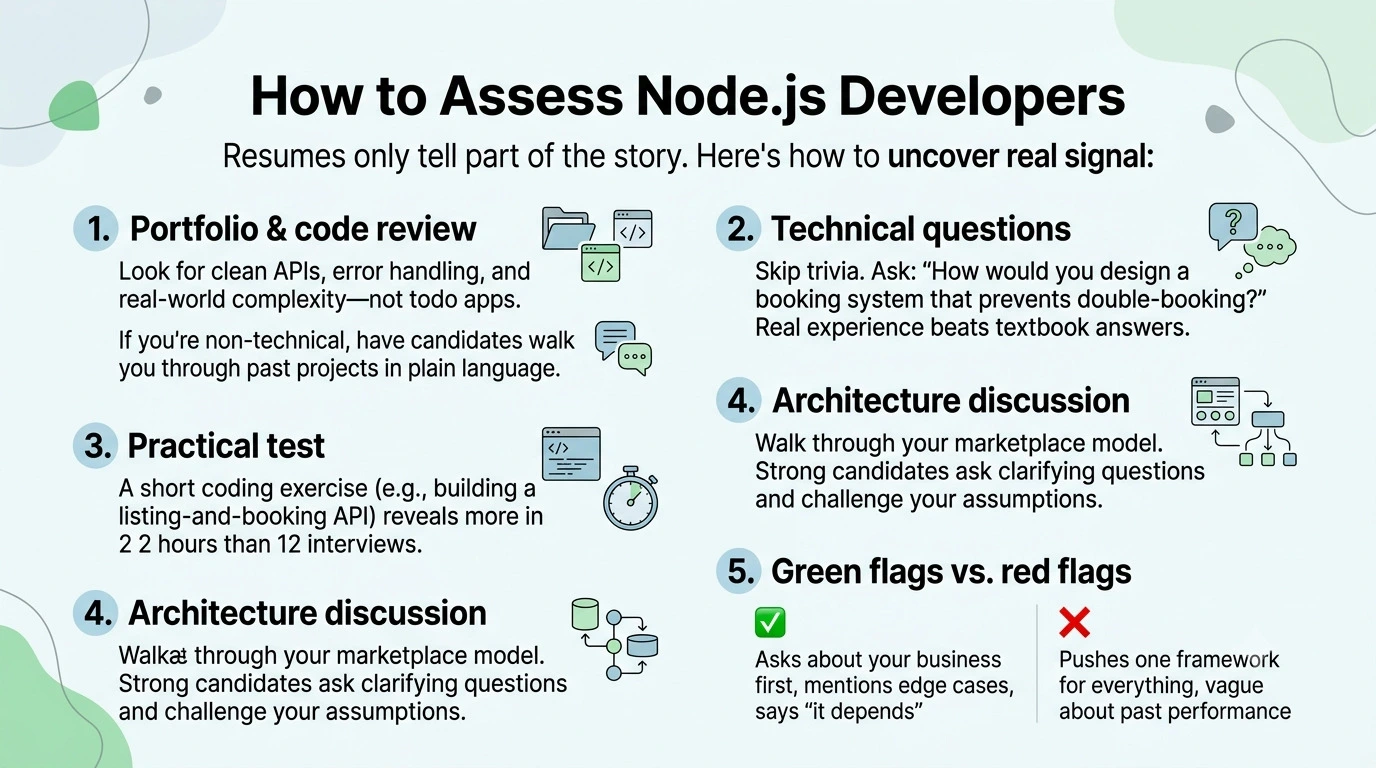
Resumes and portfolios only tell you so much. Here’s a practical hiring Node js developers evaluation sequence that surfaces real signal.
1. Portfolio and code review
If you have a CTO, technical co-founder, or fractional technical advisor, have them ask for links to production code and look for clean API structure, sensible error handling, and evidence of real-world complexity, not just to-do-list clones.
If you don’t have anyone technical on your side yet, don’t try to judge code on your own: ask the candidate to walk you through a past project in plain language, request references from real clients, and ask for a small test task you can have someone else review.
The top Node js developers will have battle-tested projects they’re proud to walk you through, whether or not you can read the code yourself.
2. Technical interview questions
Go beyond “what is the event loop.” Ask how they’d design a booking system that prevents double-booking, or how they’d structure a payout flow with platform commissions. The answers reveal whether they’ve actually built this before. When you hire Node js experts, you should hear hard-won stories, not textbook answers.
3. Practical test for marketplace backend
A short, scoped coding exercise – building a basic listing-and-booking API, for example – tells you more in two hours than a dozen behavioral interview questions.
4. Architecture discussion
Walk through your actual marketplace model with the candidate and ask them to sketch how they’d structure the data and services. Strong candidates ask clarifying questions before proposing a solution. The best ones will challenge your assumptions – that’s exactly what you want when you hire Node js development expert who’s seen what works and what doesn’t.
5. Green flags and red flags.
Green flags: they ask about your business model before talking tech, they mention edge cases unprompted (partial refunds, cancelled bookings, currency conversion), they’re comfortable saying “it depends.”
Red flags: they push one framework as the answer to everything, they can’t explain a past architectural decision, or they’re vague about how a previous project actually performed in production.
Common Mistakes When Hiring Node.js Developers
Even experienced founders repeat a few predictable mistakes when hiring Node js developers:
- Hiring for general web development experience instead of marketplace- or SaaS-specific experience.
- Skipping a practical coding exercise and relying entirely on resume and interview talk.
- Underestimating the complexity of payment and payout logic, and hiring a developer who has never actually shipped one.
- Choosing the cheapest freelancer for a product that will need long-term maintenance and scaling.
- Not defining ownership of architecture decisions early, leading to inconsistent code as the team grows.
- Assuming any full-stack JavaScript developer can handle senior-level system design without ever having done it before.
How Much Does It Cost to Hire Node.js Developers?
Node.js development costs vary widely by region, seniority, and hiring model. As a general guide:
Hiring model / region | Typical rate | Notes |
|---|---|---|
Freelance Node.js developer (US/UK) | $60–$150/hr | Wide variance by experience; senior freelancers command top-end rates |
Freelance Node.js developer (Eastern Europe) | $35–$70/hr | Often comparable quality to Western freelancers at a lower rate |
In-house Node.js developer (US) | $110,000–$160,000/yr | Plus benefits, recruiting cost, and onboarding time |
Dedicated Node.js team (Eastern Europe agency) | $6,000–$15,000/month per 2–4 person team | Scales with seniority mix and team size |
Marketplace development partner (project-based) | Varies by scope | Priced against the full project, not just developer hours |
These are directional figures, not quotes – actual pricing depends heavily on project complexity, timeline, and how much marketplace-specific experience you’re asking for. As a rule, the cheapest hourly rate rarely produces the cheapest total cost once you factor in rework, delays, and technical debt.
Node.js Version, Framework, and Stack Considerations
Stay current. Node.js releases new versions regularly, with performance improvements and security patches. Use the Active LTS (Long-Term Support) version for production.
For frameworks, consider:
- Express.js: The industry standard, lightweight and flexible
- NestJS: Structured, TypeScript-first, great for large teams
- Fastify: Performance-focused, low overhead
For databases, the Node.js ecosystem supports virtually everything. PostgreSQL is a popular choice for marketplaces due to its reliability and advanced features.
Should You Hire Node js Developers or Work With a Marketplace Development Partner?
Sure, hiring individual Node.js developers gives you control and can save money on smaller projects. But let’s be honest, if you’re building a marketplace or SaaS, you’re not just paying for code. You’re paying for someone who’s been in the trenches. Someone who knows how to structure commissions without breaking your business model. Someone who can tell you which features to build first and which ones can wait. Someone who’s already seen the mistakes that sink other marketplaces and knows exactly how to avoid them. That’s what you get when you hire Node.js programmers who’ve done this before.
If your project overlaps with custom SaaS development or needs a team that has already solved multi-sided marketplace problems before, a development partner is often the faster, lower-risk route, particularly for teams that don’t have in-house technical leadership yet.
Roobykon works as exactly this kind of partner: a Node.JS development team that builds marketplace and SaaS backends day in and day out, alongside the product thinking that keeps those backends from needing a rebuild eighteen months later.
Ready to stop hiring and start building?
Contact Roobykon today to discuss your project and get a free consultation on the right development approach for your marketplace or SaaS.
Get in touchTop Node Js Developers Hiring Checklist
- Business problem and marketplace model clearly defined before writing the job post
- Core workflows (listing, booking, payment, payout, notification) mapped out
- Technical constraints and compliance requirements documented
- Right hiring model chosen for your stage (freelancer, in-house, dedicated team, or partner)
- Job description specifies marketplace-relevant skills, not just generic Node.js experience
- Portfolio and production code reviewed, not just case studies
- Practical coding test included in the process
- Architecture discussion held using your actual product, not a generic prompt
- Budget benchmarked against realistic market rates for the hiring model chosen
- Long-term maintenance and scaling plan considered, not just initial build

Recommended articles
 How to Hire a Dedicated Software Development Team: A Practical Guide for Founders and Product Owners
Most founders hire a dedicated development team backward – they pick a vendor, negotiate a price, and then figure out what they actually need. By then, it's usually too late. This guide flips that.
 Top Web Development Companies in Eastern Europe in 2026
Searching for the top web development companies in Eastern Europe? This 2026 guide ranks the best web development agencies for SaaS platforms, marketplaces, custom web applications, and MVPs.
 How to Hire Ruby on Rails Developers: A Practical Guide for Founders and CTOs
Hiring Rails developers? Skip the generic checklists. This practical guide helps founders choose the right model, avoid costly mistakes, and know when to hire a team instead of a solo coder.
 The Best Marketplace Software for Founders
Beneath every successful multi‑vendor marketplace lies a critical architectural decision. This technical deep dive from Roobykon Software examines the best software to build a marketplace.