Why does choosing an MVP partner matter more in 2027 than ever?
How did we build this ranking of top MVP development companies?
Which is the best MVP software development company for your case? (comparison table)
Which is the best MVP software development company for your case? (comparison table)
How do you choose the right minimum viable product development agency?
Subscribe and you will promptly receive new published articles from the blog by mail
The best MVP development companies in 2027 are Roobykon Software, thoughtbot, Altar.io, Upsilon, Codica, Netguru, Imaginary Cloud, Brainhub, Fueled, and Airdev. Each one wins a different scenario: marketplace MVPs, SaaS MVPs, no-code validation, or premium consumer apps.
Pick by product type first, then by region (USA, UK, or Europe) and budget. The right partner cuts your scope before it writes a single line of code.
- The best MVP partner depends on product type first: marketplace, SaaS, no-code validation, or premium consumer app
- Roobykon is the top MVP product development company for payment-heavy, two-sided marketplaces; other firms win SaaS, design-led, regulated, or no-code builds.
- Choose a top startup MVP development agency by portfolio fit, discovery phase, verified client feedback, and post-MVP scale path.
- A minimum viable product development agency should cut scope before quoting and say honestly when Sharetribe, no-code, or custom code fits.
- Budget and region matter: USA, UK, and Europe teams differ in rates, time-zone overlap, and delivery speed.
- The MVP matters less than the one risky question it is built to answer; write that question in one sentence and shortlist two or three firms.
Why does choosing an MVP partner matter more in 2027 than ever?
Because building a demo is now cheap, but building the right test is not. AI coding tools let anyone generate a clickable prototype over a weekend. What they don’t generate is the judgment about which 20% of features actually prove your business.
We see the result every quarter at Roobykon. Founders arrive with a generated prototype that looked finished until the first real payout split, refund, or dispute. We wrote up the pattern in detail in why AI-generated marketplace MVPs break early.
An MVP is also not the same thing as a polished first release. If your team keeps mixing the terms, start with the difference between MVP MMP and MLP. It changes how you brief any agency on this list.
This guide compares the top 10 MVP development companies we respect, including our own team. We show how we scored them, where each one shines and where each one is the wrong call.
How did we build this ranking of top MVP development companies?
We scored each company on six criteria that predict whether an MVP teaches you something. Popularity and headcount were deliberately left out. A 3,000-person firm can be a poor fit for a founder with $40,000 and twelve weeks.
We started from a long list of agencies that publicly offer MVP services. We read their case studies, verified reviews on Clutch, G2, and GoodFirms, and their own published MVP process. 10 made the cut.
Criterion | What we checked | Weight |
|---|---|---|
MVP focus | A dedicated MVP service, MVP case studies, a stated timeline | 25% |
Product thinking | A discovery or scoping phase before development starts | 20% |
Verified client feedback | Recurring themes in third-party reviews, not star averages alone | 20% |
Post-MVP path | Can the same team scale the product, or will you rebuild? | 15% |
Pricing transparency | Published budget ranges or engagement models | 10% |
Regional fit | Delivery overlap with clients in the USA, UK, and Europe | 10% |
A note on bias
Roobykon Software is on this list, and we wrote it. We placed ourselves first only for the scenario we know best: marketplace MVPs. For SaaS, no-code, or premium consumer apps, we point you to others below, because that is the honest answer.
The list answers a question we hear on almost every discovery call: which software development firms specialize in MVP development, rather than just selling it as one more service line? Every company here has MVP work as a core offer, not a footnote.
Information is current as of October 2026. Agencies change pricing and teams often, so verify details on a call before signing.
Which is the best MVP software development company for your case? (comparison table)
There is no single best MVP software development company, only the best fit for your product type. Use this table to shortlist two or three names, then read their profiles below.
Company | HQ and delivery | Best for | Core approach | Published budget signal |
|---|---|---|---|---|
Estonia; clients in the USA, UK, Europe | Marketplace MVPs, payment-heavy platforms | Ruby on Rails, React, Node.js, Sharetribe | On request | |
thoughtbot | USA (Boston roots), remote | Design-led startup MVPs | Rails, Hotwire, design sprints | On request |
Altar.io | Lisbon and London | Founders wanting a co-founder-style partner | Lean scoping, React, React Native | $5,000 to $180,000 per project (Clutch) |
Upsilon | USA, remote team | Early-stage US startups, AI MVPs | 3-month MVP, discovery phase | On request |
Codica | Ukraine, remote | SaaS and marketplace MVPs | Ruby on Rails, React, Vue | On request |
Netguru | Poland | Funded startups needing a large bench | Full-cycle product teams | On request |
Imaginary Cloud | London, Lisbon, Coimbra | Scale-ups and corporate innovation | Scoping sessions, AI PoCs | On request |
Brainhub | Poland | Fintech and regulated MVPs | TypeScript, Node.js, React | On request |
Fueled | New York, London | Premium consumer mobile apps | Native iOS and Android, brand-first | $10,000 to $2M+ (Clutch) |
Airdev | San Francisco | Fast no-code validation | Bubble | $5,500 to $70,000 (Clutch) |
Budget ranges come from each company’s Clutch profile at the time of writing. “On request” means no public range, so ask for one in your first call.
Who are the top 10 MVP development companies in 2027?
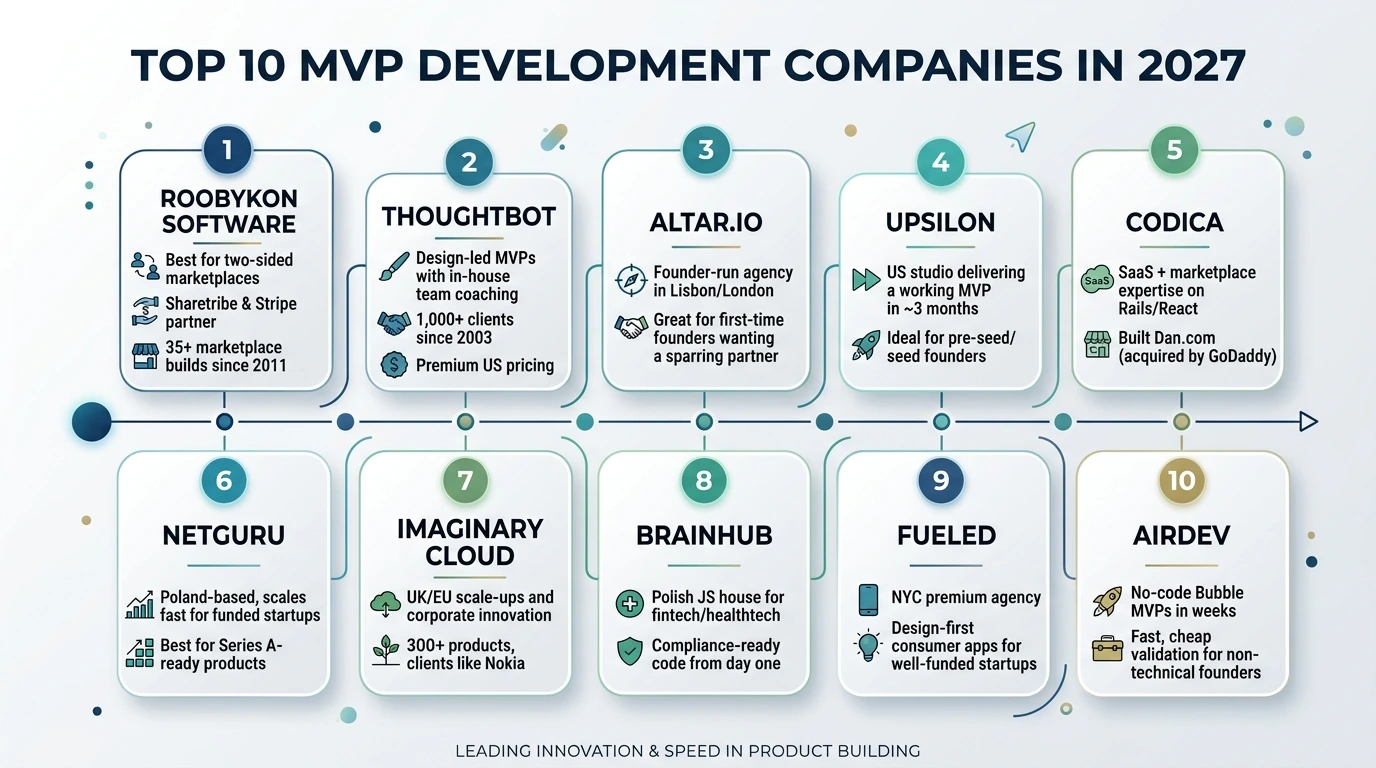
1. Roobykon Software
Roobykon is the best marketplace MVP development company on this list if your product has two sides, a commission, and money moving between strangers. We have built marketplaces since 2011, with 35 marketplace solutions behind a team of around 30 people.
Best for: two-sided marketplaces, rental and service platforms, complex payment splitting.
Why founders pick us: we are an official Sharetribe development partner and a Stripe-verified partner. That lets us choose honestly between a fast Sharetribe launch and a bespoke build. As a bespoke MVP development company, we only go custom when the business model needs it.
Proof: one holistic-treatments marketplace we customized onboarded 200 practitioners in its first month, according to the client’s verified Clutch review. Roobykon also won a Clutch Global Award in 2024.
Stack: Sharetribe, Ruby on Rails, Node.js, React, Next.js, React Native, PostgreSQL, AWS, Medusa.js.
Watch out: if you need a native game or a hardware-connected app, we are not your top MVP development company. Our depth is in marketplaces, SaaS, and web platforms. Our full playbook is in marketplace MVP development in 2026/27.
2. thoughtbot
thoughtbot is the best startup MVP development company for founders who want design and engineering taught, not just delivered. The consultancy has worked with over 1,000 clients since 2003.
Best for: design-led MVPs in the USA, founders building an in-house team in parallel.
Why founders pick them: they run product design sprints, validated prototypes, and investor-ready roadmaps before the full build. Their team can embed with yours or be the whole team. Their open-source work in the Rails world is a quiet signal of engineering depth.
Watch out: this is a senior US team, priced accordingly. If your budget is under $50,000, you may get more scope from a nearshore partner in Europe.
3. Altar.io
Altar.io is a top startup MVP development agency built by former startup founders, based in Lisbon with a London office. Clients repeatedly praise how well they define what an MVP should include.
Best for: first-time founders who want a co-founder-style sparring partner, especially in the UK and Europe.
Why founders pick them: a structured process that strips the MVP down to its core features before design and development. Clutch lists project costs from $5,000 to $180,000.
Watch out: Clutch reviewers note that post-MVP costs could be clearer. Ask for a version 2 estimate before you sign.
4. Upsilon
Upsilon is a US-headquartered product studio founded in 2012 that works remote-by-design. Their offer is direct: a working MVP in about three months for early-stage startups.
Best for: pre-seed and seed founders in the USA who need a fundable product fast, including AI-powered MVPs.
Why founders pick them: Upsilon also builds its own B2B SaaS products, so they understand the founder side. They run a discovery phase and can switch to team augmentation once you find traction.
Watch out: a fixed three-month rhythm suits clear ideas. If your concept is still fuzzy, budget for a longer discovery first.
5. Codica
Codica is arguably the best SaaS MVP development firm for founders who want marketplace and SaaS experience under one roof. Founded in 2015 in Kharkiv, the team relocated and kept delivering after Russia’s full-scale invasion in 2022.
Best for: SaaS dashboards, subscription products and multi-vendor marketplaces.
Why founders pick them: they take products from MVP to full-featured platforms on Ruby on Rails and React. On Clutch, Codica says it helped build the domain marketplace Dan.com, later acquired by GoDaddy.
Watch out: Codica is web-first. For a mobile-only consumer app, compare them against a mobile specialist.
6. Netguru
Netguru is a top MVP product development company for startups that already have funding and expect to scale the team fast. The Poznań-based firm has grown into one of the largest product houses in Europe.
Best for: Series A-ready products that need design, web, mobile, and QA at once.
Why founders pick them: deep benches mean they can staff a product quickly and keep it staffed after launch. They also publish practical research on choosing MVP partners, which says a lot about their maturity.
Watch out: large agencies run on process. A bootstrapped founder with a two-person budget may feel like a small client there.
7. Imaginary Cloud
As a top startup MVP development agency, Imaginary Cloud, founded in 2010, works from London, Lisbon, and Coimbra and reports 300+ products delivered for clients in 80+ countries. Its client list includes Nokia, Thermo Fisher and BNP Paribas.
Best for: corporate innovation teams and scale-ups in the UK and Europe launching a new product line.
Why founders pick them: paid scoping sessions turn a vague brief into a costed MVP plan. They also run AI proofs of concept, useful when you are not sure AI belongs in version one.
Watch out: their sweet spot is enterprise and scale-up work. Pre-seed founders should ask how small an engagement they accept.
8. Brainhub
Brainhub is a Polish JavaScript house known for fintech and other regulated products. This is one of the software development firms that specialize in MVP development for compliance-heavy sectors. Their engineers work mainly in TypeScript, Node.js, and React.
Best for: fintech, insurtech, and healthtech MVPs where audit trails and code quality matter from day one.
Why founders pick them: they treat maintainability as a feature. That matters when an MVP will face a bank’s or a regulator’s due diligence within a year.
Watch out: quality-first teams are rarely the cheapest or the fastest. If you only need to test demand, a lighter option may be smarter.
9. Fueled
Fueled is a New York minimum viable product development agency with London and Chicago offices that has built apps for brands such as HBO and Glamour. On Clutch, project costs range from $10,000 to more than $2 million.
Best for: well-funded consumer startups in the USA or UK where design is the product.
Why founders pick them: brand, UX, and native mobile under one roof. If your competitors win on polish, Fueled builds polish.
Watch out: this is premium pricing. A Fueled MVP can cost more than an entire seed round elsewhere.
10. Airdev
Airdev is a San Francisco agency and Bubble gold partner that builds MVPs on no-code. Clutch lists projects from $5,500 to $70,000, and reviewers often mention delivery in a few weeks.
Best for: non-technical founders who need to test demand before raising.
Why founders pick them: speed and cost. A Bubble MVP can validate an idea for a fraction of a custom build.
Watch out: no-code has a ceiling. Complex payment logic, heavy traffic, or unusual integrations can force a rebuild later, so plan the exit before you start.
How do you choose the right minimum viable product development agency?
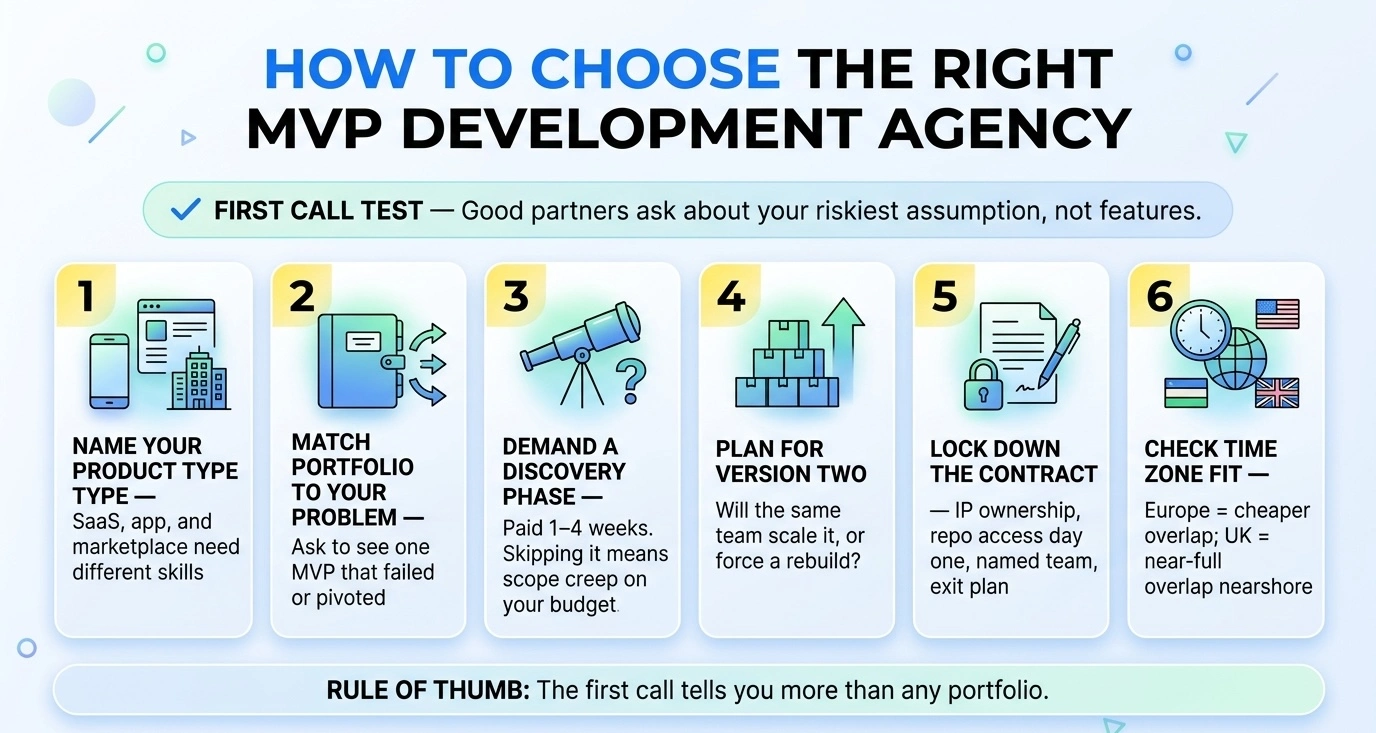
Choose the minimum viable product development agency that asks the hardest questions about your business before quoting a price. In our experience, the first call tells you more than any portfolio. A good partner talks about your riskiest assumption; a weak one talks about features.
Step 1. What kind of product are you validating?
Name your product type before you contact anyone. A SaaS dashboard, a consumer app, and a two-sided marketplace need very different skills.
Marketplaces are the trickiest case, because you must attract supply and demand at once. If you are still choosing a direction, review different marketplace models and categories.
Step 2. Does their portfolio match your problem, not just your industry?
Look for live products that solved a problem like yours. A fintech logo means little if your MVP is really about matching, booking, or payouts.
Ask to see one MVP that failed or pivoted. The best MVP software development agencies can explain what the data taught them, not only what they shipped.
Step 3. Will they run a discovery phase?
A paid discovery of one to four weeks is a good sign, not an upsell. It produces a scoped feature list, wireframes, a technical plan, and a realistic estimate.
Agencies that skip discovery tend to discover your scope during development, on your budget.
Step 4. What happens after the MVP works?
Ask how the MVP turns into version two. Will the same team scale it, or will the architecture force a rebuild?
This is where custom marketplace builds, Sharetribe, and no-code split. Each is valid; just choose with your growth plan in mind.
Step 5. Do the contract and the team set-up protect you?
Check three things in writing: full IP ownership, access to the code repository from day one, and named people on your project. A minimum viable product development company should also agree on an exit plan in case you part ways.
Step 6. Does the time zone and region fit?
Teams in Europe often give US founders a few hours of daily overlap at lower rates than local USA agencies. UK founders usually get near-full overlap with nearshore teams in Portugal, Poland, Ukraine, or Estonia. Decide how many live hours a week you actually need.
So which MVP development company should you hire in 2027?
Hire the top startup MVP development agency whose best work looks like your product, and who argues with your scope before signing. For marketplaces, that is a specialist; for SaaS, a SaaS-savvy studio; for pure demand testing, no-code is often enough.
The agency matters less than the question your MVP is built to answer. Write that question down in one sentence. Then bring it to two or three companies from this list and see who sharpens it.
Ready to test your marketplace or SaaS idea?
Roobykon Software offers a free technical consultation for founders in the USA, UK, and Europe. We will tell you whether Sharetribe, no-code, or a custom build fits your idea, even when the answer is not us.
Get in touchFAQ

Recommended articles
 How to Build a Peer-to-Peer Marketplace Website: Architecture, Payments, and Choosing the Right Partner
What a founder needs to decide before building a peer-to-peer marketplace platform: business model, money rules, build path, trust, and partner choice – with honest cost and timeline benchmarks from real builds.
 AI App Security Checklist for Founders: From Working Demo to Safe Product
AI startup security best practices for founders: ownership lists, payment tests, package checks, backup restore proof, and the six demonstrations to ask your developer for.
 From Idea to Launch: How to Build a Two-Sided Marketplace That People Actually Use
Thinking about building a two‑sided marketplace? In 2026, you can launch an MVP without coding in days, but scaling requires custom logic, multi‑vendor payouts, and a robust trust layer. Roobykon's guide breaks down business models, feature priorities, software options, and what it actually costs to go custom.
 How to Hire Node.js Developers for Marketplace and SaaS Products
Marketplace and SaaS founders face a critical decision: who builds your platform? This guide covers how to hire Node.js developers who understand real-time features, payment flows, multi-sided permissions, and scalability.
