What Is AEO GEO B2B Marketplace?
SEO vs AEO for B2B Marketplaces: What Actually Changes?
Why B2B Marketplaces Need AEO & GEO
Which Pages Should Be Optimized for AEO Marketplace?
What Makes an AEO Marketplace Page Ready?
How AEO GEO Changes Marketplace Content Strategy
Why Classic Link Building Still Matters for AEO
Technical AEO Foundation for Marketplace Platforms
AEO Strategy for B2B by Marketplace Type
Subscribe and you will promptly receive new published articles from the blog by mail
This is the guide to read if you want to know what B2B companies need to know about AEO, why classic SEO alone no longer keeps a marketplace visible, and what actually changes once AI systems start answering questions instead of just linking to pages. Consider it a from-SEO-to-AEO tutorial for marketplace founders, based on platforms we’ve actually built.
Buyers increasingly ask ChatGPT, Perplexity, or Gemini to find a vendor instead of typing a query into Google. Recent survey data shows 84% of B2B SaaS CMOs are already using AI tools for vendor discovery, up from just 24% a year earlier. Zero-click search is already the default. If your marketplace isn’t built for AI systems to read, understand, and cite, it simply doesn’t exist for a growing share of your buyers.
That’s the shift from SEO to AEO in B2B in one sentence – your marketplace has to be built for machines to recommend, not just for humans to click. If you’re running a B2B marketplace, everything below is written for you.
- AEO doesn't replace SEO, it builds on it. SEO is your foundation; AEO is the next floor you're adding on top. If you're looking for a from SEO to AEO tutorial, this is where you start.
- For marketplaces, AEO means being understandable to AI systems in specific buyer and supplier scenarios. Both sides matter.
- Your most valuable pages for AEO are category pages, location pages, listing pages, vendor profiles, comparison pages, and FAQ/help center content.
- Your marketplace has to answer real questions: where to find, how to compare, how much it costs, who to trust, how to book or get a quote.
- Technical architecture matters as much as content. If crawlers can't access your key content, AI can't cite it. That's the first step in how to do AEO in SEO for B2B business – make sure you're even visible to the machines.
- Founders who bake SEO/AEO into their MVP or scaling phase gain a long-term advantage that's genuinely hard to copy later.
What Is AEO GEO B2B Marketplace?
Answer Engine Optimization (AEO) for B2B businesses means structuring your marketplace content, product pages, supplier data, category pages, and technical architecture so search engines and AI answer systems can understand, extract, and cite your platform as a trusted source.
Think of it this way: traditional SEO helps users find your pages in search engines. AEO helps AI systems understand and recommend your marketplace.
The goal shifts from “win the click” to “win the answer.” And the stakes are real, as Semrush’s research found that visitors arriving through AI citations convert at 4.4x the rate of traditional organic search visitors.
SEO vs AEO for B2B Marketplaces: What Actually Changes?
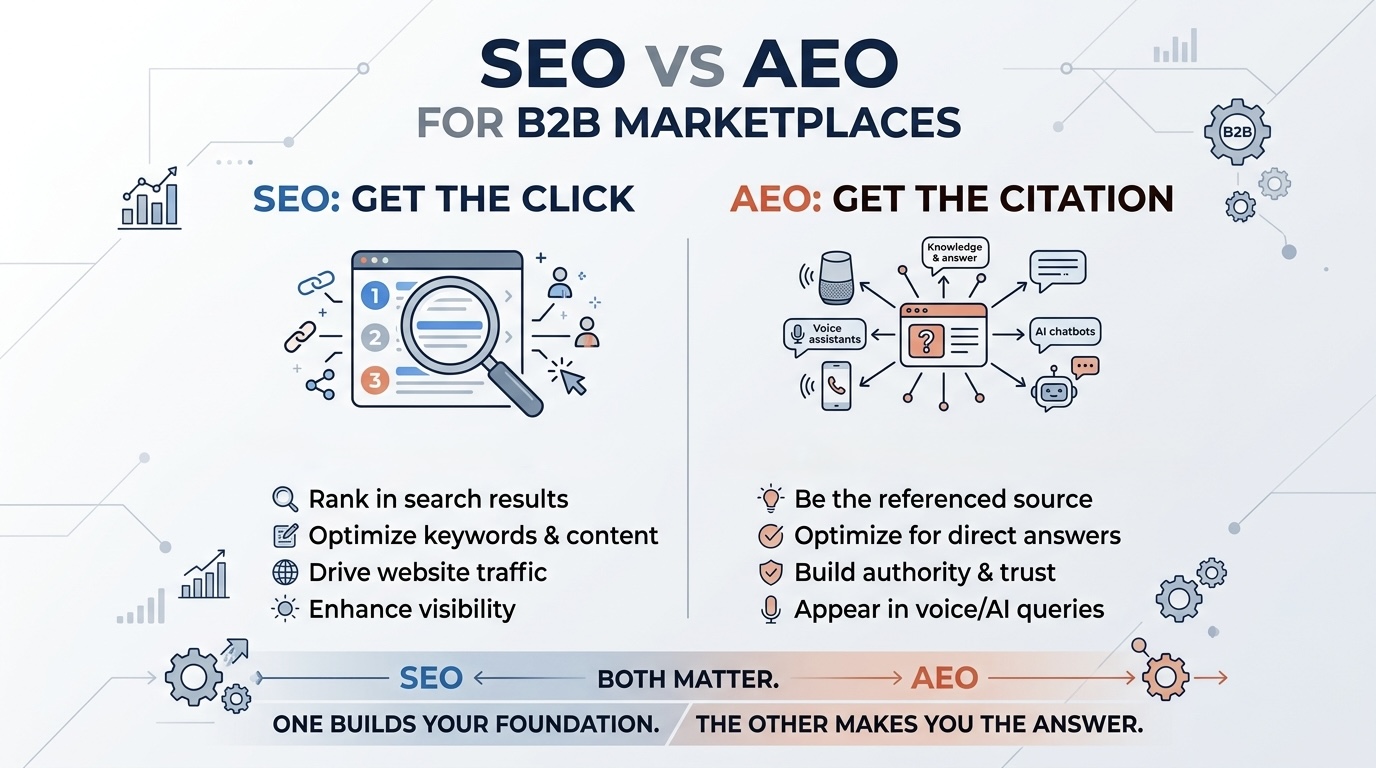
This is really the shift from SEO to AEO for B2B in a nutshell, or as some call it, the shift from SEO to AEO in B2B – SEO isn’t going anywhere. It still handles the essentials, such as crawling, indexation, rankings. But the path a user takes to reach you has split into two very different journeys, and it helps to see them side by side.
The Google path: query → search engine → results page → click → your site. SEO’s entire job is to win that click.
The AI path: query → the LLM generates an answer (often personalized) → the user sees a handful of recommendations, yours possibly among them → the session usually ends right there, with no click at all. If anything happens next, it’s the user remembers your name and visits directly later, or your name resurfaces the next time they search on Google.
For a marketplace with hundreds or thousands of pages, SEO is still non-negotiable. Without it, you don’t have a foundation to build AEO marketplace on, it’s like trying to put up a skyscraper on sand. If you’re deciding between a custom build or a pre-built solution, our breakdown of building a local online marketplace covers the trade-offs in detail.
But AI isn’t going away either, and nobody knows exactly how these systems will source and link to sites a year from now. That uncertainty is exactly why you can’t ignore it. Both channels matter, and treating them as competitors misses the point.
Put simply, with you or without you, people are going to keep asking LLMs questions, and the model is going to keep generating answers that name real brands. The only question that matters is whether your marketplace is on that list.
For Marketplaces, Visibility Is No Longer Only About Ranking
Layer | Traditional SEO Focus | AEO Focus for Marketplaces |
|---|---|---|
Visibility | Rank category, landing pages and products | Be mentioned in AI answers |
Content | Keywords and page copy | Direct answers to user scenarios |
Technical SEO | Crawlability and indexation | Extractable, structured, entity-rich pages |
Marketplace UX | Listings and filters | Clear category, provider, location, and trust context |
Measurement | Clicks, rankings, CTR | AI mentions, citations, assisted conversions |
Why B2B Marketplaces Need AEO & GEO
Search logic is changing, and businesses that don’t adapt lose visibility they can’t easily win back. That 84% jump in CMOs using AI for vendor discovery isn’t a fringe behavior anymore, it’s rapidly becoming the default way B2B buyers start their research.
Think about how buyers already use AI tools day to day: “what’s the best platform for X,” “compare these three vendors,” “who’s verified in this space.” Generic questions like these are exactly where marketplaces either show up or don’t. Which is why you need to build content that speaks directly to both sides of your marketplace: the vendors trying to be found, and the buyers trying to find them. That’s what a true AEO B2B marketplace strategy looks like – serving both audiences, not just one.
We’ve seen this play out across dozens of marketplaces we’ve helped build. Take Swoop, for example – a Lithuanian platform born from three friends’ frustration with hunting for bicycle parts across scattered social media groups. The platform connects sports enthusiasts buying and selling used equipment, with a clear mission to become the largest used sports gear marketplace in Lithuania. Their success depends on being found by both sellers looking to list gear and buyers searching for specific items. That’s two-sided visibility in action.
Or consider The Playpen Chicago, a boat rental marketplace that connects private boat owners, yacht rental agencies, and licensed captains with people looking to rent a boat on Lake Michigan. The platform’s entire value proposition hinges on answering a specific buyer question: “how do I get out on the water without owning a boat?” Meanwhile, it answers the supplier question just as clearly: “how do boat owners and captains monetize their assets?”
Users of marketplaces rarely search abstract categories. They search specific business scenarios, combining service or product type, location, budget, urgency, booking format, trust level, supplier type, and other conditions.
For a yacht rental marketplace, buyer-side queries might look like:
- “Where can I rent a yacht for a corporate event in Dubai?”
- “Best yacht charter platform for private events in Croatia”
- “How much does it cost to rent a yacht with a captain in Greece?”
- “Trusted yacht rental marketplace with verified boat owners”
- “Where can I compare yacht rental prices in Europe?”
- “Luxury yacht rental platform with secure payment”
- “Best place to book a yacht for a team event”
- “Yacht rental marketplace with instant booking”
And supplier-side queries:
- “Where can I list my yacht for rental?”
- “Best platform for yacht owners to get bookings”
- “Marketplace for yacht charter companies”
- “How can yacht owners get more rental requests?”
- “Where can boat rental companies find international clients?”
This is the part founders miss most often – every marketplace has two sides of search demand, not one.
- Demand side: buyers, renters, clients, companies, event planners, procurement teams
- Supply side: vendors, suppliers, owners, professionals, service providers
Your AEO strategy for B2B has to answer questions from both sides. Ignore one, and you’re leaving half your potential visibility on the table.
Marketplace Type | Buyer-Side Questions | Supplier-Side Questions |
|---|---|---|
Yacht rental | “Where can I rent a yacht for a corporate event in Dubai?” | “Where can I list my yacht for rental?” |
Equipment rental | “Where can I rent construction equipment for a short-term project?” | “Marketplace for equipment rental companies” |
Talent booking | “Where can I book musicians for a wedding in London?” | “How can performers get more event bookings?” |
Property rental | “Where can I rent a venue for a business event?” | “Where can property owners list event spaces?” |
Healthcare services | “Where can clinics find verified healthcare professionals?” | “Platform for healthcare specialists to receive bookings” |
B2B supplier | “Where can I compare verified industrial suppliers?” | “Where can manufacturers find B2B buyers?” |
The Numbers Don’t Lie
The shift toward AI-powered search isn’t some distant future we need to prepare for – it’s happening right now, and it’s already changing how B2B buyers find vendors.
In 2024, Gartner predicted that by 2026, traditional search engine traffic would drop by 25% as AI-powered search takes over. Think about that. A quarter of the traffic you might have counted on just a couple of years ago? Gone. Redirected to ChatGPT, Perplexity, and their AI cousins.
Meanwhile, the business case for AEO is getting stronger. A recent study by ABI Research found that B2B companies investing in AEO strategies are seeing measurable improvements in AI-generated citations and referral traffic from AI platforms.
Platforms that figure out how to show up in AI answers are winning the attention of buyers who’ve stopped typing into Google and started asking questions directly to ChatGPT or Perplexity. This is what from search to AI in B2B really looks like in practice – buyers skip the blue links and go straight to whatever gives them an answer, because it’s faster and it doesn’t take five open tabs to compare vendors.
Which Pages Should Be Optimized for AEO Marketplace?
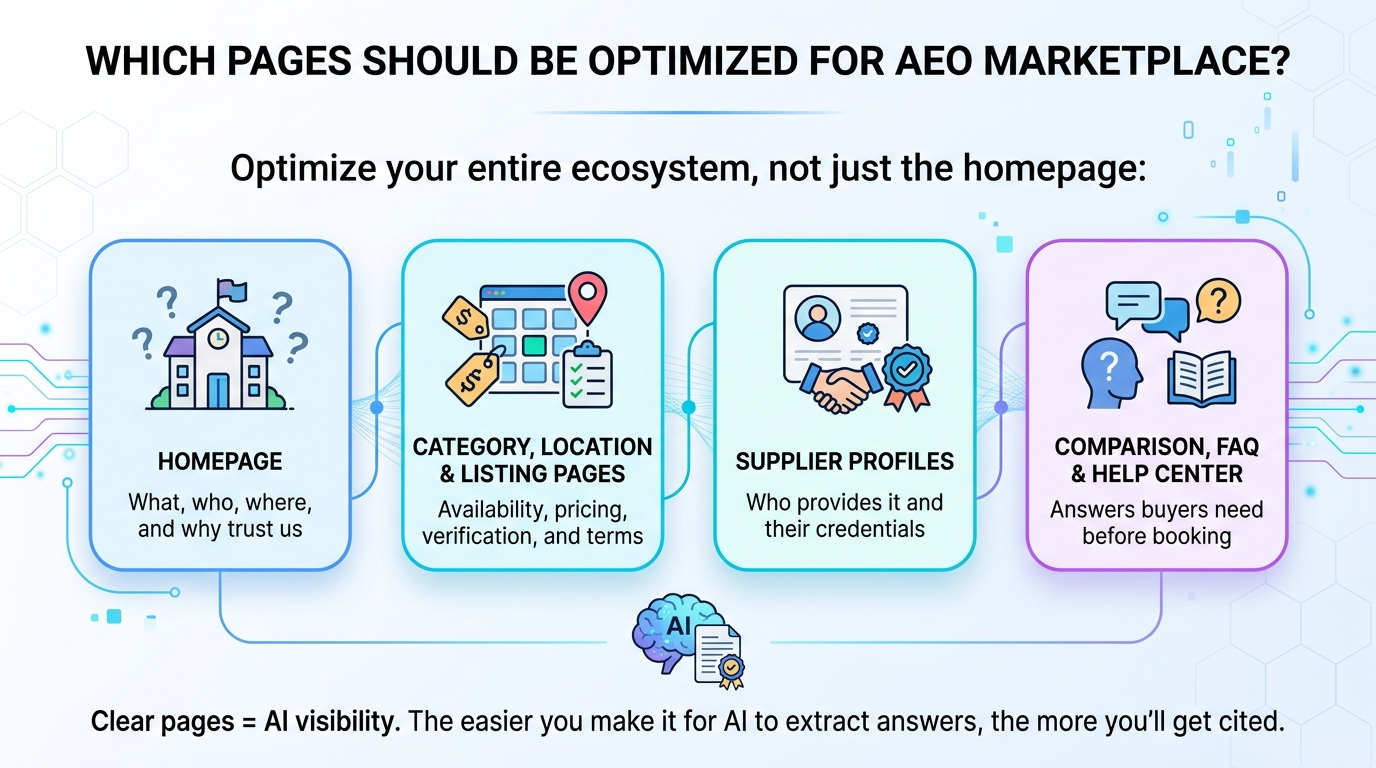
For AEO, a B2B marketplace should optimize more than just the homepage. It needs the full ecosystem of pages that answer buyer questions at every stage of the decision-making process.
The homepage should clearly explain what the marketplace does, who it’s for, which industries or locations it covers, how booking or purchasing works, and why users can trust the platform.
Category, location, listing, and supplier profile pages need to go deeper: what’s available, where it’s offered, who provides it, how pricing works, whether suppliers are verified, and what terms apply.
Comparison pages, FAQs, help center content, and blog articles matter too, because they answer the questions buyers ask before they’re ready to book, request a quote, or contact a supplier. Think “how to choose a verified supplier,” “how much equipment rental costs,” “yacht rental with captain vs. bareboat charter,” or “supplier verification checklist.”
Consider this your from SEO to AEO tutorial in practice. The stronger and clearer these pages are, the easier it is for AI systems to understand your marketplace, extract reliable answers, and recommend your platform for relevant queries.
Traderoo demonstrates this principle well. The platform lets users buy and sell websites – a niche that requires exceptional clarity. Sellers need to present their digital projects professionally, while buyers need consistency across listings to make informed comparisons. We built a smart, step-by-step listing flow that balances flexibility with structure. That’s exactly the kind of clarity AI systems reward.
What Makes an AEO Marketplace Page Ready?
A marketplace page becomes AEO-ready when it’s easy for both users and AI systems to understand. It shouldn’t just describe a category, supplier, service, or location, it should explain how the marketplace works, who it’s for, what options exist, and why users can trust the providers listed there.
For B2B marketplaces, this matters even more, because buyers usually compare several options before acting. They want pricing, provider quality, verification, booking terms, risk, and the next step. AI systems are looking for the same clarity. If that information is vague, hidden, or scattered across disconnected pages, your marketplace becomes harder to recommend.
A strong AEO-ready page usually combines four things: clear marketplace context, useful decision-making answers, visible trust signals, and structured information that’s easy to extract.
Marketplace Context AI Must Understand | Decision-Making Questions the Page Should Answer | Trust Signals That Support Recommendations | Page Structure and Data AI Can Extract |
|---|---|---|---|
Marketplace type | How to choose | Verified providers | Clear H1/H2/H3 hierarchy |
Core offer | Compare options | Reviews | Answer-first paragraphs |
Target buyers and suppliers | Understand pricing | Ratings | Comparison tables |
Covered categories | Verify providers | Case studies | FAQ sections |
Locations | Book or request a quote | Secure payments | Pricing blocks |
Transaction model | Reduce risk | Insurance, certifications, cancellation terms, support process | Schema markup, internal links, structured data |
HomeHak, a tenant-first rental marketplace we built, is a great example of this principle in action. The platform flipped the traditional rental model: instead of showcasing properties first, it puts tenants at the center. That meant building pages that answer not just “what properties are available” but “how do I find a home that fits my needs as a tenant?” The platform uses Stripe ID Verification for tenant identity checks and AWS Bedrock for AI-powered recommendations – trust signals and personalization that make both users and AI systems confident in the platform.
How AEO GEO Changes Marketplace Content Strategy
Content for AEO and for modern SEO isn’t really two separate disciplines anymore. Good SEO stopped being just about keyword placement years ago, it’s been about matching user intent and answering real questions for a long time. What’s new is how AI systems read and reuse that content.
Recent market data shows LLMs favor content that’s easy to lift and quote. In practice, that means your pages should have:
- short paragraphs
- a question in the heading
- a short, direct answer right underneath it
- lists where they make sense
- clear conclusions
- original research or real experience
- a structure that holds up against EEAT expectations
- an FAQ block built from real questions people ask LLMs and from your own experience, not a generic template
That’s the real shift from SEO to AEO for B2B at the content level. It’s less about targeting a phrase like “yacht rental Dubai” and more about matching the real intent behind that search – renting a verified yacht with a captain in Dubai for a private, corporate, or luxury event, and explaining what affects the price, how to compare providers, what makes one trustworthy, and what to ask before booking.
Why Classic Link Building Still Matters for AEO
Do you still need link building? Yes, but not the kind built around a generic guest post on a random site. What actually moves the needle for AEO is brand mentions, specifically reviews and mentions on platforms where real people share real experience. LLMs are looking for exactly that kind of signal – genuine usage experience they can point to when recommending a product or service.
A few platforms worth prioritizing for review and mention building (each niche will have its own extra channels worth chasing).
- Customer review sites, G2 being the standard for B2B software
- Quora
- Reddit, more relevant for B2C than B2B but still worth monitoring
- YouTube
- User-generated content generally
- Press releases
The common thread across all of them is authenticity. A polished sponsored post reads differently to an LLM than a thread where a real user describes what happened when they actually used your marketplace. Build for the second kind.
Technical AEO Foundation for Marketplace Platforms
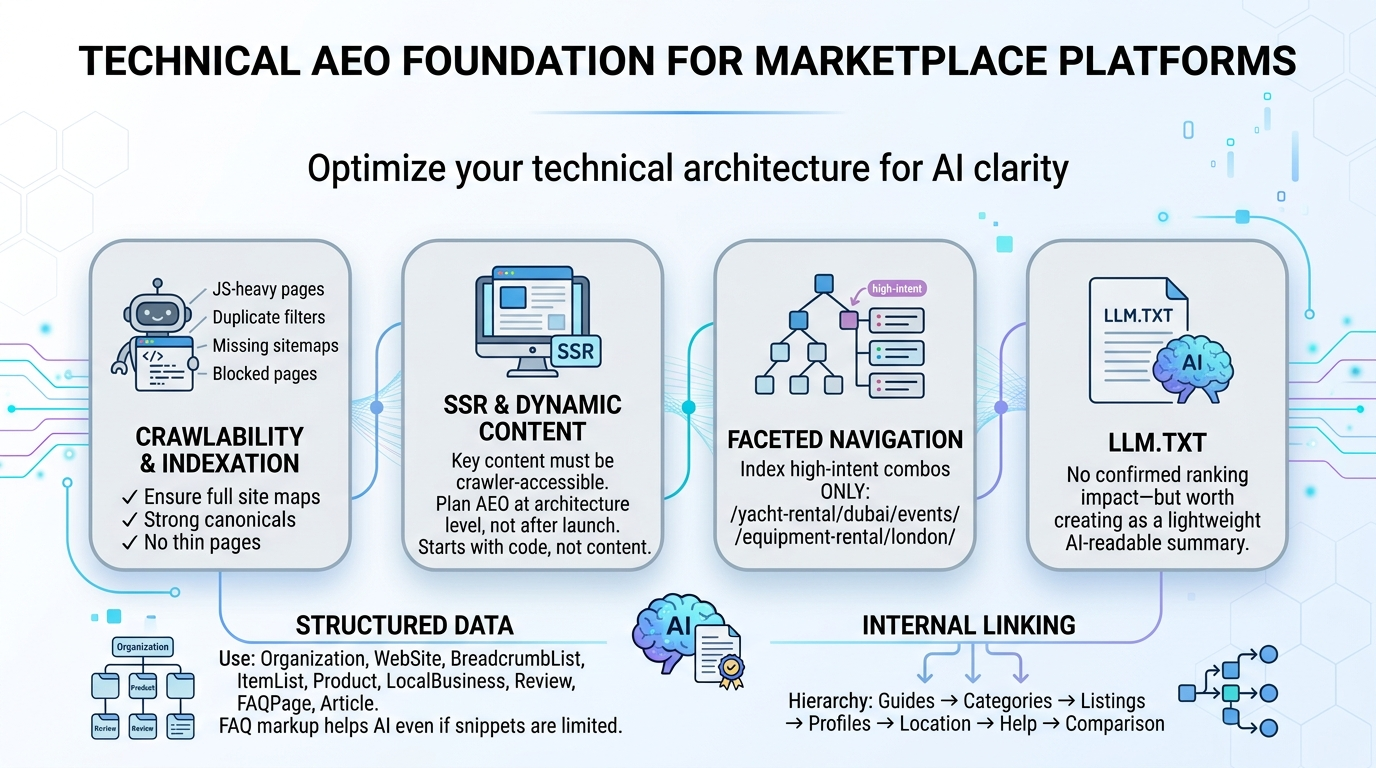
Crawlability and Indexation
Many marketplaces technically exist for users but remain poorly understood by Google and AI systems.
Common problems:
- JavaScript-heavy pages
- Listings that load only after interaction
- Filters generating duplicates
- Important pages missing from sitemaps
- Weak canonical rules
- Thin category pages
- Closed or non-indexed vendor/listing pages
SSR, Prerendering, and Dynamic Content
If your marketplace runs on a modern frontend framework, you need to make sure key content is actually accessible to crawlers.
Roobykon insight: Plan your SEO and AEO at the technical architecture level, not after launch. This isn’t something you can bolt on later. Trust us, we’ve seen founders try, and it almost always means rebuilding half the platform. This is exactly what B2B companies need to know about AEO: it starts with the code, not the content.
Faceted Navigation and Indexable Landing Pages
Not every filter combination should be indexed. But high-intent combinations deserve their own landing pages, for example:
- /yacht-rental/dubai/corporate-events/
- /equipment-rental/london/excavators/
- /event-venues/barcelona/corporate-events/
- /suppliers/germany/packaging-materials/
Structured Data for Marketplace Pages
Use schema markup extensively:
- Organization
- WebSite
- BreadcrumbList
- ItemList
- Product or Service (where relevant)
- LocalBusiness (for local provider pages)
- Review/AggregateRating (for real reviews)
- FAQPage (for help/FAQ blocks)
- Article (for guides)
One nuance worth flagging: Google has scaled back how often it displays rich results for FAQPage markup outside a narrow set of authoritative sites. That doesn’t make the markup a mistake, though. But it still helps other search engines and AI systems parse your Q&A content correctly. Think of it as part of your Answer Engine Optimization (AEO) for B2B businesses toolkit. It’s worth keeping even if it no longer guarantees a rich snippet.
Internal Linking and Entity Relationships
A marketplace needs strong internal linking logic:
- Guides link to categories
- Categories link to listings
- Listings link to vendor profiles
- Vendor profiles link to related listings
- Location pages link to local categories
- Help center links to transactional pages
- Comparison pages link to relevant marketplace sections
LLM.txt
There’s no confirmed evidence that having an llm.txt file directly affects ranking inside LLM systems. Even so, it’s worth creating one. Think of it as a lightweight, machine-readable summary of what your marketplace is, who it serves, and where your most important pages live. It costs little to set up, and as AI crawlers standardize around this kind of file, having one in place early means you won’t be scrambling to add it later.
AEO Strategy for B2B by Marketplace Type
Different marketplace models need different AEO priorities. A rental marketplace has to make availability, location, pricing, insurance, and booking terms easy to understand. A supplier marketplace should lean harder into verification, product comparison, MOQ, certifications, and quote requests. The goal isn’t one content template for everyone, it’s matching each page type to the questions buyers and suppliers are actually asking in search engines and AI tools.
Marketplace Model | What Users Ask AI/Search | What the Page Must Make Clear | AEO Content Priority |
|---|---|---|---|
Rental marketplace | “Where can I rent [asset] in [location] for [use case]?” | Availability, location, pricing, insurance, provider verification, booking terms, use cases | Location pages, use-case landing pages, pricing explanations, verified provider details, insurance information, booking terms |
Service marketplace | “Where can I find verified [specialist] near me?” | Credentials, reviews, service area, specialization, response time, booking process, trust signals | Provider profiles, review blocks, credential details, service-area pages, FAQ sections, booking process explanations |
Product and supplier marketplace | “Where can I compare verified [product] suppliers?” | MOQ, bulk pricing, certifications, delivery geography, supplier verification, product differences, quote logic | Supplier pages, product category pages, comparison tables, certification details, delivery information, request-a-quote flow |
Talent and event marketplace | “Where can I book [talent] for [event] in [location]?” | Event type, location, availability, portfolio, pricing, reviews, booking protection | Portfolio pages, event-specific landing pages, pricing guides, review sections, availability details, booking protection information |
Booking marketplace | “What is the best platform to book [service] instantly?” | Booking speed, availability, cancellation terms, payment security, provider quality, customer support | Booking flow pages, trust and safety content, cancellation policy, instant booking explanations, payment details, support information |
AEO Strategy for B2B by Marketplace Growth Stage
Pre-Launch Marketplace
No full platform yet, but you can still build a visibility foundation:
- Niche landing pages
- Waitlist pages
- Buyer-side intent research
- Supplier-side intent research
- Early guides
- Category architecture
- FAQ about the marketplace model
MVP Marketplace
At the MVP stage, the priority is avoiding technical debt:
- Indexable core pages
- Clean URL structure
- Basic category pages
- Supplier onboarding pages
- Buyer FAQ
- Structured homepage
- Conversion tracking
Growing Marketplace
As you scale, add programmatic elements:
- Programmatic category/location pages
- Vendor profile optimization
- Listing templates
- Internal linking automation
- Schema markup
- Content clusters
- Marketplace comparison pages
Scaling Marketplace
At scale, AEO becomes part of the platform itself:
- SSR/prerendering
- Performance optimization
- Multilingual SEO
- Advanced faceted navigation
- Structured provider data
- AI visibility monitoring
- Content governance
- Entity consistency
Stage | Main AEO Risk | What to Prioritize |
|---|---|---|
Pre-launch | No demand validation | Landing pages, search intent research, early content |
MVP | Thin pages and weak structure | Indexable pages, basic schema, clear category logic |
Growth | Listings grow faster than architecture | Programmatic pages, internal linking, vendor profiles |
Scale | Technical complexity blocks visibility | SSR, performance, canonical logic, entity consistency |
What Founders Should Check Before Investing in AEO
As a founder, you need to think beyond Google rankings. Ask yourself:
- Is my marketplace mentioned in AI answers?
- Does AI describe my platform correctly?
- Does AI understand which categories and locations I cover?
- Can AI compare my marketplace with other solutions?
- Can AI extract trust signals from my site?
Can Users and AI Understand What Your Marketplace Does in 10 Seconds?
- Homepage positioning
- Category names
- Marketplace model
- Buyer/supplier distinction
- Main use cases
- Location coverage
Do Your Category Pages Answer Buying Questions?
- What this category includes
- Who it’s for
- Pricing factors
- Provider comparison criteria
- Trust signals
- FAQs
- Links to relevant listings
Are Your Supplier and Listing Pages Detailed Enough?
- Full provider information
- Location
- Availability
- Pricing or quote logic
- Verification status
- Reviews
- Terms
- Booking/contact CTA
Can Crawlers Access Your Key Content?
- Rendered HTML
- Sitemap
- Canonical tags
- Noindex rules
- Duplicate filter pages
- JS-loaded content
- Performance
- Mobile UX
How Roobykon Helps Build AEO-Ready Marketplaces
Roobykon Software specializes in marketplace website development that doesn’t just work for users, it works for AI systems too.
We’ve watched too many founders pour everything into building amazing platforms, only to see them struggle with visibility because AI-led search got treated as an afterthought. “We’ll fix SEO later,” they’d say. But later usually means rebuilding half the architecture, which is expensive, frustrating, and entirely avoidable.
Migrating from SEO to AEO for B2B business isn’t something you slap on at the end. It’s not a plugin you install or a checklist you tick off in a weekend. It’s a fundamental shift in how you think about your platform, and it needs to be baked into the foundation from day one. Optimising for AI-led search has to be part of the architecture conversation, not a follow-up task.
That’s exactly why we treat AEO as a core principle that guides every line of code, not an afterthought. We make sure your marketplace checks all the right boxes:
- Crawlable: with SSR, clean URL structures, and proper indexation
- Structured: with schema markup, entity relationships, and logical information architecture
- Answer-ready: with content that directly addresses buyer and supplier questions
- Trustworthy: with clear trust signals, verification processes, and transparent policies
We’ve helped founders navigate the steps to launch a marketplace website with AEO built in from the start. For those building on Sharetribe, we also offer specialized SEO for Sharetribe platform services that bridge the gap between platform capabilities and AI visibility.
Our approach to SEO for marketplaces goes beyond traditional tactics, we build platforms designed to be cited, not just found.
Ready to build a marketplace that actually gets seen?
You've read the playbook, you know the stakes. Let's talk about your marketplace.
Contact usFAQ

Recommended articles
 AI Marketplace Transformation: Why Your Platform Won’t Survive Without It
AI is revolutionizing marketplaces, not as a bolt-on feature, but as the new operating system of commerce. This article breaks down the trends, the data, and the practical steps founders need to take to build for an agent-driven future.
 How to Build an Online Marketplace MVP in 2026
Turning a marketplace idea into reality is fraught with risk. This guide cuts through the complexity, showing you how a focused MVP is the antidote.
 Advanced Search for Sharetribe Marketplace: How We Built a Smarter Way for Users to Find What They Need
Internal search users convert at 2-3x higher rates, but only if the search actually works. We walk through building a smarter search for marketplace on Sharetribe, adapting it for aviation, real estate, rentals, and beyond.
 Must-Have AI Tools for Marketplace Businesses
Stop guessing which AI tools you actually need. Our article gives you a complete breakdown of AI categories for marketplaces, real tool recommendations, and a phased roadmap.