Subscribe and you will promptly receive new published articles from the blog by mail
Many founders believe that simply launching a Sharetribe instance is enough to attract traffic. The reality is different. Without a deliberate Sharetribe optimization strategy, your platform remains invisible to the very users you’re trying to serve. We’ll show you how to fix that.
Why SEO Matters for Sharetribe Marketplaces
Google Ads and social media campaigns deliver immediate gratification. You turn on the budget, and the traffic flows. But the moment you pause that Sharetribe promotion spend, the faucet runs dry.
SEO Sharetribe strategy operates on a different timeline. It requires patience and consistent effort, but it builds a compounding asset. A well-optimized marketplace continues to attract suppliers and customers even when your marketing team is on vacation.
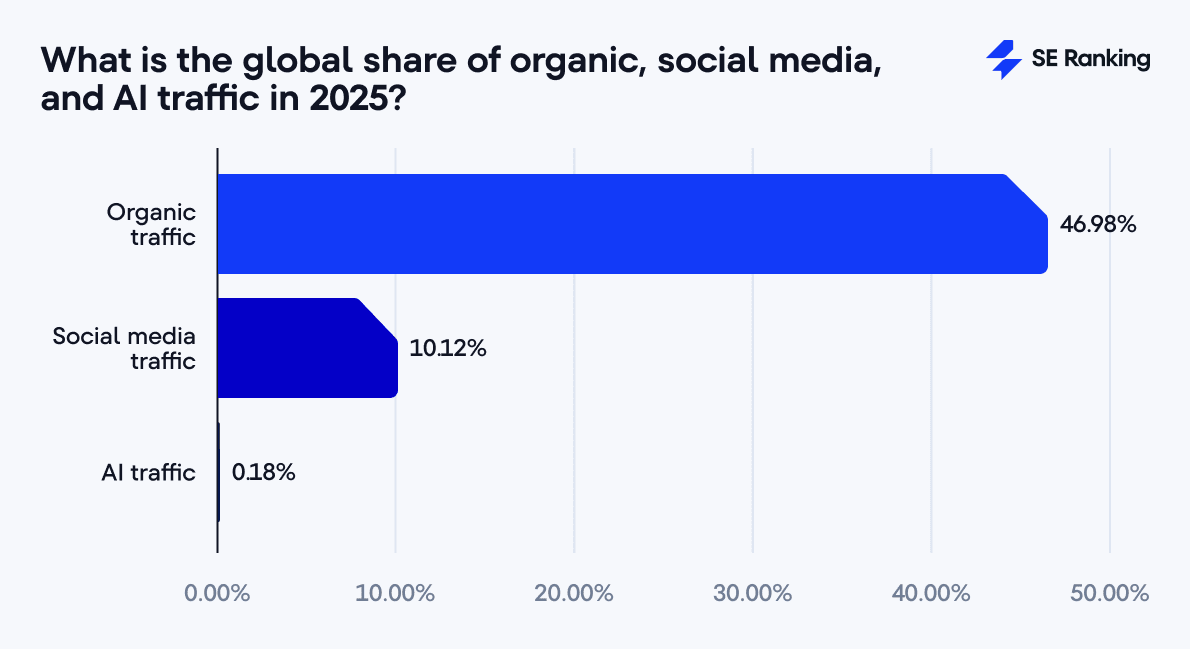
The data backs this up. Despite the rise of AI search and social commerce, organic search remains the dominant driver of commercial traffic. According to the most recent research from SE Ranking, organic traffic still represents 46.98% of all website traffic in 2025.
Similarly, comprehensive industry analysis confirms that approximately 90% of B2B buyers use search engines to research potential purchases, underlining search as the core discovery channel for high-value transactions. If you want to sustainably promote Sharetribe platforms, organic visibility is foundational.
AEO, GEO, AIO, or LLMO for Sharetribe Marketplace?
You’ve likely heard the new acronyms: Generative Engine Optimization (GEO) or Large Language Model Optimization (LLMO). The question arises: do we need a new playbook for Sharetribe marketing? The answer is reassuringly simple.
Generative AI models like ChatGPT and Google’s AI Overviews pull information from the same web that classic search engines crawl. Without solid SEO Sharetribe fundamentals – technical hygiene, logical structure, backlinks, and useful content – LLMs won’t have enough signals to trust or surface your site. Classic SEO earns your seat at the table. Once that foundation is in place, you can go further: tailoring content specifically for how AI models evaluate and surface information.
Step-by-Step Guide: How to Optimize a Sharetribe Marketplace for Search
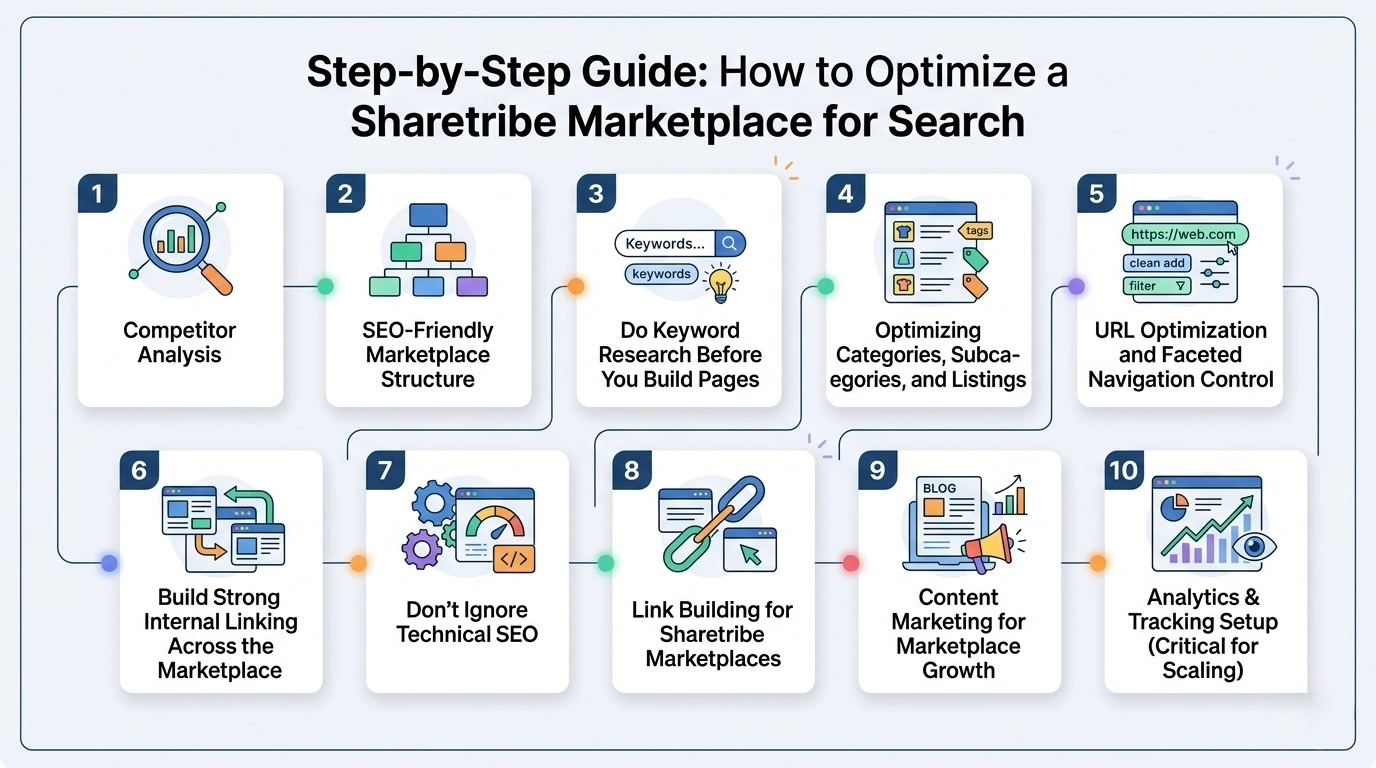
We’ve prepared a tactical, step-by-step roadmap specifically designed for the unique SEO Sharetribe architecture. This is a tailored framework for marketplace success.
1. Competitor Analysis
Before writing a single line of code or content, you must understand the landscape. Identify who ranks for your target terms. Are they aggregators like Yelp or niche-specific directories?
Analyze their site structure, their backlink profiles, and their content depth. This analysis informs your Sharetribe optimization priorities. You aren’t trying to outspend them; you’re trying to out-structure them.
2. SEO-Friendly Marketplace Structure
Organic traffic requires a scalable, logical structure that aligns with keyword intent and user expectations. A flat architecture where every listing lives on one page will never rank for high-value queries.
How a Sharetribe site structure should look:
- Category Pages
- Subcategory Pages
- Location Pages
- Vendor/Provider Profile Pages
- Blog/Educational Content
- Informational Pages
The Golden Rule: One Intent = One Page
For example, if your marketplace offers car rentals, you aren’t just targeting “car rental.” You’re targeting “car rental Miami,” “BMW rentals near me,” and “Miami Airport car rental.”
Your URL structure should mirror this logic:
- Homepage: domain.com (targets “car rental”)
- Brand Categories: /bmw-rental, /mercedes-rental
- Type Categories: /suv-rental, /minivan-rental
- Location Pages: /car-rental-miami
- Location + Niche (Subcategories): /car-rental-miami/airport, /bmw-rental/miami
How to Determine Your Structure
Your marketplace architecture will typically follow one of two models:
- Location-Based Structure. If your service is tied to a physical place – rentals, local services, in-person experiences – location pages should lead your hierarchy.
- Product/Service-Based Structure. If location is secondary and the offering itself matters most – digital services, SaaS marketplaces, product categories – lead with product or service pages.
Decide early whether your marketplace is more location-dependent or service-dependent. This choice will shape how your entire SEO Sharetribe structure is built.
Tip: Avoid special characters, capital letters, and underscores in your URLs. Stick to lowercase letters, hyphens, and keyword-rich slugs for clean, search-friendly URLs.
The Critical URL SEO Sharetribe Constraint
Out of the box, Sharetribe generates non-SEO-friendly URLs like /s?pub_categoryLevel1=catagoryname. Achieving clean, keyword-rich URLs requires custom development.
This is the single most important investment you can make for Sharetribe marketing success. Without custom URL routing, you are essentially trying to run a marathon with your shoelaces tied together.
Need a scalable, SEO-friendly structure?
Our team at Roobykon Software specializes in custom Sharetribe development – reach out to us, and we'll help you get it right from the start.
Book Your Call Now3. Do Keyword Research Before You Build Pages
A common mistake founders make is creating marketplace categories based on internal logic or personal preference rather than actual search demand. SEO Sharetribe projects must begin with semantic research and keyword clustering. This research defines three critical things:
- What pages should exist.
- What pages should be indexable.
- What content should support those pages.
Be Realistic with Your SEO Strategy
If your marketplace is new, competing for “Car Rental” is a losing battle against Enterprise and Hertz. Instead, leverage Sharetribe promotion tactics by targeting long-tail, lower-volume keywords specific to your niche.
“Limousine car rental Wynwood Miami” is easier to rank for and brings higher intent traffic. Use tools like Ahrefs, Semrush, Serpstat, and Google Keyword Planner to map this out.
4. Optimizing Categories, Subcategories, and Listings
This is where the heavy lifting of Sharetribe optimization happens. Individual listings are often too “thin” to rank on their own. They lack context, authority, and sufficient text.
Therefore, your Category and Location pages become your SEO Sharetribe heavy hitters.
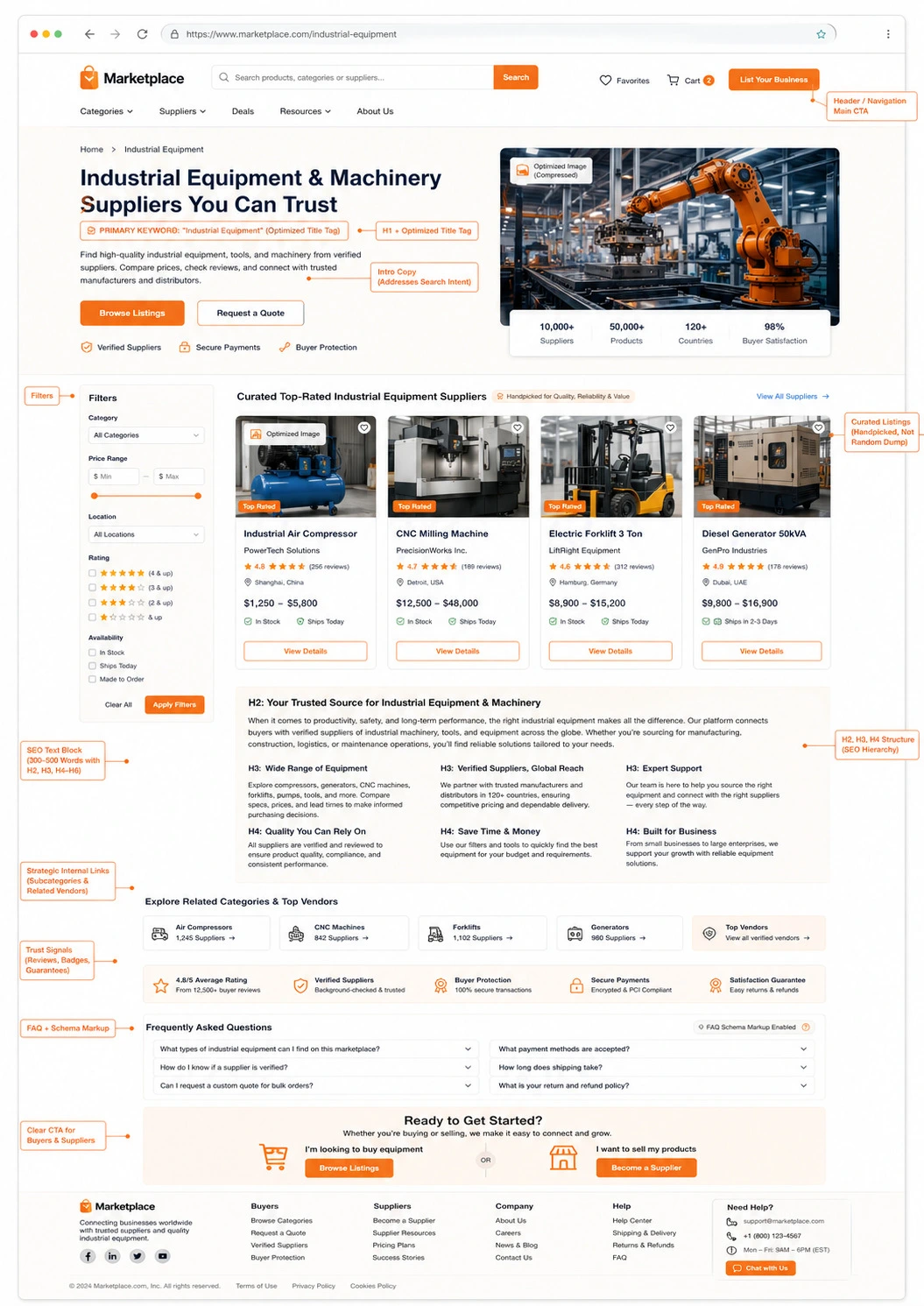
What a High-Performance SEO Landing Page Must Include:
- Optimized H1 and Title Tag: Primary keyword front and center.
- Unique SEO Text Block: 300-500 words explaining the category with hierarchical H2-H6 headings.
- Intro Copy: Immediately addressing the user’s search intent.
- Curated Listings: Don’t just dump all listings; feature the best ones.
- FAQ Block + Schema Markup: Capture “People Also Ask” traffic.
- Strategic Internal Links: Pointing to subcategories and related vendors.
- Trust Signals: Reviews, badges, guarantees.
- Clear CTA: For both buyers and suppliers.
- Optimized Images: Compressed and relevant.
Common Pitfalls: Multiple H1 tags on a single page or keyword stuffing the Title Tag.
Tip: The Meta Description doesn’t directly boost rankings, but it is your ad copy in the search results. A compelling description significantly increases Click-Through Rate (CTR), which does influence rankings.

5. URL Optimization and Faceted Navigation Control
Without proper URL controls, your Sharetribe marketplace can spiral into indexation chaos almost overnight. Search engines waste crawl budget on low-quality parameter pages while duplicate content dilutes your ranking signals across hundreds of auto-generated URLs. Defining these rules early prevents costly cleanup later.
Managing Filters (Faceted Navigation)
By default, Sharetribe filter pages generate messy URLs with parameters like /s?pub_categoryLevel1=physiotherapist&pub_countiesserved=has_all%3Adonegal. This is a disaster for SEO Sharetribe efforts because:
- These URLs are not user-friendly.
- They are often open for indexing, creating thousands of thin, duplicate pages.
- This wastes Google’s “crawl budget,” causing Google to view your site as low-quality.
The Fix: You must implement canonical tags pointing back to the main category page or use robots.txt to block parameter URLs entirely. Canonicalization is the recommended approach.
Handling Listing URLs
Sharetribe generates a unique UUID for every listing: /l/2f9b63a4-2a1d-4d20-9871-0c53b5df4d87. Even if you create a custom clean URL like /car-rental-miami, the ugly UUID URL still exists and is accessible. This creates duplicate content.
The Fix:
- Add a <link rel=”canonical”> tag to the custom page pointing to the preferred clean URL.
- Set up a 301 redirect from the /l/{uuid} to the custom URL.
Tip: Always include keywords in your clean URLs. This carries ranking weight and improves click-through rates from search results. Just don’t overdo it – too many keywords can look like spam and hurt your SEO Sharetribe efforts.
6. Build Strong Internal Linking Across the Marketplace
Internal linking is the circulatory system of your website. It distributes “link equity” from high-authority pages (like your homepage or popular blog posts) to the pages you want to rank (money pages). In Sharetribe marketing, this is often overlooked.
How to structure your internal links:
- Homepage → Category Pages
- Category Pages → Subcategories & Top Vendors
- Blog Posts → Commercial Landing Pages (Location pages)
- FAQ Content → Related Service Pages
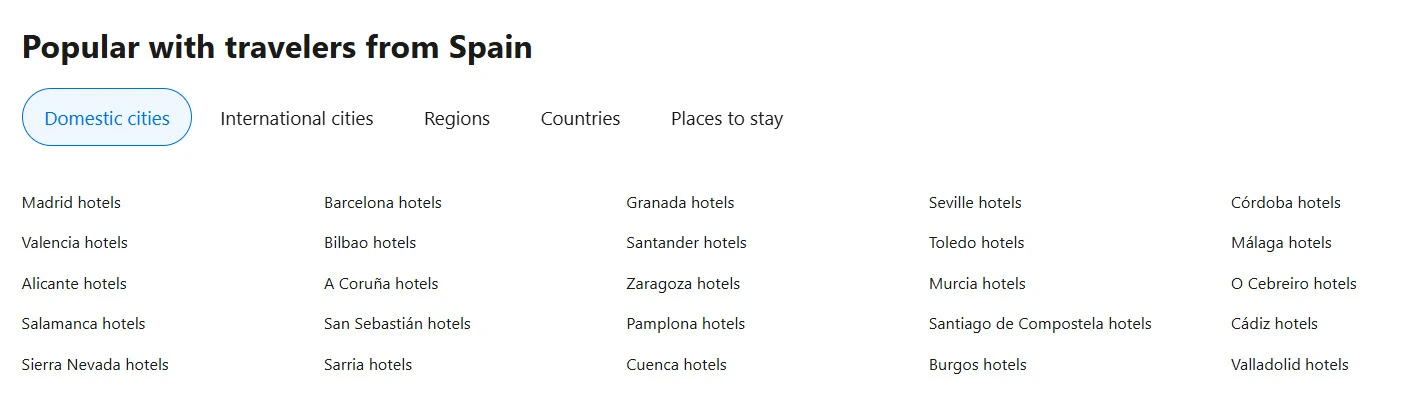
Useful internal linking blocks:
- Breadcrumbs (essential for UX and SEO).
- “Related Categories” widgets.
- “Top Providers/Brands” sections.
- “Popular Locations” footer links.
- “Similar” sections.
7. Don’t Ignore Technical SEO
A beautiful marketplace will fail if the technical foundation is cracked.
- Mobile-Friendliness: Non-negotiable. Sharetribe templates are generally responsive, but test custom CSS changes thoroughly.
- Core Web Vitals: Use Google Lighthouse to audit loading speed (LCP), interactivity (FID/INP), and visual stability (CLS). Slow load times kill Sharetribe promotion efforts.
- Indexation Control: Use robots.txt to block filter pages and login pages. Use XML sitemaps to guide Google only to your valuable URLs.
- Schema Markup: Implement Organization, Product (for listings), and FAQPage schema to enhance rich snippets in search results.
- Image Optimization: Enable lazy loading, use WebP format, resize images before upload, and utilize a CDN.
- HTTPS: Ensure your SSL certificate is always active.
8. Link Building for Sharetribe Marketplaces
Even with perfect structure and content, your marketplace won’t rank in competitive niches without authority. Link building for SEO Sharetribe should be industry-focused and trust-driven, not spammy.
What works best for marketplaces:
- Niche Directories: Get listed in industry-specific resource pages, not generic link farms.
- Supplier Partnerships: Encourage your vendors/providers to link to their profile on your marketplace.
- Guest Posting: Write for relevant industry blogs.
- Data-Driven PR: Publish a quarterly report on trends within your marketplace data (e.g., “Average Day Rates for BMW Rentals in Florida 2026”). Journalists love data.
9. Content Marketing for Marketplace Growth
Content is about supporting the marketplace ecosystem. However, you don’t need a blog just for the sake of having one. Content marketing should be deployed after the core Sharetribe optimization of categories and locations is complete.
How content supports Sharetribe:
- Attract Buyers: “How to Choose the Right SUV Rental for a Family Trip.”
- Educate Suppliers: “How to Optimize Your Profile to Get More Bookings.”
- Build Trust: Case studies of successful transactions on your platform.
The goal is to drive readers from these informational posts into your core marketplace pages via contextual internal links.
10. Analytics & Tracking Setup (Critical for Scaling)
Without proper analytics, you’re navigating in the dark. You need to understand which SEO Sharetribe strategies are driving listings and bookings, not just traffic.
Must-have SEO & Analytics tools:
- Google Search Console: Monitor indexing status and keyword clicks.
- Google Analytics 4 (GA4): Track user behavior.
- Google Tag Manager: Deploy event tracking without developer dependency.
- Meta Pixel: For retargeting and future Sharetribe promote campaigns.
- Bing Webmaster Tools: Similar to GSC but for Bing search – imports your data from GSC for easy setup and covers an often-overlooked traffic source.
What to track:
- Listing Views: Which categories drive the most engagement?
- Search Usage: What are users typing into the internal search bar?
- Micro-Conversions: Clicks on phone numbers, map directions, or “Visit Website” buttons.
- Supplier Registrations: Is organic traffic attracting sellers or just buyers?
Need SEO Help for a Sharetribe Marketplace?
Navigating the technical nuances of custom URL structures, canonical tags, and scalable landing page creation on Sharetribe can be overwhelming.
At Roobykon Software, we specialize in Sharetribe optimization and development. We engineer marketplaces to be found. If you’re ready to move beyond random traffic and build a sustainable, organic growth engine, we’re here to help.
Not sure where to start?
Book a free consultation with our team, and we'll help you identify the highest-impact Sharetribe optimization opportunities for your marketplace.
Contact UsFAQ on SEO for Sharetribe Marketplace

Recommended articles
 How to Build an Online Marketplace Website (Complete Guide for 2026)
You have a marketplace idea. Now what? This complete guide answers the questions every founder faces: How do I validate my concept? What features actually matter in an MVP? This article provides practical answers to the challenges of building a marketplace startup from scratch.
 The First 6 Months: What to Expect After Launching Your Sharetribe Marketplace
Building a successful Sharetribe marketplace requires more than launch-day excitement. This article outlines a clear six-month action plan based on real-world metrics, behavior tracking, and user feedback to help marketplace operators scale intentionally and efficiently.
 The Ultimate Guide on How To Build a Multi-Vendor Marketplace in 2026
Unlock the secrets of successful marketplaces. This guide explains how a multi-vendor website works and provides a clear plan to build your own, from validating your idea to launching and driving growth.
 Top 10 Reasons Users Leave Your Site, and You Lose Profits: Figures, Facts, Statistics!
Even one extra second of your site's load time can cost you up to $4.1 billion annually. By contrast, minimizing the data, you enter when registering can bring in additional revenue. Want to know how neglecting your target audience can ruin your business? Read our article.