Subscribe and you will promptly receive new published articles from the blog by mail
The best no-code MVP builder for most founders in 2026 is still Sharetribe for pure marketplaces, Bubble for logic-heavy platforms, and Softr or Glide when you already have data in Airtable. Below, we compare 10 of the best no-code tools to build MVP marketplace products, show how to pick the right one, and explain when it’s time to move from a no-code MVP to custom development with a partner like Roobykon.
- Sharetribe, Bubble, and Softr remain the best no-code MVP builder options for most marketplace types in 2026
- Match the platform to your transaction model first, then compare pricing and ceiling
- Budget for the full first year of fees, not just the launch cost, when using a no-code MVP builder
- Plan a clean data export path so switching tools later doesn't mean starting over
- Rising workarounds, fees, or missing enterprise features are the clearest signals no-code has hit its ceiling
- A development partner like Roobykon can rebuild around your validated no-code data instead of from zero
How We Evaluated These No-Code Platforms
Most best no-code tools roundups just list whatever’s popular on Product Hunt. We scored these on five things that actually matter for a marketplace, not a to-do app: two-sided user roles, built-in payments and payouts, search and filtering, reviews, and how much it hurts to leave later.
Pricing at MVP scale (under maybe 500 users) counted more than pricing at growth scale in our scoring. The whole point of a no-code MVP is to test demand cheaply, not to become the permanent home for a business doing seven figures in GMV.
- Marketplace-native features – vendor onboarding, commission splits, booking or ordering flows out of the box
- Payments – native Stripe Connect or similar split-payment support
- Speed to launch – realistic time from signup to a testable MVP
- Ceiling – how far you can push the platform before you hit a wall
- Exit path – how easy it is to export data and rebuild in custom code later
10 Best No-Code Tools to Build MVP Marketplace in 2026–2027
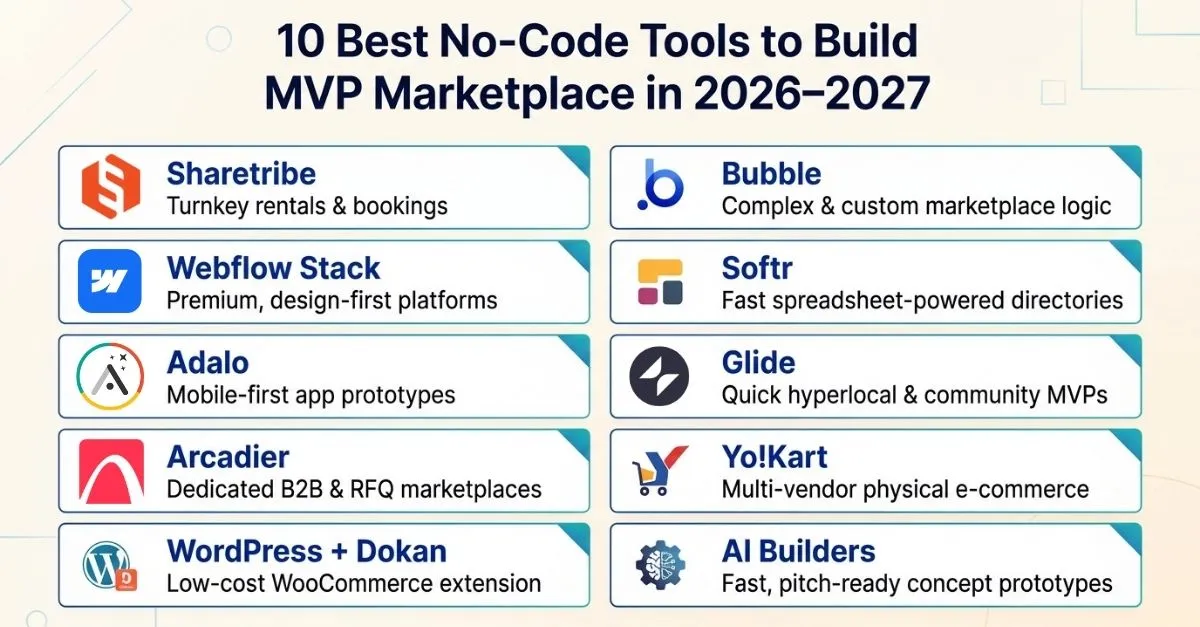
Here’s the actual list that we’d point a client toward if they asked us tomorrow to build a marketplace MVP with no-code.
1. Sharetribe
If there’s one tool people mean when they say “just use no-code,” it’s this one. Sharetribe is about as close as the industry gets to a purpose-built no-code MVP builder for marketplaces – vendor profiles, listings, built-in Stripe Connect payments, and messaging are already there, so you’re testing real supply and demand in days, not months.
The catch is that Sharetribe has opinions about how a transaction should flow, and it doesn’t love being argued with. Multi-party bookings or unusual pricing rules eventually need code extensions or a rebuild. We’ve walked a few clients through a migration from Sharetribe Go to Sharetribe Flex once the old version stopped fitting, and if you want inspiration first, our roundup of top Sharetribe marketplaces is worth a skim before you build.
- Best for: rentals, services, bookings, straightforward buy/sell
- Pricing: paid plans start once you’re past the free trial, scales with GMV
- Ceiling: moderate – great for validating, limiting for complex logic
2. Bubble
Bubble is really a visual programming language wearing a marketplace costume, and that’s exactly why it’s the most flexible no-code MVP tool here. Custom matching logic, multi-step approval workflows, oddball user roles – Bubble can usually model it, given enough patience.
The flip side is the learning curve. It’s steeper than Sharetribe’s, full stop. Give yourself a few weeks even for a lean build, and if nobody on your team has ever thought about a database schema, it’s worth hiring a Bubble specialist for the first pass rather than fighting it alone.
- Best for: marketplaces with unusual logic or workflows
- Pricing: mid-tier, workload-based pricing at scale
- Ceiling: high for a no-code tool, but performance degrades under heavy traffic
3. Webflow + Memberstack/Foxy stack
On its own, Webflow isn’t a marketplace tool at all – it’s a website builder. But bolt on Memberstack for logins and Foxy or Stripe for payments, and you get one of the best no-code tools to build MVP platform pages that actually look like a funded startup made them, not a weekend project.
We’d pick this stack when the brand has to feel premium from launch day – a curated, editorial marketplace, not a high-volume commodity one where nobody cares what the checkout page looks like.
- Best for: design-led, curated, or content-heavy marketplaces
- Pricing: several subscriptions stacked together, moderate total cost
- Ceiling: low for transaction complexity, high for design polish
4. Softr
Softr’s whole pitch is turning a spreadsheet into a website, and it delivers – an Airtable base can become a working front end in an afternoon. For founders who think in rows and columns rather than schemas, it’s a genuinely fast no-code MVP builder.
It shines for a directory-style MVP you just want to put in front of a waitlist. Honestly, a lot of teams use it for one job only: finding out whether anyone will bother filling out a listing at all.
- Best for: directories, curated lists, lightweight two-sided marketplaces
- Pricing: low starting cost, scales reasonably
- Ceiling: limited once transaction volume or logic grows
5. Adalo
Adalo’s whole reason for existing is native mobile apps, which matters a lot if your users – gig workers, delivery drivers, people buying from their neighbors – live on their phones and barely open a browser. Custom actions and a visual database make basic marketplace logic doable.
It won’t out-polish Bubble or Sharetribe, and it shows. Think of Adalo as a mobile-first prototyping tool you’ll probably outgrow, not somewhere you plan to still be in two years.
- Best for: mobile-first, app-only marketplace MVPs
- Pricing: affordable entry tier
- Ceiling: low-to-moderate, best treated as disposable prototype
6. Glide
Glide plays in the same spreadsheet-to-app space as Softr, but it leans harder into feeling like a real native app, and it’s added AI-assisted generation that lets you go from a prompt (plus a spreadsheet) to something clickable. That earns it a spot among the best no-code AI tools for MVP development.
It’s a good match for a scrappy, hyperlocal idea – a neighborhood tool-share, a community bulletin for services – where “usable by Friday” beats “polished by next quarter.”
- Best for: hyperlocal or community marketplaces, fast prototypes
- Pricing: generous free tier, low paid tiers
- Ceiling: low – a validation tool, not a scaling platform
7. Arcadier
Arcadier doesn’t get talked about as much as Sharetribe, which is a bit unfair – it’s a marketplace-specific SaaS builder with solid B2B, B2C, and services templates, plus a lower-code path for teams who eventually want to get their hands dirty in the code without a full rebuild.
It lands somewhere between Sharetribe and hiring a dev team: more room to configure things your way, still much faster than starting from a blank repo.
- Best for: B2B marketplaces and RFQ-style platforms
- Pricing: mid-to-higher tier for marketplace-specific SaaS
- Ceiling: moderate-to-high depending on plan
8. Yo!Kart
Yo!Kart is a bit of an odd fit for a “no-code” list because it’s self-hosted and license-based, but it earns its place for anyone building multi-vendor e-commerce rather than a services marketplace. Vendor dashboards, commission management, and abandoned-cart recovery come baked in – the kind of commerce plumbing generic builders often skip.
Being self-hosted means more setup work up front than a pure SaaS tool. In exchange, you dodge the recurring per-transaction fees that quietly eat your margin once GMV starts climbing.
- Best for: multi-vendor product marketplaces (physical goods)
- Pricing: one-time license plus hosting
- Ceiling: moderate, e-commerce focused
9. WordPress + Dokan Multivendor
If half your team already knows their way around WordPress, don’t ignore this option out of snobbery. The Dokan plugin turns an existing WooCommerce store into a working multi-vendor marketplace without writing code, and it’s a cheap way to test a marketplace MVP no-code approach on infrastructure you already trust.
It’s not as slick as a purpose-built SaaS tool, and yes, plugin conflicts will eat an afternoon here and there. But WordPress developers are everywhere, so finding help when something breaks at 11 p.m. is rarely the problem.
- Best for: teams already invested in WordPress/WooCommerce
- Pricing: low – plugin cost plus hosting
- Ceiling: moderate, depends heavily on hosting and plugin quality
10. AI-Powered App Builders (Lovable, Bolt, and similar)
This newer crop of AI-first builders will happily turn a plain-language description into a clickable prototype in an afternoon. It’s probably the fastest of the best no-code AI tools for MVP development right now – the catch is that “fast” and “ready for real users” aren’t the same thing.
We’d use these to get a proof of concept in front of investors or a first cohort of testers, and stop there. Real money changing hands and real vendor disputes need more hardening than a generated app tends to have.
- Best for: pitch-ready prototypes, rapid concept validation
- Pricing: usage-based, generally inexpensive at MVP scale
- Ceiling: low for production use, high for speed of first draft
Quick Comparison: Best No-Code MVP Marketplace Builders
A side-by-side view of the best no-code platforms to build MVP marketplace products, at a glance.
Tool | Best For | Native Payments | Ceiling |
|---|---|---|---|
Sharetribe | Rentals, services, bookings | Yes (Stripe Connect) | Moderate |
Bubble | Custom logic marketplaces | Via plugins | High |
Webflow stack | Design-led marketplaces | Via Foxy/Stripe | Low-Moderate |
Softr | Directories, lightweight MVPs | Via integrations | Low |
Adalo | Mobile-first MVPs | Via plugins | Low-Moderate |
Glide | Hyperlocal, AI-assisted apps | Via integrations | Low |
Arcadier | B2B marketplaces | Yes | Moderate-High |
Yo!Kart | Multi-vendor e-commerce | Yes | Moderate |
WordPress + Dokan | WooCommerce teams | Yes (WooCommerce) | Moderate |
AI app builders | Rapid prototypes | Rarely production-ready | Low |
How to Choose the Best No-Code MVP Marketplace Builder?
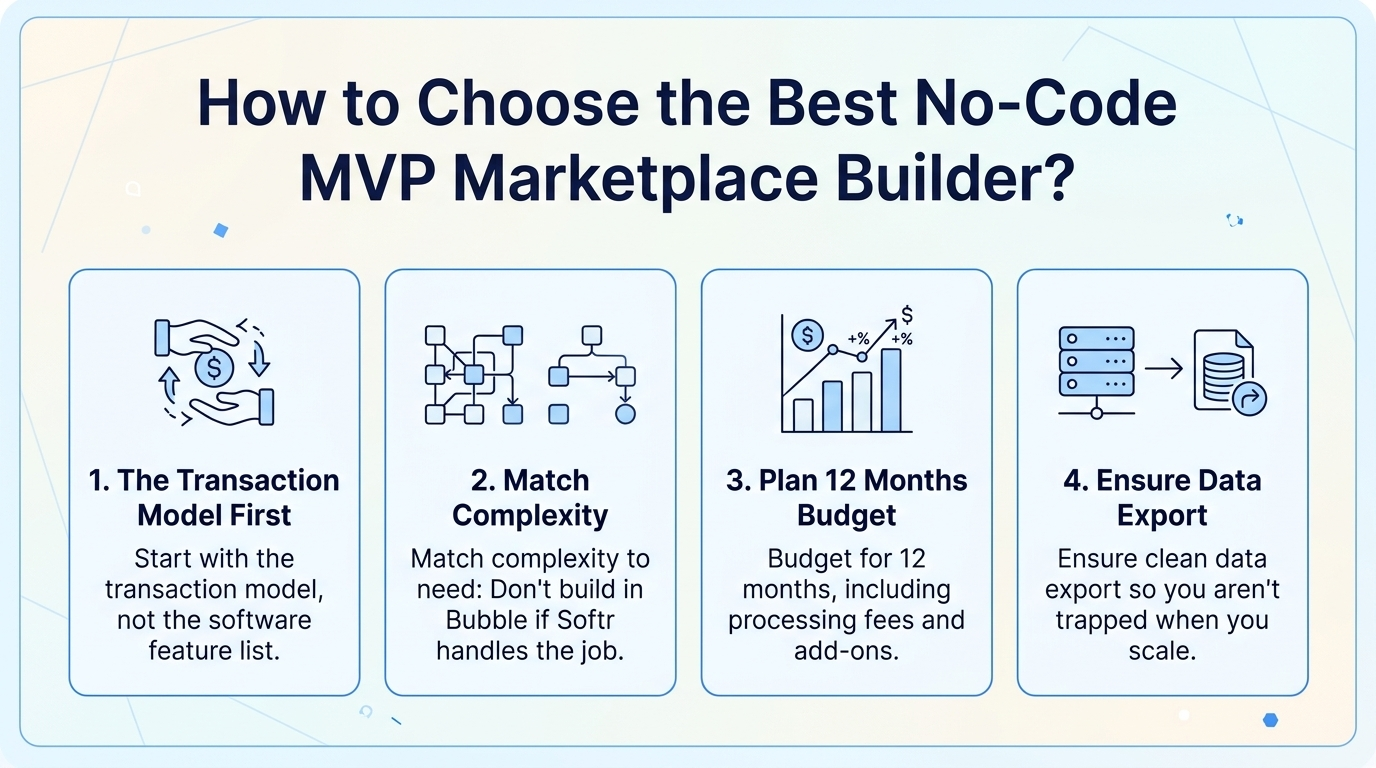
Don’t start with the tool list – we know that’s ironic given the ten tools above, but hear us out. Start with your transaction model. A booking marketplace, a product marketplace, and a service-RFQ marketplace all run on different logic, and the right no-code MVP builder for one is often a mediocre fit for another.
Before you compare a single tool, it’s worth taking 15 minutes to choose the right type of marketplace you’re actually building – horizontal, vertical, B2B, and P2P marketplaces each pull toward different platforms on this list.
Match the tool to your transaction complexity
A simple listing-and-contact marketplace – basically a local directory – doesn’t need a database, let alone Bubble-grade flexibility. Softr or Glide will get you there faster, and honestly with less headache.
Budget for the full first year, not just the launch
Add up payment processing fees, the add-ons you’ll inevitably need, and someone’s time to maintain the thing, because the number on a pricing page rarely matches what a marketplace MVP no-code build costs actually by month six.
Plan your exit before you need it
Ask, up front, what happens to your vendor data, reviews, and transaction history the day you outgrow the tool. A platform that exports data cleanly is worth more than one with a slightly prettier template – you’ll thank yourself later.
When No-Code Tool Is Not Enough?
No-code earns its keep during validation. It stops earning its keep the moment you notice your workaround-to-feature ratio creeping up, page load times start bleeding conversions, or a better-funded competitor’s custom platform starts making yours look dated.
We’ve sat across the table from more than a few founders who hit this exact wall after using a no-code MVP builder to prove demand – and the pattern is almost boringly consistent: the MVP’s own success is what breaks it. More vendors, more listings, more weird edge cases, and suddenly the ceiling you didn’t know was there is very much in the way.
- You’re stacking third-party plugins just to replicate basic logic
- Transaction fees on the no-code platform now cost more than a custom build would
- You need custom search, recommendations, or fraud detection the platform can’t support
- Investors or enterprise clients are asking about security, uptime, or compliance you can’t fully answer
It’s also a good moment to revisit the types of marketplace business models you’re running on, since a shift from a flat commission to something like subscription-plus-commission often happens right around the same time founders leave no-code behind.
Roobykon – Your Partner Beyond the No-Code Stage
Roobykon Software is a custom development agency with teams in New York and Tallinn, and we’ve shipped marketplace platforms across rentals, services, B2B trade, and e-commerce. That means we’ve watched the no-code-to-custom transition happen from both sides of the table, more times than we can count.
To be clear, we’re not in the business of talking people out of no-code too early – plenty of good businesses run happily on Sharetribe or Bubble for years, and there’s no prize for going custom sooner than you need to. When you do outgrow it, we build around the data you’ve already validated instead of starting from a blank page, so your existing vendors and history don’t get thrown out with the old platform.
If cost is the thing keeping you up at night, our marketplace development cost estimate breakdown is a decent next read. Earlier in the process and still deciding what to build at all? Our take on marketplace niches worth building might save you a wrong turn before you even open a no-code tool.
- Custom marketplace development in Ruby on Rails, React, and modern stacks
- Migration support from Sharetribe, Bubble, or WordPress into custom platforms
- Ongoing product strategy so your roadmap doesn’t outrun your infrastructure again
Not Sure If You've Outgrown No-Code Yet?
We're not here to push you off Sharetribe or Bubble too early. Get an honest assessment of whether you're ready for custom – or should stay put a while longer.
Get a Free Platform AssessmentFAQ

Recommended articles
 Sharetribe Reviews 2026: An Honest Look at the No-Code Marketplace Platform
Building a marketplace in 2026? Stop scrolling – this Sharetribe review is your reality check. We've crunched the numbers, analyzed real customer feedback, and mapped the platform against every marketplace type.
 From Idea to Launch: How to Build a Two-Sided Marketplace That People Actually Use
Thinking about building a two‑sided marketplace? In 2026, you can launch an MVP without coding in days, but scaling requires custom logic, multi‑vendor payouts, and a robust trust layer. Roobykon's guide breaks down business models, feature priorities, software options, and what it actually costs to go custom.
 The Best Marketplace Software for Founders
Beneath every successful multi‑vendor marketplace lies a critical architectural decision. This technical deep dive from Roobykon Software examines the best software to build a marketplace.
 MVP, MMP, and MLP: What is the difference, and which concept will help you create a successful marketplace
Marketplace creation is a complex ecosystem integrating technological innovation, user experience design, and strategic market positioning. MVP, MMP, and MLP represent progressive conceptual frameworks that enable entrepreneurs to navigate this complexity.
