Subscribe and you will promptly receive new published articles from the blog by mail
A few years ago, “smart” marketplace features meant a recommendation widget bolted onto a product page. That’s not what we’re talking about anymore. Today, artificial intelligence changing how buyers and sellers meet, negotiate, and transact is the whole story, and if you run a platform, ignoring it isn’t really an option.
- AI adoption in business has gone mainstream fast: most organizations now use AI in at least one function, though only a minority have turned that into measurable profit impact, which is where architecture and execution matter most.
- AI-driven traffic and orders are compounding, often converting better and carrying higher order values than traditional search – this is not a marginal channel anymore.
- Agent-led marketplaces are moving from concept to infrastructure, with trillions of dollars in commerce projected to shift toward autonomous agents by 2030.
- Trust is still catching up to capability: most consumers are open to AI-assisted purchasing, but very few are ready to hand over full control, which shapes how agent features should be rolled out.
- The winners will be the platforms that build for AI from the ground up: clean data, structured APIs, and agent-ready architecture – not the ones adding it as an afterthought.
The AI marketplace shift is already here
Call it AI marketplace transformation, call it the next stage of e-commerce – either way, the mechanics of online marketplaces are being rewritten in real time. Search now is a whole new conversation. Pricing is a live model reacting to demand, competitor moves, and even weather. Customer support is an agent that resolves the issue before a human ever sees it.
The numbers don’t lie
Enterprise AI adoption has climbed sharply. 75.4% of consumers have now used AI tools like Claude, ChatGPT, and Gemini to help with shopping or purchase decisions. 80.4% say AI shopping experiences have already met or exceeded their expectations. And 71% of consumers expect generative AI to influence at least half of their spending decisions over the next 12 months.
On the shopping side, the growth of artificial intelligence is even more dramatic: AI-referred traffic to U.S. retail sites grew 393% year over year in Q1 2026. In May 2026 alone, AI-referred traffic grew 138% year over year and has grown 1,324% (more than 14x) since October 2024. Orders arriving through AI-powered search have grown nearly 13x over the same period.
What’s driving this AI marketplace transformation?
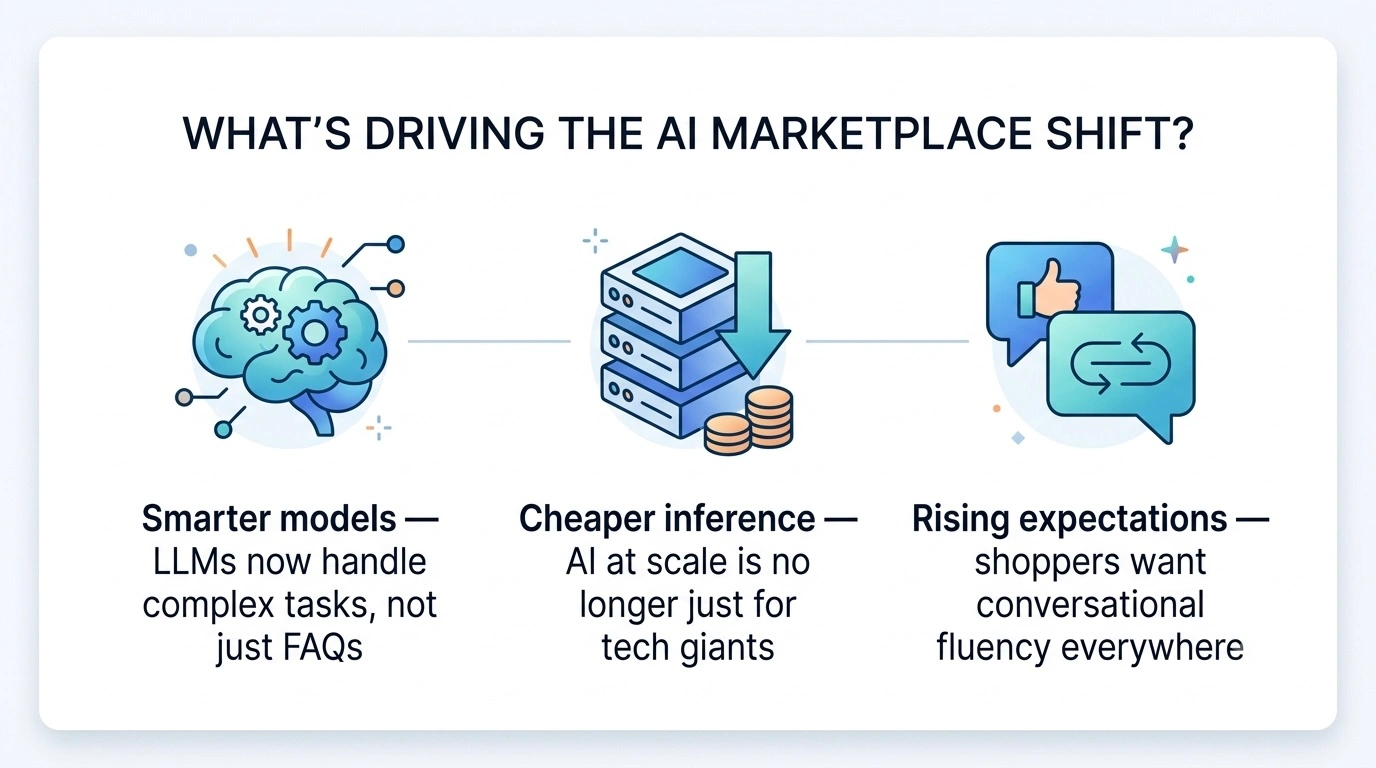
Three things, mostly:
- Better foundation models. LLMs got good enough to handle nuanced, multi-step tasks, not just chatbots answering FAQs.
- Cheaper inference. Running AI at marketplace scale (millions of listings, millions of users) stopped being a luxury only tech giants could afford.
- Buyer expectations. People who use conversational AI daily expect the same fluency from the platforms where they shop, book, or hire, and analysts already estimate that a large share of consumers use some form of artificial intelligence somewhere in their shopping journey, from comparing prices to summarizing reviews.
From personalization to autonomy: the shifting AI marketplace
Early marketplace AI was mostly about personalization – “customers who bought this also bought that.” The shifting AI marketplace landscape now goes much further. Vector search understands intent instead of exact phrasing.
Dynamic pricing engines adjust in seconds instead of nightly batch jobs. Fraud detection catches patterns no rule-based system would ever flag. Recommendation engines built on AI are now converting at multiples of what traditional search delivers, which is exactly why so many platform owners describe marketplace AI reshaping as the biggest architectural shift since mobile-first design.
Here’s the uncomfortable truth: almost everyone is “doing AI,” but hardly anyone can point to real profit from it yet. The data backs that up. But don’t read that as “AI doesn’t work.” Read it as “most people aren’t doing it right.” The real ROI comes when you’re intentional – when you have a clear problem to solve, when your data isn’t a mess, and when artificial intelligence is baked into your architecture, not glued on top of it.
Where Roobykon Fits In
As an online marketplace development company with over a decade of experience, Roobykon Software has been helping businesses navigate these shifts before they became mainstream. We understand that AI marketplace integration is about fundamentally rethinking how your platform operates.
From custom Sharetribe development to AI-powered search and recommendation engines, we build solutions that grow with your ambitions. Our marketplace development services cover everything from MVPs to enterprise-grade platforms across multiple industries.
Enter the agents
The most interesting artificial intelligence trend right now is a new kind of participant. Agent-led marketplaces are platforms where AI agents don’t just assist a human buyer or seller; they act on their behalf. An agent can compare vendors, negotiate terms, place an order, and even handle post-purchase support, all without a person clicking through ten tabs.
This isn’t speculative. Analysts project agent-driven commerce will redirect trillions in global retail spend by 2030, with a meaningful share of U.S. e-commerce running through autonomous agents. Some marketplaces are already building APIs for third-party shopping agents to transact directly – quietly redefining who counts as the customer. Consumer comfort is following the same curve: a majority of shoppers now say they’re at least somewhat comfortable with an agent-led marketplaces making a purchase on their behalf, even if only a small share currently let an agent complete a transaction unsupervised.
That gap between “comfortable in theory” and “trusts it fully” is where the next few years of product decisions will actually happen.
Why founders should care about AI marketplace transformation
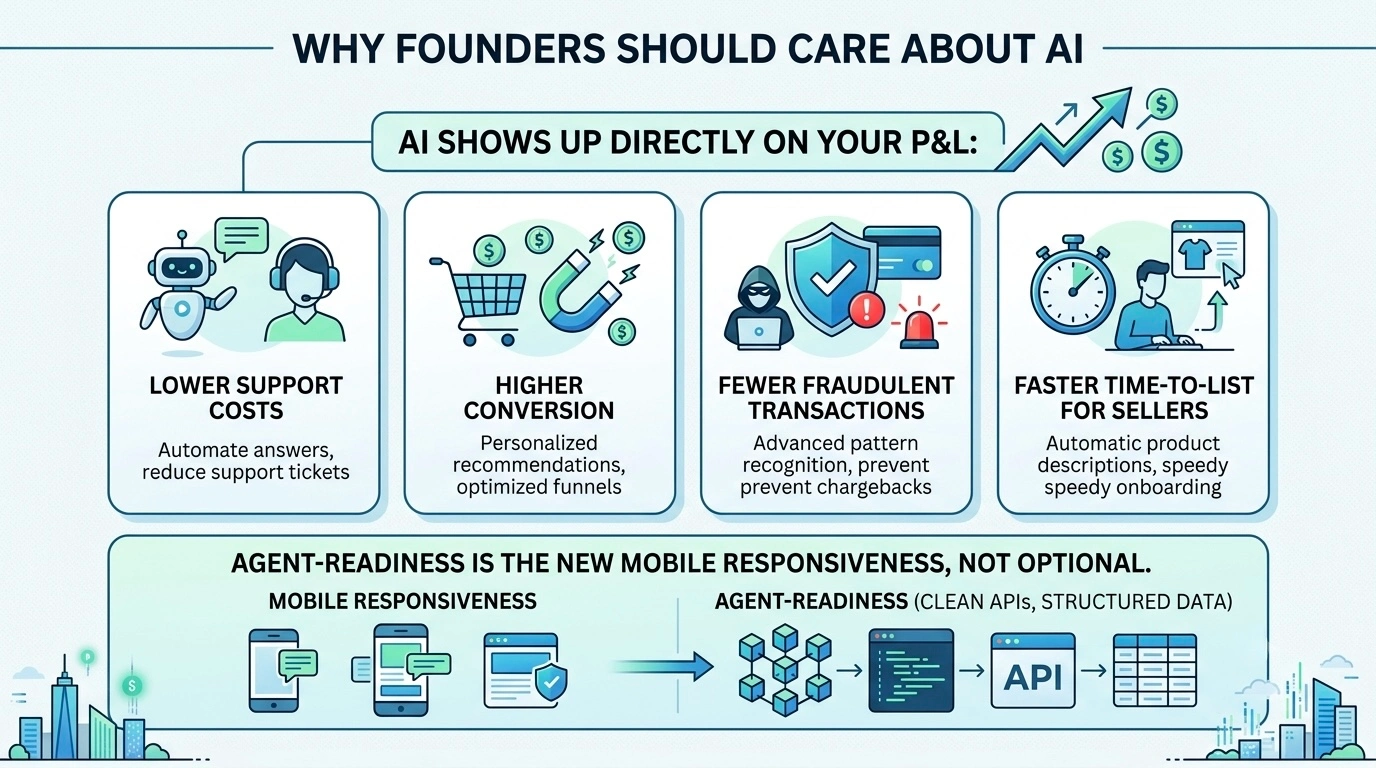
It’s easy to read all this as hype. It isn’t. Artificial intelligence is revolutionizing marketplaces in ways that show up directly on a P&L: lower support costs, higher conversion from better search and recommendations, fewer fraudulent transactions, and faster time-to-list for sellers.
Gartner-style forecasts already expect a large share of enterprise applications to embed AI agents within the near term, and forward-looking platforms are treating “agent-readiness” – structured data, clean APIs, machine-readable catalogs – the same way they once treated mobile responsiveness: not optional.
Platforms that treat AI as a bolt-on feature are already behind the ones that built it into their core architecture from day one. If you’re planning to transform business with AI – whether that means adding a recommendation engine, an AI-assisted onboarding flow, or a full agent-ready API – the platforms that move now, with a clear technical roadmap, are the ones that will define what “normal” looks like in this space over the next few years.
Building for what’s next
The shifting AI marketplace landscape presents both opportunity and risk. A divide is emerging between traditional procurement paths and AI-discovered buyers. New and long-tail buyers are entering through public channels where pricing is transparent, and alternatives are seconds away.
For founders, the takeaway is clear. This isn’t about bolting on AI. It’s about rebuilding your product, your pricing, your entire approach around it. The ones who get that – and get it fast – are the ones who’ll shape where this whole industry goes next.
Not sure where to start with AI?
AI adoption can feel overwhelming, but it doesn't have to be. Our team works with founders to identify the highest-impact use cases for their marketplace. Contact us – we'll help you figure out what actually makes sense for your business.
Book a free consultation
Recommended articles
 Top Web Development Companies in Eastern Europe in 2026
Searching for the top web development companies in Eastern Europe? This 2026 guide ranks the best web development agencies for SaaS platforms, marketplaces, custom web applications, and MVPs.
 The Best Marketplace Software for Founders
Beneath every successful multi‑vendor marketplace lies a critical architectural decision. This technical deep dive from Roobykon Software examines the best software to build a marketplace.
 TOP 5 Marketplace Business Models to Build in 2026
Unlock high-growth opportunities in the digital economy. Our deep-dive article identifies the top 5 marketplace business models primed for success in 2026. We break down the data, consumer trends, and operational advantages of each model.
 How to find a web development partner for your startup: a step-by-step guide
Choosing the wrong development partner can cost you months. Use this expert guide from Roobykon Software to find a trusted web development partner who treats your startup like their own.