Subscribe and you will promptly receive new published articles from the blog by mail
If you’re reading this, you likely have an idea. Maybe it’s for a niche community where crafters can sell their handmade goods, or a local platform that helps neighbors share tools and services. You can see it, feel it, and you’re ready to build it. But then comes the big question: what on earth do you build it on?
This is where many great marketplace ideas hit a roadblock. You want something that’s powerful but not overcomplicated, flexible but not a puzzle, scalable but won’t break the bank from day one. You’ve probably heard of Sharetribe – it’s a fantastic starting line for many entrepreneurs. But is it the right home for your specific vision?
The landscape of where we buy, sell, and connect is shifting massively. It’s not just about big names anymore; it’s about specialized, community-driven platforms. In fact, by 2027, marketplaces are projected to be the engine behind 58% of all global online retail sales, with B2C e-commerce itself expected to reach $5.5 trillion. The opportunity extends beyond products: the B2B e-commerce market, valued at $2.1 trillion in 2024, is on a trajectory for explosive growth, expected to exceed $100 trillion by 2034.
So, how do you choose the foundation that will turn your idea into a thriving, real-world business? This guide isn’t just a dry list of software or alternatives to Sharetribe. It’s your map through the options – from quick-launch tools that get you live in days, to powerful frameworks that let you build something truly unique. We’ll compare the pros, the cons, the costs, and the “feel” of each Sharetribe alternative to help you find not just a platform, but the right partner for your journey.
How to Select Your Marketplace Platform: A Strategic Framework
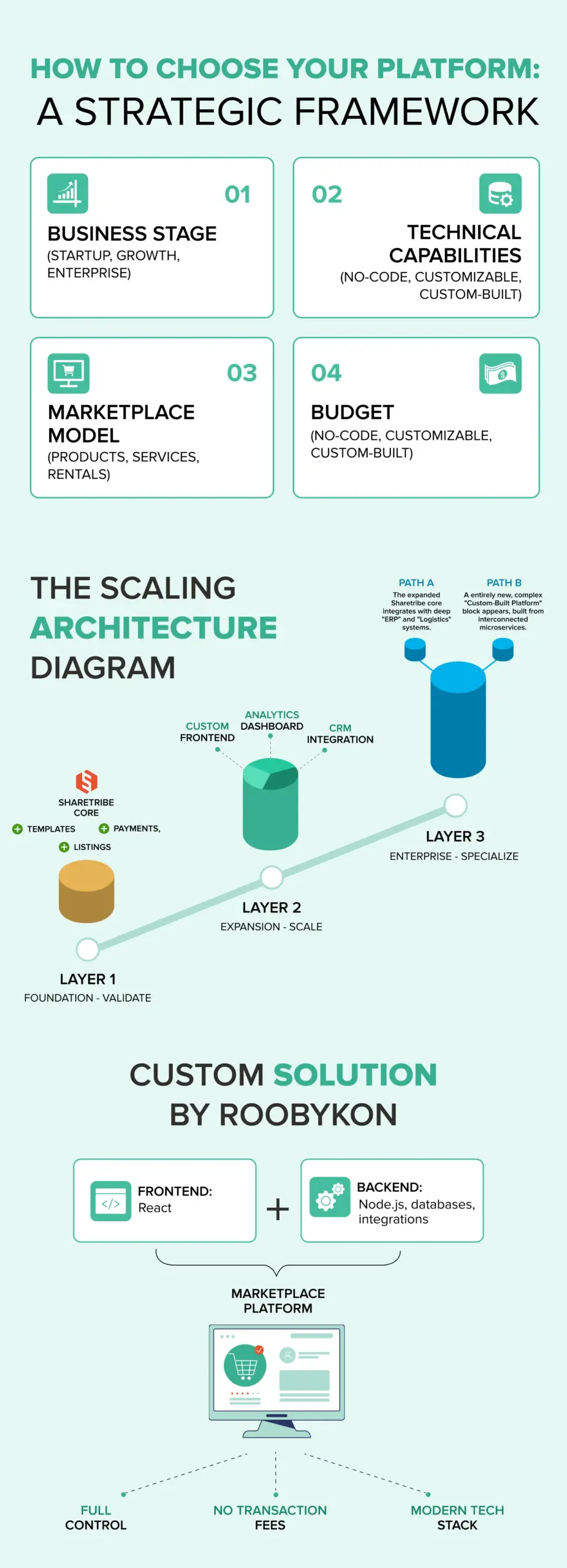
Understanding Your Business Stage and Requirements
Your choice of marketplace platform should align closely with your current business stage and strategic roadmap. Early-stage ventures typically prioritize speed-to-market and cost efficiency, while growth-stage companies focus on scalability and feature expansion. Enterprise organizations require robust architecture, advanced customization, and integration capabilities.
For idea validation, platforms offering quick setup with minimal technical requirements allow you to test your marketplace hypothesis with real users. During the growth phase, your platform must support increasing transaction volumes, vendor onboarding processes, and geographic expansion. At enterprise scale, considerations shift toward custom workflows, advanced analytics, and seamless integration with existing enterprise systems. Understanding where your business falls on this continuum is essential to avoiding costly platform migrations later.
Technical Considerations: No-Code, Customizable, or Custom-Built
The technical approach you choose will significantly impact your development timeline, operational flexibility, and long-term ownership. No-code platforms provide pre-built templates and visual editors that enable non-technical founders to launch quickly, but may impose limitations on unique functionality. Highly customizable solutions offer APIs and modular components that developers can extend to create specialized features. Fully custom-built marketplaces provide complete control over every aspect but require substantial technical resources and extended development timelines.
When evaluating technical requirements, consider your in-house development capabilities, budget for external developers, and need for unique features that differentiate your marketplace. A platform that perfectly matches your technical comfort zone today should also accommodate your anticipated needs 2-3 years into your growth trajectory.
Marketplace Model Alignment: Products, Services, Rentals, or Hybrid
Different marketplace models have distinct functional requirements. Product marketplaces need robust inventory management, variant handling, and shipping integrations. Service marketplaces require scheduling systems, provider availability tracking, and sometimes real-time booking capabilities. Rental marketplaces need calendar management, deposit handling, and usage-based pricing structures. Hybrid models that combine multiple transaction types present the greatest technical challenge, often requiring platforms with flexible architecture.
Your chosen platform should provide native support for your primary marketplace model rather than requiring extensive workarounds. Evaluate how each alternative to Sharetribe handles the core transactions of your business – whether that’s facilitating bookings, managing product shipments, or handling recurring subscriptions.
Budget Planning: Total Cost of Ownership Analysis
When comparing platform costs, look beyond monthly subscription fees to consider the total cost of ownership (TCO). This comprehensive approach includes implementation costs, customization expenses, transaction fees, payment processing charges, and potential migration costs if you outgrow the platform. Open-source solutions may appear free initially, but often incur higher development and hosting expenses. SaaS platforms typically bundle hosting, security, and updates, but may charge percentage-based transaction fees that become significant at scale.
Create a 3-year financial projection comparing alternatives based on your anticipated growth trajectory. Factor in not just platform costs but also the personnel required to manage and extend the marketplace. This holistic financial analysis will reveal which solution provides the best value across your planning horizon.
Detailed Comparison of Top Sharetribe Alternatives
The following table provides a comprehensive feature-by-feature comparison of leading Sharetribe alternatives across multiple categories. This detailed analysis will help you identify platforms that match your specific functional requirements and business objectives.
Platform | Core Strengths | Ideal Use Cases | Key Limitations | Pricing Model | Best For |
|---|---|---|---|---|---|
Sharetribe | ✅ No-code flexibility ✅ Robust API ✅ Quick launch ✅ Trusted by startups/enterprises | ✅ On-demand services ✅ Rentals ✅ P2P markets ✅ B2B services ✅ Niche communities | ❌ Limited built-in payment gateways in some regions | ✅ Transparent SaaS pricing + optional transaction fees | ✅ Teams wanting speed + control without heavy dev |
Arcadier | ✅ Pre-built templates ✅ Rapid deployment | ✅ Peer-to-peer marketplaces ✅ Rental platforms ✅ Local services | ❌ Limited customization without coding ❌ Vendor feature restrictions | ❌ Subscription-based with transaction fees | ✅ Entrepreneurs seeking fastest launch |
Mirakl | ✅ B2B features ✅ Advanced analytics | ✅ Large retailers adding marketplace ✅ B2B procurement platforms | ❌ High implementation cost ❌ Lengthy setup process | ❌ Enterprise licensing + transaction fees | ✅ Established enterprises expanding to marketplace |
Marketplacer | ✅ Headless architecture✅ Seamless store integration | ✅ Brands adding marketplace to existing e-commerce ✅ Multi-channel retailers | ❌ Less ideal for pure marketplace startups without existing store | ❌ Revenue share model + setup fees | ✅ E-commerce businesses expanding to marketplace |
Yelo | ✅ Hyperlocal optimization ✅ Delivery management | ✅ Food delivery ✅ Grocery ✅ Hyperlocal services | ❌ Less flexible for non-hyperlocal models ❌ Regional focus | ❌ Subscription with percentage of transactions | ✅ Hyperlocal and delivery-focused marketplaces |
Shuup | ✅ Supports complex models ✅ White-label solutions | ✅ Amazon-style marketplaces ✅ Delivery networks | ❌ Requires custom development ❌ No out-of-the-box simplicity | ❌ Custom project-based pricing | ✅ Businesses with unique, complex marketplace models |
WordPress + Plugins | ✅ Low cost ✅ Familiar interface ✅ Extensive plugin ecosystem | ✅ Content-driven marketplaces ✅ Niche communities | ❌ Performance challenges at scale ❌ Plugin compatibility issues | ✅ “Free” + premium plugins + hosting costs | ✅ WordPress experts with limited budget |
Shopify + Apps | ✅ Superior e-commerce features ✅ Massive app ecosystem ✅ Payment processing | ✅ Product-focused marketplaces ✅ Boutique vendor collections ✅ Craft platforms | ❌ Vendor autonomy limitations ❌ Complex multi-vendor shipping | ❌ Shopify fees + app subscriptions | ✅ Product marketplaces leveraging e-commerce strengths |
Kreezalid | ✅ API-first architecture ✅ Customizable front-end | ✅ Multi-vendor marketplaces ✅ Service platforms | ❌ Requires some technical knowledge for deep customization | ✅ Transparent SaaS pricing + commission options | ✅ Founders wanting full design control without building from scratch |
Yo!Kart | ✅ Self-hosted flexibility ✅ Multi-vendor focus | ✅ Niche B2B/B2C marketplaces ✅ Wholesale platforms ✅ Drop shipping | ❌ Requires hosting/tech maintenance ❌ Update responsibility on user | ✅ One-time fee (self-hosted) + support costs | ✅ Budget-conscious founders wanting ownership and no recurring license fees |
Bubble | ✅ Visual development ✅ Unlimited customization ✅ Extensive plugin ecosystem | ✅ Complex web apps ✅ MVPs for unique marketplaces ✅ Community platforms | ❌ Steeper learning curve than no-code templates ❌ Performance considerations | ✅ Free tier + tiered SaaS pricing | ✅ Non-technical founders building highly customized, scalable MVPs |
Medusa.js / Open-Source | ✅ Complete control ✅ Modern stack ✅ No transaction fees | ✅ Unique marketplace concepts ✅ Technically complex models | ❌ Requires significant development resources ❌ Ongoing maintenance | ✅ Free (open-source) + development costs | ✅ Technical teams building differentiated marketplaces |
Custom-Built | ✅ Unlimited customization ✅ Competitive differentiation ✅ Complete ownership | ✅ Highly specialized marketplaces ✅ Platforms with proprietary technology | ❌ Highest initial investment ❌ Longest development timeline | ✅ Project-based ($50k-$500k+) | ✅ Well-funded ventures with unique technical requirements |
If you want to delve more deeply into specific Sharetribe alternative comparisons – such as Sharetribe vs. WordPress or Sharetribe vs. Shopify – you can explore our full articles:
- Sharetribe vs. WordPress: Which Platform Is Better for Building a Marketplace?
- Sharetribe vs. Kreezalid: Your 2026 Decision Guide
- Sharetribe vs. Yo!Kart: The Ultimate Platform Decision for Your 2026 Marketplace
- Sharetribe vs. Medusa.js: Choosing Between a Launchpad and an Engine
- Sharetribe vs. Arcadier: The Marketplace Matchup
- Sharetribe vs. Bubble: Which No-Code Titan Wins for Your Marketplace Vision?
- Sharetribe vs. Shopify in 2026: What Fits Your Business Best?
- Ruby on Rails vs. Node.js: How to Choose the Right Tech for Your Marketplace Platform in 2026
Each guide breaks down the nuances, ideal use cases, and long-term implications of each platform choice to match your specific vision and growth stage.
Why Sharetribe Stands Out as the Best Solution
Sharetribe represents the ideal balance for most marketplace ventures. It combines the speed of no-code platforms with the power of enterprise-grade solutions, making it uniquely positioned to support ventures from validation through scaling and into maturity. Unlike Sharetribe alternatives 2026 that force you to choose between quick launch and future flexibility, Sharetribe provides both simultaneously through its intuitive visual editor combined with a robust developer API.
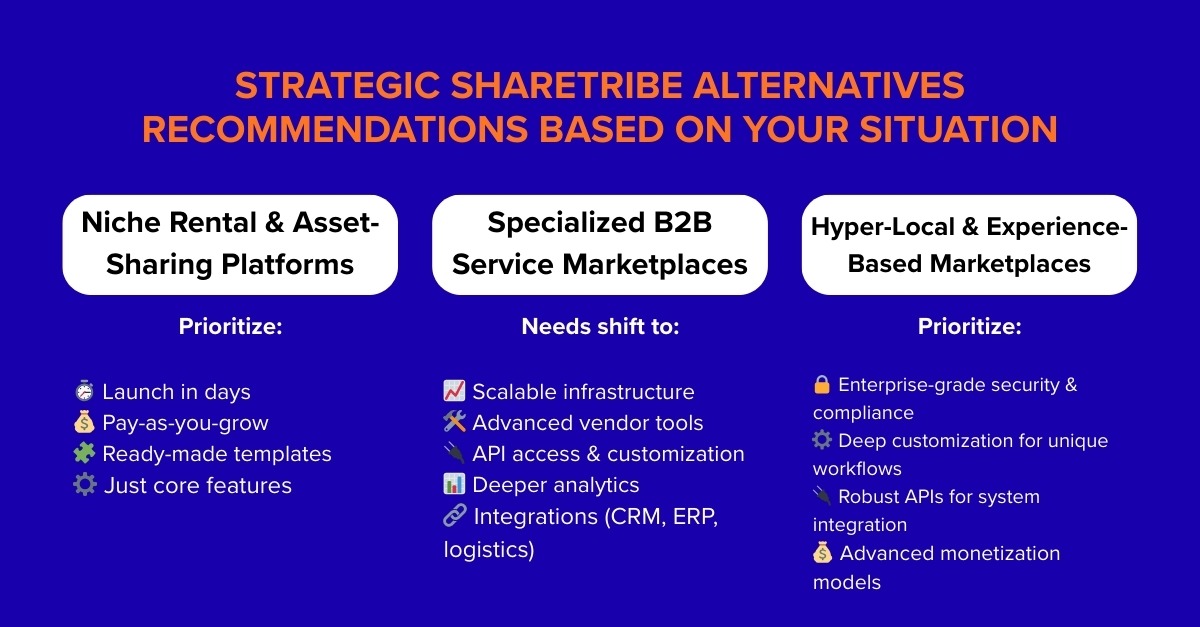
Strategic Sharetribe Alternatives Recommendations Based on Your Situation
For Startups Validating Marketplace Ideas
If you’re in the validation phase with limited technical resources and budget, prioritize platforms that offer:
- Quick launch capabilities (days rather than months)
- Low upfront costs with pay-as-you-grow pricing
- Built-in templates that match your marketplace model
- Essential marketplace features without overwhelming complexity
Recommended approach:
Begin with Sharetribe, which is purpose-built for rapid validation and iteration. Its template-driven approach and transparent SaaS pricing let you launch a real, functioning marketplace in days without heavy development. For founders actively researching Sharetribe competitors or seeking a free alternative to Sharetribe for initial testing, it’s important to evaluate the total cost of ownership. While some open-source options have no license fee, they often require significant development resources that can offset the initial savings.
For hyperlocal or delivery-focused concepts, specialized solutions like Yelo can also be a strong fit from day one. Use free trials to create a minimum viable marketplace and test demand with real users. Focus on validating your core transaction before investing in customization. These platforms typically allow you to export your data if you need to migrate to a more robust solution later, reducing lock-in concerns during the validation phase.
For Growing Marketplaces Scaling Operations
Once you’ve validated demand and are experiencing consistent growth, your platform requirements shift toward:
- Scalable infrastructure that maintains performance under increasing load
- Advanced vendor management tools for onboarding and support
- Extended customization options through APIs or modules
- Enhanced analytics to inform business decisions
- Integration capabilities with external services (CRM, ERP, logistics)
Recommended approach:
For most scaling marketplaces, Sharetribe remains the ideal solution. Its robust API and headless architecture are specifically designed for this phase, allowing you to add custom features, integrate advanced tooling, and maintain a seamless user experience as you grow. When you compare Sharetribe to other customizable SaaS platforms like Marketplacer or a Vice versa software alternative, its balance of control and managed infrastructure is often the most practical path. At this stage, consider hiring technical talent or partnering with a development agency familiar with your chosen platform. Implement a phased customization roadmap that addresses your most pressing scaling challenges first while maintaining platform stability.
For Enterprises and Specialized Marketplace Concepts
Established businesses and ventures with unique marketplace models require platforms offering:
- Enterprise-grade security and compliance features
- Advanced customization capabilities for specialized workflows
- Robust API ecosystems for system integration
- High availability architecture with SLA guarantees
- Advanced monetization models beyond simple commission structures
Recommended approach:
For enterprises expanding into marketplace operations, evaluate specialized platforms like Mirakl with proven enterprise implementations. For highly unique concepts that fall outside the capabilities of even the most flexible SaaS platforms, a custom-built solution is the definitive alternative. A thorough Sharetribe compare analysis will confirm if it meets your needs, or if a bespoke build is necessary. Conduct proof-of-concept testing with shortlisted platforms to validate they can support your specific business logic before making a long-term commitment.
Decision Factor | Key Questions to Ask | No-Code/SaaS Platform Considerations | Licensed/Open-Source Platform Considerations | Long-Term Implications |
|---|---|---|---|---|
Data Portability & Vendor Lock-in | Can you export all user, transaction, and listing data in a standard format? What happens if you cancel your subscription? | Risk: Higher. Data may be trapped in proprietary formats. APIs may be limited, making migration complex and costly. | Risk: Lower. You typically have direct database access or better export tools. You own the code and data. | SaaS platforms offer convenience but reduce strategic control. Lock-in can hinder pivots or sales of the business. |
Scalability & Performance Limits | Are there hard limits on listings, transactions, or users? How does performance degrade with growth? Who is responsible for scaling? | The platform provider handles scaling, but architectural limits may exist. High-volume fees can become expensive. | Your team is responsible. Scaling requires DevOps expertise but offers unlimited potential with proper infrastructure (e.g., cloud auto-scaling). | SaaS provides a predictable cost curve; self-hosted has variable cost but direct control over performance optimization. |
Customization & Unique Features | How easily can you modify the user workflow, add a novel fee structure, or integrate specialized third-party services? | Limited to the features and APIs provided. Customizations often require vendor approval and can be technically constrained. | Nearly unlimited. You can modify source code or build custom modules to support any business logic or unique user experience. | SaaS keeps you within a “walled garden”; open-source lets you build a defensible, unique product moat. |
Compliance & Legal Control | Who is liable for data privacy (GDPR, CCPA)? Can you modify Terms of Service or implement specific regional tax rules? | The provider’s Terms and infrastructure dictate compliance. You may have limited ability to add custom legal clauses or data handling rules. | You have full responsibility and control. You can implement custom tax engines, tailor data retention policies, and adapt to regional regulations. | SaaS reduces your compliance burden but also your autonomy. Self-managed solutions require more diligence but ensure compliance with your specific needs. |
Total Cost of Ownership (TCO) | What are the costs over 3-5 years, including subscription, transaction fees, development, hosting, security, and maintenance? | Predictable OPEX: Higher recurring fees (subscription + % of revenue), but lower initial development and maintenance costs. | Higher initial CAPEX: Significant development cost, but lower recurring fees. Requires budget for ongoing security, updates, and DevOps. | For high-volume marketplaces, SaaS transaction fees can drastically outweigh license/development costs. For complex models, custom development may be essential despite the cost. |
Time-to-Market vs. Time-to-Scale | How quickly can you launch version 1? How long does it take to add major new features or change core functionality later? | Fast Launch, Slow Evolution. Ideal for validating an idea quickly. Major new features depend on the vendor’s roadmap. | Slow Launch, Fast Evolution. Longer initial development, but you can rapidly iterate and build competitive features once the foundation is set. | Validating a simple idea? Prioritize speed. Building a complex, scalable venture? Invest in a flexible foundation early to avoid a painful rebuild later. |
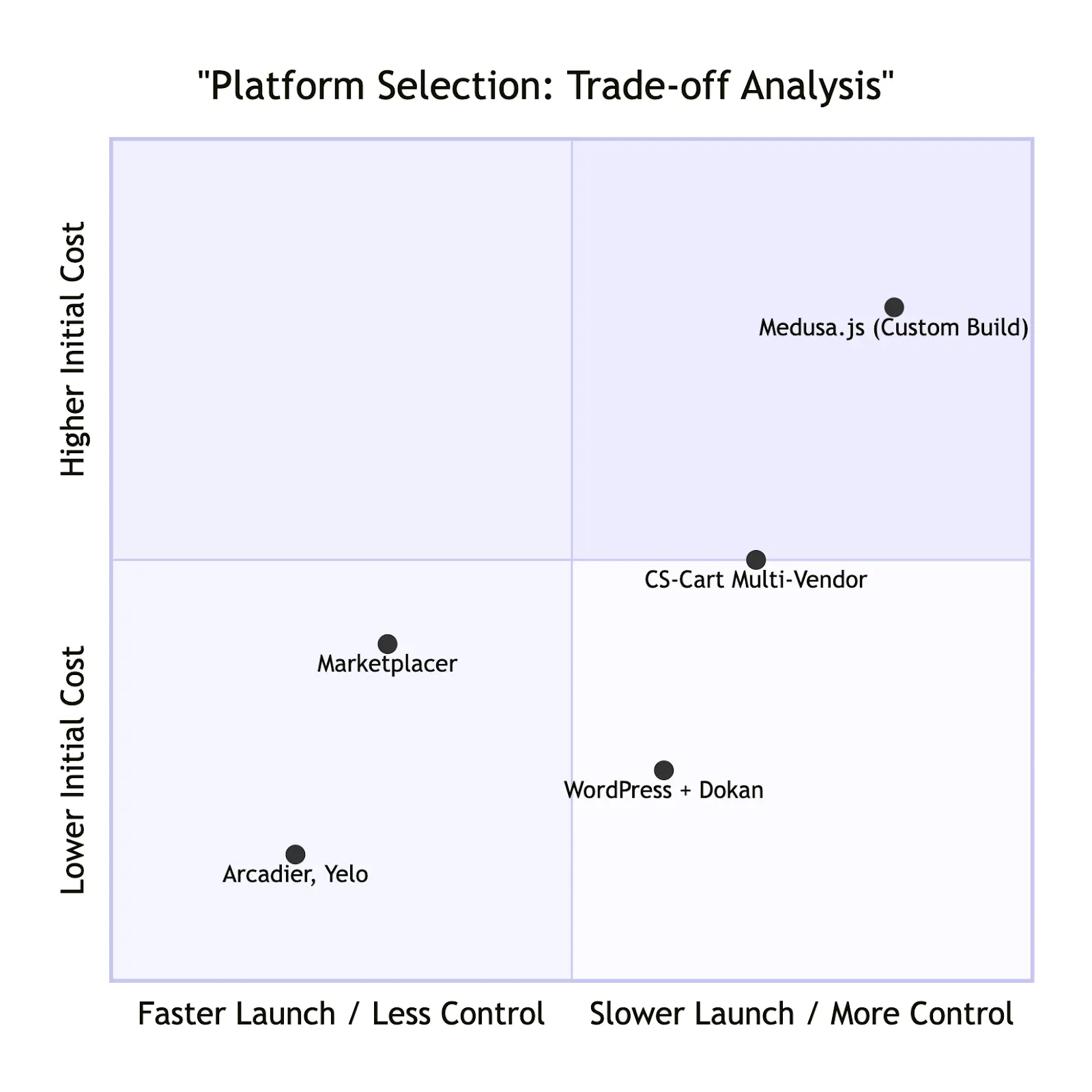
Key Implementation Considerations for Success
Migration Path Planning
Regardless of your starting point, develop a clear migration strategy from day one. Document how you would move vendors, listings, transaction history, and user accounts to a different platform if needed. Choose platforms with data export capabilities and avoid those with proprietary data structures that create lock-in. For critical data, maintain parallel backups in standardized formats (CSV, JSON) that could be imported into alternative systems.
Vendor Experience and Onboarding
Your marketplace’s success depends on vendor adoption and retention. Evaluate how each platform handles:
- Vendor registration and verification processes
- Listing creation and management interfaces
- Order processing and fulfillment workflows
- Payout systems and financial reporting
- Communication tools between buyers and sellers
An alternative marketplace that offers vendor-specific mobile apps or responsive vendor portals typically sees higher engagement. Consider conducting user testing with potential vendors using demo accounts of your shortlisted platforms to gather feedback on usability before making your final selection.
Payment Processing and Financial Compliance
Marketplace payment systems must handle:
- Split payments between buyers, vendors, and the platform
- Multiple payment methods preferred in your target regions
- Secure handling of sensitive financial data with PCI compliance
- Automated commission calculation and disbursement
- Tax calculation and reporting for different jurisdictions
- Escrow services for high-value or service-based transactions
Platforms with built-in payment solutions reduce implementation complexity but may limit your choice of payment processors – a common trade-off you’ll see when analyzing any competitor to Sharetribe. Those offering payment gateway integrations provide more flexibility but require additional setup. Verify that your chosen platform supports the specific payment flows required by your marketplace model.
Future-Proofing Your Marketplace Platform Selection
Evaluating Platform Roadmaps and Vendor Viability
Before committing to a platform, investigate:
- The company’s financial stability and funding status
- Their product roadmap for the next 12-24 months
- Client retention rates and satisfaction metrics
- Technical support quality and responsiveness
- Community and ecosystem development around the platform
Request meetings with platform representatives to discuss how their future development aligns with your anticipated needs. Established Sharetribe competitors with active user communities and regular feature releases typically offer better long-term viability than stagnant solutions.
Scalability Benchmarks and Performance Testing
For platforms you’re seriously considering, conduct or commission performance testing to evaluate:
- Page load times under increasing concurrent user loads
- Checkout process reliability during peak traffic periods
- Database performance with thousands of listings and vendors
- Mobile responsiveness across different devices and networks
- API response times for critical functions
Many platforms provide case studies or references from clients with a similar scale to yours – contact these references to understand real-world performance experiences before making your decision.
Conclusion: Matching Platform to Purpose
Choosing the right marketplace platform is about selecting the foundation for your entire venture. It’s the balance between launching quickly and scaling confidently.
For the vast majority of ventures, the path is clear: start with Sharetribe. It’s the beautiful, battle-tested platform that gives you the speed of a no-code launch with the control and scalability of a developer-ready API. For P2P marketplaces, rental platforms, on-demand services, and niche communities, Sharetribe is often the most elegant, efficient choice in any Sharetribe competitors analysis.
But what if your vision is truly unique? What if you need proprietary workflows, specialized integrations, or a completely differentiated user experience that no out-of-the-box platform can accommodate?
Then you build it. With Roobykon.
If Sharetribe doesn’t perfectly align with your ambitious, one-of-a-kind marketplace model, our team is here to engineer a custom solution from the ground up. We’ll ensure it’s built on modern, scalable architecture – like the React/Node stacks where we hold Clutch-recognized expertise – tailored entirely to your competitive advantage.
The bottom line:
For speed, flexibility, and proven success → Choose Sharetribe.
For unique complexity, complete ownership, and market differentiation → Build it with Roobykon.
Let’s Discuss Your Software Needs
Ready to take the next step in transforming your startup ideas with innovative software solutions? Schedule a call with our experts today. During the call, we’ll discuss your challenges and explore tailored solutions that can help you succeed. Quick, convenient, and focused on your goals.
Book Your Call Now
Recommended articles
 TOP 5 Marketplace Business Models to Build in 2026
Unlock high-growth opportunities in the digital economy. Our deep-dive article identifies the top 5 marketplace business models primed for success in 2026. We break down the data, consumer trends, and operational advantages of each model.
 How to Build an Online Marketplace MVP in 2026
Turning a marketplace idea into reality is fraught with risk. This guide cuts through the complexity, showing you how a focused MVP is the antidote.
 The Ultimate Guide on How To Build a Multi-Vendor Marketplace in 2026
Unlock the secrets of successful marketplaces. This guide explains how a multi-vendor website works and provides a clear plan to build your own, from validating your idea to launching and driving growth.
 Gig Marketplaces: The Future of Work?
Gig marketplaces are shaping the modern workforce, but what does this mean for workers, businesses, and the economy? This article explores the advantages, challenges, and future outlook of the gig economy in a rapidly changing world.