What does Black Friday mean for a B2B marketplace?
How do you improve search and product discovery before Black Friday?
How do you reduce friction in the B2B buying flow?
How should pricing, payments, and invoicing work during Black Friday?
How do you build buyer trust at the moment of decision?
Which innovative features lift conversion on a B2B marketplace?
How do you prepare sellers and operations for Black Friday?
How should you set up marketing and analytics for Black Friday?
Pre-launch checklist: what must be done before Black Friday 2026?
How can Roobykon help you prepare your B2B marketplace for Black Friday?
Subscribe and you will promptly receive new published articles from the blog by mail
Preparing a B2B marketplace for Black Friday is less about servers than most guides suggest. As a founder, your job is to pick one goal, choose offers a finance team can defend, get sellers’ deals live two weeks early, and remove the places where B2B orders stall: quotes, volume pricing, invoice payments, and approvals. On the technical side, you don’t have to set anything up yourself. You need to know what to check and what to ask your developer. That is the short version of preparing B2B marketplace for Black Friday; the rest of this guide fills in the detail.
Black Friday 2026 lands on Friday, November 27, and Cyber Monday follows on November 30. For business buyers, it isn’t really about impulse. It’s the week procurement teams use up annual budgets, stock up before January price lists, and lock in terms for the next quarter. So if you are asking how to prepare your business for Black Friday, start with the calendar.
Most advice on how to prepare for Black Friday shopping is written for online stores selling sneakers and headphones. A B2B marketplace breaks in different places. Think of a 40,000-SKU catalogue, sellers who set their own prices, and a buyer who can’t order until a manager clicks “approve”.
Roobykon builds and supports custom marketplaces, and November is when weak spots show up. This checklist is what our team actually goes through when preparing for Black Friday 2026 with a client, written for founders rather than engineers.
- Start preparing for Black Friday 2026 eight weeks out: ask your team to test search, product pages, and checkout at 3–5x your normal peak, and agree on a change freeze by November 20.
- When preparing a B2B marketplace for Black Friday offers, pick ones a finance team can defend: volume tiers, bundles, free-shipping thresholds, and extended payment terms.
- The heart of how to prepare B2B business for Black Friday is removing friction: quotes with expiry dates, saved carts, one-click reorder, and approvals that lock the campaign price.
- Collect seller offers by November 6, check them automatically, and track one goal metric on a live dashboard.
- You don’t need to know the technology. You need a short list of questions for your developer, and this guide gives you one for every technical step.
What does Black Friday mean for a B2B marketplace?
For a B2B marketplace, Black Friday is a short campaign that rewards bigger, earlier, or repeat orders. It isn’t a flat 50% off. Business buyers care about unit cost and payment terms, so your offer has to survive a conversation with their finance team. That is why preparing for Black Friday 2026 starts with the offer, not the servers.
The demand is real. Adobe Analytics counted $11.8 billion in US online sales on Black Friday 2025, and plenty of those shoppers buy for work, too. After a weekend of slick consumer checkouts, a clunky B2B portal on Monday morning feels twice as slow.
Which Black Friday offers work in B2B?
The offers that work are the ones a buyer can defend in a budget meeting. Picking the right offer is the first real decision in how to prepare your business for Black Friday. Here’s how the usual options compare, and what each one asks of your platform.
Offer type | Why B2B buyers care | What the platform must support |
|---|---|---|
Volume discounts | Lower unit cost on spend they planned anyway | Tiered prices per product and per seller |
Bundles | One order covers a whole kit or project | Bundles that check stock on every item inside |
Free shipping thresholds | Freight is a real line on the invoice | Cart rules, per seller or platform-wide |
Early access for repeat buyers | Rewards loyalty and spreads the load | Buyer groups and deals only they can see |
Extended payment terms | Protects cash flow at year end | Net 30/60 through a “buy now, pay later” provider for businesses |
How do you get sellers to join the campaign?
Sellers are half the job of preparing a B2B marketplace for Black Friday, so make joining take minutes, not meetings. In our experience, sellers sign up when they can opt in from their dashboard, set a discount or tier, and see their deal card before it goes live.
Set the submission deadline two to three weeks before launch. Give them a reason to say yes, like a lower commission on campaign orders or a spot in the Black Friday collection.
Then check every offer automatically: a minimum discount, confirmed stock, and no price hikes in the 30 days before the sale. In the EU, the Omnibus Directive requires discounts to be shown against the lowest price of the previous 30 days, so make sure the platform keeps a price history for each product.
Which single goal and metric should you choose?
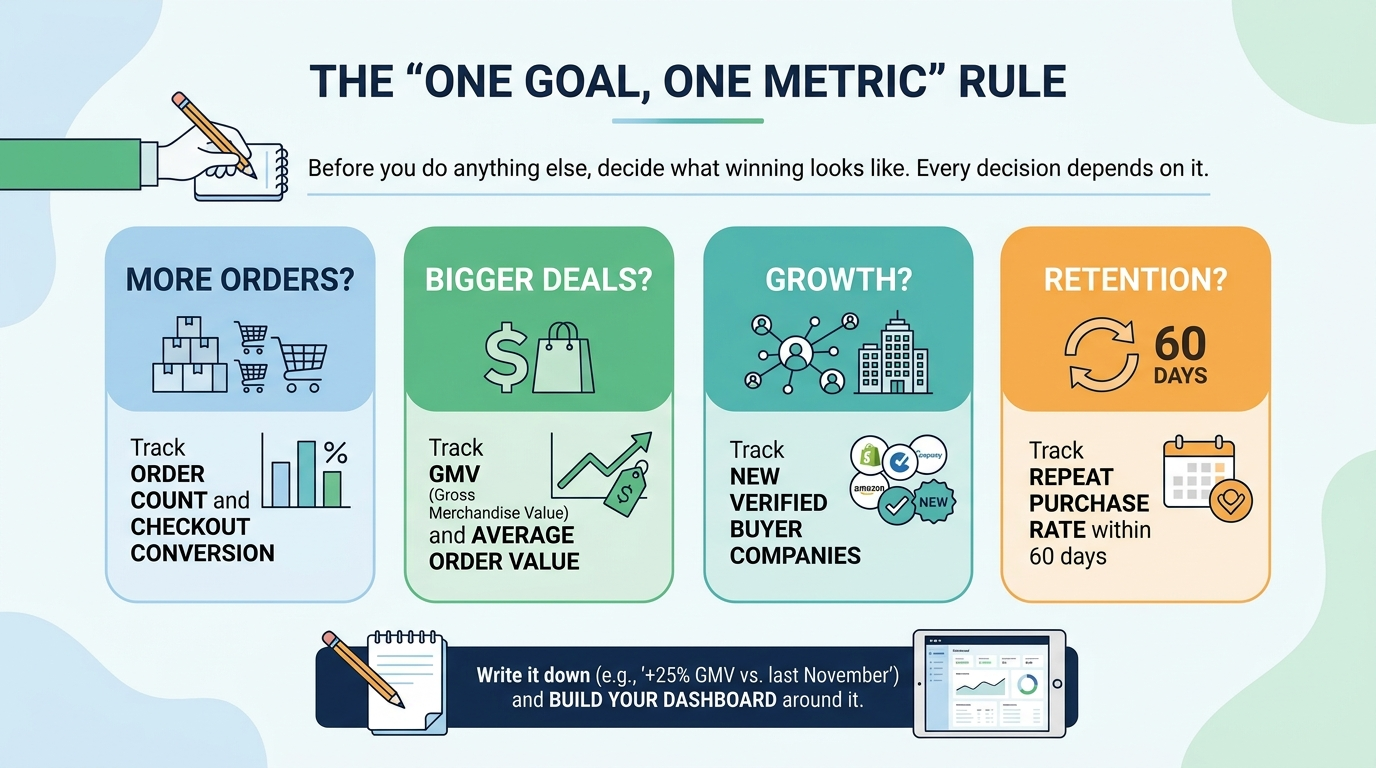
One goal, one number. That’s the rule we push hardest, because every later decision depends on it. Before you plan anything else on how to prepare your business for Black Friday, decide what winning looks like. Teams preparing a B2B marketplace for Black Friday without a clear target tend to celebrate traffic and miss revenue.
- More orders → order count and checkout conversion rate.
- Bigger deals → GMV and average order value.
- Growth → number of new verified buyer companies.
- Retention → repeat purchase rate within 60 days.
Write it down, something like “+25% GMV vs. last November”, and build every dashboard around it.
How do you improve search and product discovery before Black Friday?
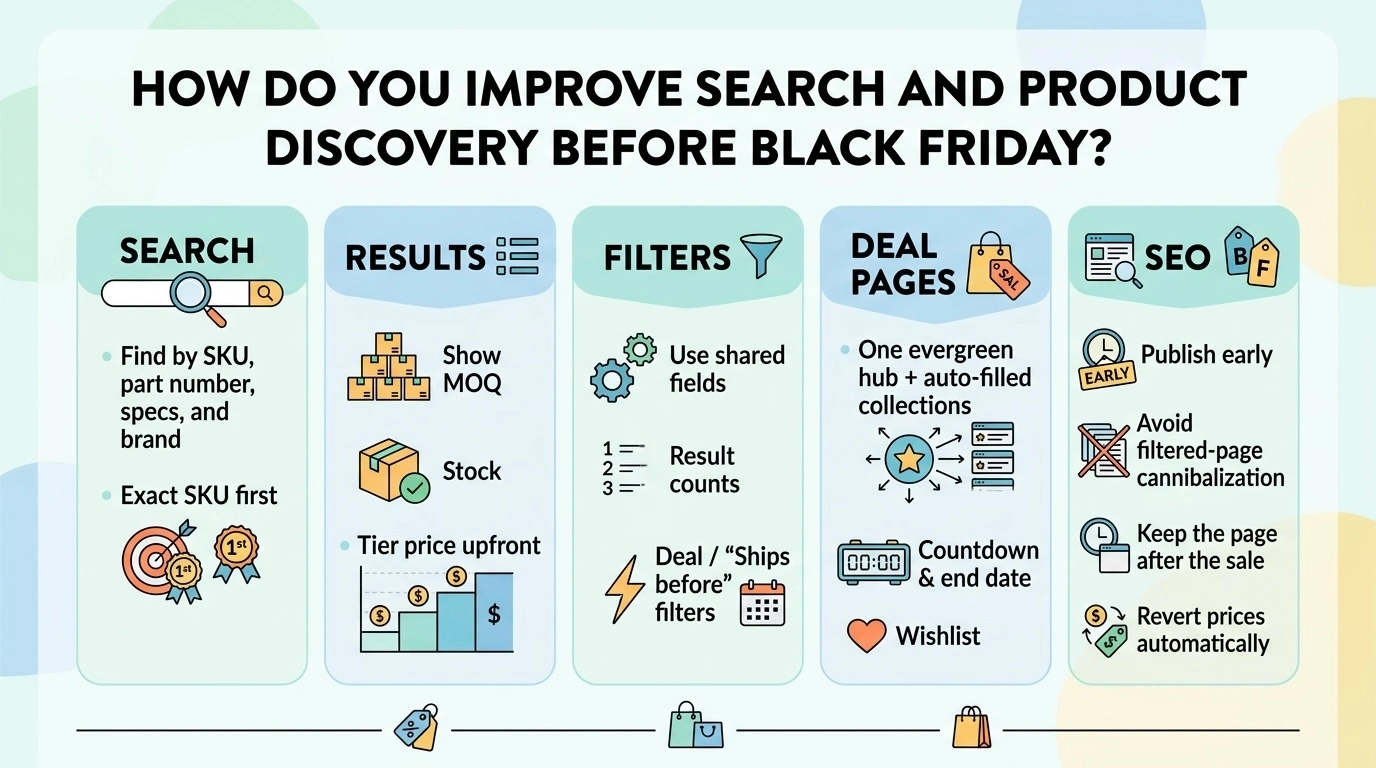
Make search understand queries the way business buyers type them, and give your deals their own pages that Google can find. A buyer who can’t find a part number in two tries will leave, even if you have the best price on the market. If you only have time to prepare for Black Friday in one area beyond performance, make it search.
Bad search is one of the classic user experience issues that drive people away. Black Friday traffic just makes it obvious faster.
How should search handle B2B queries?
It should find products by SKU, manufacturer part number, specs, and brand, not only by name. Ask your developer whether search looks at all of those, and whether an exact SKU match always comes first. If you’re preparing for Black Friday 2026 on a tight timeline, this is one of the fixes with the best return.
You can test the rest yourself in ten minutes. Search for “10mm”, “10 mm”, and “0.4 in” and see whether you get the same items. Then check that minimum order quantity, stock, and tier price show right in the results, so a buyer can rule an item in or out without clicking.
Typos and partial codes matter too. Someone typing “6205-2RS” in a hurry should still land on “SKF 6205-2RSH”. If they don’t, you have a clear, specific task to hand to your developer.
How do filters work for a catalogue with thousands of SKUs?
Filters only work when every seller describes products the same way. If one seller writes “stainless steel” in a description and another picks “Steel – stainless” from a list, a material filter can’t catch both. Agree on a set of shared fields, such as material, size, certification, lead time, and seller location, and make sellers fill them in.
Show how many items sit behind each filter, hide filters with no results, and let buyers combine several at once without the page reloading. For the campaign, add a “Deal” filter and a “Ships before [date]” filter. Buyers want to know the discounted item will actually arrive in time. That small filter is one of the details of how to prepare for Black Friday shopping that buyers actually notice.
How to prepare Black Friday landing pages and deal collections?
Build one main hub and a handful of category collections, and let them fill up automatically from approved offers. Once a seller’s offer is approved, it should show up in the right collection without anyone curating it by hand.
Add a countdown, a clear end date, and filters by category and seller. Many buyers can’t order on the spot, so let them save deals with wishlist functionality in a marketplace and come back after internal sign-off.
What do campaign pages need to rank in Google?
A permanent address, early publishing, and a plan for the day after. This is the part of how to prepare Black Friday pages that keeps paying off long after the sale. We recommend one evergreen address like /black-friday rather than /black-friday-2026, so links and rankings keep building year after year.
- Publish the hub in October with a “coming soon” message, so Google finds it before the rush.
- Ask your developer to make sure filtered versions of the hub don’t compete with the main page in search results.
- Ask whether your product pages tell Google their price and stock, so deals can appear in search with the price visible.
- After the sale, keep the page live with an “ended” message and links to current offers. Don’t delete it.
- Make sure deal prices go back to normal automatically when the campaign ends.
Case study: How YourLocalFlower made search and URLs work for sales
YourLocalFlower is a Danish marketplace that connects local florists with buyers and with wholesale suppliers. Roobykon built it on Sharetribe and launched it in May 2020 on a tight deadline, because the client wanted to reach the market before its competitors did.
Three parts of that build map straight onto Black Friday marketplace preparation. Advanced search and sorting, plus a homepage slider of products and sellers, keep buyers from getting lost among many similar offers. Unique, readable page addresses for sellers and listings became part of the client’s marketing and SEO strategy, backed by a blog that brings in organic traffic. And buyers can check out without registering first, which removes one of the most common reasons a first-time visitor leaves. Each one is worth copying when you are preparing for Black Friday 2026.
How do you reduce friction in the B2B buying flow?
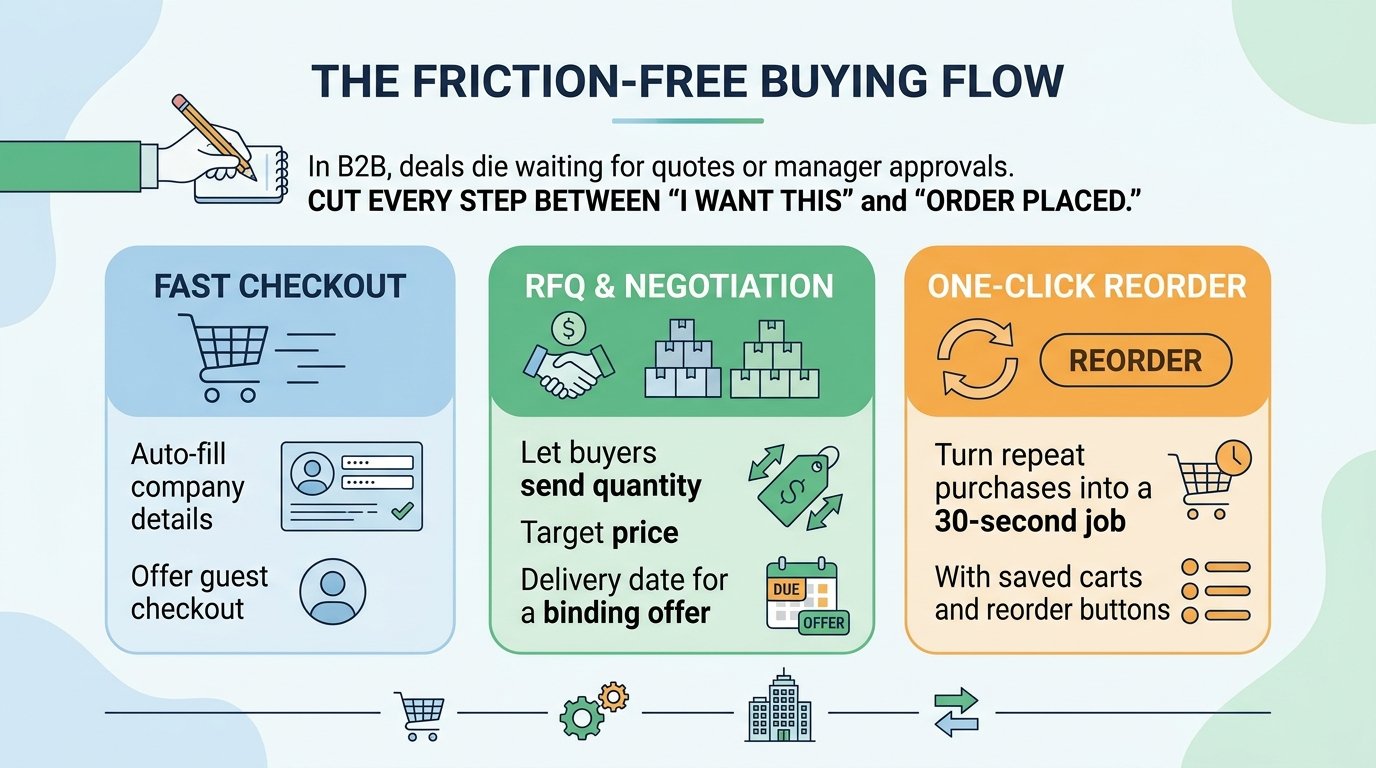
Cut every step between “I want this” and “order placed”, including the steps that happen inside the buyer’s own company. In B2B, deals rarely die on a form field. They die waiting for a quote or a manager’s sign-off. So any answer to how to prepare B2B business for Black Friday has to cover the buying flow, not just the storefront.
The starting point isn’t great for anyone. Baymard Institute puts the average documented cart abandonment rate at 70.22%, and estimates large sites could lift conversion by 35.26% with better checkout design alone.
What makes checkout fast for business buyers?
A fast checkout only asks for what it can’t already know. Baymard’s testing shows an ideal checkout can be as short as 12–14 form elements, and most sites ask for far more. Trimming it is one of the quickest wins when you are preparing B2B marketplace for Black Friday.
- Fill in company details automatically from a VAT or registration number.
- Let people check out as guests or register with just an email, and finish the account after the order.
- Save multiple delivery addresses, cost centres, and PO numbers per company.
- Show the full price, with shipping and tax, before the final step. Surprises at the end kill orders.
Why add Request for Quote (RFQ) and negotiation tools?
Because nobody buys 2,000 units at list price. An RFQ flow lets the buyer send quantity, target price, and delivery date, and lets the seller answer with a binding offer, all inside the platform.
Keeping the haggling on your platform protects your commission and tells you where demand really is. We walk through one build in our marketplace price negotiation workflow case study. For Black Friday, give quotes an expiry date so campaign prices end with the campaign. Walk through the whole quote flow yourself, as a buyer and as a seller, because preparing business for Black Friday means more quotes than usual.
How do one-click reorder and saved carts help?
They turn a repeat purchase into a 30-second job. Most B2B buying is replenishment, so a “Reorder” button in order history and named carts like “Monthly cleaning supplies” save buyers from searching all over again.
During the sale, show the Black Friday price right inside those saved carts and reorder lists. When a buyer sees their usual items marked down, they tend to order sooner, and more. That makes it the simplest answer to how to prepare for Black Friday shopping peaks from repeat buyers.
How should pricing, payments, and invoicing work during Black Friday?
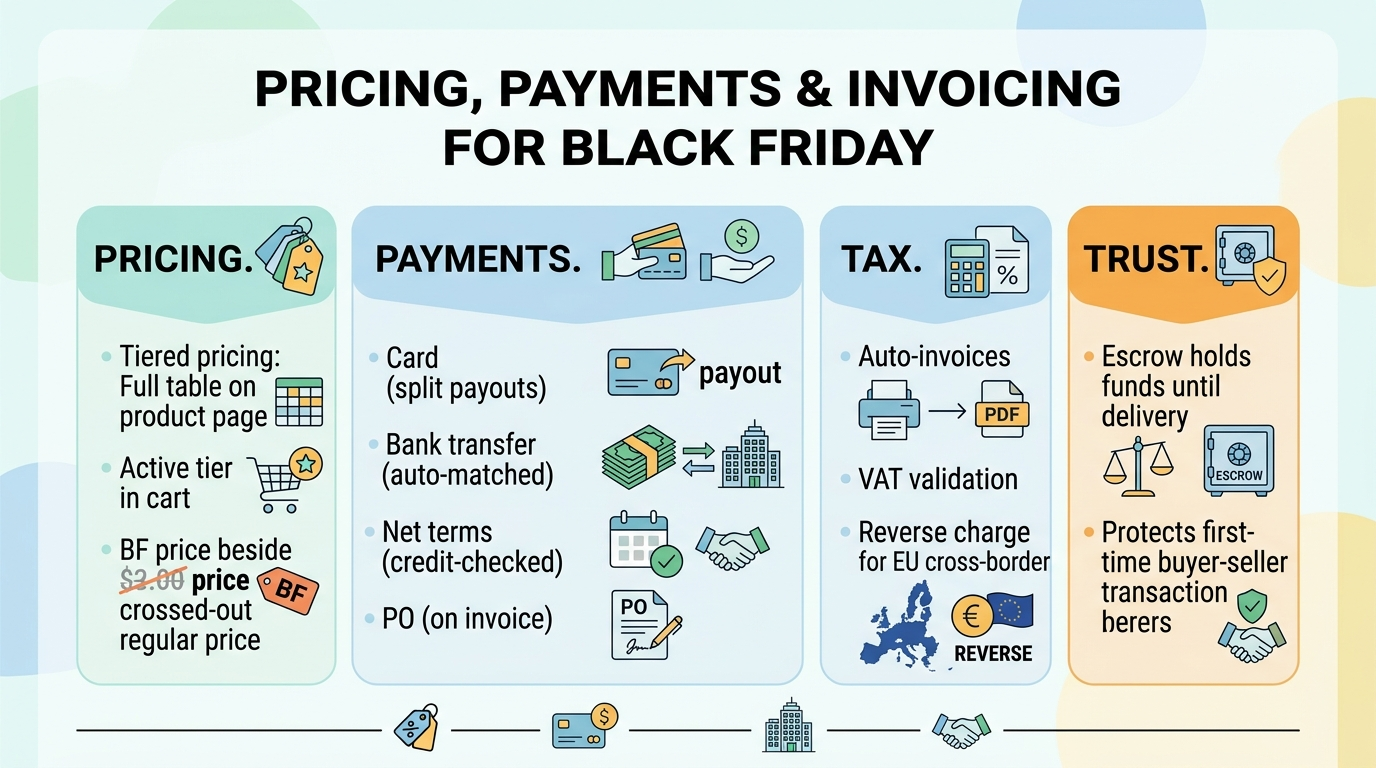
A business buyer should see the real unit price, pay the way their company pays, and get a correct invoice without emailing anyone. When clients ask us how to prepare B2B business for Black Friday, this is usually where most of the custom development goes.
How do you display tiered and volume pricing?
Show the whole tier table on the product page and the active tier in the cart. A buyer should see “1–49 units: €12.40 · 50–199: €11.20 · 200+: €9.90”, plus a nudge like “Add 12 more to unlock €11.20”.
During the campaign, cross out the regular tier price and show the Black Friday price next to it. Then ask your developer one question: “What happens to price calculation when thousands of carts are open at once?” Tier pricing under heavy load is one of the most common reasons we see checkouts slow down, and it’s far cheaper to find in October. Getting tiers right is a big part of preparing for Black Friday 2026 on the pricing side.
Which B2B payment options should you offer?
The ones procurement teams already use, and that’s rarely just a card. Here’s what each method needs from the platform, which is the core of how to prepare Black Friday payment flows.
Payment method | Typical use | What to check with your developer |
|---|---|---|
Card | Small and first orders | A payment provider that splits each payment between sellers and pays them out automatically (e.g. Stripe Connect) |
Bank transfer | Mid-size orders | Each payment is matched to its order automatically, with no manual checking |
Invoice / net terms (30–60 days) | Repeat company buyers | A provider that checks the buyer’s credit and pays the seller upfront |
Purchase order | Large enterprises | Buyers can enter a PO number, and it appears on the invoice |
How do you automate tax, VAT, and invoices?
With a tax service, plus invoices created automatically for every order. In the EU, the platform should check the buyer’s VAT number at checkout and apply the reverse charge on cross-border B2B sales, so the buyer, not the seller, accounts for the VAT. It’s the unglamorous side of how to prepare B2B business for Black Friday, and the first place mistakes show up on an invoice.
Case study: MaterialsNow, RFQs and B2B payments in one flow
MaterialsNow is a reverse marketplace for specialty materials that grew out of a US distribution business. Buyers post a Request for Quote, and vetted suppliers bid with a price and a delivery estimate. A first-time buyer can even start an RFQ before creating an account. Roobykon started work on the platform in February 2021, it went live in August 2021, and a further two months of feature work followed the release.
The hardest parts of the project were the ones this section is about. ACH bank payments, the standard US bank transfer, had to feel as easy as a card checkout while still meeting banking and security requirements, so we added them alongside Stripe Connect, which splits payments and pays out each supplier automatically. Tax was the other big problem. We connected Avalara, so tax is calculated automatically on every order by location, transaction type, and product category. Both are exactly the problems that surface when preparing a B2B marketplace for Black Friday payments.
Why use escrow and payment protection?
It lets two companies that have never met do business without a leap of faith. The money is held after payment and released to the seller once delivery is confirmed or a set period passes.
Black Friday is when many buyers try a new seller for the first time. Visible payment protection makes that first order feel safer and keeps disputes down after the rush. It’s a cheap trust feature to add when you prepare for Black Friday.
How do you build buyer trust at the moment of decision?
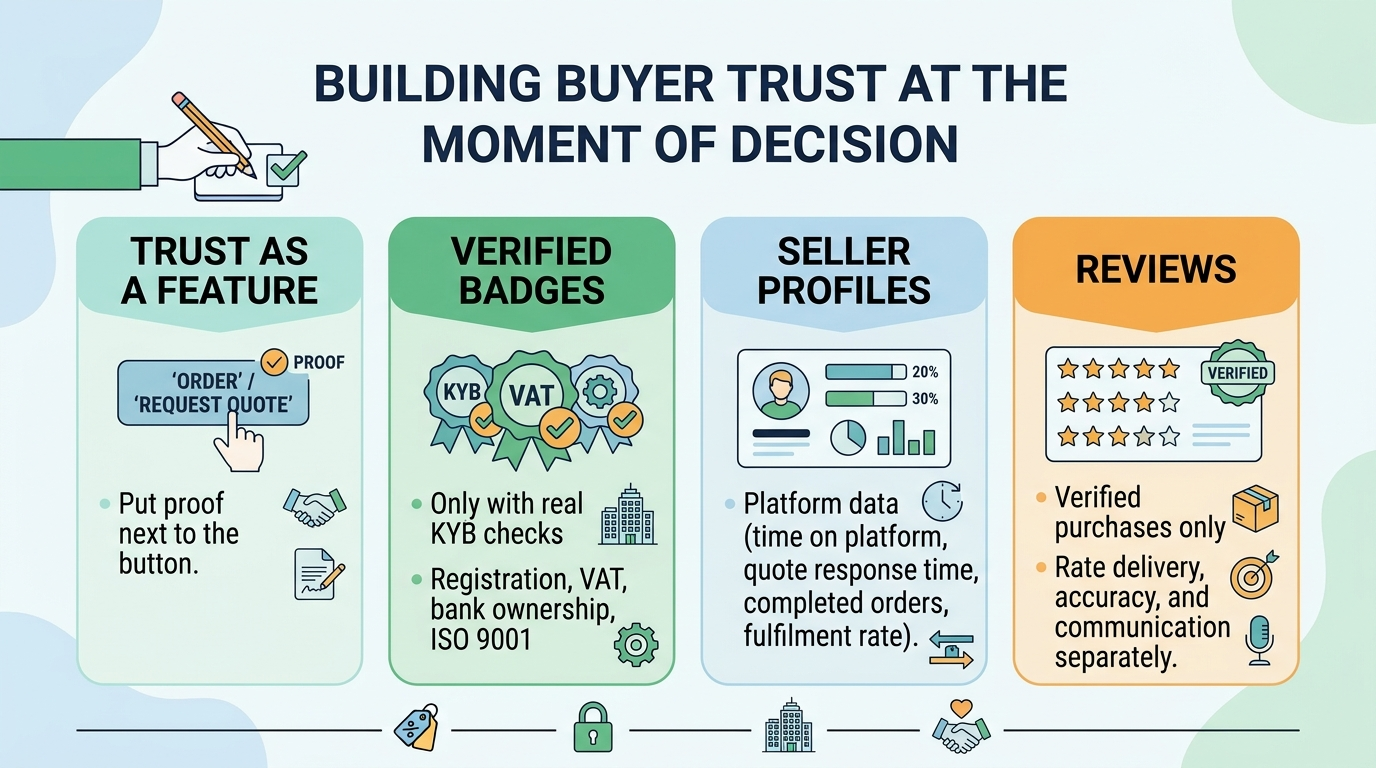
Show proof, not promises, right next to the “Order” or “Request quote” button. The buyer is spending their company’s money. If the order goes wrong, it’s their name on it, so they need evidence that the seller is real and reliable. Preparing business for Black Friday means treating trust as a feature, not a footnote.
What should verified seller badges and company profiles show?
Only facts the platform has actually checked. A “Verified” badge means nothing unless there’s a real business check behind it (often called KYB, “know your business”): company registration, VAT number, bank account ownership, and certifications like ISO 9001 where they matter.
On the seller profile, list time on the platform, average quote response time, completed orders, and fulfilment rate. Pull these numbers straight from platform data so sellers can’t polish them. Doing this early is a practical part of how to prepare your business for Black Friday.
How should reviews, ratings, and order history appear?
Reviews should come from verified purchases only, and show up both on the product and on the seller. Let buyers rate delivery time, product accuracy, and communication separately. One overall star score hides exactly the details a B2B buyer is looking for. If you’re preparing business for Black Friday, collect the first verified reviews before launch day.
Which innovative features lift conversion on a B2B marketplace?
The ones that give buyers their time back: personalised recommendations, AI-assisted search, quick answers to pre-sale questions, live stock data, and automatic follow-ups. None of them needs a full rebuild. Most can be added to the platform you already have. When it comes to preparing business for Black Friday on a tight budget, these are the features we’d prioritise.
Buyers are already used to AI helping them shop. Adobe reported that traffic from AI tools to US retail sites grew 805% year over year during Black Friday 2025, and that habit doesn’t switch off when people sit down at their work desk. Buyers researching how to prepare for Black Friday shopping increasingly ask an AI assistant first, so your product data has to be clean enough to be found and quoted.
How do personalised recommendations help returning buyers?
They put the right deals in front of the right company. Use order history to show “Deals on items you usually buy”, matching accessories, and categories that the company orders every month.
You don’t need complex AI to start. Simple rules based on past orders and items often bought together work well in B2B, because demand is repetitive and fairly predictable. That makes it realistic even when you only have a few weeks to prepare for Black Friday.
What does AI-assisted search and product matching do?
It turns a vague request into a short list of matching products. A buyer types “food-safe gloves for a 20-person kitchen, size M, under €0.10 a pair” and gets results that fit the spec, the price, and the pack size. It’s one of the more advanced answers to how to prepare B2B business for Black Friday, but also one of the most visible to buyers.
AI can also take an uploaded parts list or spreadsheet and match each line to a product in your catalogue. We cover the main use cases in our guide on how AI improves marketplace platforms.
How should abandoned cart and quote follow-up work?
Automatically, and in step with how B2B buying actually works. Send a reminder within 24 hours of an abandoned cart, and ping both sides when a quote is about to expire.
Mention the campaign end time in every message. If a cart is stuck waiting for approval, nudge the approver, not the person who built it. Few things in how to prepare your business for Black Friday pay back as fast as these follow-ups.
Can’t build all of this before November? That’s normal, so ship the smallest useful version first. Knowing how to choose between MVP MMP and MLP helps you decide what goes live now and what waits until the rush is over.
How do you prepare sellers and operations for Black Friday?
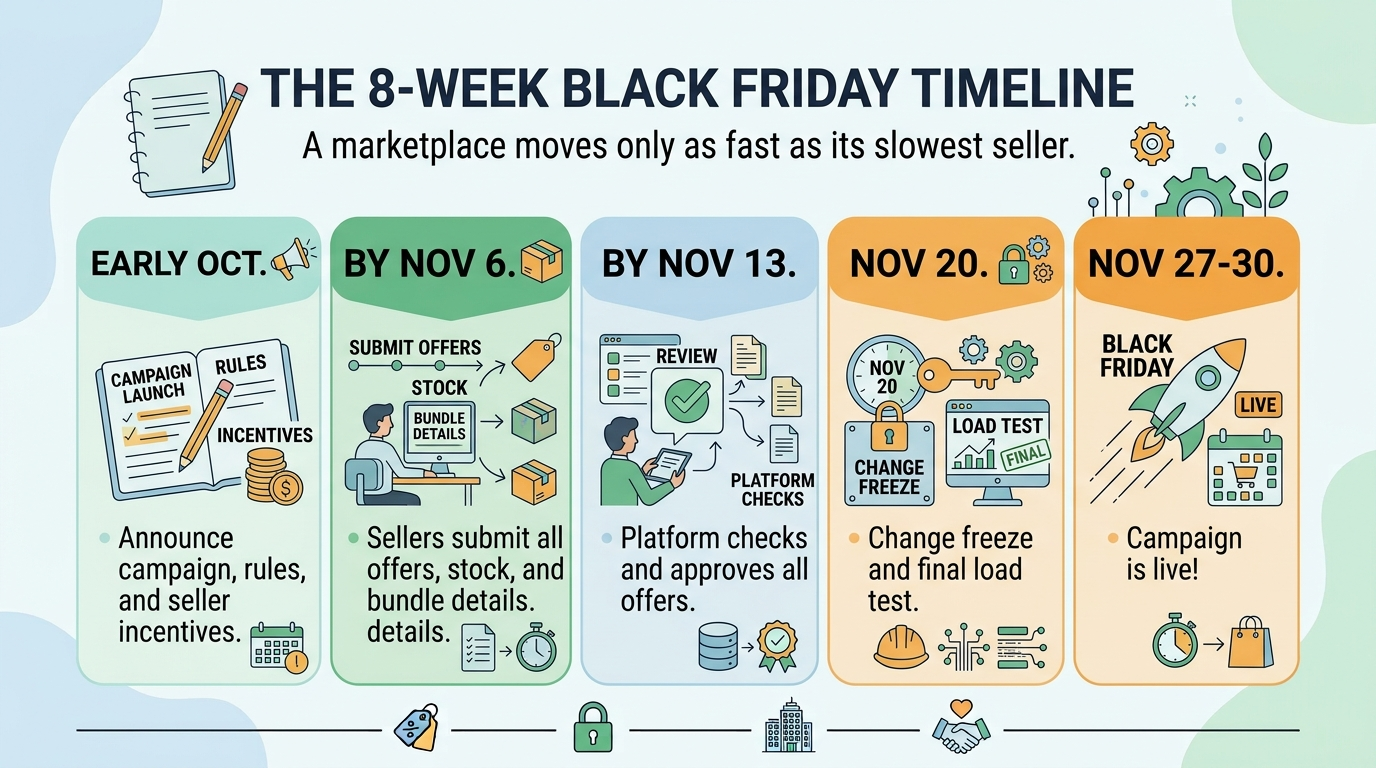
Give them a fixed timeline, self-service tools, and rules they can’t misread. A marketplace moves only as fast as its slowest seller. Sellers need to prepare for Black Friday on the same timeline you do. Preparing business for Black Friday on a two-sided platform means getting dozens, sometimes hundreds, of independent companies ready at once.
What timeline should sellers follow?
A calendar with hard deadlines and automatic reminders from the platform. Friendly emails asking “how’s it going?” don’t work in November. If you are preparing for Black Friday 2026, this schedule is realistic for a November 27 launch:
- Early October: announce the campaign, the rules, and the commission incentive.
- By November 6: sellers submit offers, stock levels, and bundle details.
- By November 13: the platform checks offers, and sellers fix anything rejected.
- November 20: change freeze, final load test, and a seller preview of the live deal pages.
- November 27 – December 1: the campaign runs, with a daily performance report for each seller.
Case study: HireCompare, a B2B launch in the last two weeks of November
HireCompare is a B2B marketplace where Irish businesses hire and sell equipment, from construction firms and industrial operators to small contractors. Its timeline looks a lot like a Black Friday plan. Development started on October 1, 2023, and ran for about 45 days in short cycles, with testing alongside the final one. A pre-release went to a small group of users on November 15, the public launch followed on November 30, and a post-release round of work handled whatever real traffic turned up. It is a compact example of how to prepare Black Friday launches on a fixed deadline.
How should support, fulfilment, and returns be organised?
Staff up and write the playbook before the first order lands. Support is the part of how to prepare for Black Friday shopping that most teams leave to the last week. Prepare saved replies for the top questions, set clear escalation paths to sellers, and agree on response times for order confirmation and dispatch.
If your marketplace serves one city or region, local delivery and pickup slots will fill up fast. Our guide on launching a marketplace for local communities explains how to set up local fulfilment rules that hold up when demand spikes.
How should you set up marketing and analytics for Black Friday?
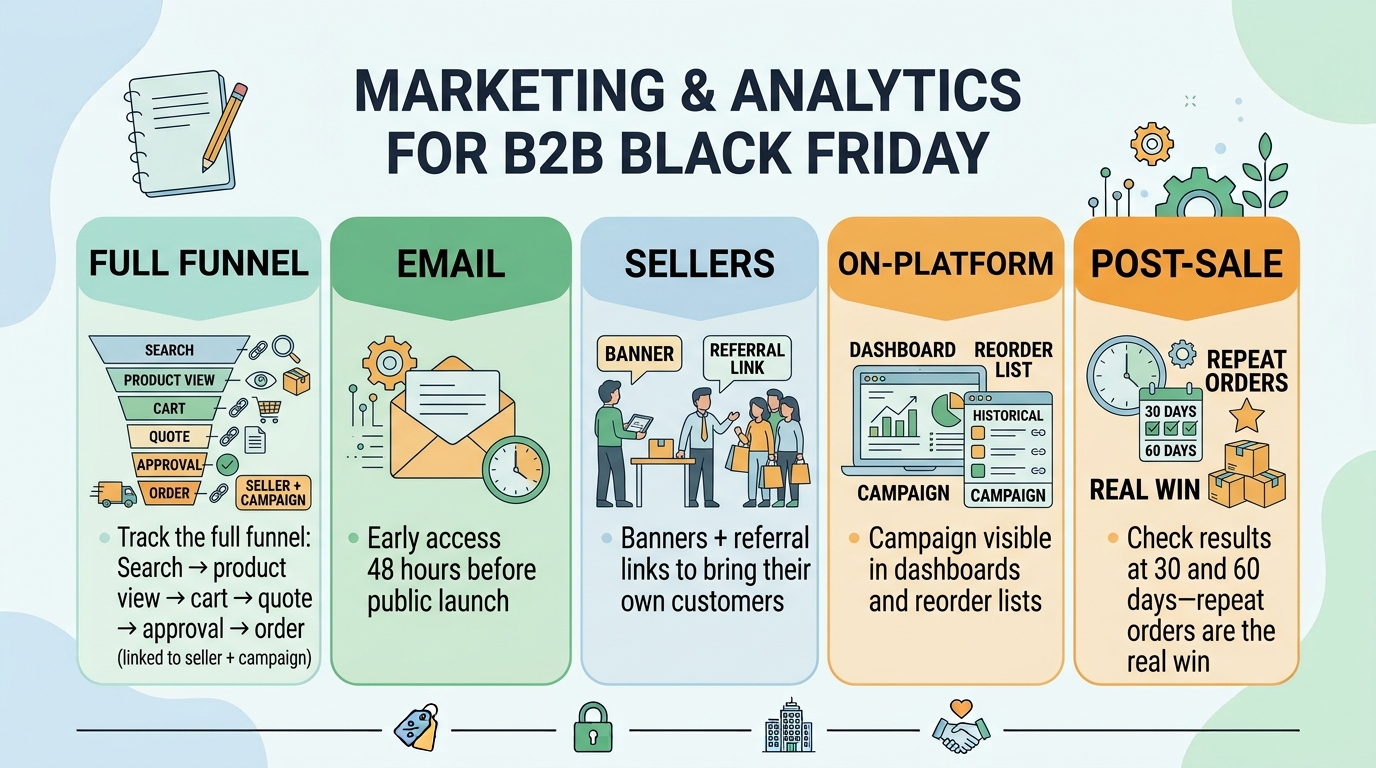
Tracking first, campaigns second. Good advice on how to prepare for Black Friday shopping always starts with measurement, and B2B is no different. You want to see, live, which channel, offer, and seller is moving your one goal metric. Without clean data, you can’t fix a weak offer while the sale is still on.
Which buyer actions should you track?
The full B2B funnel, not just purchases. That’s search, product view, add to cart, quote requested, quote accepted, approval submitted, approval granted, and order placed, each linked to the seller and the campaign. Getting this tracking in place is step one of how to prepare Black Friday reporting. Before launch, place a few test orders yourself and check that every step shows up on the dashboard.
Which marketing channels work for B2B Black Friday?
The ones that reach buyers who already know you. Email and in-app messages to existing accounts usually pay back best, with retargeting and LinkedIn as the way to reach new companies. Here is how to prepare Black Friday outreach for each channel:
- Email repeat buyers an early-access invite 48 hours before the public launch.
- Give sellers ready-made banners and a referral link, so they bring their own customers onto the platform.
- Show the campaign on account dashboards and inside reorder lists, where buyers already spend their time.
How do you measure results after the sale?
Compare results with your target and with a normal month, then look again 30 and 60 days later. In B2B, the real win is the buyers who keep ordering after the banners come down.
If you’re already thinking about how to prepare your business for Black Friday next year, this report is your starting point. Write down which offers, sellers, and fixes paid off, and put the rest on the 2027 plan.
Pre-launch checklist: what must be done before Black Friday 2026?
This is the table we go through with clients in the last weeks of preparing for Black Friday 2026. The third column shows who usually owns each line. Replace it with a real person’s name, not a team’s, and tick it off as you go. It is also the short answer to how to prepare B2B business for Black Friday when time is tight.
Area | Check | Usual owner |
|---|---|---|
Strategy | One goal and one metric agreed and written down | Founder |
Sellers | Campaign rules, incentive, and offer upload tool live | Founder, operations |
Performance | First load test of search, product pages, and checkout done, results shared with you | Developer |
Capacity | Clear answer on what the platform provider handles and what your team handles; provider limits checked | Developer |
SEO | Evergreen /black-friday hub published and visible to Google | Marketing |
Search | SKU, spec, and synonym search tested; Deal filter added | Developer |
Sellers | All offers submitted with stock and price history | Operations |
Buying flow | Quote expiry, saved carts, reorder, and approval price lock tested | Developer |
Payments | Invoice, net terms, bank transfer, and VAT checks tested end to end | Developer, finance |
Trust | Verified badges, delivery estimates, and dispute rules visible | Operations |
Analytics | Campaign dashboard working, test orders showing up | Marketing |
Release | Final load test, change freeze, off-switches for promos in place | Developer |
Operations | On-call rota, rollback rehearsed, support replies ready | Operations |
Marketing | Early-access email to repeat buyers sent | Marketing |
Post-sale | Prices revert, campaign page switches to “ended” state | Developer |
Still have several open lines in mid-November? Cut scope, don’t move the launch. A small campaign that works beats a big one that falls over in the first hour of peak traffic.
How can Roobykon help you prepare your B2B marketplace for Black Friday?
We can take the technical half of this checklist off your plate, so you can focus on offers, sellers, and buyers. Roobykon Software builds and scales custom marketplaces, and we work on existing platforms as often as on new ones, from the first audit to launch-day support.
What does a pre-season engagement include?
It usually starts with a two-week audit, written in plain language: what’s at risk, what to fix first, and what can wait until after the sale. Focused fixes follow, and they land before the change freeze.
- Performance and load testing: realistic tests of your key buyer journeys, and fixes for the slow spots we find.
- Search and discovery: SKU and spec search, filters, and campaign pages that Google can find.
- B2B buying flow: RFQ and negotiation, saved carts, reorder, multi-user company accounts, and approval workflows.
- Payments and invoicing: split payouts, net terms, escrow, VAT checks, and automatic per-seller invoices.
- AI features: AI-assisted search, product matching, and chatbots built on your own catalogue data.
- Launch support: monitoring, engineers on call, and a rollback plan that’s been tested, not just written.
Still figuring out how to prepare for Black Friday shopping demand?
Or you just need an extra pair of hands to finish features before November 20? Either way, contact Roobykon and tell us about your marketplace.
Contact us
Recommended articles
 Must-have features for launching a trusted vehicle-sharing platform
Trust is everything in shared mobility. This article unpacks how intuitive UX, transparent pricing, secure payments, and flexible admin tools come together to build user loyalty. Learn from real examples and best practices shaping the future of car sharing.
 How to Build a Peer-to-Peer Marketplace Website: Architecture, Payments, and Choosing the Right Partner
What a founder needs to decide before building a peer-to-peer marketplace platform: business model, money rules, build path, trust, and partner choice – with honest cost and timeline benchmarks from real builds.
 Best Marketplace Ideas Worth Building on Sharetribe in 2026-2027
Discover the strongest Sharetribe marketplace ideas for 2026–2027 across rental, services, products, and B2B trade. Learn how to validate demand before writing a feature spec, and when to bring in a Sharetribe development partner like Roobykon.
 How to Create a Nanny & Babysitter Marketplace That Parents Actually Trust
Parents don’t trust nanny marketplaces because of design – they trust verification, background checks, real reviews, and responsive support. This guide compares Sharetribe vs custom builds, explains must-have features, and shows how Roobykon approaches safe childcare platforms.