Quick Verdict: Is Sharetribe Worth It in 2026?
Sharetribe Reviews: What Users Usually Like
Sharetribe Complaints and Limitations Founders Should Know
Sharetribe Pricing in 2026: What to Consider Beyond the Monthly Plan
Sharetribe by Marketplace Type: Where It Works Best
When Sharetribe Is Enough, and When You Need a Sharetribe Developer
How Roobykon Helps Founders Get More from Sharetribe
Subscribe and you will promptly receive new published articles from the blog by mail
4.7 out of 5. That’s Sharetribe’s rating on G2. On Capterra, it’s 4.5. On Product Hunt, it’s a staggering 4.9.
Impressive, right?
Now here’s another number: 2%. That’s Sharetribe’s transaction fee on every sale processed through your marketplace. Over three years, on a million dollars in volume, that’s $20,000 you’re paying just for the privilege of using the platform.
These two numbers tell a story – one that’s far more nuanced than a single Sharetribe customer review star rating can capture.
You’ve heard the name Sharetribe thrown around. You’ve seen the shiny case studies. You’ve even poked around their website, feeling that familiar mix of excitement and dread: “Can this really work for me? Or am I about to sink months of effort into the wrong tool?”
We get it. We’ve talked to dozens of founders who’ve been exactly where you are. Some walked away thrilled. Others… well, let’s just say they learned the hard way.
So here’s the real Sharetribe review for 2026 – the good, the bad, and the ugly.
- Launch speed is real: Go from sign-up to a working marketplace in days, not months – a top praise in most Sharetribe reviews.
- Launch a no‑code MVP in 1–3 weeks; custom Extend‑plan builds take 6–16+ weeks.
- No-code has a ceiling: The visual builder handles standard flows (rentals, services, simple products) well, but complex workflows, custom approvals, or unusual transaction logic will require developer help – the #1 caveat in any honest Sharetribe platform review.
- The true cost is more than the subscription: Factor in ~2% Sharetribe transaction fees + ~2.9% Stripe fees + custom dev + third-party tools. Model your margins before you commit.
- It's not for every marketplace: Highly regulated industries, B2B with negotiated pricing, and multi-vendor event coordination often need substantial custom code from the start.
- You can grow without rebuilding: Sharetribe's killer feature is the path from no-code prototype to fully custom frontend/backend – a key reason why Sharetribe reviews rate it above alternatives.
Quick Verdict: Is Sharetribe Worth It in 2026?
In one sentence: If you want to launch a standard marketplace in days without writing a single line of code – and you have a clear plan for what happens when you outgrow the templates – then yes, absolutely.
BUT if you need complex workflows, operate in a highly regulated space, or dream of total control over your codebase, you’re going to hit a wall – a reality most honest Sharetribe reviews will confirm.
What Is Sharetribe?
Think of Sharetribe as the IKEA of marketplace platforms, except the instructions are actually clear, and you don’t need a PhD in engineering to assemble it.
Founded in Helsinki in 2011 (yes, the land of saunas and Nordic efficiency), Sharetribe has helped over 1,000 founders in 50+ countries launch everything from boat rentals to tutoring marketplaces. A quick browse through any Sharetribe customer review shows just how widely the platform is used across industries.
The Sharetribe platform does three things brilliantly:
- Gives you a fully functional marketplace out of the box: listings, user profiles, messaging, payments, reviews. All connected. All working.
- Lets you tweak everything without code: colours, logos, layouts, even some business logic. No developer required.
- Gives you an escape hatch: when you need more, you can extend with custom code. Slowly, gracefully, without rebuilding from scratch.
Historically, Sharetribe offered two separate products: Sharetribe Go, a simpler no-code tool, and Sharetribe Flex, a headless, API-first platform for developers. Both have since been folded into a single, unified Sharetribe platform that lets you start entirely without code in a visual builder, then extend into custom frontend and backend logic through the same product as your needs grow.
If you’re curious how the out-of-the-box experience compares to alternatives, a Sharetribe template review is a great place to start.
Sharetribe Reviews: What Users Usually Like
Across every major review platform, a few themes repeat so consistently they’re worth treating as fact rather than opinion. Reading through Sharetribe reviews from real users reveals a clear pattern of satisfaction, but also honest feedback about where the platform excels.
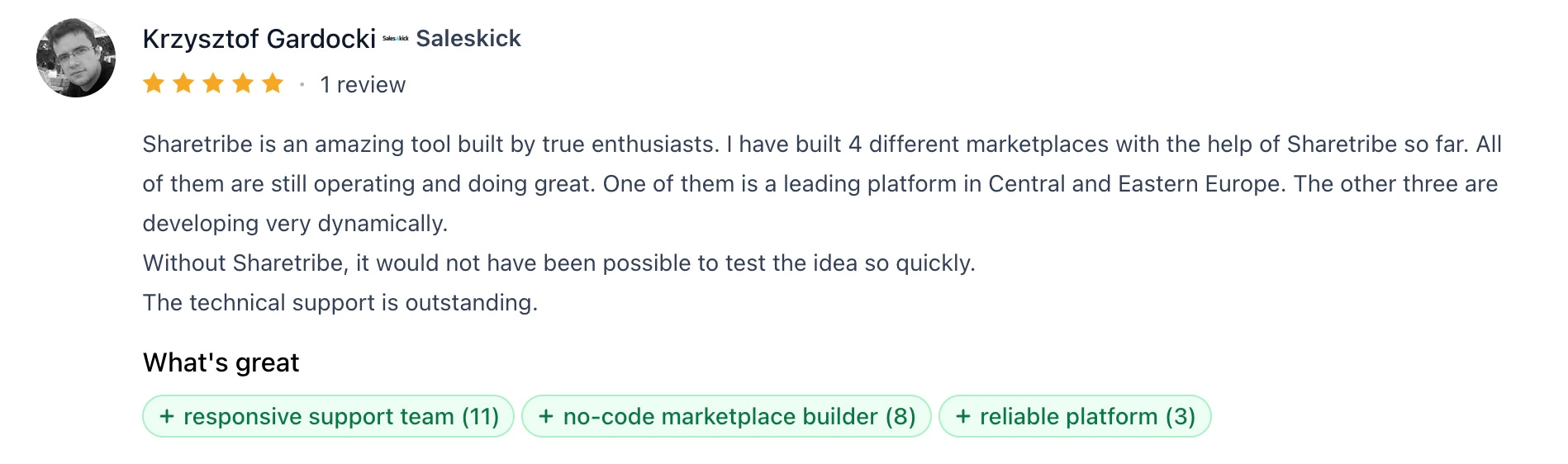
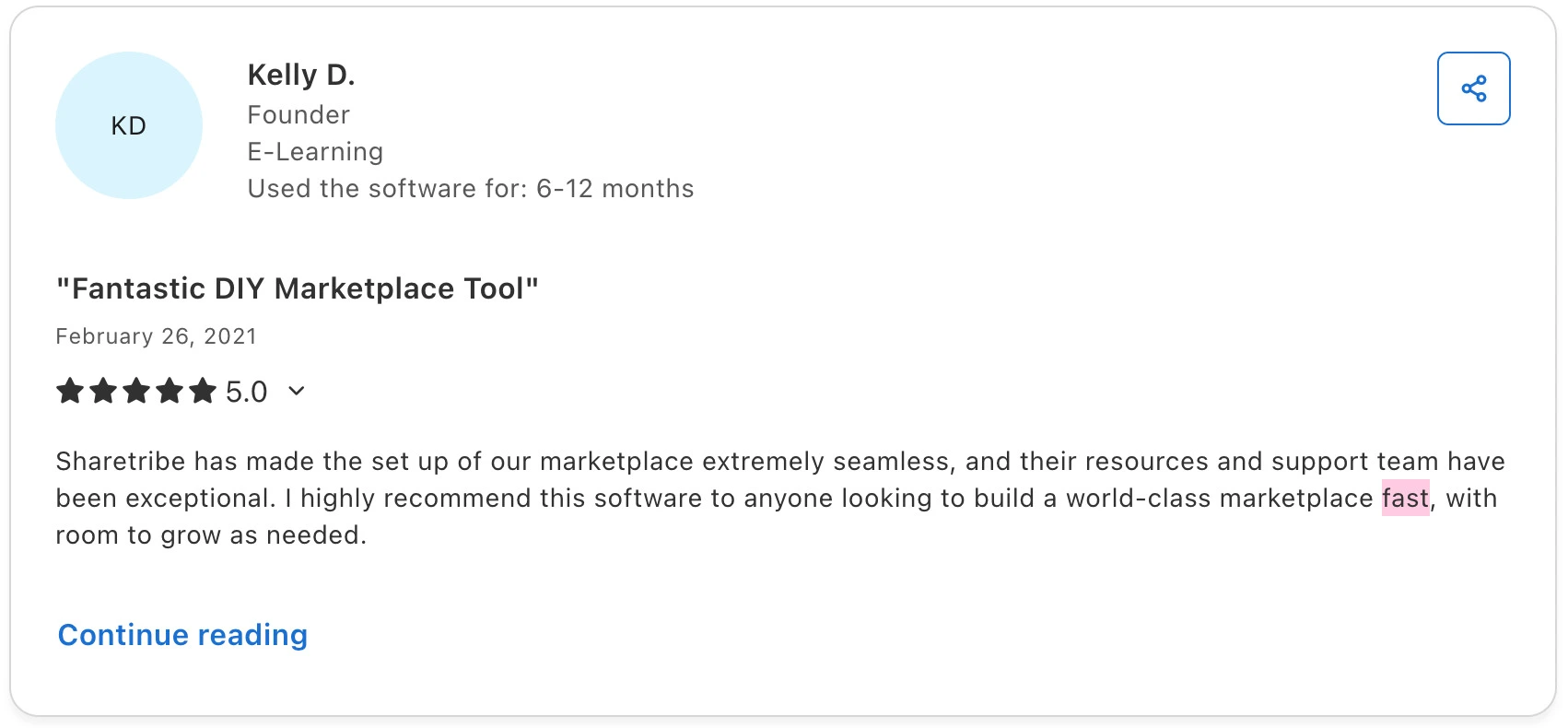
Fast launch and lower MVP risk
The single most common praise in Sharetribe customer review threads is speed. Founders describe going from a blank account to a working, testable marketplace in days rather than months. That speed translates directly into lower financial risk: instead of spending tens of thousands of dollars building core infrastructure before you know if anyone wants your product, you can validate demand with real users almost immediately.
Reviewers on G2 and Capterra repeatedly mention this as the deciding factor in choosing Sharetribe over a custom build or a generic e-commerce platform stretched to fit a marketplace model.
Marketplace features are already connected
Unlike general-purpose website builders, Sharetribe’s components are designed to work together out of the box. Listings, search and filtering, booking calendars, messaging, notifications, and a review system are pre-integrated rather than stitched together from plugins.
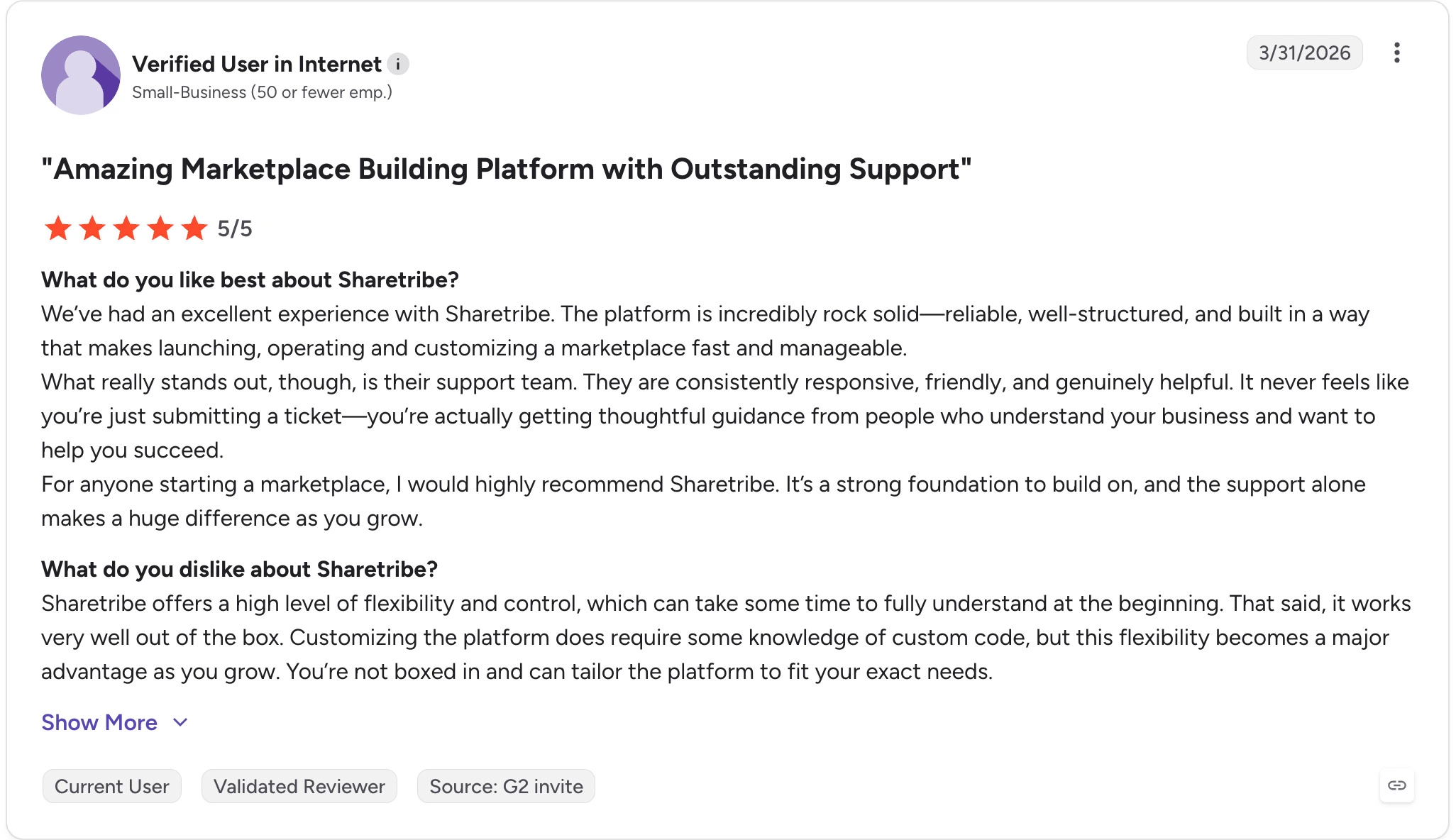
One G2 Sharetribe review put it perfectly: “The platform is incredibly rock solid—reliable, well-structured, and built in a way that makes launching, operating and customizing a marketplace fast and manageable.“
Managed infrastructure reduces operational burden
When you read through Sharetribe reviews, this is one of the most frequently mentioned advantages.
You don’t manage servers, databases, or uptime. Sharetribe’s hosted cloud infrastructure handles that layer entirely, which review after review cites as a relief for non-technical founders who don’t want to think about DevOps.
This also extends to security and compliance basics – data is hosted in secure, encrypted environments, and payments run through PCI-compliant processors, which removes a meaningful chunk of technical risk from a founder’s plate.
Clear path from no-code launch to custom development
This is the killer feature. Unlike most no-code tools that force you to rebuild when you outgrow them, Sharetribe lets you extend with custom code incrementally.
As one Sharetribe review noted: “The new Sharetribe allows founders to launch a no-code multi-sided marketplace in a weekend, while being 100% customisable to their unique business domain.”
It’s like having training wheels that you can remove one by one, without crashing. And when you’re ready to add mobile reach, building a Sharetribe mobile app is a natural next step that keeps that same flexibility intact.
Sharetribe Complaints and Limitations Founders Should Know
A fair Sharetribe review also has to cover the recurring frustrations. These aren’t dealbreakers for most founders, but they shape how realistic your expectations should be going in.
No-code customization has limits
The console is powerful – but it’s not a magic wand. You can change colours, fonts, and layouts. You can configure some business rules. But the moment you need a truly unique user flow – say, a multi-step approval process with custom validation – you’re stuck.
Several reviewers describe landing page customization as restrictive: limited font and color control, rigid templates, and little room for the kind of bespoke branding a growth-stage company might want. If pixel-perfect design control matters to your launch, you should expect to need either custom code or a developer’s help fairly early.
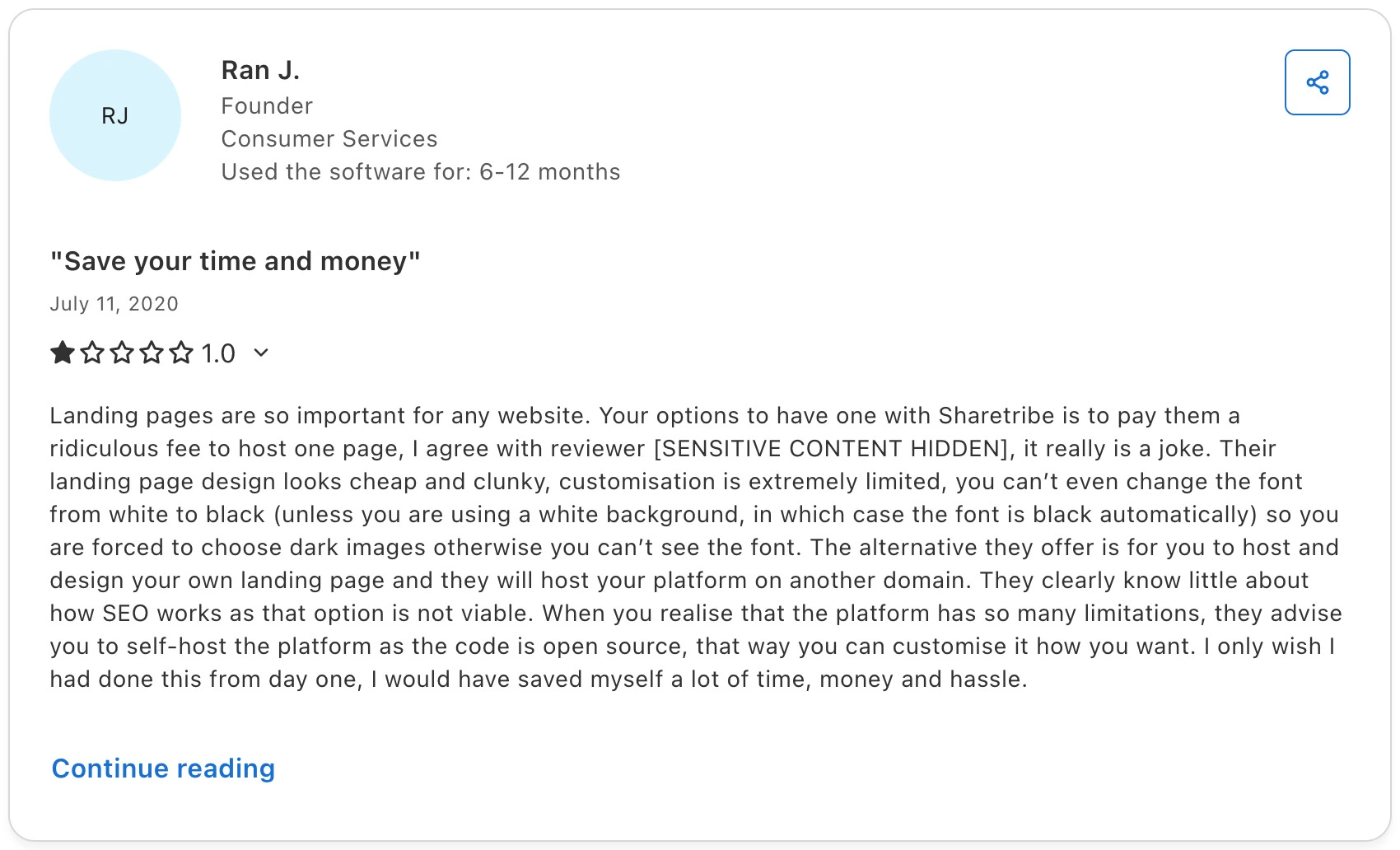
Know your limits. If your business model is too niche, be prepared to pay for custom development. This is hands-down the most frequent frustration in any honest Sharetribe review.
Complex workflows may require custom development
Sharetribe handles standard marketplace flows well: list an item, book or buy it, complete the transaction, leave a review. But what if you need:
- Complex price negotiation flows?
- Multi-step booking processes?
- Custom approval workflows?
- Specialized commission structures?
Sharetribe has been adding features to address these needs. In February 2026, the platform introduced the ability to build complex price negotiation flows without coding – including counter offers, offer updates, or both. But not every workflow is covered.
If your business model has any non-standard mechanics, plan for development work from day one rather than treating it as a later upgrade. As countless Sharetribe reviews reveal, the no-code tools are magic – but magic has limits.
Payment geography and Stripe dependency matter
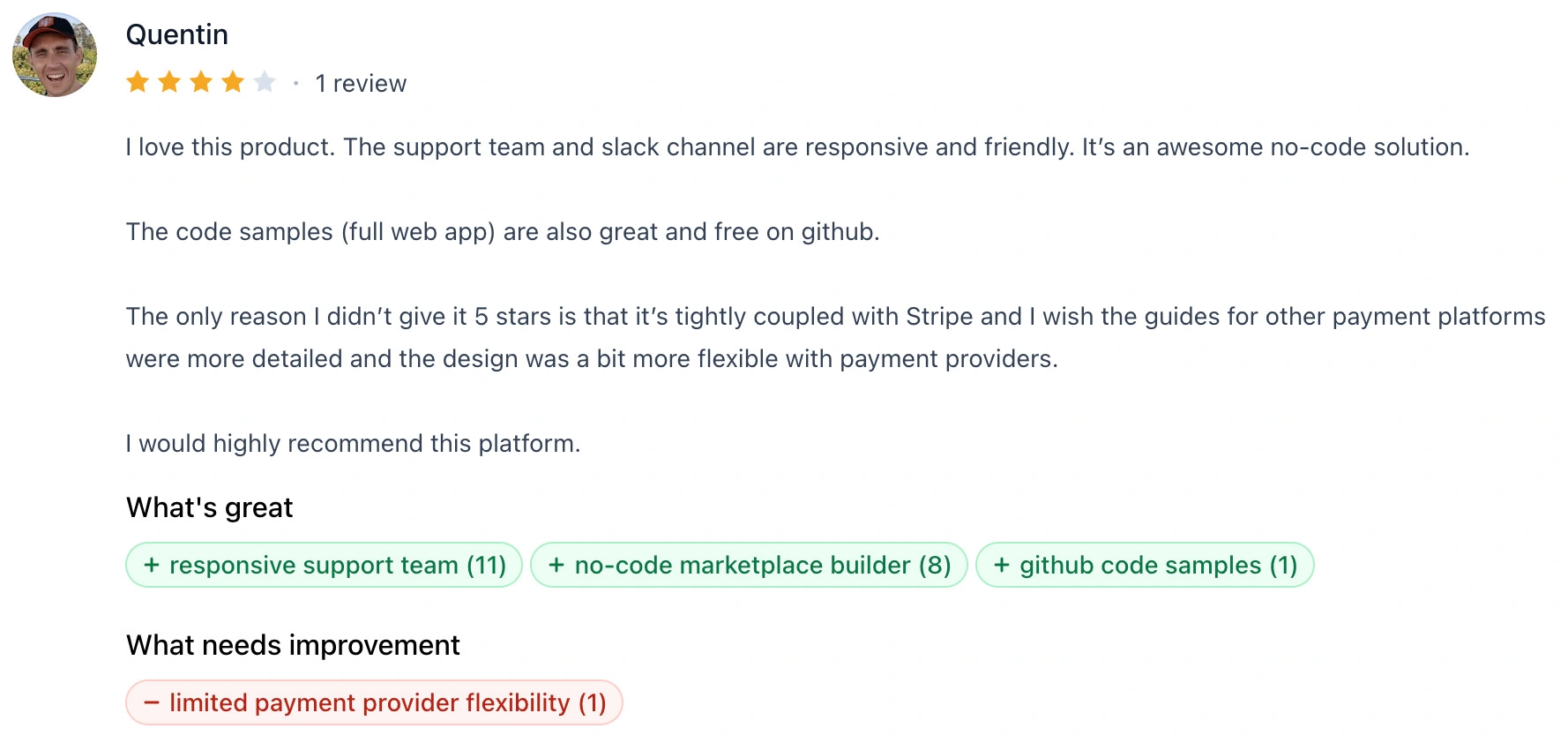
Sharetribe’s payment processing is built around Stripe Connect, and Product Hunt reviewers have flagged this as a constraint – there’s limited flexibility for marketplaces that need a different processor, and guidance for non-Stripe setups is thinner.
Because Stripe isn’t available everywhere and its fee structure varies by country, founders operating in certain regions need to check payment geography carefully before committing to a launch plan.
Pricing needs margin modeling
Some Sharetribe reviews, particularly those operating outside the US and EU, mention that costs feel higher once currency exchange and per-transaction fees are factored in. None of this is hidden because Sharetribe is transparent about its pricing, but it does mean founders in low-margin categories need to actually model commission rates against subscription and transaction costs rather than assuming the advertised monthly price is the whole picture.
Sharetribe Pricing in 2026: What to Consider Beyond the Monthly Plan
Sharetribe current pricing structure is built around four tiers:
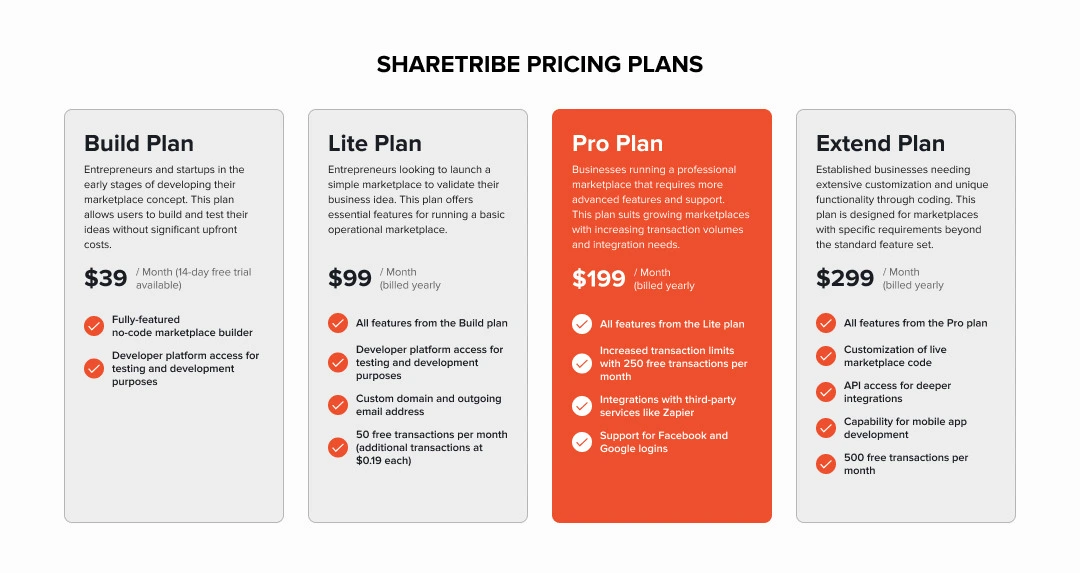
That headline pricing is straightforward. What takes more thought is the total cost of actually running a marketplace.
The Hidden Costs Nobody Tells You About
- Transaction fees: ~2% of GMV – can bleed you dry at scale.
- Stripe fees: Another 2.9% + $0.30 per transaction – that’s 5%+ of every sale.
- Custom development: If you need features beyond the console, budget $5K–$50K+.
- Third-party tools: Email marketing, analytics, CRM – they all add up.
- Migration costs: If you ever leave Sharetribe, extracting your data and users is expensive.
Pricing verdict for marketplace founders
Compared to building marketplace infrastructure from scratch (which easily runs into the tens of thousands of dollars before a single transaction happens), Sharetribe’s pricing model converts a large upfront capital cost into a predictable, scaling operating expense. For early-stage founders, that’s a meaningful advantage. The pricing only becomes a real concern at scale, in low-margin categories, or when custom development needs grow faster than expected.
Building a realistic margin model before you commit to a plan tier is worth the hour it takes. As any honest Sharetribe platform review will tell you, the monthly subscription is just the beginning – the real financial story unfolds as you grow.
Sharetribe Pros and Cons
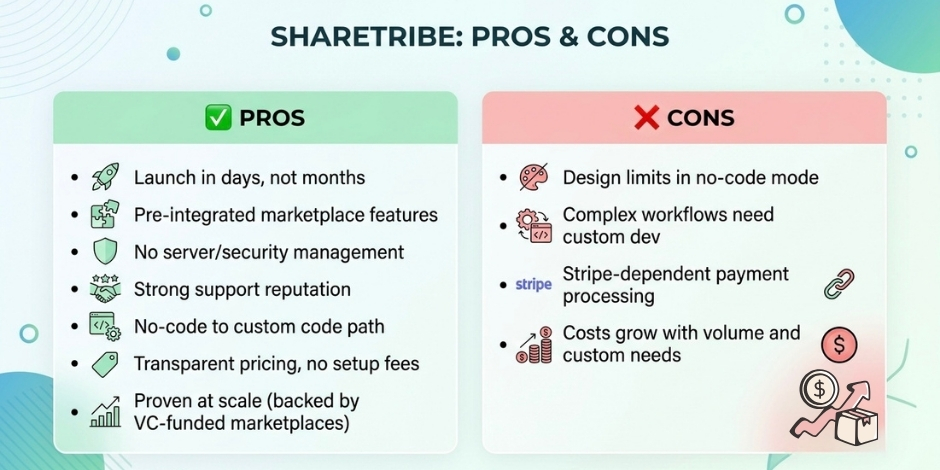
Every platform has its strengths and weaknesses, and Sharetribe is no exception. To give you a balanced view, we’ve distilled the most consistent feedback from real Sharetribe reviews across G2, Capterra, and Product Hunt – plus insights from founders we’ve worked with.
Sharetribe Pros:
- Genuinely fast time-to-launch, often days rather than months
- Core marketplace features arrive pre-integrated and tested
- Hosted infrastructure removes server, security, and uptime management from your plate
- Consistently strong support reputation across every major review platform
- A real, continuous path from no-code configuration to fully custom development
- Predictable, transparent pricing tiers with no setup fees
- Proven at scale, with marketplaces that have raised tens of millions in venture funding running on the platform
Sharetribe Cons:
- Design and layout customization has real limits in no-code mode
- Complex or non-standard transaction workflows often require custom development
- Heavy reliance on Stripe for payments, with less flexibility for other processors
- Costs can climb meaningfully once transaction volume, currency exchange, and custom hosting are factored in
Sharetribe by Marketplace Type: Where It Works Best
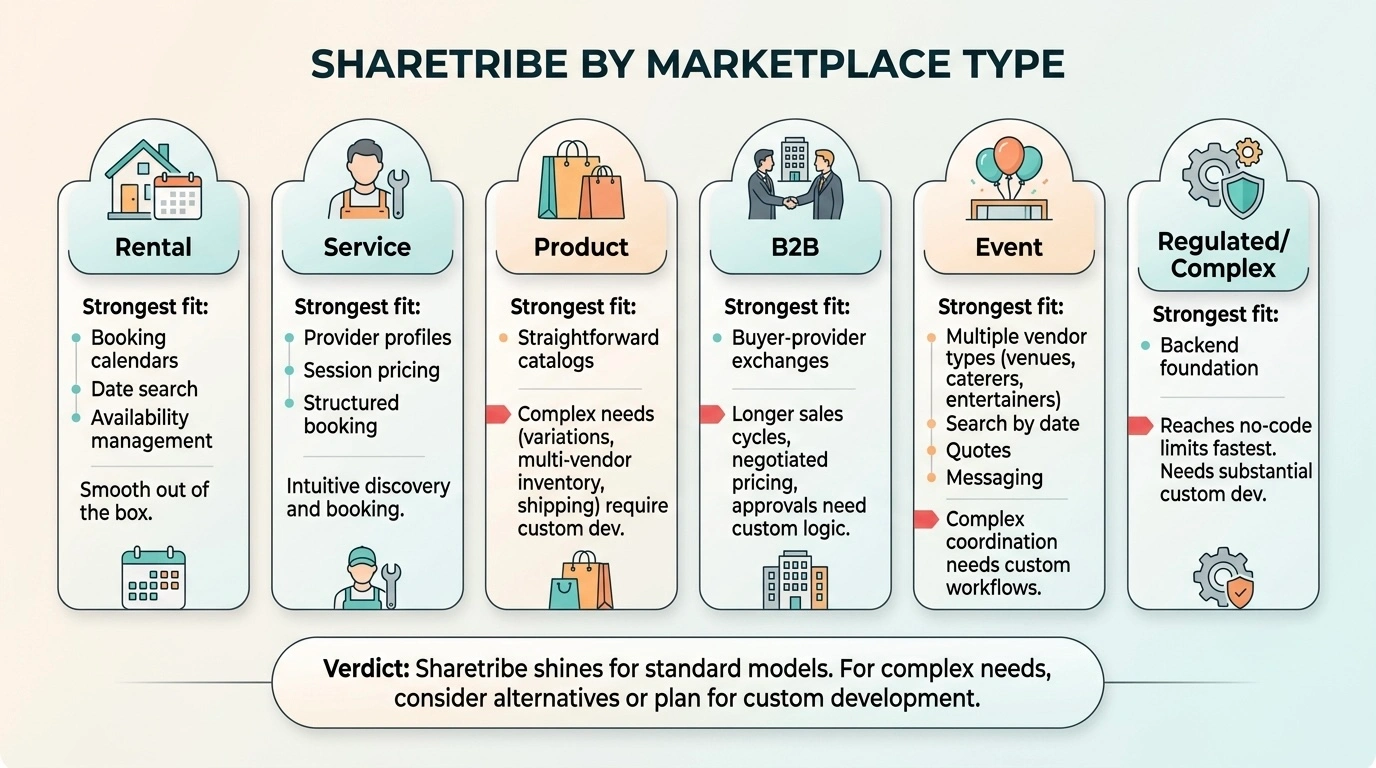
Rental marketplaces
This is one of Sharetribe’s strongest fits. Built-in booking calendars, flexible date search, and availability management make it well-suited to vehicle, equipment, property, and tool rental platforms. Reviewers consistently mention rental use cases as among the smoothest to set up. A quick Sharetribe template review will show you just how intuitive the rental flow is out of the box.
Service marketplaces
Service-based marketplaces (coaching, consulting, local trades, creative freelancing) also map naturally onto Sharetribe’s structure. Provider profiles, session-based pricing, and structured booking flows give both sides a clear way to evaluate and transact. Browse through Sharetribe reviews and you’ll see service founders consistently praise how intuitive the discovery and booking process feels.
Product marketplaces
Sharetribe handles product-based marketplaces well for straightforward catalogs, though more complex e-commerce needs – extensive product variations, multi-vendor inventory at scale, intricate shipping logic – tend to require more custom development than rental or service models. A thorough Sharetribe template review will show you that the out-of-the-box product flow is clean, but it’s not built for enterprise-level complexity.
B2B marketplaces
B2B marketplaces can work well on Sharetribe, particularly when the core transaction pattern still resembles a buyer-provider exchange. However, B2B deals often involve longer sales cycles, negotiated pricing, multi-stakeholder approval, and bulk transactions – features that frequently need custom logic layered on top of the standard toolkit.
Event marketplaces
Event marketplaces, which often involve multiple vendor types (venues, caterers, entertainers, equipment) coordinating around a single date, can be built effectively on Sharetribe with the right configuration – search by date and service type, quote requests, and integrated messaging all support this model well, though more complex multi-vendor coordination usually benefits from custom workflow development.
Highly regulated or complex marketplaces
Marketplaces in heavily regulated industries (those requiring licensing verification, complex insurance integrations, or strict compliance workflows) are where Sharetribe’s no-code layer reaches its limits fastest. These projects are usually better served by treating Sharetribe as a backend foundation and investing in substantial custom development from the outset. Any genuine Sharetribe platform review will warn you about this exact scenario.
Sharetribe vs Alternatives
Sharetribe isn’t the only marketplace platform out there, and it isn’t the right fit for every founder. Some teams are better served by open-source frameworks that offer more control at the cost of more engineering overhead; others find that general-purpose e-commerce platforms stretched with plugins meet their needs without a marketplace-specific tool at all.
We’ve put together a detailed breakdown of how the major options stack up in our guide to the top alternatives to Sharetribe, which is worth reading before you commit to any platform.
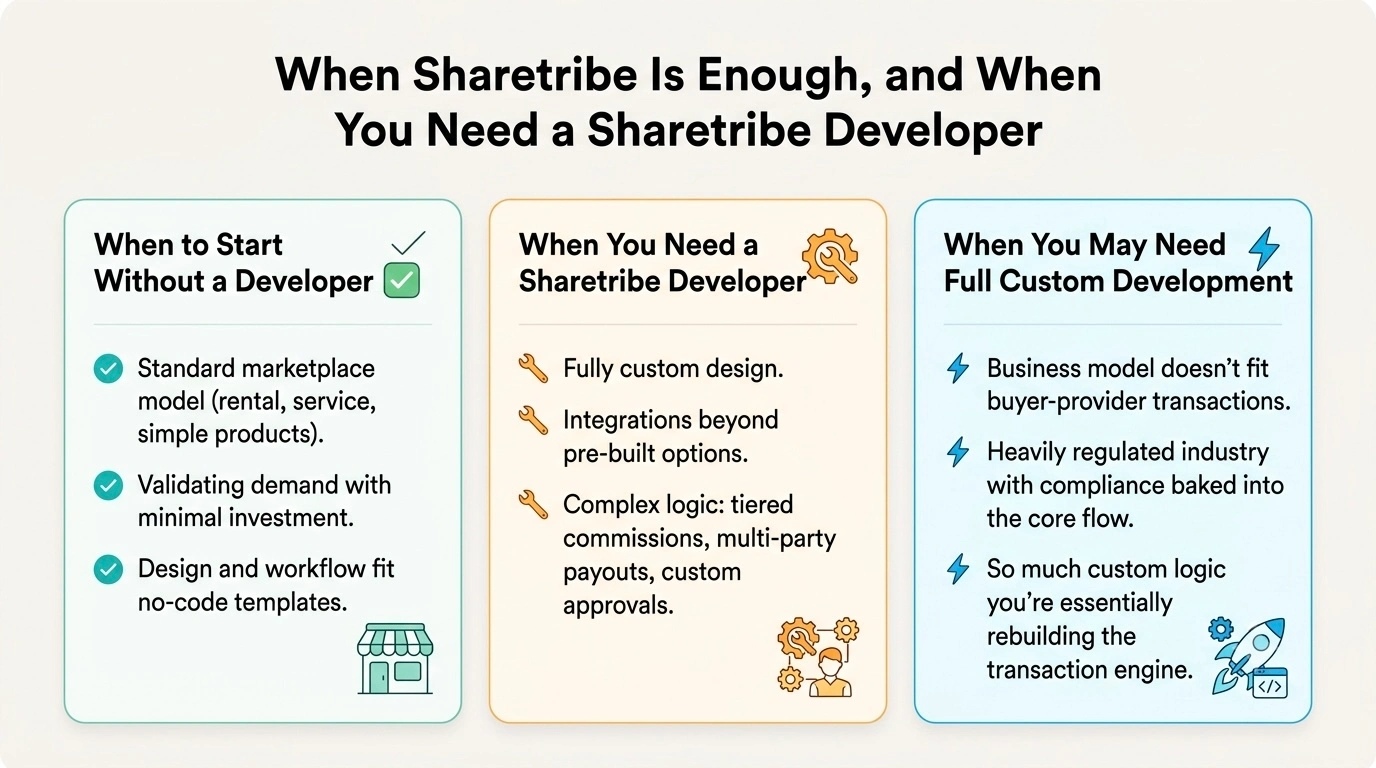
When Sharetribe Is Enough, and When You Need a Sharetribe Developer
You can start without a developer when…
Your marketplace model is close to a standard pattern (rental, service, simple product sales), you want to validate demand before investing heavily, and your design and workflow needs fit comfortably within the no-code builder’s templates and configuration options. This is the scenario most Sharetribe customer review posts describe as a smooth, successful experience.
However, the moment you need to move beyond templates, it’s time to think about bringing in expert help. To understand exactly when and how to make that leap, check out our detailed guide on how to hire a Sharetribe developer.
You need a Sharetribe developer when…
You need a Sharetribe developer when you want a fully custom design, integrations beyond the pre-built options, or transaction logic the standard builder can’t handle – tiered commissions, multi-party payouts, or custom approvals. This is where the nuance in a Sharetribe platform review really matters: templates get you 80% of the way, but the last 20% needs real expertise. That’s also the point where it’s worth understanding what to look for in a Sharetribe developer, since the quality of the developer or agency you choose directly impacts how maintainable your eventual custom code will be.
You may need custom marketplace development when…
- Your business model doesn’t map onto buyer-provider transactions at all
- You’re operating in a heavily regulated space with compliance requirements baked into the core flow
- You anticipate needing so much custom logic that you’d effectively be rebuilding most of the transaction engine anyway.
In these cases, it’s worth evaluating whether a fully custom build, rather than a Sharetribe-based one, is the more sustainable long-term investment. A balanced Sharetribe review will tell you the same: know when to walk away.
How Roobykon Helps Founders Get More from Sharetribe
Sharetribe is a great platform, but it’s not a magic bullet. To really make it sing, you need expertise. An expertise like Roobykon Software.
At Roobykon, we’ve been building Sharetribe marketplaces for years. We’re an official Sharetribe development partner and a Stripe-verified expert. Even the Sharetribe team has used our services – and recommended us to their customers.
Juho Makkonen, Co-founder & CEO of Sharetribe, says: “We really appreciate their flexibility, responsiveness, and the quality of their work… I think they’re a great technology partner for anyone looking to build their online marketplace with Sharetribe.”
What we offer:
- End-to-end development: from concept to launch and beyond
- Custom feature development: anything the console can’t do
- AI-powered enhancements: smart search, chatbots, dynamic pricing
- Integrations: payments, shipping, tax, CRM, ERP, you name it
- Sharetribe migration: from Go to the new version, or from other platforms
- Ongoing maintenance: so you can focus on growth, not bugs
With 130+ projects under our belt across real estate, education, events, travel, and more, we’ve seen (and solved) every marketplace challenge imaginable.
If you’re past the “should I use Sharetribe” question and into “how do I get the most out of it,” our end-to-end Sharetribe development services cover the customization, integration, and scaling work that takes a marketplace from a no-code prototype to a platform built to handle real growth.
Sharetribe Review Checklist for Founders
Business model checklist:
- Does your transaction pattern fit a buyer-provider exchange, or does it involve more complex multi-party logic?
- Have you identified which marketplace type (rental, service, product, B2B, event) your business most closely resembles?
- Have you reviewed how comparable marketplaces have performed on the platform?
Technical checklist:
- Have you mapped out which features you need from the no-code builder versus custom development?
- Does your payment geography work well with Stripe Connect?
- Do you have a plan for hosting custom code if you extend beyond the no-code tier?
Financial checklist:
- Have you modeled your commission rate against subscription costs, Stripe fees, and transaction volume projections?
- Have you accounted for adjacent costs – maps, analytics, third-party integrations?
- Have you budgeted for developer time, not just the monthly subscription?
Growth checklist:
- Have you planned your SEO and content architecture, or will you need outside expertise?
- Do you have a path from MVP to a custom frontend if you outgrow the no-code builder?
- Have you identified a developer or agency partner for when custom needs arise?
Final Verdict: Should You Choose Sharetribe in 2026?
Taken together, the weight of Sharetribe reviews across G2, Capterra, Trustpilot, and Product Hunt points to a platform that does what it promises for the audience it’s built for: founders who want to launch a real, working marketplace quickly, test it against actual user behavior, and grow from there without rebuilding their foundation from zero. The support quality, the pre-integrated feature set, and the genuine bridge between no-code and custom development show up consistently in independent, verified reviews from people who’ve actually used the platform.
The honest caveats matter just as much. No-code customization has a ceiling. Complex workflows, heavy regulation, and non-standard transaction models will push you toward custom development sooner rather than later. And the true cost of running a Sharetribe marketplace is more nuanced than the monthly subscription price suggests.
For most founders building a standard marketplace model, Sharetribe in 2026 is a sound, well-supported choice, provided you go in with realistic expectations about where the no-code builder ends and developer work begins.
Not sure if Sharetribe is right for you? Let's figure it out together.
Roobykon Software has helped over 130 founders launch and scale marketplaces on Sharetribe. We know exactly where it shines and where it stumbles.
Book a free consultation
ALL COMMENTS (1)
Recommended articles
 How to Build a Marketplace with Sharetribe: A Complete Guide
What can you build with no-code Sharetribe, and when do you need a developer? This article provides a clear roadmap for founders.
 How to Understand That the Development Team Is Doing Something Wrong
Development problems rarely announce themselves loudly – they accumulate quietly until something breaks. Based on real project experience, this guide covers the most reliable warning signs of an underperforming dev team, and a symptom-to-root-cause diagnostic framework.
 The Best Sharetribe Marketplace Development Companies in 2026
Looking for the best Sharetribe development company in 2026? We've done the homework. This comprehensive guide ranks the top 10 Sharetribe development partners, from Roobykon Software to global competitors.
 How to find a web development partner for your startup: a step-by-step guide
Choosing the wrong development partner can cost you months. Use this expert guide from Roobykon Software to find a trusted web development partner who treats your startup like their own.






Great overview. One thing I’d add is that founders should also think about the long-term cost of ownership, not just the monthly subscription. Transaction fees, Stripe fees, third-party services, and custom development can change the economics quite a bit once a marketplace starts growing. I recently compared those factors on this website along with alternatives and user feedback here if anyone wants another perspective.