Why Caregiving Marketplaces Are Growing Fast (And Why You Should Build One Now)
Caregiver Business Models: Monetization Strategies for Caregiving Platforms
Core Features of a Caregiving Marketplace
Compliance Requirements for Starting a Homecare Caregiver Business
How Much Does It Cost to Start a Caregiving Business? A Realistic Breakdown
Should You Use No-Code or Custom Development for Your Caregiving Business?
Work With an Experienced Marketplace Development Team for Caregivers Business Development
Subscribe and you will promptly receive new published articles from the blog by mail
The last great marketplace boom connected us to cars, coaches, and takeout. This one connects us to our parents.
Uber gave us rides. Airbnb gave us vacation homes, DoorDash gave us dinner. But none of them solved the problem that keeps CEOs awake at 3:00 AM – not their quarterly earnings, but their aging father living alone two thousand miles away.
This is the blind spot of the gig economy. And it is a $130 billion gap. The health caregiving market is growing at a CAGR of 10.99%, yet the infrastructure supporting it remains stubbornly analog. Legacy agencies charge 40% margins and provide zero transparency. Consumers are desperate for an alternative, and the demographic clock is ticking.
10,000 people turn 65 every single day in Singapore alone. In the United States, 10,000 Baby Boomers have been crossing that threshold daily for over a decade. We are living through the largest aging event in human history, and we are staffing it with Facebook posts and referral fees.
This is not a market problem, but a software one. The founders who solve it won’t just build valuable companies – they will define a category. They will become the infrastructure upon which the entire aging economy operates.
If you are researching how to start caregiving marketplace, you are asking the right question at the right moment in history. And the question is not whether the opportunity exists. The question is whether you have the roadmap to capture it. Consider this guide your starting line.
Why Caregiving Marketplaces Are Growing Fast (And Why You Should Build One Now)
The caregiving marketplace sector is exploding because of a seismic shift in demographics and consumer behavior: millions of aging baby boomers are determined to age in place rather than move to facilities, while dual-income households urgently need childcare solutions that operate beyond the rigid 9-to-5 schedule.
Simultaneously, a massive pool of qualified caregivers – many of whom left traditional employment during the pandemic – now seeks flexible, independent work that platforms can efficiently facilitate. This perfect storm of soaring demand and fragmented supply has rendered traditional agencies obsolete; they are too slow, expensive, and geographically limited.
For founders ready to build caregiving marketplace, the window to capture this market is now. The infrastructure for trust – background checks, verified reviews, instant payments – has never been more accessible to integrate. Early movers who establish branded, localized networks will own the relationship with both caregivers and families, creating a defensible marketplace moat that fuels sustained caregiver business growth for years to come.
Caregiver Business Models: Monetization Strategies for Caregiving Platforms
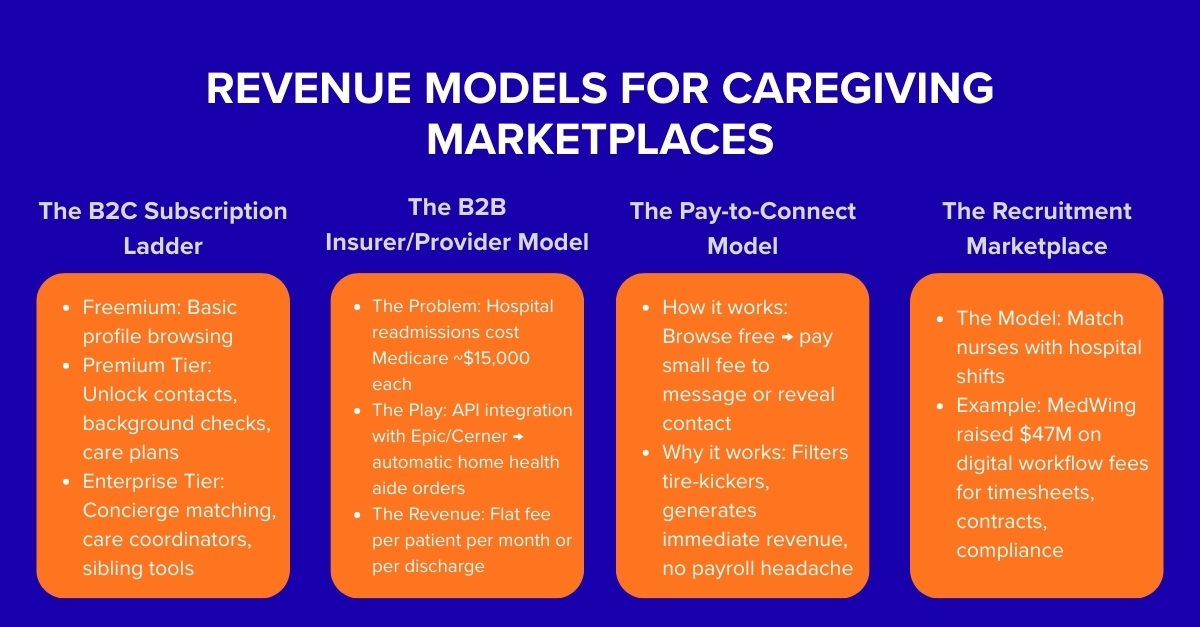
The days of simply taking a 20% cut of the hourly wage are over. Modern caregiving marketplace software relies on hybrid revenue streams, blending SaaS, B2B partnerships, and consumer subscriptions to create resilient caregiver business models.
If you build a caregiving marketplace that only connects a CNA (Certified Nursing Assistant) with a family for $25/hour and take a commission, you are building a feature, not a company. The margins are too thin, and the churn is too high.
To win in 2026 and beyond, you need to stack your revenue streams.
The B2C Subscription Ladder
Instead of taking a high percentage of the caregiver’s wage (which breeds resentment and encourages off-platform payments), shift the cost to the family.
- Freemium: Basic profile browsing.
- Premium Tier: Families pay to unlock contact details, run background checks, access detailed caregiver profiles, and use care plan templates.
- Enterprise Tier: Includes concierge matching, dedicated care coordinators, priority support, and family collaboration tools for multiple siblings managing care.
The B2B Insurer/Provider Model
This is where the real scale lies. Health systems and insurance companies are desperate to keep patients out of hospitals. A readmission for a heart failure patient costs Medicare ~$15,000.
- The Play: Your caregiver marketplace API integrates with Epic or Cerner. When a hospital discharges Mrs. Jones, the system automatically pushes an order to your platform for a home health aide visit.
- The Revenue: The insurance company pays you a flat fee per patient per month (PMPM) or a per-discharge fee. This is significantly higher than consumer subscription fees.
The Pay-to-Connect Model
Popularized in dating apps, this works exceptionally well for hyper-local caregiving marketplace MVPs.
- The Mechanism: Users browse for free. To send a message or reveal a caregiver’s phone number, the family pays a small, one-time fee.
- Why it works: It filters out tire-kickers and generates immediate revenue without the administrative headache of managing complex payroll for caregivers (you leave the actual payment negotiation to the two parties).
The Recruitment Marketplace
Hospitals and nursing homes are facing a staffing crisis. You can build a marketplace that doesn’t serve families, but rather serves institutions.
- The Model: MedWing, which raised $47M, operates a digital caregiver management platform matching nurses with shifts at hospitals. Revenue is generated through digital workflow fees for timesheets, contracts, and compliance tracking.
Core Features of a Caregiving Marketplace
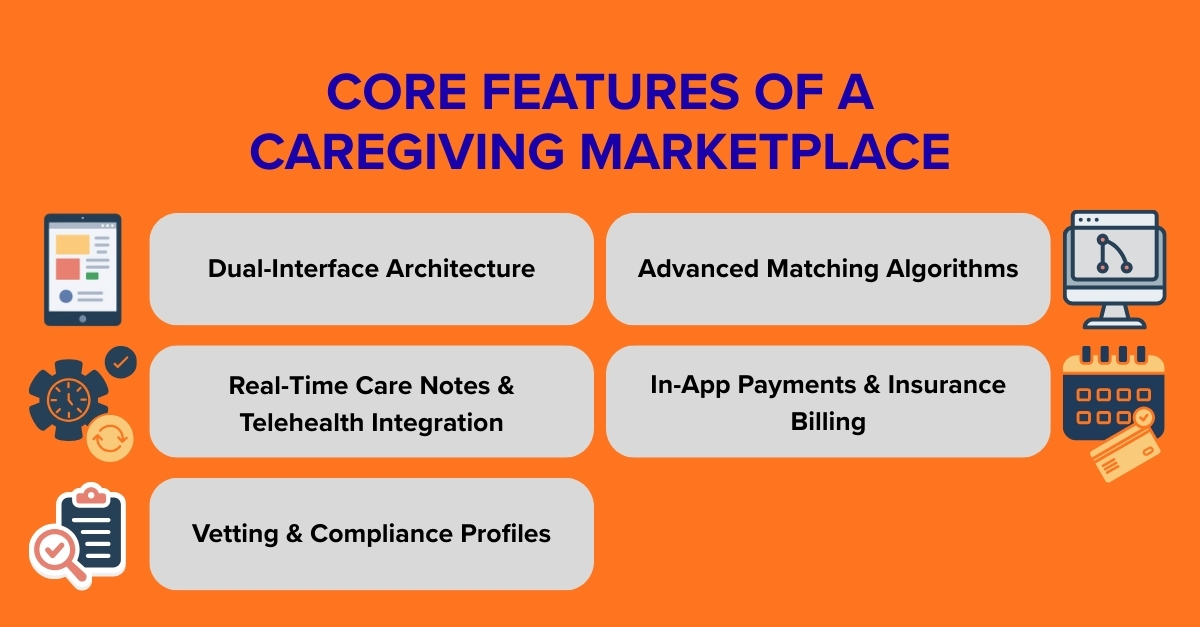
A caregivers marketplace cannot look like Uber. The stakes (health, safety, trust) are too high. Your feature set must communicate safety and reliability immediately.
Dual-Interface Architecture
You are building two distinct products.
- The Family Dashboard: Clean, compassionate, minimal. Focus on scheduling, payment, and reassurance.
- The Caregiver Experience: A lightweight interface for discovery and connection. Caregivers browse matched shifts, receive booking requests, and message families.
Advanced Matching Algorithms
- Hard Skills: Dementia care, wound care, catheter care, post-op assistance.
- Soft Skills: Language dialect, religion/cultural preferences, pet tolerance.
- Implementation: A questionnaire for families generates a “care score.” The algorithm matches the top 3 candidates, not a map of 50 irrelevant people.
Real-Time Care Notes & Telehealth Integration
Trust is built in the updates. A 2024 study of consumer behavior in healthcare apps showed that families check care notes 3x more frequently than they check financial apps.
- Feature: Caregiver uploads photos, vitals, and notes after each visit. Push notification: “Dad ate 90% of his dinner and walked 15 minutes.”
- Telehealth Bridge: Integration with platforms so the remote family member can join a virtual visit with the caregiver in the home.
In-App Payments & Insurance Billing
Payment friction kills marketplaces. If a 70-year-old child has to write a check, you have lost.
- Stripe Connect: Essential for splitting payments between the platform, the caregiver, and tax remittance.
- Long-Term Care Insurance (LTCi): A massive differentiator. Many seniors have LTCi policies that reimburse for home care. If your caregiver booking software platform can generate an invoice that automatically submits to John Hancock or Genworth, you win the enterprise contract.
Vetting & Compliance Profiles
Every profile must display trust badges. Hard badges (verified ID, background check, CPR certified) vs. Soft badges (5-star rating, “Agency Preferred”).
Compliance Requirements for Starting a Homecare Caregiver Business
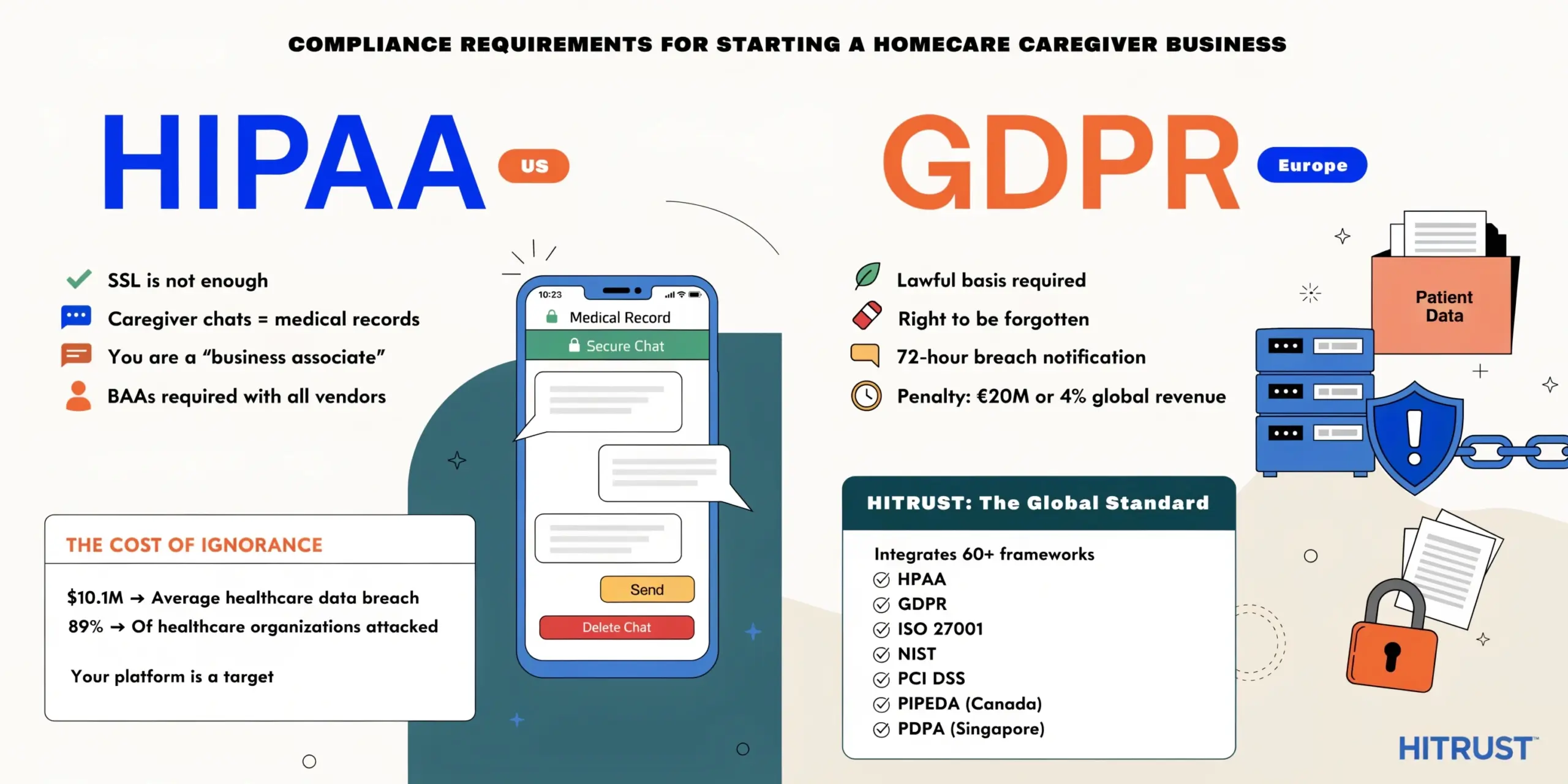
Compliance is a competitive moat. Founders who treat HIPAA as “paperwork” lose the market. Founders who treat HIPAA as “product architecture” win enterprise contracts.
The Cost of Ignorance
The average cost of a healthcare data breach is $10.1 million. That is a business-ending event for a Series A startup.
89% of healthcare organizations experienced at least one cyber attack in recent years. Your caregiving marketplace software is a target.
HIPAA: It’s Not Just About Encryption
For founders building in the United States, HIPAA (Health Insurance Portability and Accountability Act) is the foundational compliance framework. Many founders believe that if they have an SSL certificate and a password box, they are HIPAA compliant. They are wrong.
You must consider the Omnibus Rule. If a caregiver discusses a patient’s condition in the chat of your app, and that chat log is stored in plain text on your server, you are liable, not the caregiver.
Who must comply: HIPAA applies to “covered entities” (health plans, healthcare providers) and “business associates” (vendors like you who handle protected health information on their behalf). If your caregiving platform stores, transmits, or processes data for US healthcare clients, you are a business associate and must sign BAAs with both your clients and your subprocessors.
GDPR: The European Dimension
If you plan to operate in or accept users from the European Union, GDPR (General Data Protection Regulation) introduces additional requirements that shape how you start a homecare caregiver business across borders.
Key GDPR considerations for caregiving platforms:
- Lawful Basis for Processing: You must identify and document why you are collecting personal data.
- Data Subject Rights: EU users have the right to access, correct, and request deletion of their data. Your platform must support “right to be forgotten” workflows.
- Data Transfer Restrictions: If your servers are in the US but you serve EU families, you need mechanisms like Standard Contractual Clauses or binding corporate rules to legally transfer data across borders.
- Breach Notification: GDPR requires notifying supervisory authorities within 72 hours of becoming aware of a breach – a timeline that demands automated monitoring and alert systems.
The penalty for non-compliance: Up to €20 million or 4% of global annual revenue – whichever is higher.
Compliance as a Budget Item
Many founders make the mistake of treating compliance as something the developers “handle later.” In reality, compliance touches every part of your business model.
When you build caregiving marketplace that serves families, you are building a consumer product. When you build one that serves hospitals and health systems, you are building medical infrastructure. The latter comes with higher expectations.
Here is what compliance actually means for your business operations:
1. Business Associate Agreements (BAAs)
A BAA is a contract between you and any third-party vendor that might touch patient data. Your cloud host (AWS, Azure, Google Cloud) must sign one. Your payment processor must sign one. Even your email marketing tool must sign one if it receives any identifiable information.
What to ask: “Will your company sign a BAA?” If the answer is no, you cannot use them – full stop.
2. Audit Trails
You must know exactly who accessed what information and when. If a family claims their loved one’s care data was misused, you need to produce a log showing every view, edit, and export.
What this means for you: Your platform must be built to track everything. This is not optional.
3. Role-Based Access
A caregiver needs to see care instructions. They do not need to see the family’s credit card number or the patient’s Social Security information. Your platform must enforce strict boundaries between what different users can see and do.
The HITRUST Advantage
If you plan to sell to hospitals, health systems, or insurance companies, basic HIPAA compliance is the entry ticket. What gets you the contract is HITRUST certification.
But what about Europe and Australia? Is there a local equivalent?
Here is what founders expanding globally need to know: HITRUST itself has become the de facto global standard for organizations that need to prove compliance across multiple regulatory regimes simultaneously.
Unlike single-framework certifications, HITRUST CSF (Common Security Framework) integrates requirements from over 60 global standards and regulations into one certifiable framework. This includes:
- HIPAA (US healthcare)
- GDPR (European Union data protection)
- ISO 27001 (International information security)
- NIST (US federal standards)
- PCI DSS (Payment Card Industry)
- PIPEDA (Canada)
- Singapore PDPA (Personal Data Protection Act)
Why this matters for your business: HITRUST places you in an “elite group” of organizations. When a risk-averse hospital CIO evaluates your platform alongside a competitor, HITRUST certification signals that your startup is actually safer than the legacy software they have been using for decades.
Compliance is complex. You don’t have to navigate it alone. Schedule a complimentary consultation → Let’s discuss your vision.
How Much Does It Cost to Start a Caregiving Business? A Realistic Breakdown
The barrier to entry in caregiving tech is rising. “Cheap” is dangerous when lives and PHI are involved. You need to map your budget to your risk tolerance. The question “how much does it cost to start a caregiver business?” is the most common query we receive.
Let’s talk dollars and cents. This is the most frequent question in caregiving marketplace development: “I have an idea. How much do I need?”
The Problem with “Average” Cost Estimates
You will find articles claiming you can build a caregiving marketplace for $100,00 – and agencies quoting $500,000 for a similar scope. Both can be true. Both can be wrong for your context.
A barebones scheduling app is fundamentally different from home care marketplace development requiring HITRUST certification and Epic integration. Comparing costs is meaningless without scope.
The Smarter Path: Start Small, Validate Fast
Successful founders follow a consistent pattern:
Phase 1: Concierge Validation (Weeks 1–4)
Manually match 10 families with 10 caregivers. Use spreadsheets. Learn where friction lives.
Phase 2: No-Code Prototype (Weeks 5–12)
Build a simple interface using Sharetribe or Bubble. Automate booking. Keep payments.
Phase 3: Custom MVP (Months 4–9)
Once traction is validated, invest in purpose-built caregiving marketplace software. This is where you bring in a partner like Roobykon. Cost: $25,000–$100,000+.
Phase 4: Enterprise Scale (Months 9–18)
Add HITRUST, EHR integrations, insurance billing. The path to Series A.
The Only Number That Matters
The real cost is building the wrong features for the wrong users. That is why we do not give blind quotes. We start with a conversation about where you are, what you have validated, and where you need to go. Then we provide a realistic evaluation.
Should You Use No-Code or Custom Development for Your Caregiving Business?
The Case for No-Code/Low-Code
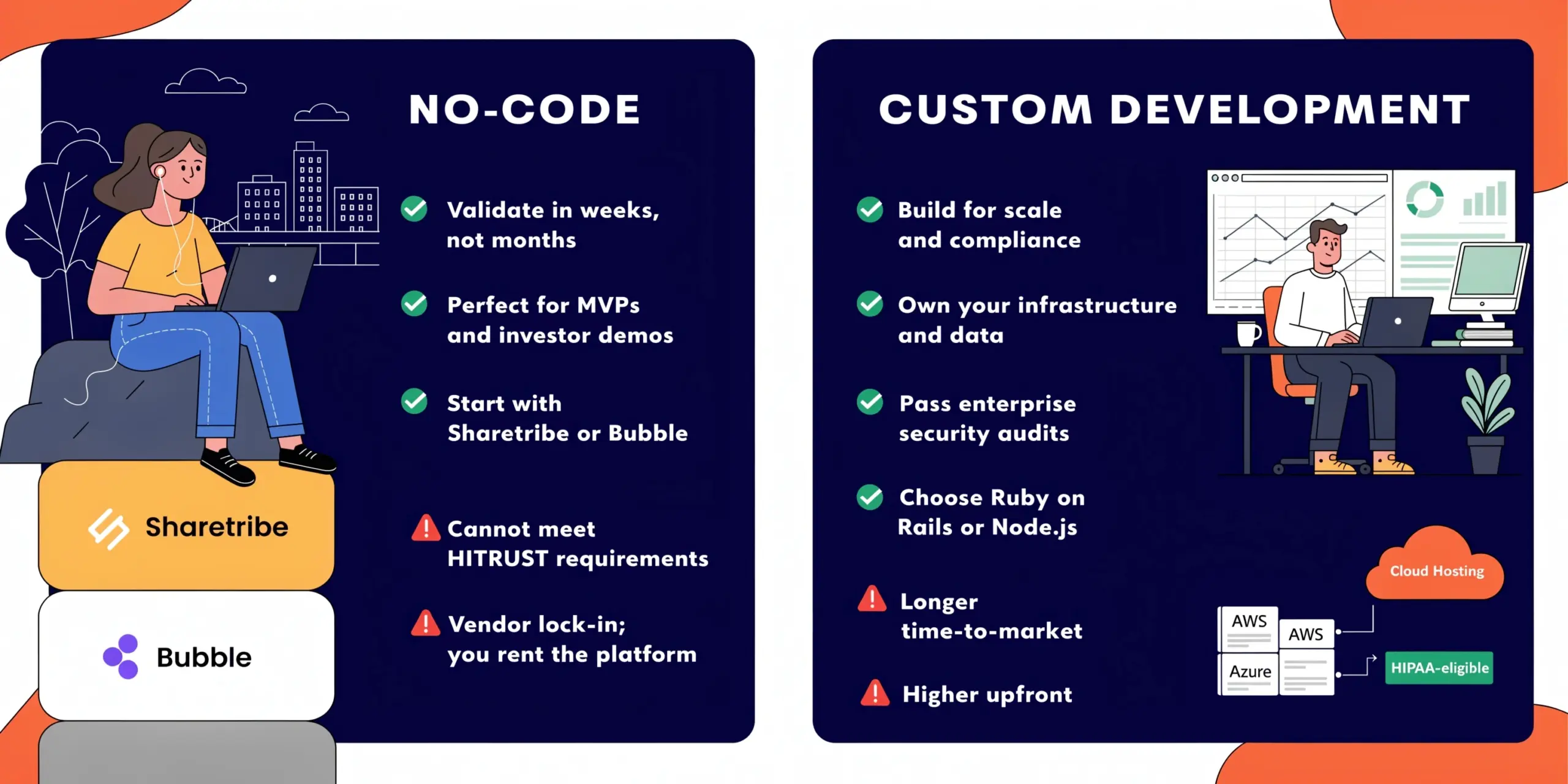
There is a specific use case where no-code shines. For founders who want to test their concept without heavy upfront investment, marketplace-specific no-code solutions like Sharetribe offer a compelling middle ground. You get pre-built functionality for user profiles, listings, and transactions – enough to validate whether families in your target city will actually pay for the service. Many successful caregiving marketplaces started as Sharetribe prototypes before graduating to fully custom architectures.
Start with No-Code, Graduate to Custom Development
But you cannot customize a no-code platform to meet HITRUST requirements easily. You are renting the infrastructure. If your no-code vendor gets hacked, your reputation burns. Furthermore, enterprise buyers (hospitals) often require a Security Questionnaire (Sig).
However, this is not an indictment of no-code. For early-stage founders, platforms like Sharetribe and Kreezalid are excellent tools. They allow you to build a proof-of-concept in weeks, not months. You can show investors a working prototype, validate that families will actually pay for your service, and iterate based on real user feedback – all before committing significant capital.
Think of no-code as your validation layer. The problem arises when founders treat the prototype as the final product. If you intend to build caregiving marketplace that serves health systems, processes protected health information, or scales to thousands of users, you need a foundation built for that reality. No-code gives you the speed to learn. Custom development gives you ownership, compliance, and enterprise readiness.
The smart path:
- Validate with no-code.
- Raise your seed round.
- Build custom with a partner like Roobykon.
That sequence gives you the best of both worlds – speed when you need it, and defensibility when you are ready to scale.
The Case for Custom Development
This is where Ruby on Rails development enters the conversation. Rails remains one of the most battle-tested frameworks for launching two-sided marketplaces. It offers the speed of convention-over-configuration – you can have user authentication, payment processing, and an admin dashboard in days, not month – combined with the flexibility to customize every layer of the stack.
When you choose custom Ruby on Rails development, you own your infrastructure. You can deploy to HIPAA-eligible hosts like AWS or Azure. You can fork your codebase. You can answer “yes” when a hospital’s procurement officer asks if you support single-tenant deployment.
Moreover, Rails has an extensive ecosystem of gems specifically relevant to caregiving marketplaces: Stripe Connect for marketplace payments, Action Cable for real-time chat between families and caregivers, and GoodJob or Sidekiq for background processing of compliance checks and shift reminders.
However, modern healthcare marketplace development requires flexibility. Our development team is equally proficient in Node.js – particularly for projects requiring high-concurrency real-time features, extensive API integrations, or where the client’s existing technology stack or internal team expertise aligns with JavaScript across the full stack.
Work With an Experienced Marketplace Development Team for Caregivers Business Development
In healthcare, experience is a feature. A team that has built a two-sided marketplace before knows how to balance the “chicken-and-egg” problem; a team that has built a healthcare marketplace before knows how to do it without getting sued. Roobykon Software has done both.
Why “Generalists” Fail
A great e-commerce developer might build you a beautiful product catalog. But they don’t know that “caregiver notes” are considered a legal extension of the medical record. They don’t know that you need to store deleted records for six years (not 30 days) to comply with state medical board regulations. They don’t know that payment processing for Medicaid waiver programs requires specific data fields that Stripe Connect does not expose by default.
When you build a caregiving marketplace, you need specialists. You need a healthcare marketplace development services team that has already made the mistakes (and learned from them) so you don’t have to.
The Roobykon Approach
At Roobykon Software, we have spent 15 years engineering marketplace platforms across e-commerce, logistics, and – critically – regulated healthcare verticals. We do not approach caregiving marketplace development as a generic software project. We approach it as infrastructure.
Let’s Discuss Your Software Needs
Ready to move beyond generalizations? Contact Roobykon Software for a complimentary technical consultation. We will listen first. Evaluate second. Build third. The only sequence that works.
Book Your Call NowFAQ

Recommended articles
 Custom Commission in Marketplaces: How to Set Different Fees for Hosts and Customers
Ditch the one-size-fits-all approach. This data-backed guide reveals the strategic framework for designing a dynamic fee structure that grows with your platform, maximizes revenue, and keeps both sides of your marketplace happy.
 The Ultimate Guide on How To Build a Multi-Vendor Marketplace in 2026
Unlock the secrets of successful marketplaces. This guide explains how a multi-vendor website works and provides a clear plan to build your own, from validating your idea to launching and driving growth.
 Why Your Business Can Benefit From Having a Mobile App
As more and more people become mobile users, marketers strive to reach them via their devices. This is where mobile applications come in handy. Let's find out why you need a mobile app and how to make the most of it.
 TOP Ruby on Rails Project Ideas in 2026
Is Ruby on Rails dying? Not even close. Explore Ruby on Rails business ideas, scaling strategies, and real-life success stories. See how industries from education to real estate still rely on Rails, with project examples and smart tech integrations.