Subscribe and you will promptly receive new published articles from the blog by mail
Launching a marketplace today means choosing the right technological foundation. Sharetribe and Yelo are leading platforms built for fundamentally different business models, each backed by significant market data and growth trends that prove their viability.
Sharetribe is the go-to solution for rentals, services, and peer-to-peer exchanges. The rental marketplace segment it serves is substantial, with the peer-to-peer rental industry alone valued at $17.7 billion in 2024 and a projected 10% Compound Annual Growth Rate (CAGR) through 2034. The platform has powered this growth, with the number of active stores experiencing a remarkable 662% year-over-year increase in Q4 2025, showcasing its traction with founders worldwide.
Meanwhile, Yelo is a specialized commerce hub for hyperlocal product commerce and last-mile delivery. This market is also exploding, projected to grow from $1.7 trillion in 2020 to an estimated $5.2 trillion by 2030. Yelo’s platform is purpose-built for this high-velocity commerce, where over 90% of orders happen on mobile devices and managing inventory, logistics, and a delivery fleet is paramount.
This decision, made early on, has long-term consequences for your operations, growth trajectory, and technical roadmap. For a team with extensive experience in this space, the Roobykon marketplace company can provide invaluable guidance.
Let’s break down the details of the Sharetribe vs Yelo debate to help you invest in the right engine for your vision.
Sharetribe vs Yelo: Quick Overview
Understanding the core DNA of each platform is the first step to a confident choice in the Yelo vs Sharetribe сomparison.
What Problem Each Platform Is Built to Solve
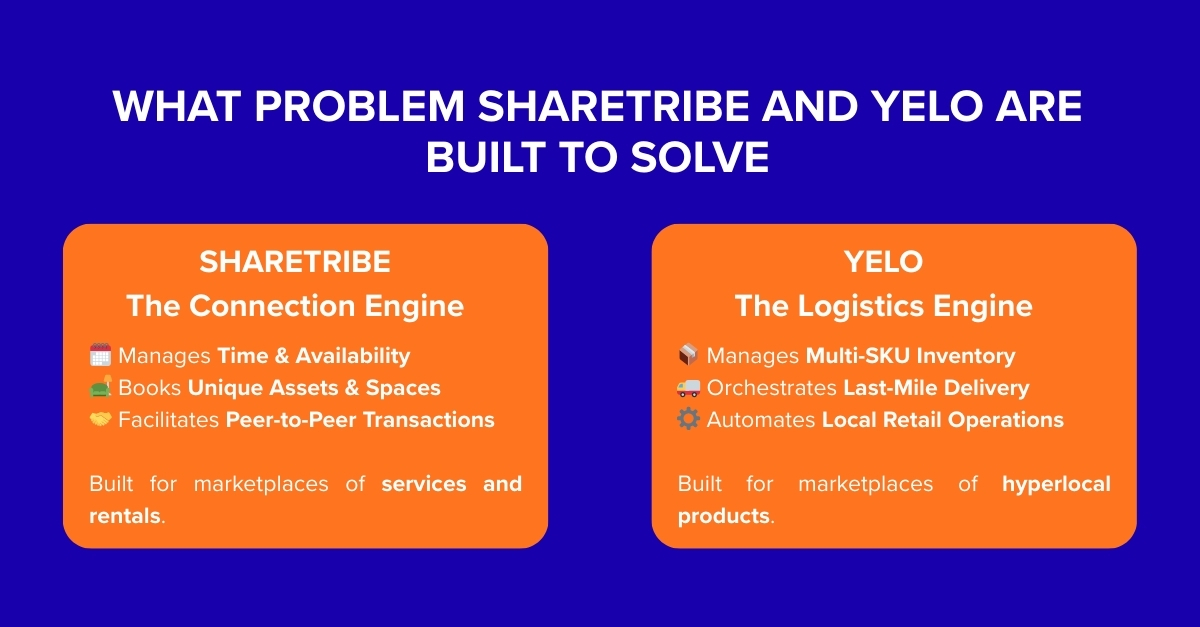
- Sharetribe is an agile marketplace engine. It’s designed to facilitate connections and transactions between people. Its architecture is optimized for managing time, availability, and unique assets – be that a spare room, a freelance designer’s calendar, or a power tool. It handles the complexities of bookings, two-sided reviews, and secure peer-to-peer payments so you can focus on community and supply growth.
- Yelo is a hyperlocal commerce and delivery and commerce platform. Built for the high-velocity movement of physical goods within a defined geography, the Yelo platform core mission is to orchestrate inventory, orders, and a delivery fleet in real-time. It solves the operational grind of local retail, from managing multi-SKU stock levels to dispatching the nearest driver for last-mile fulfillment.
One-Glance Comparison Table
Aspect | Sharetribe | Yelo |
Primary Use Case | Services, Rentals, P2P Marketplaces | Hyperlocal Product Sales & Delivery |
Core Inventory Logic | Time slots, availability, unique items | Multi-SKU retail stock, product variants |
Logistics & Fulfillment | Basic shipping/pickup options; no native delivery app | Native last-mile delivery management with driver apps, route optimization, real-time tracking |
Ideal Business Models | P2P Rentals, B2C/B2B Services, Classifieds | Hyperlocal Retail (Groceries, Food, Pharmacy), D2C Brands, Multi-Vendor Product Hubs |
Speed to Launch | Very fast (launch in a day with no-code) | Fast with pre-built vertical solutions |
Scalability Focus | User growth & transaction volume | Operational volume, delivery density, inventory throughput |
Budget Consideration | Transparent SaaS + transaction fees | Tiered SaaS plans; potential for higher initial cost but bundled delivery stack |
Core Positioning and Use Cases
Sharetribe as a Flexible Marketplace Engine
Sharetribe is your toolkit for building a connection-based economy. Its flexibility shines across diverse models:
- Rentals: It provides native tools for hourly, daily, or nightly bookings, availability calendars, and price variations – perfect for spaces, vehicles, or equipment.
- Services: Fixed booking slots, multi-seat management for classes, and provider calendars make it ideal for everything from beauty appointments to consulting.
- Hybrid Models: You can run rentals, services, and product sales simultaneously on one platform by configuring different listing types, all without writing code.
Yelo as a Hyperlocal Commerce and Delivery Operating System
Yelo for marketplace ventures is engineered for localized, inventory-heavy commerce. Its components are deeply integrated on a single system to automate core workflows, not just connected via API.
Core Automated Workflows
- Instant Order Fulfillment: A customer order automatically notifies the vendor and assigns the nearest driver via the integrated Tookan delivery system.
- Real-Time Sync: Inventory updates in the vendor app instantly reflect on the public storefront to prevent overselling.
- Seamless Tracking: Delivery status from Tookan provides live tracking directly to the customer, with no manual updates needed.
- Smart Automation: Completed deliveries can trigger review requests or marketing campaigns via the Hippo suite.
Key Business Advantages
This integration eliminates the manual work and errors of juggling separate tools, significantly reduces operational overhead, and provides a unified dashboard for data-driven decisions. It’s built for businesses where fast, reliable delivery is a core promise, not an add-on.
The architectural divide makes each platform a natural fit for specific models:
Model | Sharetribe Fit | Yelo Fit |
Peer-to-Peer (P2P) | Excellent. Built for casual sellers (e.g., Airbnb-style hosts, freelancers). | Fair. Can be used, but tools are geared toward commercial vendors. |
Business-to-Consumer (B2C) | Strong for services and rentals; good for simple product sales. | Excellent for local product delivery (e.g., grocery, food, retail). |
Business-to-Business (B2B) | Good for service marketplaces and rentals; supports negotiation flows. | Excellent for product wholesale; supports volume pricing, credit terms, complex settlements. |
Hyperlocal | Basic location search. Lacks hard geo-fencing to enforce service zones. | Core strength. Polygon-based geo-fencing ensures operational feasibility. |
On-Demand | Limited. No native real-time fulfillment tracking. | Core strength. Built for on-demand dispatch, tracking, and delivery proof. |
Feature Comparison: Marketplace Capabilities
Listings, Catalog, and Inventory
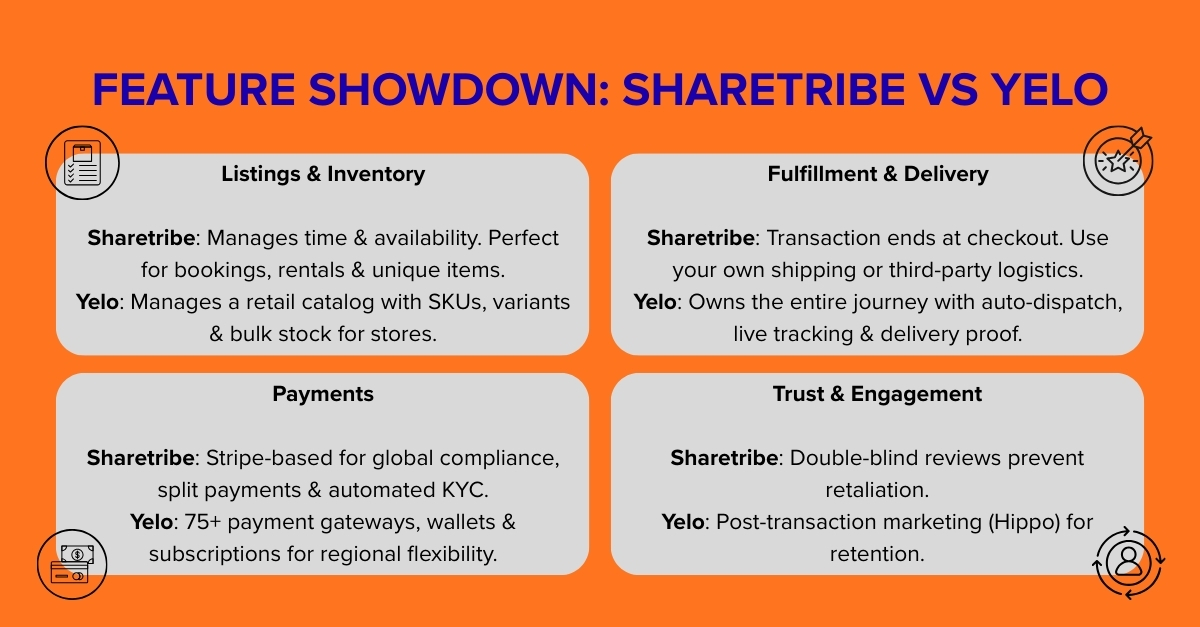
- Sharetribe manages availability and unique items. Listings are built around a calendar and booking logic. For products, it supports single or multi-item inventory that auto-reduces. It’s perfect for one-of-a-kind items, time-based services, or assets with variable pricing.
- Yelo manages a retail catalog. It handles SKUs, product variants (size, color), bulk CSV uploads, and real-time stock levels across multiple vendor storefronts. This is essential for a grocery store selling 50 units of the same cereal.
Orders, Fulfillment, and Logistics
This is the most significant point of divergence in any Sharetribe vs Yelo review.
- Sharetribe completes the transaction at the online checkout. Fulfillment is left to the parties involved, with options for standard shipping or pickup. For deliveries, you must integrate a third-party logistics provider, leading to potential system disconnects.
- Yelo owns the fulfillment journey. From the moment an order is placed, its integrated system manages dispatch (auto-assigning the nearest driver), provides Uber-like live tracking to the customer, and captures proof of delivery.
Payments, Taxes, and Refunds
- Sharetribe uses Stripe as its payment engine, providing a compliant, global framework. It handles split payments, delayed payouts (like escrow), and automated KYC for providers in 26 countries. This removes immense legal and technical complexity for founders.
- Yelo offers integration with a vast array of 75+ payment gateways, crucial for global hyperlocal businesses needing to support regional favorites. It also supports advanced commercial features like wallet systems and subscription-based payments.
Communication, Reviews, and Trust
Both platforms provide essential trust tools: in-app messaging and two-way review systems. Sharetribe emphasizes a double-blind review process where feedback is only revealed after both parties have submitted theirs, preventing retaliation. Yelo complements this with its Hippo module for post-transaction marketing automation and chatbot support to drive retention.
Operations, Vendor, and Customer Experience
Admin Tools and Automation
- Sharetribe offers a robust web console for managing users, listings, and transactions. It provides key analytics and supports workflow automation through Zapier integrations on higher-tier plans.
- Yelo’s dashboard is a central command center for the entire operation. It provides unified analytics spanning marketplace sales, delivery fleet performance, and marketing campaign success, giving a holistic view of the business.
Vendor Experience: Casual Sellers vs. Professional Merchants
- Sharetribe’s Vendor: Often a casual seller (e.g., a homeowner). The web dashboard is simple and focused on managing listings, availability, and messages.
- Yelo’s Merchant: A professional business owner (e.g., a local grocer). The dedicated Vendor Mobile App is critical, allowing them to accept orders, update live stock, and communicate with drivers directly from their phone.
Customer Experience: Web vs. Mobile Apps
- Sharetribe delivers a responsive web experience that works on any device. You can develop and launch native mobile apps, but it requires custom coding work.
- Yelo includes white-label native mobile apps (iOS & Android) for customers and vendors in its Premium and Elite plans.
Geo-Fencing and Local Availability Logic
- Sharetribe offers radius-based search. Customers can search “near me,” but the platform doesn’t strictly prevent orders from unreachable areas.
- Yelo uses polygon-based geo-fencing. You can draw precise delivery zones on a map. The platform automatically hides vendors whose service area doesn’t overlap with the customer’s location, preventing failed orders and ensuring operational integrity. This is a cornerstone of any effective Yelo website.
Technology, Customization, and Scalability
Tech Stack and Extensibility
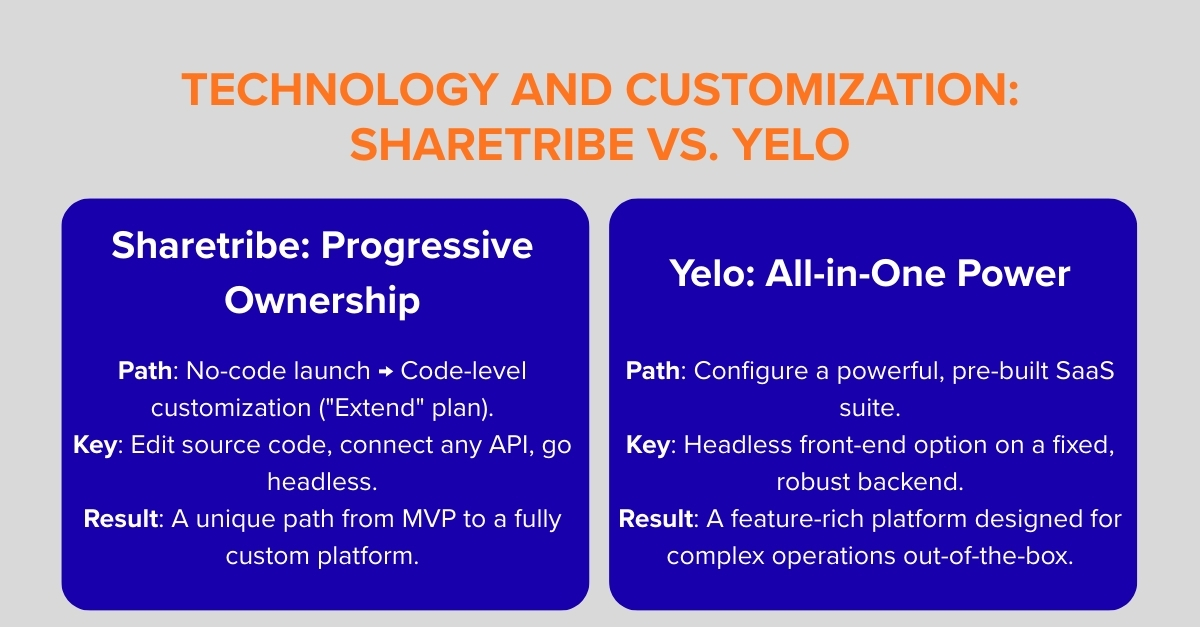
- Sharetribe: No-Code + Code Path. You can launch and customize heavily without code. For full control, its “Extend” plan unlocks the ability to edit the source code of your live marketplace, connect to any API, and build completely custom features and front-end experiences (headless). This offers a unique migration path from MVP to a fully bespoke platform, a key consideration for a Sharetribe development solution.
- Yelo: Configurable SaaS Stack. It’s a powerful, pre-built suite designed for configuration, not deep code-level customization. It offers a Headless Commerce option, giving you front-end freedom while relying on its robust, unchanging backend engine. Unlike a Bubble vs Yelo comparison, Yelo is not a visual no-code builder but a feature-rich, opinionated SaaS platform.
Integration Ecosystem
- Sharetribe has key pre-built integrations (like Stripe and Zapier) and provides a full API for custom integrations.
- Yelo boasts a broader out-of-the-box ecosystem with 100+ integrations, including its own specialized tools (Tookan for delivery, Hippo for engagement) and major payment gateways, analytics, and CRM systems.
Hidden Costs and Technical Debt
- Sharetribe: The potential hidden cost is integration complexity. If you need delivery logistics, you’ll pay for and manage a separate third-party service, creating a system you must maintain and ensuring data syncs correctly.
- Yelo: The model is more all-inclusive. A potential concern noted in user reviews is vendor lock-in and adapting to the platform’s development priorities, such as changes to its mobile app architecture.
Pricing, TCO, and Time-to-Market
Pricing Models
- Sharetribe uses a subscription + transaction fee model. Plans range from $99 to $299 per month, each including a bundle of free monthly transactions (50-500). Additional transactions cost a per-transaction fee.
- Yelo uses tiered subscription pricing. Plans (e.g., Growth: ~$39/mo, Premium: ~$149/mo, Elite: ~$192/mo) are typically based on feature access, like unlocking native mobile apps, and often advertise unlimited transactions.
Time-to-Launch and Roadmap
- Sharetribe wins on raw speed for an MVP. You can have a functional, no-code marketplace live in a single day. Your long-term roadmap is in your hands via custom code.
- Yelo enables a fast launch of a fully operational business. Because delivery, apps, and vendor tools are pre-built, you can start complex operations like hyperlocal delivery much quicker than building from scratch. Your roadmap is tied to the vendor’s update cycle.
When to Choose Sharetribe vs Yelo
Choose Sharetribe if…
- Your core value is facilitating bookings, rentals, or service appointments.
- Your suppliers are often individuals or small operators (P2P).
- You want to start validating an idea tomorrow with a no-code prototype.
- You envision needing deep, code-level customization as you scale.
- Your model doesn’t require managing a dedicated, real-time delivery fleet.
Choose Yelo if…
- You are building a hyperlocal product marketplace (food, grocery, pharmacy, retail).
- Last-mile delivery management is a core, non-negotiable part of your operation.
- Your vendors are professional merchants who need a mobile app to manage orders.
How Roobykon Can Help
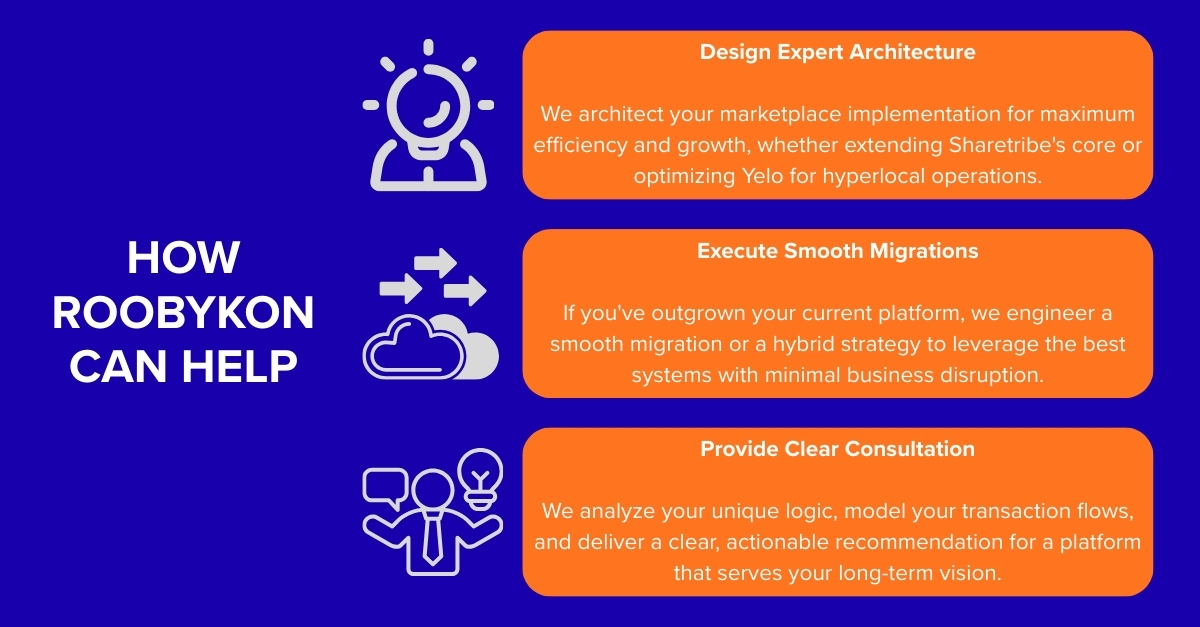
At Roobykon Software, we help founders navigate these critical decisions to build on a foundation that scales with their ambition. Whether you’re trying to compare Sharetribe vs Yelo or understand a Bubble vs Yelo comparison, our expertise cuts through the noise.
Designing the Right Marketplace Architecture
If you wonder whether Sharetribe or Yelo is the right starting point, we help you architect your implementation for maximum efficiency and growth. For Sharetribe, we design elegant custom features and workflows that extend the platform’s core strengths, offering a comprehensive Sharetribe development solution. For Yelo, we optimize your configuration and integrations to create a seamless hyperlocal operation.
Migration or Hybrid Strategies
Growth sometimes means evolution. If you’ve started on one platform and hit its ceiling, we can engineer a smooth migration path or design a hybrid strategy that leverages the best of both worlds, minimizing disruption to your live business. This is a common next step for businesses that outgrow their initial platform choice.
Next Steps: Scoping and Technical Consultation
The best choice stems from a clear understanding of your unique business logic. Let’s scope your project together. Contact Roobykon for a technical consultation. We’ll analyze your requirements, model your transaction flows, and provide a clear, actionable recommendation on the platform and architecture that will serve your vision today and for the long term. You may also find our analysis on Sharetribe vs Shopify helpful for understanding other platform comparisons.
FAQ

Recommended articles
 Sharetribe or Kreezalid? Your 2026 Decision Guide
Facing the Sharetribe or Kreezalid dilemma? Stop researching and start building. This in-depth 2026 analysis delivers a side-by-side breakdown of these leading no-code marketplace builders.
 Sharetribe vs Yo!Kart: The Ultimate Platform Decision for Your 2026 Marketplace
Need clarity on Sharetribe or Yo!Kart? Our expert analysis from Roobykon Software details their philosophies, strengths, and ideal use cases to guide your strategic platform decision for a successful marketplace.
 How to Build an Online Marketplace MVP in 2026
Turning a marketplace idea into reality is fraught with risk. This guide cuts through the complexity, showing you how a focused MVP is the antidote.
 Sharetribe vs WordPress: Which Platform Is Better for Building a Marketplace?
You have a visionary marketplace idea. But do you build on the specialized, speed-to-market engine of Sharetribe or the limitless, modular workshop of WordPress? The choice will define your launch, your budget, and your growth.